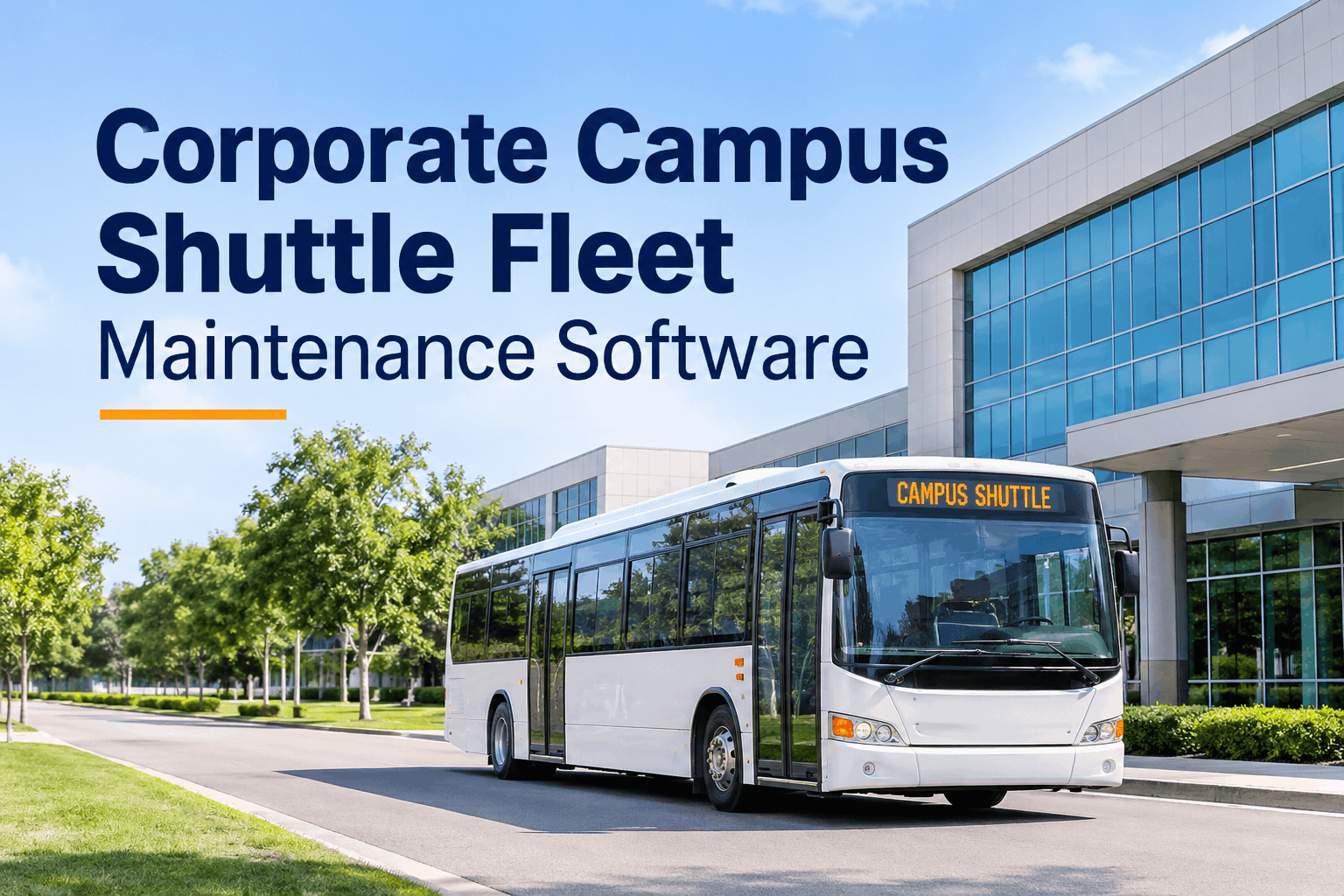
The 8:05 from the north parking lot is the one that matters — the shuttle that gets a packed load of employees to the building door before the 8:15 stand-up. When it does not show, you hear about it: in the lobby, in a Slack channel, and eventually from someone in HR asking why people are late. Corporate campus shuttle fleet maintenance software exists so the shuttle your employees count on every morning is ready every morning, because on a campus the ride is a perk people judge you on, not a line item they forget.
Corporate Campus Shuttle Fleet Maintenance Software
Your shuttles loop the campus all day — parking to buildings to the transit hub and back. One unit down at rush hour, and the loop breaks: employees stranded at a stop, late to work, and quietly deciding the shuttle is not reliable. Keeping the loop whole is the whole job.
Why a corporate shuttle fleet is its own maintenance problem
A campus shuttle fleet does not fail like a school bus operation or a transit agency. There is no federal inspection calendar forcing your hand — which sounds easier until you realize nothing external catches a slipping schedule before your riders do. The pressure here is your own workforce, every weekday, at the two hours that matter most. These are the pain points an employee transportation fleet lives with.
Two rush windows, zero slack
Demand is not spread across the day — it spikes hard at the morning arrival and the evening departure. A unit that dies at 8 a.m. cannot be fixed by 8:15, and you rarely have a spare idling the way an outsourced operator does.
The shuttle is a perk employees judge
Companies offer shuttles to ease parking, cut commute stress, and help recruiting and retention. When the ride is unreliable, the perk quietly turns into a complaint — and the people deciding whether to keep funding it are watching.
A mixed and changing fleet
Campus fleets run diesel coaches, CNG vans, low-speed carts, and a growing share of electric shuttles — often on the same lot. Each fuel type needs its own preventive maintenance logic, not one generic schedule.
You answer to facilities, not a regulator
Instead of a DOT auditor, your audience is the facilities and finance team that funds the program. They want cost per mile, availability, and a clean record that the fleet is maintained — proof the perk is worth the budget line.
Put those together and the pattern is clear: the fleet runs hardest exactly when a failure is least recoverable. Here is what a weekday actually looks like for an employee shuttle fleet — and you can sign up free and start tracking units against those peaks.
What a campus transportation team should track
You do not need a heavier process than a school district — just the right five things tracked consistently, so a small problem gets caught on a Tuesday instead of stranding the north lot on a Monday. A purpose-built bus CMMS puts it on one dashboard instead of a whiteboard and three spreadsheets.
Swipe sideways to see the full table →
None of this is exotic. It is the same discipline a transit fleet uses, sized to a campus operation and tied to the two hours that define your day. If you want to see it mapped to your own units and routes, a walkthrough demo is the fastest way.
Keep every morning shuttle ready to roll
Put preventive maintenance, pre-trip inspections, and availability on one dashboard — so the 8:05 shows up on time, every day. See it on your own campus fleet, or start tracking today.
Your campus shuttle readiness checklist
Run through this before your next Monday. If the critical items are not locked in, that is where a stranded-stop morning comes from.
- PM scheduled per fuel type, not one blanket intervalCritical
Diesel, CNG, and electric units on separate mileage-and-calendar logic so none drifts past due.
- A daily pre-trip runs before the first loopCritical
Every driver, every morning — the cheapest way to catch a problem before riders do.
- A failed inspection item opens a work order on its ownCritical
No relying on memory or a sticky note — the fault holds the unit until it is signed off.
- You know your ready-unit count before 7 a.m.Plan
A live availability view tells you if both peaks are covered while there is still time to adjust.
- Common failure parts are stocked, not back-orderedPlan
Auto-reorder alerts keep a unit from sitting off the loop for days waiting on a part.
- Cost and uptime records are ready for the budget reviewPlan
Cost per mile and availability per unit, on hand when facilities asks whether the perk pays off.
How bus fleet maintenance software holds the line
A tool built for buses — not trucking or manufacturing software retrofitted — ships ready for a passenger fleet on day one. Three capabilities do most of the work for a campus operation.
Fuel-aware preventive maintenance
Separate PM schedules for diesel, CNG, and electric units on one dashboard, triggered by mileage or calendar — so a mixed fleet stays current without a mental juggling act.
Inspections that become work orders
A digital pre-trip inspection with a failed item auto-generates a work order and holds the unit — the gap between “a driver noticed” and “someone fixed it” closes on its own.
Availability and cost dashboards
Real-time fleet availability, cost per mile, and PM compliance in one view — the ready-count you check at dawn and the numbers you bring to the budget meeting, from the same system.
It runs on the vehicles that move your people — the same purpose-built platform transit teams use on the passenger transit fleet page. Most campus operators are live in two to four weeks, not months.
Two Monday mornings, same fleet
The difference between a good shuttle program and a complaint thread is rarely a bigger budget. It is whether a problem got caught the Friday before or discovered at the stop — and a demo shows you which side of that line a campus fleet lands on.
- A coolant leak noted last week never made it to a work order
- The unit overheats on the 8:05 and pulls over with a full load
- No spare on the lot — the north loop runs 20 minutes behind all morning
- Employees post about it; facilities asks why the perk keeps failing
- Friday’s pre-trip flagged the coolant loss and opened a work order
- The part was on the shelf; the fix was done over the weekend
- Monday’s availability view shows every unit ready before 7 a.m.
- Both peaks run on time; nobody notices the shuttle, which is the point
Same fault, same fleet. The only difference is that one version caught it before an employee was standing at the stop.
“We run eight shuttles from the garages to the buildings to the light-rail stop. The number I live by is units-ready-by-seven — short at seven, somebody is late at eight, and there is no catching up once the peak starts. We used to find out about a bad unit when a driver called in from the roadside. Now the morning pre-trip catches it, it opens a work order on its own, and I walk in knowing the loop is whole. My facilities director stopped asking if the shuttle is worth it.”
Key takeaways for your employee shuttle fleet
The peaks decide everything
A failure at arrival or departure is the one you cannot recover from — so readiness has to be settled before the first loop.
No regulator, so the discipline is on you
Nothing external forces your maintenance calendar. A consistent process is what keeps a slipping schedule from reaching your riders first.
A mixed fleet needs fuel-aware PM
Diesel, CNG, and electric units each run on their own logic — one blanket interval leaves some units over-serviced and others overdue.
The records are how the perk survives budget
Cost per mile and availability are what turn “nice to have” into a funded program facilities keeps renewing.
Make the shuttle the perk nobody has to think about
Preventive maintenance, pre-trip inspections, parts, and availability — built for buses, live in two to four weeks. See it on your fleet or start free today.
Keeping the loop whole, every day
A corporate campus shuttle program lives or dies on one quiet fact: the shuttle shows up when your employees expect it. Corporate campus shuttle fleet maintenance software is how you make that boring — preventive maintenance by fuel type, pre-trips that turn into work orders, parts on the shelf, and an availability view you trust before seven. Get those right and the shuttle goes back to being the perk you built it to be. If you are ready to lock in your loop, you can sign up free and start today.