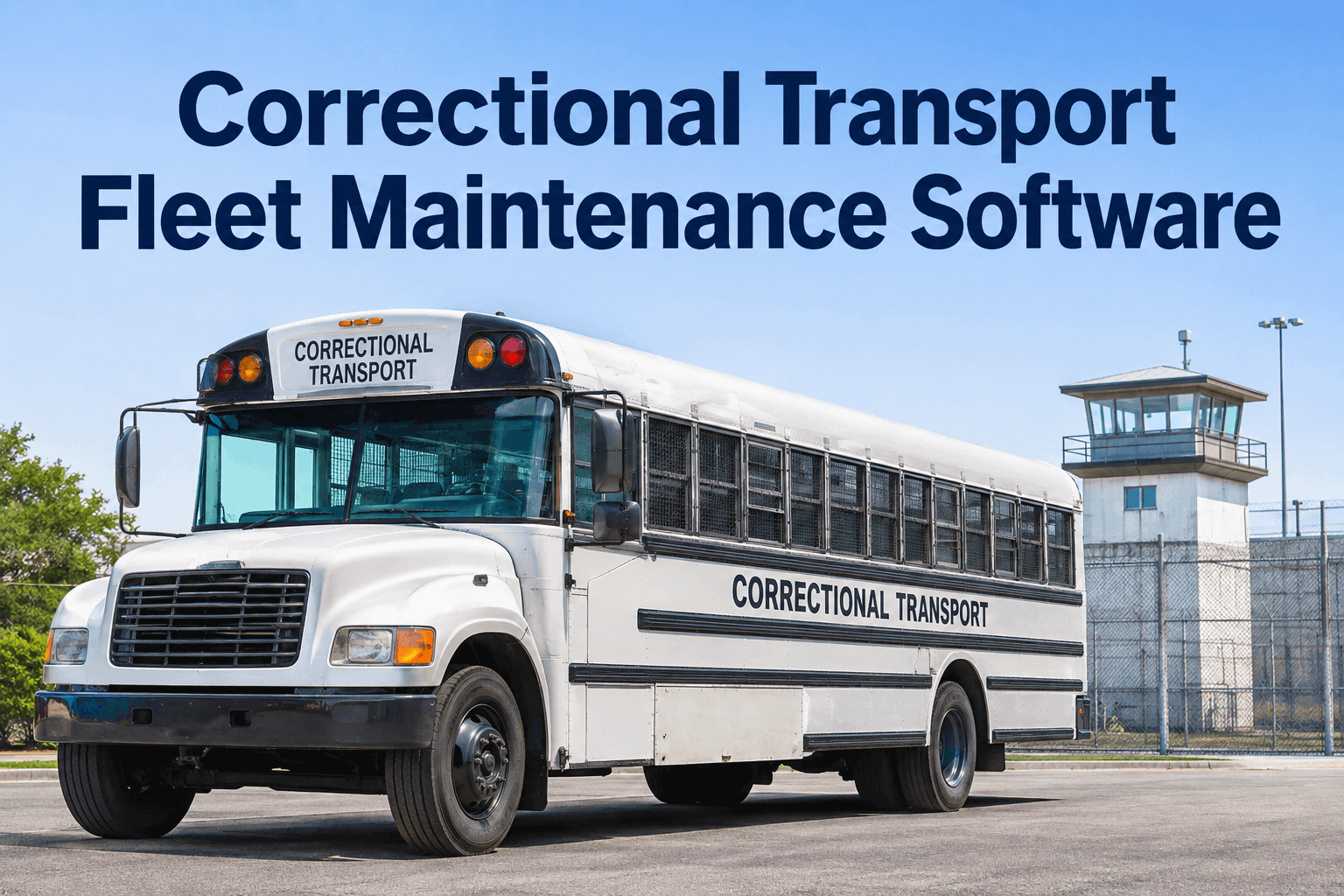
A correctional transport vehicle has two systems that can fail you, and only one of them is the engine. A cracked cage weld or a rear door that will not lock is not a maintenance nuisance — with inmates aboard on a court run, it is a security incident. Correctional transport fleet maintenance software keeps the chassis and the security build both road-ready and breach-proof, and you can see how in a quick demo.
Correctional Transport Fleet Maintenance Software
Every secure transport vehicle is two vehicles in one — a chassis and a security build — and both have to pass before it rolls. Correctional transport fleet maintenance software schedules, inspects, and tracks both, so a vehicle is never road-ready but breach-prone.
Why a Secure Transport Fleet Is Different
A prisoner transport vehicle carries risks a passenger bus never does. Four of them shape how you maintain the fleet.
Two systems, not one
You maintain the chassis and the security build — cage, partition, locks, cameras, restraint anchors. A tool that tracks only the engine leaves half the vehicle unwatched.
A failed part is a breach risk
A dead intercom, a latch that will not lock from both sides, a loose cage pin — these are not cosmetic. Each is an escape or assault liability, not a maintenance nuisance.
Checked before and after
Policy has these vehicles inspected at the start and end of every tour, inside and underneath. That is a lot of checks, and a paper note from one of them is easy to lose.
Records are your defense
When something goes wrong on a transport, the dated maintenance and inspection record is what answers an audit or a claim. Scrambled logs do not hold up.
The goal is a vehicle that is road-ready and secure at once — and a record that proves it was.
The Security Components You Have to Maintain
Beyond the usual chassis service, a secure transport vehicle has a build that needs its own scheduled checks. These are the parts a breach starts with.
Put these on a maintenance schedule that exceeds the factory one, the way secure-transport operators do — walk through security-component scheduling in a demo.
What Correctional Transport Maintenance Software Tracks
These are the things that keep a secure fleet both road-ready and breach-proof. A real corrections fleet maintenance software keeps them in one place.
Swipe sideways to see all columns
Your Secure Transport Readiness Checklist
Run this against your fleet before the next movement day. The red items are what become a security incident; the green items are what keep the fleet covered.
- Security components on a maintenance scheduleCage, locks, cameras, and anchors get scheduled checks, not just the engine.CRITICAL
- Digital pre and post-trip on every vehicleBoth ends of the tour logged, so a failed latch or dead intercom is never missed.CRITICAL
- Failed items become work ordersA flagged security defect routes straight to the shop — the vehicle is held until fixed.PLAN
- Chassis PM flagged before it slipsService by mileage or date so a breakdown never happens mid-transport.PLAN
- Secure-build parts stockedLocks, screens, and anchor hardware on the shelf, so a held vehicle gets back fast.PLAN
- Dated records per vehicleEvery check and repair time-stamped and exportable for audits and claims.PLAN
If the two critical lines are still on paper, that is where a breach or a stranded run comes from — sign up free and put both systems on one board.
How BusCMMS Keeps a Secure Transport Fleet Covered
BusCMMS is built for bus and transport fleets, so a corrections operation maps straight onto it. Three capabilities carry the load.
PM for both systems
Schedule chassis service and security-component checks on one plan, each flagged before it slips, so nothing on the vehicle goes unwatched.
Pre-trip straight to work order
Digital inspections any officer can run at both ends of a tour; a failed security item becomes a work order and holds the vehicle until it is fixed.
Audit-ready records
Dated, per-vehicle history of every check and repair, exportable on demand — the evidence that answers an audit or a liability claim.
It fits the teams that run secure movements — your public-safety transport operation, on the passenger transit fleet page. To set it up for your fleet, book a demo and bring your vehicle list.
What a Failed Check Means Before vs After the Trip
The same defect plays out two very different ways depending on whether it was caught in the yard or discovered on the road.
- Dead intercom found with inmates already aboard
- No way to monitor the compartment on a long run
- A latch that will not lock becomes an escape risk
- The incident report, not the repair, writes itself
- Pre-trip flags the dead intercom at the start of the tour
- Work order opened, part pulled from the shelf
- Vehicle held, a ready unit swapped in
- The movement runs on time, secure, logged
Same defect, same vehicle — the difference is whether the check caught it before it rolled.
From a Sheriff's Fleet Supervisor
Key Takeaways on Correctional Transport Maintenance
Correctional transport fleet maintenance software earns its keep by watching both systems and holding the record. Four things to keep in mind.
Maintain two systems, not one
The chassis and the security build both go on the schedule — the engine is only half.
A failed part is a breach risk
A dead lock or intercom is an escape liability; a failed check holds the vehicle.
Catch it in the yard
A pre-trip defect is a work order; the same defect on the road is an incident.
The record is the defense
Dated, per-vehicle history answers the audit or the claim without a scramble.
Run a correctional transport fleet off a system that watches the chassis and the security build together and the vehicle that rolls is both road-ready and breach-proof — with the record to prove it was.