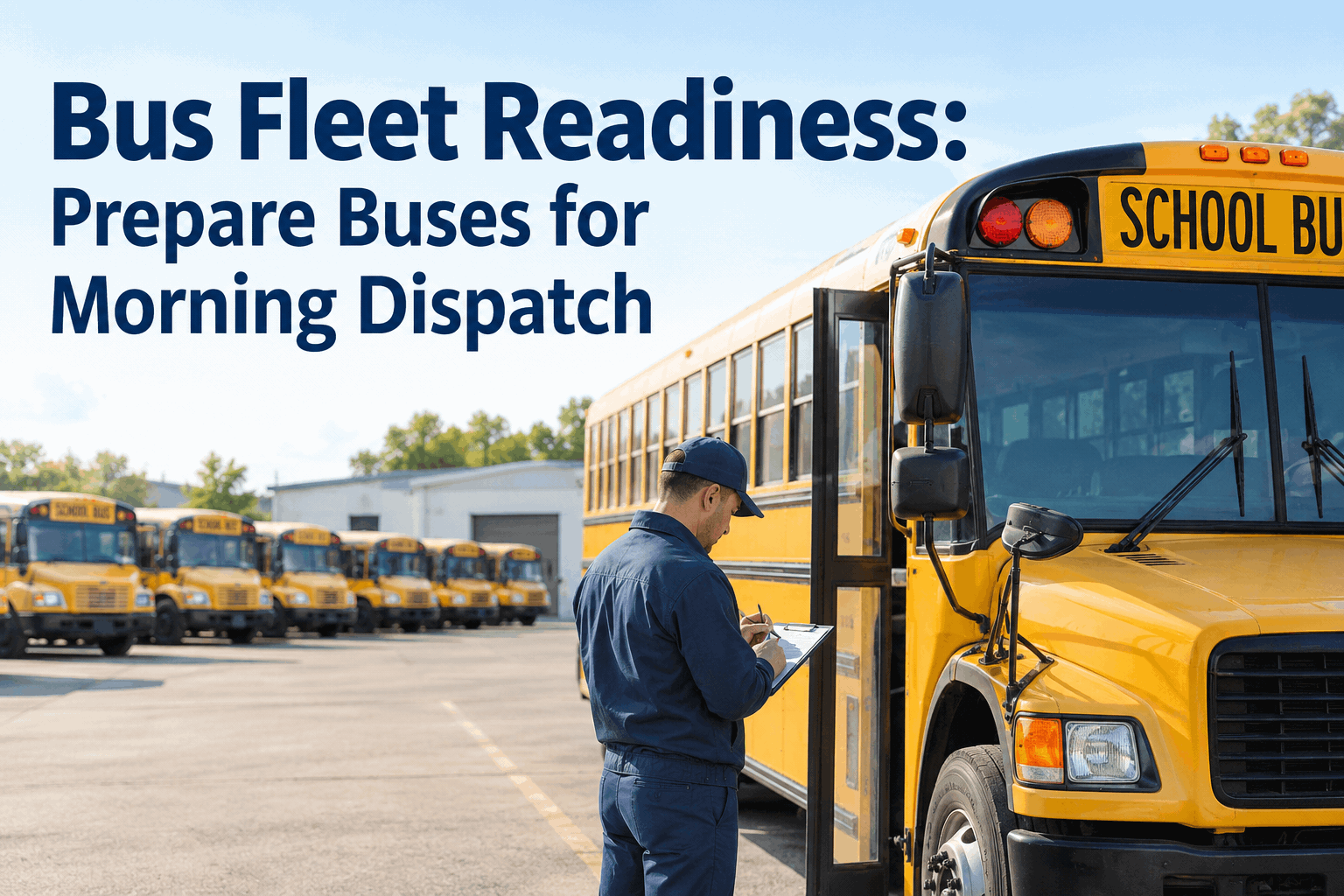
Every yellow bus in America starts the day the same way — or should. A driver walks around the vehicle, checks the brakes, tests the lights, pushes the emergency door, and signs off that the bus is safe for students. Skip that 10-minute ritual and you're gambling with DOT violations, roadside out-of-service orders, breakdowns on the route, and — worst case — student safety. This guide gives you the complete 2026 daily pre-trip inspection checklist your drivers can run every morning, organized by zone, aligned with 49 CFR 392.7 and 396.11, and available as a free printable PDF or a guided digital form through Bus CMMS .
Daily Bus Pre-Trip Inspection Checklist — Free DOT-Compliant Template 2026
Every item, in the right order, for school bus and transit drivers — printable or digital
Why the Daily Pre-Trip Is Non-Negotiable in 2026
Under 49 CFR 392.7, no driver may operate a commercial bus unless they've verified it's in safe operating condition. The 2026 CSA overhaul made this even more consequential — FMCSA now tracks "Driver Observed" violations as a separate compliance category, meaning defects your driver should have caught during the walkaround directly impact your safety score. And during the 2025 CVSA International Roadcheck, roughly 1 in 5 commercial vehicles was placed out of service, most for brake, tire, and lighting issues — every one of them catchable at the yard.
14,000
accidents prevented each year by thorough pre-trips (FMCSA estimate)
22.6%
of vehicles placed out-of-service at 2025 CVSA Roadcheck
$4,200
average cost of a single out-of-service violation
35–45%
of brake defects missed by unstructured paper inspections
The 7-Zone Pre-Trip Walkaround Method
FMCSA and CDL training programs teach a 7-zone sequence because it's the fastest way to cover every required checkpoint without backtracking. Drivers who follow the zones in order complete a thorough pre-trip in 10–15 minutes. Drivers who freelance miss items. Here's the full sequence your drivers should follow every morning, in order.
Approach & Under-Hood
Walk up, scan for leaks under the bus, open the engine compartment. Check oil, coolant, power steering, belts, hoses, and the battery.
Cab & Driver Area
Inside the bus — mirrors, steering wheel, gauges, horn, wipers, defroster, seatbelt, fire extinguisher, first-aid and body-fluid kits, reflective triangles.
Air Brake System Test
Build pressure to governor cutoff (120–140 psi), leak test (≤3 psi drop in 1 min), low-air warning at 60 psi, spring brake activation at 20–45 psi.
Lights & Signals
Headlights (high/low), turn signals, 4-way hazards, clearance, tail, brake, back-up, identification, and license plate lights — front and rear.
Exterior Walkaround
Clockwise from driver's door — tires, wheels, lug nuts, suspension, shocks, frame, fuel tanks, exhaust, body damage, reflective tape.
School-Bus-Specific Items
Stop arm, crossing gate, amber/red loading lights, strobe, emergency exits + buzzers, student mirrors (200 ft / 12 ft visibility), child check system.
Interior & Final Sign-Off
Passenger seats, handrails, entry steps, aisle, interior lights, two-way radio, cameras, wheelchair lift (if equipped). Review prior DVIR. Sign.
Skip the paper — try a guided digital version of this checklist free
The Complete Daily Pre-Trip Inspection Checklist
Here's the full checklist your drivers should run every morning, organized by the 7 zones above. Each item includes the specific pass/fail threshold where it matters, so drivers aren't guessing at "good enough."
Approach & Under-Hood
No fresh fluid leaks under the bus or around the engine
Engine oil level between min/max marks on dipstick
Coolant at proper level — no visible leaks from hoses or radiator
Power steering fluid at proper level
Belts — no cracks, fraying, or excessive slack (max ¾" deflection)
Hoses — no bulges, cracks, or chafing against other components
Battery secure, terminals clean, no corrosion or leaking fluid
Alternator and water pump mounted securely — no play
Cab & Driver Area
All mirrors clean, cracked-free, and properly adjusted
Steering wheel free play within 2" (power steering)
All gauges functional — air pressure, fuel, temp, oil, voltmeter
Horn operates — both electric and air if equipped
Windshield wipers and washer fluid working on all speeds
Heater and defroster operational
Driver seatbelt latches securely and retracts properly
Fire extinguisher — charged, sealed, mounted, no expiration issues
First-aid kit and body-fluid cleanup kit — present, sealed
Three reflective triangles and spare electrical fuses on board
Registration, insurance, medical card, and prior DVIR in folder
Air Brake System Test (4-Part)
Build-up: pressure reaches governor cutoff at 120–140 psi
Leak test: engine off, service brake applied, pressure drop ≤3 psi in 1 minute
Low-air warning activates before pressure drops to 60 psi
Spring brake engages between 20–45 psi (pop-out valve trips)
Parking brake holds bus stationary against light throttle
Service brake test: no pulling, grabbing, or fade at 5 mph
Lights & Signals
Headlights — high and low beams both functional
Turn signals operational front and rear, both sides
4-way hazard flashers — all corners working
Brake lights illuminate when pedal is applied
Tail lights, clearance lights, identification lights all lit
Back-up lights and audible alarm function in reverse
License plate light illuminated, plate clean and visible
Reflective tape / DOT tape present and not excessively worn
Exterior Walkaround — Tires, Frame, Body
Steer tires — tread depth minimum 4/32"
All other tires — tread depth minimum 2/32"
No exposed cord, belt, or ply material on any tire
Tires properly inflated — no flats, no audible leaks
All lug nuts tight, present, no rust streaks indicating looseness
Rims — no cracks, bends, or welded repairs
Suspension — no broken springs, shocks not leaking
Frame — no cracks, loose or missing fasteners
Fuel tanks — secure, caps tight, no leaks or damage
Exhaust — no leaks forward of the rear exit, no loose clamps
Body panels — no major damage affecting safety or compliance
School-Bus-Specific Items
Stop arm — extends fully, red lights flash alternately
Crossing arm — extends when entry door opens, retracts on close
Amber loading lights — flash alternately when activated
Red loading lights — flash alternately when door opens
Strobe light (if equipped) — operational, not cracked
All emergency exits open from inside AND outside
Emergency exit buzzers sound when exits are opened
Push-out windows operate freely
Crossover mirrors provide 200 ft forward / 12 ft side visibility
Child check system — rear buzzer operates, required walk-through
Interior & Final Sign-Off
Passenger entry door opens, closes, and latches from inside
Handrails secure, not bent, passenger step light works
Entry steps clean, tread not loose or worn
All passenger seats securely mounted, no broken frames
Interior lights and aisle lights operational
Two-way radio powered on and communicating with dispatch
On-board cameras operational (if equipped)
Wheelchair lift — no oil leaks, stores fully retracted (if equipped)
Prior DVIR reviewed — any noted defects confirmed repaired
Driver sign-off: bus is safe for operation
Want this checklist pre-loaded on your drivers' phones? Book a quick walkthrough
Paper Checklist vs Digital: The Real Difference
Paper works — but it leaks. Items get skipped when drivers are rushed. Defects get scribbled on the form and forgotten. Records get lost before audit day. Here's how paper and digital pre-trips actually compare on what matters to a transportation director.
Paper Checklist
Digital with BusCMMS
How a Digital Pre-Trip Actually Flows
Here's what happens when a driver runs the pre-trip through the BusCMMS mobile app. Every step is timestamped, every defect becomes a work order, and every inspection is audit-ready without anyone touching a filing cabinet.
Driver taps Start on their phone
Bus number scanned. Previous DVIR loads automatically — driver acknowledges any prior defects were repaired.
Guided zone-by-zone walk
App shows each item in order. Driver taps Pass, Fail, or Not Applicable. Required items can't be skipped.
Defect? Snap a photo, add a note
Photo + severity + description captured in seconds. Driver moves on without breaking their flow.
Work order auto-created
Defects flagged as critical pull the bus out of service. Non-critical defects route straight to the shop queue.
DVIR signed, stored, audit-ready
Digital signature captured, timestamp + GPS attached, DVIR stored for DOT retention. Pull it up in one click anytime.
Tired of Chasing Paper DVIRs?
BusCMMS turns this exact checklist into a mobile app your drivers complete in under 10 minutes — and your compliance binder writes itself. A 20-minute demo uses your buses and your routes.
What Fleet Managers Say About Switching to Digital
"Our drivers were running 20-minute paper pre-trips — and still missing items. Switched to digital and the average is 8 minutes, defect capture is up, and I haven't touched a filing cabinet in a year."
"The moment a driver flags a cracked emergency exit light, my shop foreman has a work order on his screen. No more paper sitting in a tray for three days. That's the whole game."
The daily pre-trip is the single highest-ROI routine in bus operations. Every dollar your fleet spends on structured inspections saves three to five on emergency repairs, DOT violations, and downtime. But here's the honest part: paper checklists produce paper results. They get rushed. Items get checked without being touched. The 2026 CSA overhaul — with its new Driver Observed violation category — makes inspection quality directly visible in your safety score. The fleets getting ahead are the ones putting a guided digital checklist in every driver's hand, capturing photo evidence, and routing defects in real time. That's not a software upgrade — it's how bus fleets operate safely in 2026.
Run your first digital pre-trip today — signup takes under 2 minutes
A daily pre-trip inspection isn't paperwork — it's the 10 minutes that prevent 10 hours of problems. DOT fines, roadside breakdowns, route disruptions, and the one outcome no driver ever wants to think about. Use the 7-zone walkaround above as your standard. Print the checklist, laminate it, put it in every bus folder. That's a baseline every fleet should meet.
But a printed checklist is only as good as the driver filling it out. The fleets getting audit-ready records, sub-10-minute inspections, and same-day defect repairs are the ones running the same checklist digitally — guided, photo-verified, and routed straight to the shop. That's what BusCMMS was built for, and it's why districts switch from paper and never look back.
Book a 20-minute demo and see the digital checklist running on your fleet
Ready to Retire the Clipboard?
Join the districts running this checklist digitally — with photo evidence, instant defect routing, and DVIRs stored audit-ready. Free to start, no hardware needed.