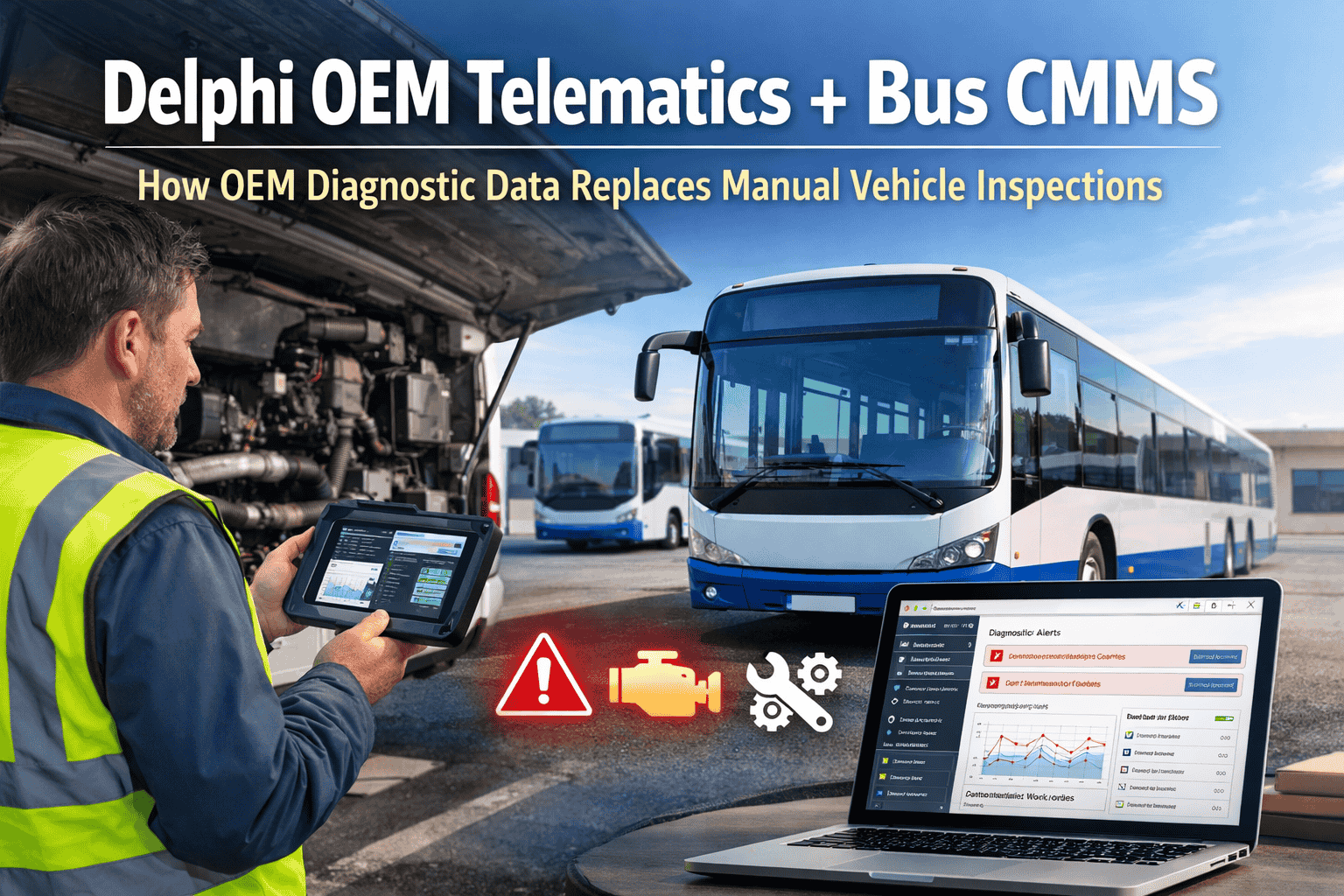
Your buses are already talking. Every engine, transmission, and brake system broadcasts hundreds of diagnostic signals through the J1939 CAN bus — coolant temperature, oil pressure, fault codes, engine hours — streaming continuously while your buses run routes. The only question is whether that data disappears into the air, or whether it flows directly into your maintenance system where it creates work orders, triggers alerts, and prevents the $8,500 breakdowns that happen when problems go unnoticed.
Delphi OEM Telematics + Bus CMMS: How Real-Time Diagnostics Replace Manual Inspections
Connect your factory-installed telematics to BusCMMS and let your buses tell you what they need — before breakdowns happen
What Your Buses Are Already Broadcasting
Modern buses with OEM telematics stream 200+ data points through the J1939 CAN bus. Here's what flows through that network every second — and how you can start capturing this data for free:
Engine Diagnostics
- Coolant temperature
- Oil pressure & level
- RPM patterns
- Fuel consumption rate
Transmission Health
- Fluid temperature
- Shift quality metrics
- Clutch pack wear
- Gear engagement data
Brake System
- Air pressure levels
- Pad wear indicators
- ABS module status
- Brake actuator health
Fault Codes (DTCs)
- Active trouble codes
- SPN + FMI details
- Severity classification
- Timestamp & location
Manual Inspections vs. OEM Telematics
Paper-Based Inspections
Driver completes 23-point checklist
Paper form sits in cab folder
Clerk processes 24-36 hours later
55-65% completion rate average
Misses internal component issues
Result:Problems found AFTER breakdown
VS
OEM Telematics + CMMS
200+ data points stream continuously
Fault codes → work orders in 60 sec
Mechanic alerted instantly via push
100% coverage, zero human error
Detects issues before symptoms appear
Result:Problems fixed BEFORE failure
Still relying on paper DVIRs? Digitize your inspection process free and see what you've been missing.
Your Buses Already Have Embedded Telematics?
82.7% of vehicles manufactured since 2024 include factory-installed diagnostics. Connect that data to BusCMMS in under 30 minutes.
How Data Flows: OEM → CMMS → Work Order
1
ECU Detects Issue
Engine control unit identifies anomaly and broadcasts DTC via J1939
2
Telematics Transmits
OEM gateway sends fault code, vehicle ID, and severity via API
3
BusCMMS Creates WO
Work order auto-generated with priority, assigned to available tech
4
Issue Resolved
Mechanic fixes problem before it becomes a roadside emergency
Total time from detection to work order:Under 60 seconds
Want to see this workflow in action with your own fleet? Book a live demo using your actual bus data.
The ROI of Automated Diagnostics
Unplanned breakdowns/year10-15
Cost per breakdown$8,500
Paper inspection compliance55-65%
Defect response time24-36 hrs
Annual breakdown cost (50 buses)$85,000 - $127,500
Unplanned breakdowns/year4-6
Preventive repair cost avg$350
Diagnostic coverage100%
Fault-to-work-order time60 sec
Annual breakdown cost (50 buses)$34,000 - $51,000
What Most Fleets Get Wrong About OEM Telematics
01
Treating Telematics as "Just GPS"
Most fleet managers only use their OEM telematics for location tracking. They're sitting on a goldmine of diagnostic data — engine health, transmission metrics, brake system status — and ignoring 95% of it. The GPS is the least valuable part of what your telematics can do.
02
Checking Dashboards Instead of Automating
Logging into a telematics dashboard once a week defeats the purpose. By the time you manually spot a fault code, the damage is already done. The fleets seeing real ROI have automated the data flow — fault detected, work order created, mechanic alerted — all without human intervention.
03
Running Telematics and CMMS as Separate Systems
Your telematics knows when something's wrong. Your CMMS knows how to fix it. When these systems don't talk to each other, you're manually copying data between platforms — wasting time and missing critical alerts. Integration isn't optional; it's where the value lives.
Ready to stop making these mistakes? Start your free trial and connect your OEM telematics in under 30 minutes.
J1939 Fault Codes That Create Automatic Work Orders
BusCMMS categorizes incoming fault codes by severity and triggers the appropriate response automatically. Here's how the system handles common diagnostic trouble codes:
Swipe to see more
Want to see how BusCMMS handles your specific fault codes? Book a demo and we'll walk through your actual fleet data.
"The shift from reactive to predictive maintenance isn't about buying more technology — it's about connecting the technology you already have. Most buses manufactured in the last five years are already broadcasting hundreds of diagnostic parameters. The fleets that win are the ones that pipe that data directly into their maintenance workflow instead of letting it evaporate into the air. When a fault code automatically becomes a prioritized work order with parts recommendations, you've eliminated the human delay that turns $350 repairs into $8,500 emergencies."
See how other fleets have reduced breakdowns by 60% with telematics integration. Schedule a 20-minute walkthrough of the BusCMMS platform.
Common Questions
Do I need to install new hardware on my buses?
If your buses were manufactured after 2020, they likely have OEM telematics already embedded. 82.7% of vehicles produced in 2024 include factory-installed diagnostic hardware. BusCMMS connects through the manufacturer's API — no additional devices required. For older buses without embedded telematics, aftermarket J1939 gateways can be installed to enable the same data flow.
Does this replace manual pre-trip inspections?
OEM telematics supplements manual DVIRs rather than replacing them. Federal regulations still require drivers to perform visual inspections. However, telematics catches the 200+ internal diagnostics that visual inspections can't see — oil pressure trends, transmission fluid degradation, emerging brake issues. Together, you get complete coverage: human eyes on the exterior, machine monitoring on the interior.
Which bus manufacturers does BusCMMS integrate with?
BusCMMS integrates with major OEM telematics platforms including those from Thomas Built, Blue Bird, IC Bus, and Lion Electric, as well as third-party telematics providers like Samsara, Geotab, and Zonar. The J1939 protocol is standardized across heavy-duty vehicles, so any bus broadcasting diagnostic data can connect.
How quickly can I get set up?
Most fleets complete the integration in under 30 minutes. You'll generate an API token from your telematics provider, paste it into BusCMMS, and select which vehicles to sync. Fault codes typically start flowing within the hour. No IT department required — if you can copy and paste, you can connect your fleet.
Ready to Let Your Buses Do the Talking?
Connect your OEM telematics to BusCMMS and transform diagnostic data into proactive maintenance. No new hardware. Setup in 30 minutes. Start preventing breakdowns today.