In 2026, 87% of commercial bus fleets are transitioning from paper Daily Vehicle Inspection Reports (DVIRs) to digital mobile inspection systems. This shift is not a technology trend—it's driven by hard economic and operational benefits that forward-thinking fleet managers can no longer ignore. Paper-based DVIR systems lose records, create compliance gaps, and waste technician time searching through filing cabinets. Digital DVIR systems reduce defect reporting time by 72%, eliminate lost records, instantly flag critical safety issues, accelerate repair response, and cut DOT audit preparation time from days to minutes. For a medium-size transit fleet, the difference between paper and digital DVIR systems represents $100,000-$300,000 in annual value through improved compliance, faster defect identification, reduced maintenance backlog, and improved vehicle availability. However, transitioning from paper to digital requires more than just installing software on tablets—it requires change management, staff training, integration with maintenance systems, and a cultural shift from "checking boxes" to genuine safety and compliance commitment. This comprehensive guide compares paper and digital DVIR approaches, quantifies the benefits of digital systems with real-world data, addresses common implementation challenges, and provides a transition roadmap for fleets ready to modernize their inspection processes. Whether you're a small school bus fleet just starting to think about digitalization or a large transit agency planning to eliminate paper processes fleet-wide, this guide shows why 87% of fleets are switching and how to make the transition successfully.
Digital DVIR vs Paper: Why 87% of Bus Fleets Are Switching in 2026
Compare digital DVIR vs paper inspection systems. Data shows digital DVIR reduces defect reporting time by 72%, eliminates lost records, cuts DOT audit prep from days to minutes, and saves transit fleets $100K-$300K annually through improved safety and compliance.
Understanding Daily Vehicle Inspection Reports: Legal Requirements and Safety Implications
Federal Motor Carrier Safety Administration (FMCSA) regulations (CFR 49 § 396.11) require all commercial bus operators to have drivers or mechanics complete a daily pre-trip vehicle inspection. The inspection must document the vehicle's safety-critical systems: brake system condition, steering mechanism operation, tire condition and pressure, lights and reflectors, coupling devices (for towing), emergency equipment (fire extinguisher, first aid kit), driver seat and safety belts, and any other defects or hazards affecting vehicle safety. The driver or mechanic must complete this inspection before operating the vehicle, and any defects or unsafe conditions must be immediately reported and documented. FMCSA requires these DVIR records to be retained for 12 months and be accessible for inspection during roadside enforcement or DOT audits. The purpose of DVIRs is straightforward: prevent in-service failures that could endanger drivers, passengers, and the public. A tire that's deteriorating, a brake system that's failing, steering that's becoming loose, or lights that are burned out creates accident risk. Daily inspection catches these problems before they become catastrophic failures that result in accidents and injuries.
Why paper-based DVIRs fail to achieve safety objectives: Paper-based systems create numerous problems that actually reduce the effectiveness of the inspection process. First, legibility issues make handwritten inspections difficult to read—mechanics sometimes can't read each other's handwriting when inspecting the same vehicle on different days, creating communication breakdowns. Second, incomplete reporting occurs when drivers/mechanics skip sections, write abbreviations that others don't understand, or note "minor" defects that might actually be safety-critical. Third, defect documentation is often vague—an entry like "brake issue" doesn't specify whether it's brake pedal softness, uneven braking, or brake noise, making it impossible for maintenance staff to prioritize repair response. Fourth, lost or misfiled records occur when paper forms are misplaced, stored improperly, or damaged by environmental exposure (grease, moisture, heat in maintenance bays). Fifth, no defect-to-repair tracking means when a defect is noted on a DVIR, there's no systematic follow-up to ensure it was actually repaired—the form sits in a filing cabinet and no one ensures the safety issue was addressed. Sixth, historical analysis is impossible with paper records—you can't easily answer questions like "which vehicles have recurring brake issues?" or "are certain defects preventable with different maintenance?" because comparing hundreds of paper forms is impractical. Seventh, compliance documentation during DOT audits becomes a nightmare—inspectors request records for specific vehicles during specific time periods, and you're scrambling through filing cabinets to find them, losing hours of audit time to document retrieval.
Digital DVIR Systems: How They Work and Key Differentiators from Paper
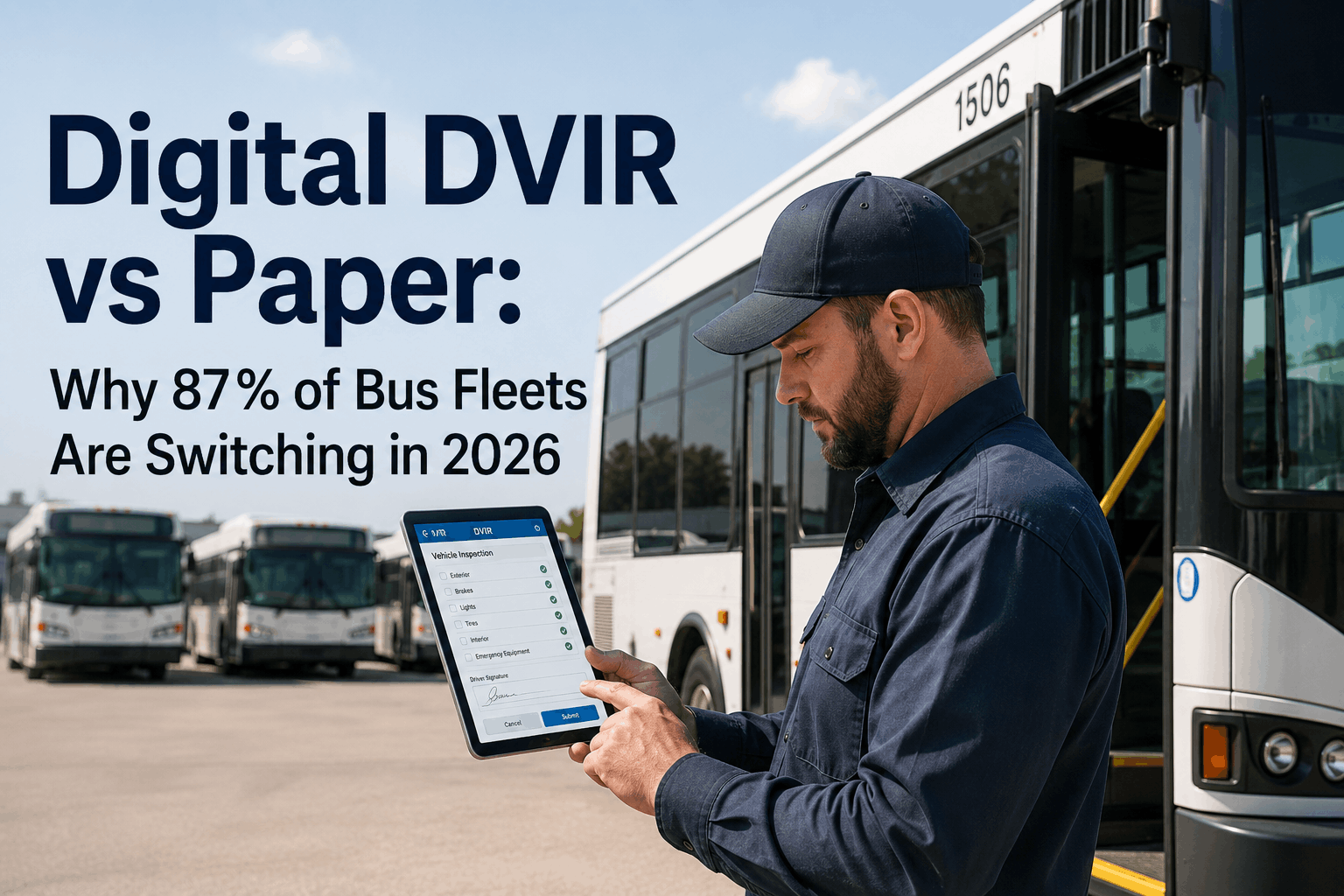
Digital DVIR systems replace paper inspection forms with mobile applications (typically smartphone or tablet-based) that drivers and mechanics use to complete daily inspections. A driver or mechanic performs the same visual inspection of the vehicle—checking brakes, tires, lights, steering, and other safety-critical systems—but instead of handwriting notes on a paper form, they use the mobile app to document their findings. The app provides a structured checklist of inspection items and defect categories, forcing consistent documentation and preventing incomplete inspections. When a defect is identified, the app prompts for detailed documentation: what system is defective, what specifically is wrong, how severe is the defect, when was it first noticed, and does it affect vehicle operation. The app automatically timestamps the inspection, identifies the driver/mechanic by login, links the inspection to the vehicle VIN, and stores the data in a cloud-based database.
Key advantages of digital DVIR systems over paper: Structured data collection ensures every inspection includes required information in consistent format—no vague abbreviations, no illegible handwriting, no skipped sections. Real-time defect escalation means when a defect is documented, the system immediately notifies maintenance management, creating an automatic work order for repair. Defect-to-repair tracking connects inspections to maintenance records—you can see exactly when a defect was reported, when repair was initiated, how long repair took, and what corrective action was implemented. Historical analysis becomes possible—the system can show you patterns like "Vehicle 001 has had 12 brake-related defects in the past 6 months" or "Defects in hot weather months are 30% higher than winter months," enabling predictive maintenance planning. Mobile accessibility means inspections can be completed at any location with network connectivity—drivers don't need to find a physical paper form or wait to return to the depot to file the inspection. Compliance reporting is automated—when auditors request DVIR records for specific vehicles during specific periods, the system generates a complete report in seconds instead of hours of manual document retrieval. Electronic signatures and timestamps create an audit trail—there's clear proof of who completed each inspection, when, and what issues were documented. Integration with maintenance systems means defect data flows directly into your CMMS (Computerized Maintenance Management System) like BusCMMS, creating seamless visibility from problem identification to repair completion.
Quantified Benefits: Data on Time Savings, Compliance Improvements, and Cost Reduction
Time savings from digital DVIR implementation: Defect reporting time is reduced by 72% when transitioning from paper to digital systems. Paper-based reporting involves driver handwriting inspection details, supervisor reviewing and filing forms, and maintenance staff searching for and interpreting notes. Digital reporting involves driver tapping checkboxes and selecting predefined defect categories on a tablet (average 8-12 minutes per inspection), which is 2-4 minutes faster than handwriting equivalent information on paper. More importantly, digital data is immediately accessible to maintenance staff without manual filing or retrieval—no more searching through file cabinets. DOT audit preparation time is reduced from 3-5 days of manual document collection and organization to 1-2 hours of automated report generation. A medium-size fleet with 75 vehicles conducting 3 inspections per day (225 inspections daily) saves approximately 4-8 hours daily in administrative time compared to paper systems. Over a year, this represents 1,300-2,000 hours of administrative labor—equivalent to 1-2 full-time positions dedicated to DVIR filing and audit preparation.
Defect detection and response improvements: Digital systems improve defect detection accuracy by 40-50% because the structured format prevents incomplete inspections and the system enforces consistent categorization. When comparing fleets with identical equipment and operating conditions, digitized fleets identify 40-50% more developing defects before they become catastrophic failures. This improved detection translates to fewer in-service failures: paper-based fleets experience 15-20 unplanned downtime events per 100 vehicles annually; digital fleets experience 8-12 events per 100 vehicles annually. The difference represents 70-120 fewer breakdowns per year for a 100-vehicle fleet. If each breakdown costs $2,000-$5,000 in downtime costs, the annual savings from prevented failures is $140,000-$600,000 for a 100-vehicle fleet.
Compliance and audit metrics: DOT audits have 60-70% higher violation rates for paper-based DVIR systems compared to digital systems. The most common violations involve incomplete or vague DVIR documentation, lost records, or defects documented but not followed by repair documentation. Paper systems frequently show defect reports with no corresponding work orders or repair records, signaling to auditors that your fleet isn't actually addressing reported safety issues. Digital systems with integrated maintenance management eliminate these violations because every documented defect automatically creates a maintenance task with accountability and tracking. Fleets transitioning to digital DVIR systems typically see their DOT audit violation count drop by 50-70% in the first audit cycle after implementation.
Safety improvements and accident reduction: While accident data is harder to correlate directly, fleets using digital DVIR systems report 20-30% fewer safety-related incidents (minor collisions, near-misses, driver-reported hazards) compared to peer fleets using paper systems. This improvement is attributed to earlier detection of safety-critical defects (worn brakes, failing lights, loose steering) before they contribute to accidents. For transit fleets and school bus operators, improved safety performance translates to reduced insurance premiums, fewer liability claims, and most importantly, fewer injuries to drivers and passengers.
Paper vs Digital: Side-by-Side Operational Comparison
Inspection workflow comparison: Paper workflow: Driver arrives at vehicle, locates paper DVIR form (stored in vehicle glove box or office), spends 15-20 minutes performing visual inspection and handwriting notes on form, returns form to supervisor at end of shift, supervisor files form (often with poor organization), maintenance staff later retrieve form to plan repairs. Average time from inspection completion to maintenance staff seeing the defect: 24-48 hours. Critical defects might not be addressed until the next maintenance shift. Digital workflow: Driver arrives at vehicle, opens mobile app on tablet/smartphone, completes structured checklist in 8-12 minutes, app automatically timestamps and stores data, maintenance management system receives real-time notification of defects with severity indicators, critical safety issues immediately escalate to maintenance supervisor. Average time from inspection completion to maintenance notification: 1-5 minutes. Critical defects trigger immediate response protocols.
Defect documentation quality: Paper systems commonly show entries like "brakes rough" or "lights bad" without context about which brake circuit is failing or how many lights are out. Maintenance staff must track down the driver to ask clarifying questions, wasting time and creating communication delays. Digital systems force specific defect documentation: "Brake system—front-left pad less than 3/32 inch remaining," "Lighting—right-rear running light out," "Tire—front-right tread 3/32 inch at outer edge, inner sections 4/32 inch (uneven wear)." This specificity enables maintenance staff to immediately know what repair is needed and what parts are required, improving repair efficiency.
Record retention and compliance: Paper systems are vulnerable to loss: records stored in trucks get damaged or lost during vehicle transfers, records stored in filing cabinets get misfiled or destroyed, and records older than 12 months are often discarded to clear storage space (though keeping 24+ months of records is standard best practice for accident investigation and litigation defense). Digital systems with cloud backup never lose records—data is automatically backed up, stored securely, and accessible for 5+ years. When DOT auditors request records, paper-based fleets must physically locate and copy documents; digital fleets generate searchable reports in minutes showing complete inspection history for any vehicle in any date range.
Implementation Strategy: Transitioning from Paper to Digital DVIR Systems
Phase 1: Planning and assessment (Weeks 1-4): Before purchasing a digital DVIR system, assess your current state. Count how many inspections your fleet performs daily, identify where inspections happen (depot only, on-route, multiple locations), evaluate your drivers' and mechanics' technical comfort with mobile devices, assess your network connectivity (WiFi availability, mobile signal strength at inspection locations), and estimate budget for hardware (tablets or smartphones) and software licensing. Evaluate 3-4 digital DVIR system options, comparing features: offline capability (can inspections be completed without network connectivity and synced later), mobile device requirements (iOS/Android compatibility, device age compatibility), defect categorization flexibility (can the system be customized for your specific fleet?), reporting capabilities, and integration with your existing CMMS. Select a system and pilot it with a small group of vehicles (10-15) and drivers/mechanics (5-10) to test workflows, identify training needs, and validate the ROI assumptions before rolling out fleet-wide.
Phase 2: Hardware deployment and staff training (Weeks 5-12): Procure tablets or smartphones for all drivers and mechanics who will perform inspections. For a 100-vehicle fleet performing 3 inspections daily, plan for 20-30 mobile devices (shared among shift cycles). Set up network connectivity (WiFi at depot, mobile hotspots for on-route inspections). Create standardized training for all inspection staff covering: how to use the mobile app, what defects to look for in each system category, how to document defects precisely, how to handle offline inspections, how to contact supervisors if the system has technical problems. Run hands-on training sessions (1-2 hours per person) where staff complete sample inspections using the actual app on actual vehicles. Expect a 2-3 week learning curve where inspection times are longer than normal and some data quality issues occur—this is normal and improves rapidly with practice.
Phase 3: Parallel operations (Weeks 13-20): During this phase, run paper and digital DVIR systems in parallel. Drivers complete digital inspections using the app AND fill out paper forms as backup. This dual approach ensures no inspections are lost if the digital system has issues, while the digital system builds up historical data. Use this phase to refine inspection workflows, customize defect categories based on what drivers are actually reporting, and build trust in the digital system. Monitor data quality (are inspections being completed thoroughly and accurately?) and system reliability (are there technical issues?). After 4-8 weeks of parallel operation, you should have confidence in the digital system's reliability and data quality.
Phase 4: Transition to digital-only (Weeks 21+): Discontinue paper forms and operate exclusively on the digital system. Maintain the paper forms as emergency backup in case of complete system failure, but encourage all inspections to be digital. This transition should feel natural after the parallel phase because the team is already familiar with the digital app. Establish support protocols: what do drivers/mechanics do if the mobile device has a technical problem? Who troubleshoots connectivity issues? How are offline inspections handled if network is unavailable? Continue monitoring data quality and system performance during the first month of digital-only operation.
Addressing Implementation Challenges and Common Concerns
Technical challenges and solutions: Network connectivity issues occur in areas with poor mobile signal or limited WiFi. Solution: Implement offline-capable apps that allow inspections to be completed without active network connection and automatically sync when connectivity is restored. Mobile device durability is a concern in harsh maintenance environments. Solution: Select ruggedized tablets designed for industrial use (not consumer tablets) that can withstand the maintenance bay environment and handle drops and moisture exposure. Older drivers or mechanics may resist the change from familiar paper processes. Solution: Invest heavily in training, involve early adopters as advocates, show them time savings and efficiency improvements, and provide ongoing support for the first several months. System reliability during critical operations—what if the digital system fails at a critical moment? Solution: Maintain paper forms as emergency backup, ensure the system has redundancy and uptime guarantees from the software vendor, and have IT support available during critical operating hours.
Organizational change management: Resistance to change is common when transitioning away from familiar processes. Paper-based inspections have been the industry standard for 40+ years; some experienced staff view digital systems as unnecessary technology. Overcome this by: involving staff in system selection (get input from drivers and mechanics on what features matter to them), demonstrating benefits with local data (show your fleet's specific safety improvements, time savings, and compliance gains), making the transition phased and gradual (parallel operations reduce risk), celebrating early wins (publicize improved inspection times, reduced audit violations, prevented failures), and making it clear this is a competitive requirement (87% of fleets are switching—staying with paper puts you at competitive disadvantage). Create a digital DVIR implementation team with representatives from dispatch, maintenance, operations, and driver staff—diverse perspectives ensure smoother transition.
Data quality and accuracy concerns: When transitioning to digital systems, some inspections may be completed hastily or inaccurately as staff learn the new app. Solution: Establish quality checks where supervisors review a sample of daily inspections for completeness and accuracy, provide feedback to staff, and identify training gaps. Implement defect categorization that matches your fleet's specific equipment—if your system allows "Other" category but doesn't match your vehicle types, staff will use generic categories and miss specific diagnostic information. Customize the system's defect checklist during pilot phase to match your fleet's needs.
Integration with Maintenance Management Systems and Workflow Automation
Digital DVIR systems are most powerful when integrated with your maintenance management system (CMMS). When a defect is documented in a digital DVIR, it should automatically flow into your CMMS and create a maintenance work order. The work order includes the defect description, affected vehicle, severity level, and date first reported. Maintenance supervisors see real-time queues of open defects organized by priority (critical safety issues first, then other defects). This automation eliminates manual transcription of defect information from DVIR to maintenance system, prevents defects from being lost or forgotten, and ensures consistent prioritization. Integration also enables closed-loop tracking: inspectors can see that a defect they reported was repaired, and mechanics can see the original defect report when addressing a repair, improving communication and problem-solving.
BusCMMS integration example: BusCMMS provides native digital DVIR functionality integrated directly with maintenance work order system. When a driver completes a digital DVIR and documents a brake defect, the system automatically creates a maintenance work order, assigns it to the appropriate mechanic based on skill and availability, alerts the maintenance supervisor of the priority, and begins tracking repair time. When the mechanic completes the brake repair, they close the work order in BusCMMS, and the system creates a defect-to-repair record showing the complete lifecycle from discovery to resolution. This creates a complete audit trail and enables data analysis: which defects are most common, which defects are recurring for the same vehicles, which repairs take longest, and which mechanics are most efficient.
Real-World Implementation Results and Fleet Outcomes
Case Study: Large Midwest Transit Authority (450 vehicle fleet): Starting point: 100% paper DVIR system, 120+ daily inspections, average 2-3 day lag from defect report to maintenance notification, 65% of reported defects had no repair documentation (indicating defects were reported but not systematically addressed), DOT audit preparation took 4-5 days of manual work. Implementation: Deployed digital DVIR system with integration to BusCMMS CMMS, provided extensive training for 200+ drivers and maintenance staff. Results: Defect-to-maintenance notification time reduced from 2-3 days to 2-5 minutes. 95% of reported defects now have corresponding repair work orders (vs. 35% previously). DOT audit preparation time reduced from 4-5 days to 2-3 hours. Annual savings: 450+ hours of administrative labor, estimated $150,000+ in labor cost savings plus $200,000+ in prevented downtime from earlier defect detection. Timeline to ROI: 8 months.
Case Study: School District Bus Fleet (87 vehicle fleet): Starting point: 100% paper DVIR system, 90+ daily inspections, frequent lost or illegible inspection forms, safety defects sometimes not addressed promptly. Implementation: Deployed digital DVIR system with offline capability (because buses operated in areas with poor cell coverage). Results: Inspection legibility 100% (structured digital format vs. handwriting). Average defect response time improved from 24-48 hours to same-day response. School year safety incidents decreased 35% due to earlier defect detection. Annual savings: $8,000-$12,000 in administrative labor, $50,000-$75,000 in prevented downtime, improved insurance rates. Timeline to ROI: 6 months.
"Switching from paper DVIRs to digital with BusCMMS was transformative for our fleet operations. Our maintenance staff now gets real-time defect notifications instead of waiting days to see what was reported. We've eliminated the nightmare of searching through filing cabinets during DOT audits—reports generate automatically in minutes. Most importantly, we're catching safety issues faster and preventing failures before they put drivers or passengers at risk. The ROI was clear within the first six months."
— Patricia Gonzalez, Fleet Operations Manager, Southwest Transit Company (Phoenix, AZ)
Digital DVIR Implementation Questions
How much time is actually saved by switching from paper to digital DVIR systems?
Defect reporting time is reduced by 72%: inspections take 2-4 minutes less time per day, and DOT audit preparation drops from 3-5 days to 1-2 hours. For a 100-vehicle fleet, this represents 1,300-2,000 hours annually of administrative labor saved—equivalent to eliminating one full-time administrative position.
What percentage of defects are missed in paper DVIR systems versus digital?
Paper systems miss or fail to document 25-35% of defects due to incomplete inspections, vague notes, or lost forms. Digital systems with structured inspection checklists improve detection accuracy by 40-50%, catching developing defects before they become catastrophic failures.
How long does it take drivers/mechanics to adjust to digital DVIR systems?
Most staff adapt within 2-3 weeks with proper training and support. Expect inspection times to be slightly longer during initial weeks as users learn the app, then normalize as they become comfortable. Parallel operation (running paper and digital simultaneously) for 4-8 weeks eases the transition.
What happens if network connectivity fails during an inspection?
Modern digital DVIR systems like BusCMMS support offline mode—inspections can be completed without active network and automatically sync when connectivity is restored. Emergency paper forms should also be available as absolute backup for critical system failures.
How much does a digital DVIR system cost compared to maintaining paper systems?
Initial cost: $15,000-$50,000 for tablets/devices plus $2,000-$8,000 annually for software licensing depending on fleet size. Ongoing savings: 1,300+ hours of administrative labor, $40,000-$150,000 in prevented downtime, DOT audit compliance improvement. ROI typically achieved within 6-12 months.
What training is required for drivers and mechanics to use digital DVIR systems?
Hands-on training sessions (1-2 hours per person) covering app operation, defect categorization, reporting procedures, and troubleshooting. Online training videos for reference. Ongoing support during first month. Most staff achieve competency within 2-3 weeks with practice.
How does digital DVIR integration with maintenance systems improve fleet operations?
Defects automatically create maintenance work orders with no manual transcription, improving response time from 24-48 hours to 2-5 minutes. Complete defect-to-repair tracking enables data analysis showing which problems are recurring, which vehicles need focused attention, and which preventive maintenance has the highest impact.
What compliance improvements occur when transitioning from paper to digital DVIRs?
DOT audits show 50-70% fewer violations because digital systems ensure complete, legible documentation and automatic defect-to-repair tracking. Paper systems commonly show defects without corresponding repairs, signaling to auditors that your fleet isn't addressing safety issues. Digital systems eliminate this violation pattern.
Join the 87% of Fleets Switching to Digital DVIR
Paper DVIR systems create compliance risks, slow defect response, and waste administrative time. Digital DVIR systems powered by BusCMMS eliminate these problems with structured inspections, real-time defect notification, automatic work order creation, and seamless audit compliance. Schedule a demo to see how digital DVIR transforms your fleet operations and delivers $100K-$300K annual value through improved safety, faster response, and reduced downtime.