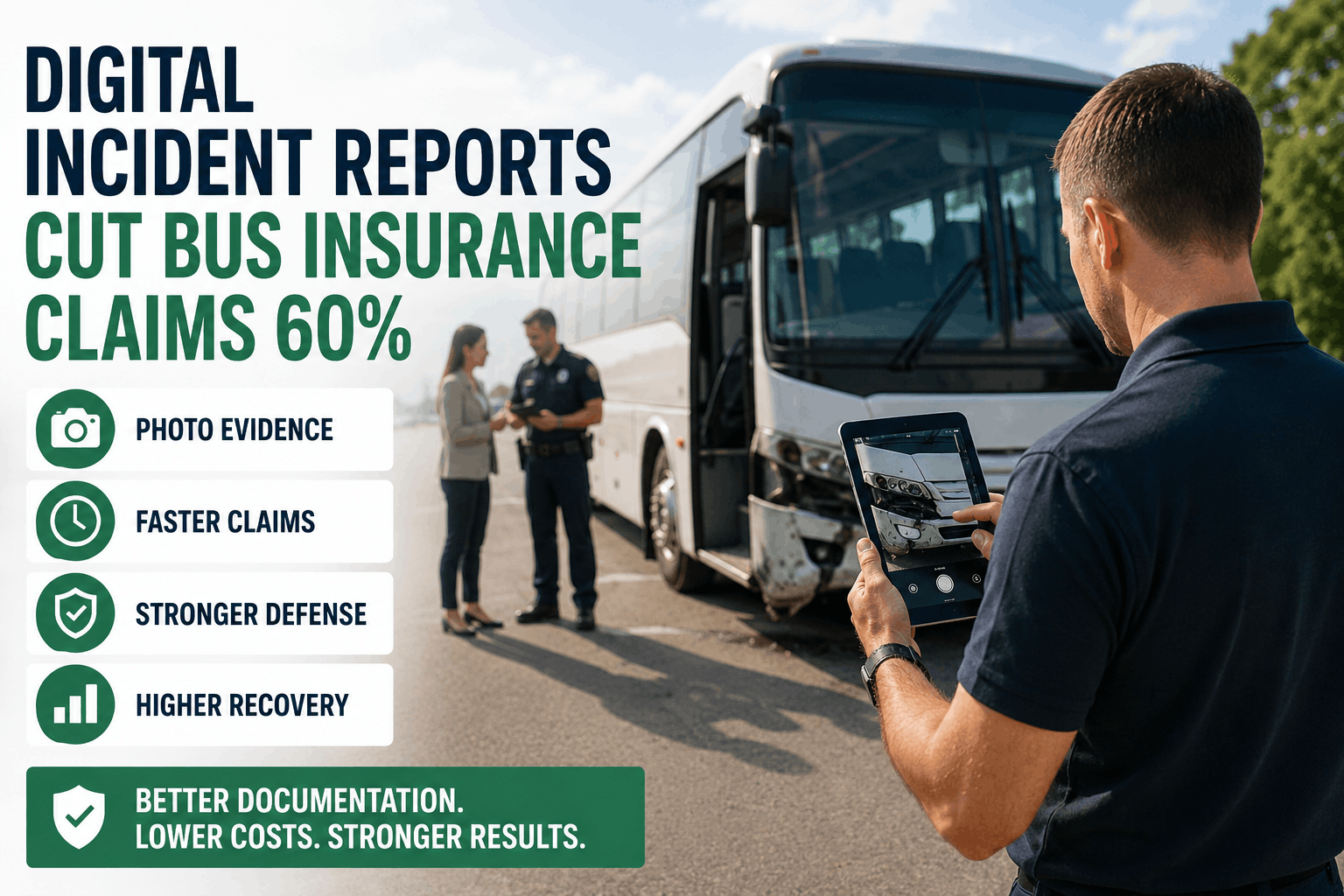
Every bus accident that goes undocumented properly costs your fleet money. Insurance adjusters deny claims, liability disputes drag on for months, and your legal team scrambles to reconstruct what happened from handwritten notes and memory. US bus fleet operators are losing thousands of dollars per incident, not because of the accident itself, but because their documentation workflow fails at the critical moment. Bus fleets that switch to digital incident reporting through a purpose-built CMMS resolve insurance claims up to 60% faster, recover 35% more in liability disputes, and reduce claim denial rates significantly. The difference is structured, timestamped, photo-backed digital records that insurers and courts accept without challenge. BusCMMS is built specifically for bus fleet incident documentation, guiding drivers through every required step from the scene while fleet managers receive real-time notifications and compliance alerts. If you want to see exactly how this works for your fleet, schedule a demo today, or start your free trial and configure your incident workflow this week. This guide covers what digital incident reporting actually changes, how photo documentation and timestamped CMMS records affect the claims process, and why US-based bus fleets are making the switch right now.
Bus fleets using BusCMMS digital incident reporting resolve claims faster, recover more, and reduce liability exposure on every incident.
Why Paper Incident Reports Fail Bus Insurance Claims
When a bus is involved in an accident in the United States, the clock starts immediately. FMCSA post-accident drug testing windows open. Insurer notification deadlines begin. Evidence at the scene starts to degrade. And if your driver is filling out a handwritten form in the back of the bus while trying to manage a distressed passenger situation, the chance of incomplete, inaccurate, or missing documentation rises dramatically.
Paper-based incident reporting has three core failure points that directly damage your insurance claims. First, information is incomplete because there is no system forcing the driver to capture every required field before moving on. Second, photos are either not taken, taken on a personal phone and lost, or submitted days later without GPS or timestamp metadata. Third, the report reaches the fleet manager hours or days after the incident, long past the optimal window for insurer notification and post-accident compliance actions.
Insurance adjusters reviewing a claim with incomplete documentation, no timestamped photos, and a report submitted two days after the incident have legitimate grounds to reduce or deny that claim. This is not an edge case. It is the standard outcome for bus fleets still relying on paper processes. The financial impact across a 50-vehicle fleet can reach tens of thousands of dollars per year in preventable claim losses.
Figures reflect operational benchmarks from US commercial bus fleet operations. Individual results vary by fleet size, route type, and insurer.
What Digital Incident Reporting Delivers
How Photo Documentation and Timestamped Reports Change the Claims Process
Insurance adjusters and legal teams work from evidence. When a bus fleet submits a claim supported by GPS-tagged, timestamped photos taken within minutes of the incident, a driver attestation captured on a structured digital form, a linked police report number, a passenger manifest with injury status records, and a maintenance history showing the vehicle was in proper working condition, the claim moves forward without challenge. When a fleet submits a handwritten form with no photos, submitted three days later, the claim becomes a negotiation.
BusCMMS digital incident reporting changes what evidence exists at the moment of submission. Drivers open the BusCMMS mobile app immediately after securing passengers and calling emergency services. The guided form walks through every required field including location data pulled automatically, weather conditions, road surface, involved parties, witness contact information, and a structured injury assessment checklist. Photo and video uploads are embedded directly in the form with automatic metadata capture. The driver cannot submit an incomplete report — required fields are enforced before submission is accepted.
The moment the driver submits, the fleet manager receives an instant notification with a full incident summary. FMCSA post-accident drug and alcohol testing alerts fire automatically based on severity thresholds. The insurer notification checklist opens in the fleet manager dashboard with timestamp tracking for every communication. This entire chain of documentation happens within the first 30 minutes of the incident, which is precisely the window that determines whether a claim succeeds or fails.
Driver secures passengers, calls 911, opens BusCMMS mobile app immediately from the scene.
Driver completes structured form with GPS location, photos, witness details, passenger injury status. Required fields enforced before submission.
Fleet manager receives real-time notification with full incident summary, FMCSA compliance alerts, and insurer notification checklist.
Complete digital package including photos, timestamps, CMMS maintenance history, and police report link submitted to insurer within the compliance window.
BusCMMS Digital Incident Reporting Capabilities
Every photo and video captured through BusCMMS is automatically tagged with time, date, GPS coordinates, and device metadata. This creates legally admissible evidence documentation that insurers and courts accept as accurate and unaltered. Drivers upload directly from the incident form without switching apps or risking file loss through personal photo libraries.
Schedule a DemoThe BusCMMS driver incident form covers every data point required by US commercial fleet insurers including weather, road conditions, vehicle speed, passenger count, injury assessment, third-party contact information, and witness statements. Required fields are enforced — a report cannot be submitted as complete unless all mandatory sections are filled. This eliminates the single biggest cause of claim denial: missing information.
Schedule a DemoWhen an incident is logged in BusCMMS that meets FMCSA post-accident drug and alcohol testing thresholds, the system automatically triggers a compliance alert to the designated safety officer. The alert includes testing deadline information and location guidance. For US commercial bus operators subject to DOT regulations, this automated trigger protects the fleet from regulatory violations that can compound the financial damage of an already costly incident.
Schedule a DemoOne of the most powerful insurance claim tools in BusCMMS is the automatic link between every incident report and the full maintenance history of the involved vehicle. When an insurer or opposing legal team raises questions about vehicle condition, brake maintenance, tire condition, or inspection compliance, your fleet manager can pull a complete documented maintenance log directly from BusCMMS and attach it to the claim file instantly.
Schedule a DemoBusCMMS incident records include dedicated fields for police report numbers, responding officer names, jurisdiction details, tow service records, and third-party insurer reference numbers. All of this information is stored in one place and accessible instantly when insurers request supporting documentation. No more searching email threads or calling dispatchers to find a report number submitted weeks ago.
Schedule a DemoMissing insurer notification windows is a primary cause of claim complications for US bus fleets. BusCMMS includes a built-in insurer notification checklist that opens automatically when an incident is submitted. Every communication with the insurer is logged with a timestamp, creating an auditable record of your fleet's compliance with notification obligations. This protects your fleet if the insurer later disputes the timeliness of notification.
Schedule a DemoDigital vs Paper: Insurance Claims Performance Comparison
Benchmark figures based on US commercial fleet insurance claim data. Actual timelines depend on insurer, claim complexity, and documentation quality submitted.
Insurance Claim Problems BusCMMS Solves
Insurance adjusters in the US increasingly require photographic evidence of vehicle damage, road conditions, and scene layout before approving commercial fleet claims. Paper-based fleets where drivers take photos on personal phones and email them later face metadata gaps, timing disputes, and lost files that create grounds for denial or reduction.
BusCMMS requires photo upload as part of the incident form completion. Photos are captured directly in the app, automatically tagged with GPS coordinates and timestamps, and stored in the central CMMS record. The insurer receives a complete photo package attached to the claim file that cannot be questioned on timing or authenticity grounds.
See How It WorksIn multi-party accidents involving a bus and one or more passenger vehicles, witness accounts can determine fault assignment entirely. Fleets that fail to collect witness names, contact numbers, and statements at the scene lose critical evidence that cannot be recovered days later when memories fade and people are no longer at the location.
The BusCMMS incident form includes a dedicated witness documentation section that prompts drivers to collect and record witness information before leaving the scene. These records are stored permanently in the CMMS and can be shared directly with insurers and legal counsel as part of the claim package, strengthening your fleet's liability position significantly.
See How It WorksWhen a claimant or their legal team argues that the bus had pre-existing mechanical issues that contributed to the accident, your fleet needs to demonstrate a documented preventive maintenance history for that specific vehicle. Without a CMMS linking maintenance records to vehicles, this defense requires weeks of manual record retrieval that may still produce incomplete evidence.
Every BusCMMS incident report is automatically linked to the maintenance history of the vehicle involved, including inspection logs, brake records, tire replacement dates, and completed preventive maintenance work orders. Your fleet manager can produce a complete vehicle condition history for any incident within minutes, providing a powerful defense against vehicle condition claims.
See How It WorksUS commercial vehicle insurance policies typically require notification within 24 to 72 hours of a reportable incident. Paper-based fleets where reports travel from driver to depot to fleet manager by hand routinely miss these windows, giving insurers grounds to invoke policy compliance clauses that can reduce or void coverage on that specific claim.
BusCMMS incident submission is instant. The driver submits from the scene, the fleet manager is notified within seconds, and the insurer notification checklist opens immediately. The entire notification chain happens within minutes of the incident, well within any standard commercial bus insurance policy reporting window. Every notification step is timestamped and logged as proof of compliance.
See How It WorksBusCMMS vs. Competitors: Insurance Claim Support Features
| Capability | BusCMMS | Fleetio | Samsara | Geotab | Verizon Connect | Fleet Complete |
|---|---|---|---|---|---|---|
| GPS-tagged photo upload in incident form | ✓ Built-in | Partial | Partial | ✗ | ✗ | Partial |
| Enforced required fields before submission | ✓ Mandatory | ✗ | ✗ | ✗ | ✗ | ✗ |
| FMCSA post-accident compliance trigger | ✓ Automated | ✗ | Limited | ✗ | ✗ | ✗ |
| Insurer notification timestamp log | ✓ Full audit trail | ✗ | ✗ | ✗ | ✗ | ✗ |
| Maintenance history linked to incident | ✓ Automatic link | ✓ | ✗ | Partial | ✗ | Partial |
| Witness and passenger documentation | ✓ Structured | ✗ | ✗ | ✗ | ✗ | ✗ |
| Police report reference tracking | ✓ | ✗ | ✗ | ✗ | ✗ | ✗ |
| Bus fleet specialization | ✓ Purpose-built | General | General | General | General | General |
| Exportable claim documentation package | ✓ One-click export | Partial | Partial | Partial | ✗ | Partial |
Stop losing money on preventable claim denials. BusCMMS gives your fleet the documentation infrastructure to win every claim you deserve to win.
Built for US Bus Fleet Insurance and Regulatory Requirements
US bus fleet operators face a layered compliance environment that directly intersects with insurance claims. FMCSA regulations govern post-accident drug testing for CDL drivers, DOT inspection requirements determine vehicle condition documentation standards, and state-level commercial vehicle regulations vary by operating territory. When an insurance claim is filed, evidence that your fleet complies with these regulatory requirements strengthens your position and reduces insurer leverage to dispute or reduce the claim.
BusCMMS supports the documentation workflows that US-based bus fleet operators need across school bus operations, transit authority fleets, charter services, shuttle operations, and government transport fleets. Inspection logs, maintenance records, driver qualification files, and incident reports are all stored in one connected system, creating the complete compliance picture that insurers and regulatory reviewers expect to see.
Automated post-accident drug and alcohol testing alerts for CDL drivers. Compliance trigger fires within seconds of incident submission based on configurable severity thresholds aligned with FMCSA regulations.
Pre-trip and post-trip inspection logs stored in BusCMMS link directly to vehicle profiles. When a claim raises vehicle condition questions, inspection compliance history is immediately available and exportable.
BusCMMS incident workflows are configurable to align with state-specific commercial vehicle reporting requirements across all US operating territories including school bus mandates, transit authority standards, and charter operator rules.
Insurer notification checklists in BusCMMS are configurable to match the specific notification requirements of your commercial fleet insurance policy, with timestamp logs providing proof of compliance for every notification step.
BusCMMS provides documentation workflow support. Fleet operators are responsible for compliance with applicable federal, state, and local regulations. BusCMMS does not provide legal or regulatory advice.
What Complete Digital Documentation Is Worth Per Incident
The financial value of a complete digital incident report varies by claim type, but across common US bus fleet incident scenarios the difference between well-documented and poorly documented claims is measurable and significant. Consider a passenger injury claim where a passenger alleges ongoing injury and initiates legal proceedings. A fleet with complete digital documentation including timestamped photos showing the actual scene, a structured passenger assessment completed within minutes of the incident, a full maintenance history proving vehicle condition, and logged witness statements is in a substantially stronger position than a fleet presenting a handwritten form submitted three days after the event.
How US Bus Fleets Use BusCMMS to Protect Their Insurance Claims
A school bus operator in Ohio with 88 vehicles was experiencing an average of 3 to 4 insurance claim complications per year due to incomplete incident documentation. Paper forms completed by drivers were arriving at the transportation office 24 to 48 hours after incidents with missing photos, no witness information, and incomplete passenger injury assessments. Two of the fleet's liability claims in 2023 were partially denied due to documentation gaps, resulting in out-of-pocket expenses the fleet should not have incurred.
After deploying BusCMMS, the Ohio operator's drivers completed all incident documentation from the scene on mobile devices. Required fields including photo uploads, witness capture, and passenger injury assessments could not be skipped. The transportation director received instant notifications for every incident and the insurer notification checklist was completed within the same day for all reportable events.
A regional transit authority in Texas operating 210 buses was managing incident reports across three depots using a combination of paper forms, email submissions, and a general-purpose maintenance software not designed for bus fleet incident documentation. Claim files for liability disputes required days of manual assembly from multiple systems, and the transit authority's risk management team consistently identified documentation quality as their primary liability exposure.
BusCMMS centralized all incident documentation across the three depots into a single searchable system. The risk management team gained a real-time dashboard showing all open incidents, notification compliance status, and pending compliance actions. Claim documentation packages that previously required two days of manual assembly were generated in under 20 minutes from BusCMMS export tools.
A charter bus operator based in Florida with 40 vehicles running interstate routes was facing a specific challenge: incidents happened far from the home depot with drivers who had no access to the office incident form system. When a side-impact collision occurred on a multi-day charter run in Georgia, the driver called it in by phone and completed a paper form at a roadside stop. The insurer questioned the timing of documentation and the absence of scene photos, and the claim was reduced significantly from what the operator expected to recover.
BusCMMS mobile incident submission works anywhere with a cell signal. After deployment, all 40 drivers were equipped with BusCMMS mobile access. When an interstate incident occurred three months post-deployment, the driver submitted a complete report including 12 timestamped photos, witness contacts, and a full scene description within 22 minutes of the incident. The fleet manager received instant notification and completed insurer notification within the hour.
BusCMMS Digital Incident Reporting Deployment Roadmap
Review your current incident documentation gaps, map your commercial insurance policy notification requirements, and identify FMCSA compliance triggers relevant to your fleet type and operating territory.
Register all vehicles in BusCMMS with full asset profiles including VIN, license plate, make, model, year, and current inspection status. This ensures every incident report links automatically to the correct vehicle maintenance history.
Configure incident form fields to match your insurance policy requirements and state regulatory reporting obligations. Set required field rules, photo upload minimums, and FMCSA compliance severity thresholds.
Configure insurer contact details, notification timeline requirements, and checklist steps in BusCMMS. Link the notification workflow to your specific insurance policy reporting obligations.
Train all drivers on BusCMMS mobile incident submission. Practice scenarios cover photo capture, witness documentation, passenger injury assessment, and form submission from the field.
Activate real-time incident notifications, compliance alert routing, and claims reporting dashboards for fleet managers and safety officers. Configure role-based access for risk management and legal teams.
BusCMMS support team provides go-live assistance, confirms all incident workflow steps are functioning correctly, and schedules a 30-day review to assess documentation quality and compliance alert performance.
What Fleet Operators Say About BusCMMS Incident Reporting
Before BusCMMS, our drivers were filling out paper forms at the scene that would reach our office a day later with half the information missing. We had two claims partially denied in one year because we could not produce timestamped photos or a complete witness record. After we went live with BusCMMS, the first major incident we had was documented completely in under 25 minutes from the scene. The driver uploaded 9 photos, captured both witnesses, completed the passenger injury assessment, and we had the insurer notified within 90 minutes. That claim resolved in 18 days. It used to take us 6 to 8 weeks for anything similar. The difference in what we recovered versus what we lost on that previous claim paid for the platform many times over.
Frequently Asked Questions
Insurers resolve claims faster when they receive a complete documentation package upfront including timestamped photos, structured driver statements, and maintenance history, eliminating the back-and-forth requests that extend paper-based claim timelines by weeks. BusCMMS ensures this complete package is ready for submission within hours of the incident, not days. Schedule a demo to see the full claim package output.
Photos captured through BusCMMS include embedded GPS coordinates, timestamps, and device metadata that establish authenticity and timing, which are the primary requirements for photographic evidence in US commercial liability proceedings. Fleet operators should consult with their legal counsel regarding specific evidentiary requirements in their state. Start your free trial to test the photo documentation system with your own incidents.
BusCMMS mobile incident forms support offline data capture, allowing drivers to complete the full incident report including photos in areas with limited connectivity, with automatic submission once signal is restored. Your fleet manager receives the complete report as soon as the device reconnects, preserving the original capture timestamps from the scene.
When an incident is submitted in BusCMMS that meets FMCSA post-accident testing thresholds based on severity criteria, the system automatically sends a compliance alert to the designated safety officer with testing deadline information and nearest authorized facility guidance. This protects US commercial bus operators from regulatory violations that compound the financial impact of an already costly incident.
Yes, BusCMMS incident records including all form data, timestamped photos, maintenance history links, police report references, witness information, and insurer notification logs can be exported as a complete claim documentation package in standard formats. Fleet managers and risk teams access this export directly from the incident record without manual assembly.
BusCMMS is designed to scale from small single-depot operators with under 20 vehicles up to large multi-depot transit authorities with hundreds of assets, with the same digital incident reporting capabilities available regardless of fleet size. Small fleet operators benefit from the same documentation quality improvements that protect their insurance claims just as significantly as larger operators. Start free trial with no fleet size minimum.
Most bus fleet operators complete BusCMMS incident module configuration within one to two business days, with driver mobile onboarding completed within a week for fleets up to 100 vehicles. The BusCMMS onboarding team provides guided setup support to ensure your incident forms, compliance triggers, and notification workflows are correctly configured before your first live incident.
BusCMMS supports role-based access controls that allow fleet operators to provide controlled access to incident records for authorized external parties including insurance brokers, risk management consultants, and legal counsel without exposing unrelated fleet operational data. Your fleet manager controls all external access permissions directly from the BusCMMS dashboard. Book a demo to see the access control setup.
Protect every insurance claim your bus fleet files. Complete digital documentation from the scene, FMCSA compliance alerts, and one-click claim packages built for US commercial bus operators.
Purpose-built for bus fleets. Ready in days. Pays for itself on the first well-documented claim.