Your drivers are still using paper DVIRs (Daily Vehicle Inspection Reports). Forms get lost, handwriting is illegible, defect reports are vague, follow-up on repairs is sporadic, and when auditors ask for records, you're scrambling through filing cabinets. Meanwhile, fleets that switched to digital DVIR apps submit inspections in 30 seconds, defects are logged with photos and timestamps, work orders are created automatically, and auditors get complete documentation instantly. The cost difference is negligible — digital DVIR apps cost $5–$15 per vehicle per month. The compliance and operational benefits are enormous. This guide compares paper and digital DVIR side-by-side: compliance risk, speed, accuracy, audit readiness, driver adoption, and cost-benefit analysis. If you're still on paper, the data for switching is overwhelming.
Fleet Tech
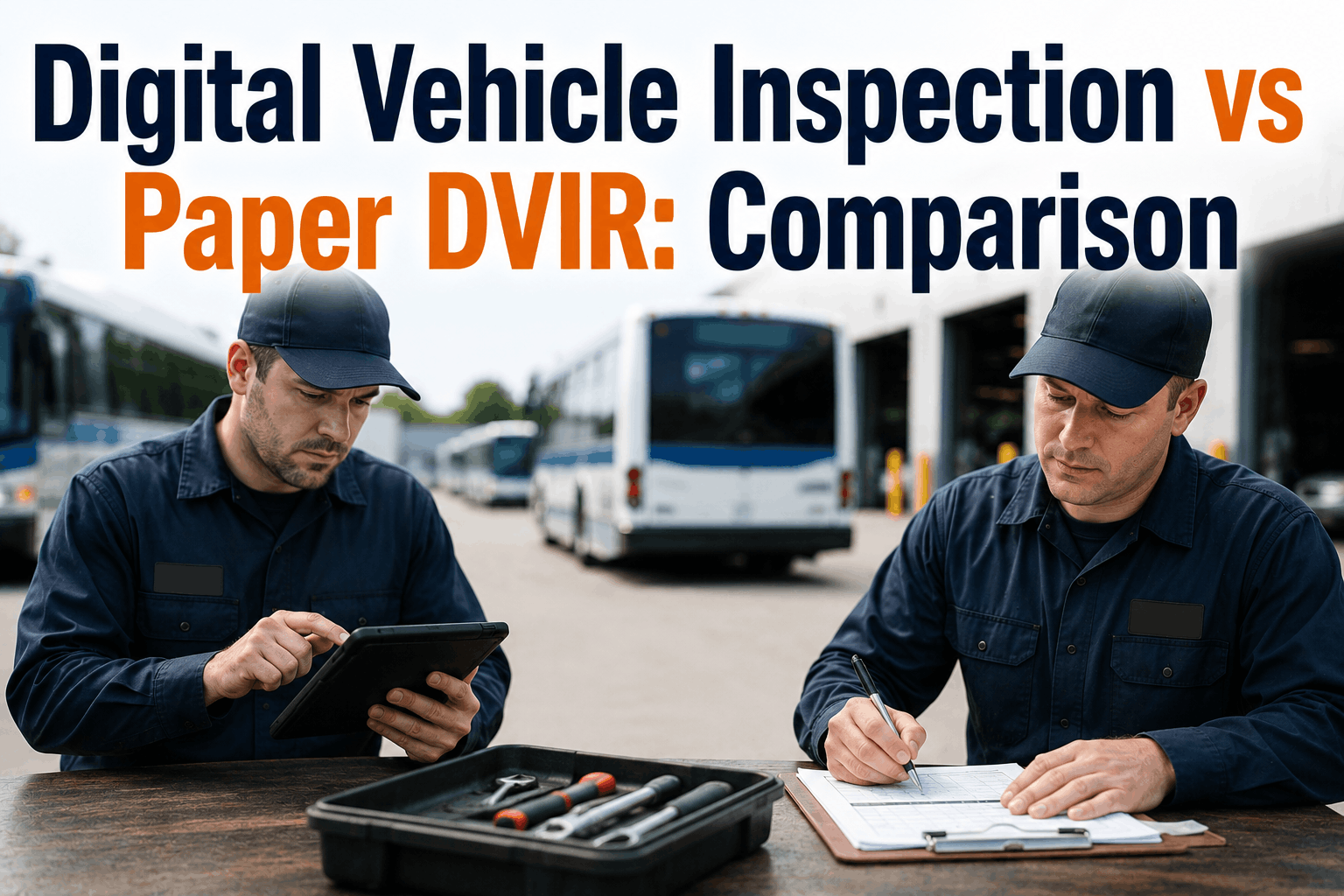
Digital Vehicle Inspection vs. Paper DVIR: 2026 Comparison
Why fleets are ditching paper. See the side-by-side comparison of compliance, speed, audit readiness, and ROI for digital DVIR systems.
The Case for Change: Why Fleets Switch to Digital
Paper DVIRs were designed for an era before smartphones and cloud storage. They required manual filing, drove audit nightmares, and created compliance gaps. Digital DVIR eliminates every problem paper creates. Most fleets that switch report they wish they'd done it years earlier.
Driver Acceptance
66% of bus drivers prefer digital DVIR over paper (survey data). Reason: faster (fewer steps), automatic work order creation means repairs happen faster, less bureaucratic friction.
Compliance Audits
FTA and FMCSA auditors now expect digital documentation. Paper records during audit = red flag (appears disorganized). Digital records = professional, audit-ready.
Operational Efficiency
Defect reports go directly to maintenance. No manual data entry. No lost forms. Work orders created instantly. Repair turnaround time drops 40–60%.
Side-by-Side Comparison: Paper vs. Digital
SUBMISSION & TIME INVESTMENT
Paper DVIR
Driver fills out form by hand (5–10 minutes). Writes legibly. Submits to supervisor or files manually. Takes time out of shift start/end.
Digital DVIR
Driver opens app, checks boxes on form template (2–3 minutes). If defect, adds photo (30 seconds). Submits with 1 tap. Instant timestamp. Complete.
✓ WINNER: Digital (Faster, less intrusive, automatic timestamping)
DATA ACCURACY & LEGIBILITY
Paper DVIR
Handwriting often illegible. Vague descriptions ("vibration" instead of "vibration at steering wheel above 50 mph"). Technician must guess what driver meant. Poor defect documentation.
Digital DVIR
Dropdown menus force structured data. Defect descriptions required. Photo attachment shows exactly what driver is reporting. No guessing. Technician knows immediately what to fix.
✓ WINNER: Digital (Clear data, photos, forced structure)
WORK ORDER CREATION
Paper DVIR
Driver fills out defect section. Form sits in bin. Supervisor reviews (maybe). Manually creates work order in system (if they remember). 24+ hour delay. Work gets lost.
Digital DVIR
Defect reported → Instant notification to maintenance manager → Work order auto-created in CMMS → Technician sees it immediately. Turnaround time: hours instead of days.
✓ WINNER: Digital (Instant, automated, no delays)
AUDIT READINESS & RECORD RETENTION
Paper DVIR
Auditor asks for 3 months of DVIRs. You search through filing cabinets. Forms are missing, damaged, illegible. You can't produce complete records. Auditor flags non-compliance.
Digital DVIR
Auditor asks for records. You run report from system. All 3 months, all buses, all defects, all photos — exported in 2 minutes. Perfect documentation. Auditor satisfied immediately.
✓ WINNER: Digital (Complete, fast, audit-proof)
COMPLIANCE RISK
Paper DVIR
FMCSA 49 CFR 396.11 requires DVIRs to be documented and retained 3 months. Missing or incomplete records = violation. Many fleets on paper fail this requirement unintentionally.
Digital DVIR
System auto-retains records. Digital timestamps prove compliance. No gaps, no missing documents. Zero compliance risk from documentation failure.
✓ WINNER: Digital (Zero compliance risk)
COST
Paper DVIR
Forms: $500/year (50 buses). Filing: 2 hours/week admin time ($2,000/year). Lost productivity from manual work order entry: immeasurable. Storage: cabinet space. Total: ~$2,500+/year + intangible costs.
Digital DVIR
Software: $5–$15/vehicle/month = $3,000–$9,000/year (50 buses). Zero admin time (system does it). Instant work orders (no manual entry). Total: ~$6,000/year PLUS massive operational gains.
✓ WINNER: Digital (Slight cost increase buys massive ROI)
The Math: Why Digital Makes Financial Sense
50-Bus Fleet Switching to Digital DVIR
Annual digital DVIR cost: 50 × $10/month × 12 = $6,000
Admin time saved (2 hrs/week): $2,000
Reduced repair turnaround (1 hour average per defect, 5 defects/week): $5,000
Audit preparation time (saves 20 hours/year): $1,500
Prevented compliance violation (average fine): $3,000 (saved, not earned)
———
Total annual benefit: $11,500 for $6,000 investment = 192% ROI
"We were on paper DVIRs. Compliance audit found missing records, vague defect descriptions, and no way to prove we'd followed up on defects. Auditor cited us for inadequate DVIR program. Forced us to implement digital DVIR. Switched in 60 days. Drivers complained for 2 weeks, then loved it (faster than paper). Within 3 months, we had complete defect documentation, zero missing records, and work orders were being created automatically. Next audit: zero findings on DVIR compliance. The digital switch paid for itself in admin time savings alone."
— Compliance Manager, 50-bus transit agency, Colorado
Make the Switch: Paper to Digital
192% ROI. Zero compliance risk. Instant work orders. 50x faster audits. Digital DVIR is the obvious choice for 2026.