DOT Bus Inspection Requirements 2026 — Complete Compliance Reference Guide
If you manage a bus fleet in 2026, three things changed that you need to act on now. FMCSA officially authorised electronic DVIRs on March 23 (FMCSA-2025-0115). The CSA scoring system overhauled how vehicle maintenance violations are weighted. And penalties for out-of-service violations jumped to $23,048 per incident as of late 2024. This guide covers every DOT inspection requirement that applies to your bus fleet — frequency, documentation, penalties, the six inspection levels, and the five compliance changes that took effect in 2026 — so you walk into any audit or roadside stop fully prepared.
New 2026: eDVIRs now explicitly legal — FMCSA-2025-0115, effective 23 March 2026
$23,048 max fine per OOS violation (updated Dec 2024)
New CSA split: "Driver Observed" violations now scored separately
5 DOT Compliance Changes Bus Fleets Must Know for 2026
2026 is not a routine compliance year. Four regulatory shifts and one penalty update combine to create meaningful new exposure for bus operators who haven't updated their compliance programmes. Here is what changed, and what it means for your fleet day to day.
01
eDVIRs Now Explicitly Authorised
Effective 23 March 2026 — FMCSA-2025-0115
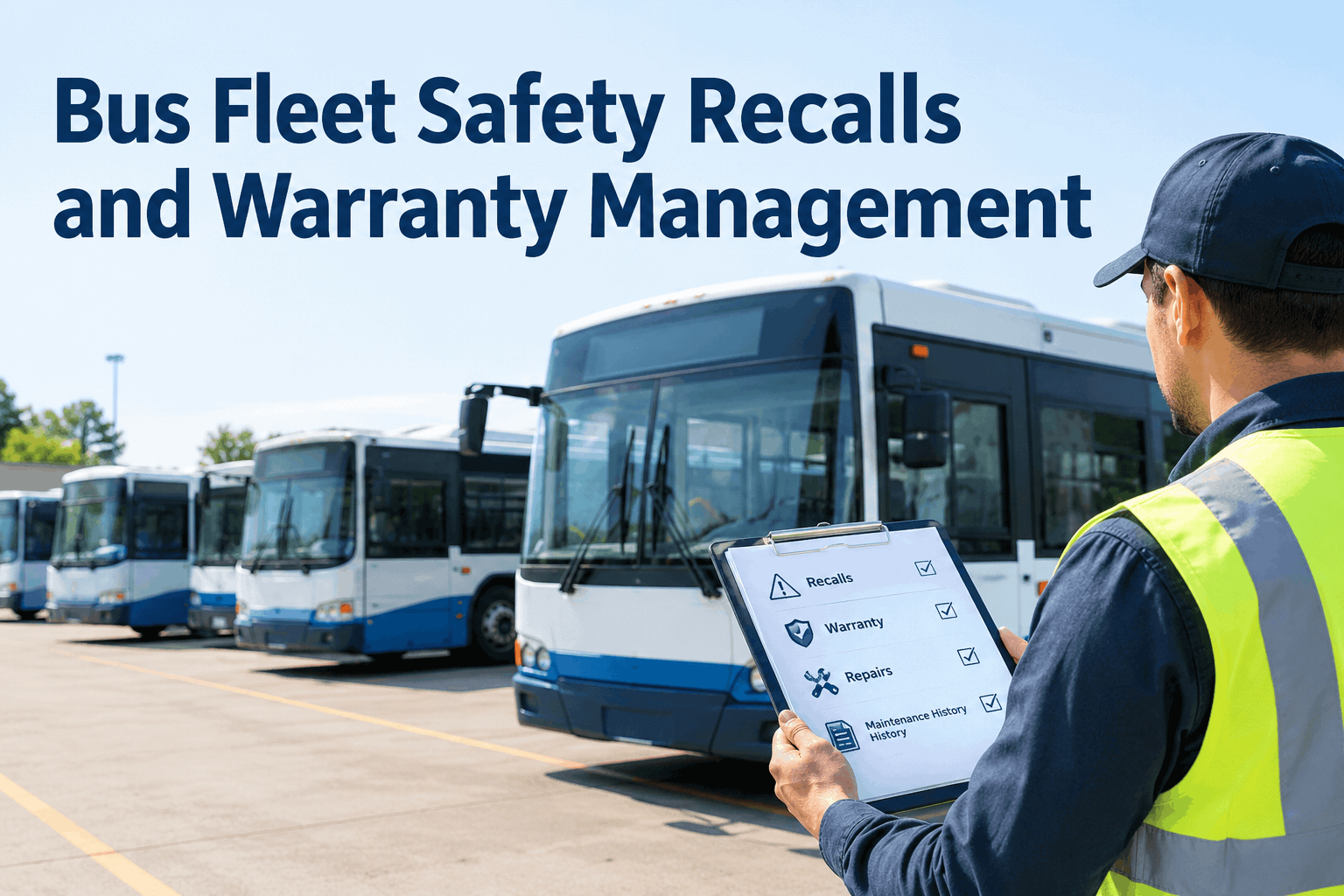
FMCSA added explicit eDVIR language to §396.11 and §396.13. Electronic creation, maintenance, and digital signatures are now unambiguously compliant. Paper DVIRs remain legal but create avoidable audit risk — missing signatures, lost reports, and no timestamp chain.
Fleets using digital inspection platforms are now explicitly compliant
02
CSA Vehicle Maintenance BASIC Split
Most significant SMS overhaul since 2010
The Vehicle Maintenance BASIC now splits into two categories: "Vehicle Maintenance" for issues found during routine maintenance, and "Vehicle Maintenance: Driver Observed" for defects a driver should have caught on a pre-trip walkaround — burned lights, bald tires, visible leaks. Driver inspection quality now creates a distinct, visible mark on your carrier profile.
Poor pre-trip inspection habits now directly damage your CSA score
03
New CSA Severity Scoring — Simplified Two-Tier System
Replaces complex 1–10 scale
FMCSA replaced the 1–10 severity scale with a two-tier system: out-of-service violations receive a weight of 2, all other violations receive a weight of 1. Over 2,000 individual violation codes consolidated into approximately 100 broader groups. Every violation now counts more visibly against your carrier profile.
Each OOS violation now carries 2× the weight of any other violation
04
Drug Clearinghouse — CDL Revocation Now Enforced
Active enforcement 2026
States are now required to downgrade CDL privileges for drivers in "prohibited" Clearinghouse status. Pre-employment full queries, annual limited queries, and timely violation reporting are all mandatory and actively audited. Paper Medical Examiner Certificates no longer accepted — certification must link directly to CDL record.
Missing Clearinghouse queries are an automatic audit failure
05
Penalty Increases — Updated December 2024
Currently enforced across all CMV operations
FMCSA updated maximum civil penalties. Operating under an OOS order: up to $23,048. Vehicle OOS violations: up to $2,304. Recordkeeping failures: $1,544 per day. Operating with an unsatisfactory safety rating: up to $33,252. The average OOS violation costs fleets $4,200+ including vehicle downtime.
Single OOS incident = up to $23,048 plus $4,200+ average downtime cost
DOT Bus Inspection Frequency — What's Required and When
Federal law sets the minimum. States regularly exceed it. Use this table to verify your obligations — and identify any gap between what you are doing and what the regulation requires.
Inspection Type
Required Frequency
Regulation
Record Retention
Who Performs
Daily
Pre-Trip Inspection
Before every route — no exceptions
49 CFR §392.7
Not required if no defects; DVIR 3 months
Driver
Daily
DVIR — Post-Trip Report
End of each day's work on each vehicle
49 CFR §396.11
3 months from report date
Driver + Mechanic + Next Driver
90 Days
Emergency Exits & Push-Out Windows
Every 90 days — buses only
49 CFR §396.3
Part of general maintenance records
Qualified mechanic
Annual
Full DOT Annual Inspection
Every 12 months minimum — all CMVs
49 CFR §396.17
14 months — most recent on vehicle
Qualified inspector (§396.19)
State-Level
State DOT Inspection
Varies — school buses often every 6 months
State-specific
Per state requirements
State-certified inspector
Passenger-carrying buses must complete DVIRs regardless of whether defects are found — unlike property-carrying CMVs. This is a common audit trap that catches unprepared fleets.
The 6 CVSA Inspection Levels — Which One Will Your Bus Face?
Every DOT roadside inspection follows one of six CVSA-defined levels. Level I is the most comprehensive and most common. Level V is vehicle-only and most common for school buses. Understanding what each level involves tells you exactly how to prepare. See how Bus CMMS prepares your fleet for every level — book a 20-minute demo.
Level I
Most Common
North American Standard — Full Inspection
Full vehicle and driver inspection. Includes under-vehicle check. Inspector examines all mechanical components plus all driver documentation. Takes 45–90 minutes. Brakes, tires, lights, steering, suspension, exhaust, frame, coupling, and cargo securement all checked.
Vehicle + DriverUnder-vehicleAll documentation
Level II
Common
Walk-Around Inspection
Vehicle and driver inspection without going under the vehicle. Inspector examines everything visible during a walkaround plus all driver qualifications and documentation. The new "Driver Observed" CSA category applies directly to defects found here.
Vehicle + DriverNo under-vehicleWalkaround only
Level III
Driver Focus
Driver-Only Credentials Check
Driver credentials, documentation, and hours-of-service compliance. No vehicle mechanical inspection. CDL validity, medical certificate status (now linked to CDL record), Clearinghouse status, and HOS logs all reviewed.
Driver onlyCDL + medicalHOS logs
Level IV
Special
Special Study Inspection
Single item or focused study. Usually part of a targeted enforcement programme looking at one specific component type — e.g., brake performance during a brake safety week, or specific light types during a lighting blitz.
Single focusTargeted study
Level V
School Bus
Vehicle-Only Inspection (No Driver Required)
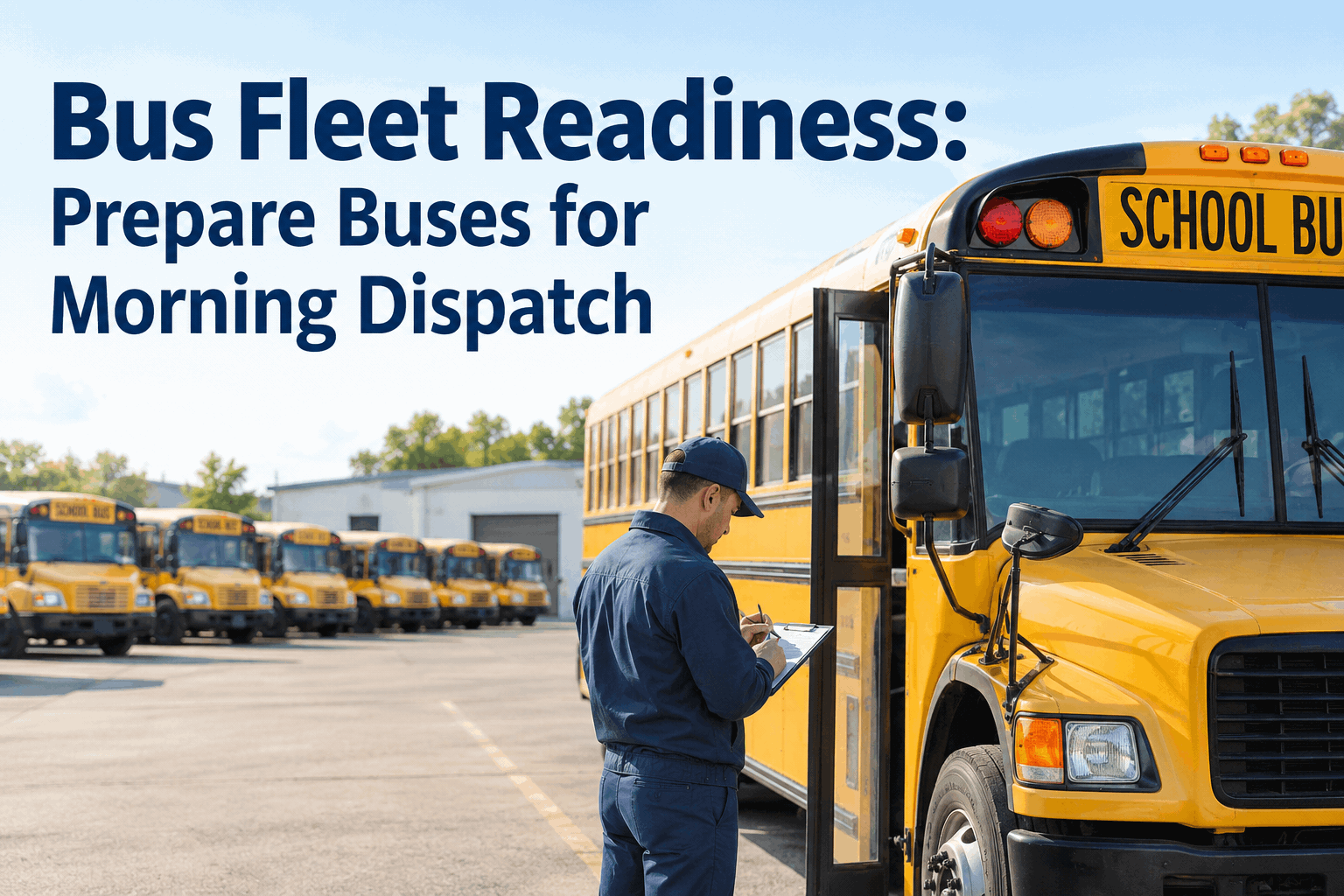
Full vehicle inspection conducted without the driver present. Most common for school buses. Inspector checks all mechanical components using the same standards as Level I but without driver documentation review. Can happen at depot or terminal.
Vehicle onlyNo driver neededCommon for school buses
Level VI
Hazmat Only
Enhanced Inspection for Radioactive/Hazmat
Enhanced Level I plus radioactive material transport requirements. Only applies to vehicles transporting highway route controlled quantity (HRCQ) shipments of radioactive materials. Not applicable to most bus fleets.
Hazmat/radioactive onlyNot bus-relevant for most
Documentation Your Bus Must Have Ready — Before the Inspector Arrives
Mechanic certification of repairs (or none needed)
Next driver's review and acknowledgment signature
49 CFR §396.11 + §396.13
Annual Inspection Report
Retain 14 months — most recent kept on vehicle
Inspector qualifications on file (§396.19)
All Appendix A items inspected and recorded
Sticker, report, or decal on vehicle
Date of inspection and inspector signature
Vehicle identification details
49 CFR §396.17 + §396.21
Maintenance Records
Service life + 6 months after disposal
PM schedules and service completion records
Repair orders linked to DVIR defects
Parts replacement documentation
90-day emergency exit inspection records
Brake inspector qualifications (§396.25)
49 CFR §396.3
Driver Qualification Files
3 years post-termination
CDL validity with correct endorsements (P, S)
Medical certificate linked to CDL record (not paper)
Pre-employment Clearinghouse full query
Annual Clearinghouse limited query
MVR and prior employment verification
49 CFR §391 + Clearinghouse
60% of Audit Violations Are Documentation Failures — Not Mechanical
Every Document Above, Stored Per Vehicle, Retrievable in Seconds
Bus CMMS stores DVIRs, annual inspection reports, maintenance records, and 90-day emergency exit checks digitally against each vehicle — with automated retention alerts and instant audit export. No scrambling. No gaps.
2026 DOT Penalty Reference — Exact Fines by Violation Type
These are the current maximum civil penalties as updated by FMCSA in December 2024. They apply to all commercial motor vehicle operations including school buses, transit buses, and charter operators. These maximums apply per violation, per day — not per inspection event.
Violation
Maximum Fine
Regulation
Risk Level
Operating under an out-of-service order
$23,048
49 CFR §396
Critical
Unsatisfactory safety rating — operating
$33,252
49 CFR §385
Critical
Operating with unrepaired defect before dispatch
$15,420
49 CFR §396.11
High
Falsifying a DVIR to conceal a defect
$12,700
49 CFR §396.11
High
Vehicle OOS violation at roadside
$2,304
CVSA / FMCSA
Medium
Recordkeeping failures (DVIR, maintenance logs)
$1,544 / day
49 CFR §396
Medium
Failing to complete required DVIR (defect present)
$1,270 / day
49 CFR §396.11
Moderate
Beyond financial penalties, violations impact CSA BASIC scores, trigger additional roadside scrutiny and FMCSA audits, increase insurance premiums, and create significant litigation exposure when a vehicle is subsequently involved in an incident.
The DOT-Ready Bus Fleet Compliance Workflow
Compliance is not a once-a-year event — it is a daily process that either runs automatically or creates weekly scrambles. Fleets that systematise these four steps consistently pass every inspection at every level. See how Bus CMMS automates all four steps — book a 20-minute demo.
1
Daily — Driver Completes Guided DVIR Before Every Route
Every driver walks through all 11 FMCSA inspection areas before departure. Each defect is documented with photo and description. Report is signed and timestamped. If no defects: signed "satisfactory." The next driver reviews and acknowledges before operating.
49 CFR §392.7 + §396.11Bus CMMS: Mobile guided checklist
2
On Defect — Mechanic Receives Alert, Certifies Repair
When a defect is reported, a work order is created immediately and routed to maintenance. The mechanic repairs the defect and certifies the repair on the DVIR. The bus cannot be dispatched until this certification is recorded. This closes the 3-signature chain required under §396.13.
49 CFR §396.11(a)(3) + §396.13Bus CMMS: Auto work order + repair cert
3
Every 90 Days — Emergency Exit Inspection Completed and Logged
All emergency exits, push-out windows, and emergency door marking lights are inspected and confirmed functional. The inspection is logged with date, inspector, and result. Alert sent 14 days before next due date so no fleet ever misses this interval.
Annually — Full Appendix A Inspection, Records Retained 14 Months
A qualified inspector (§396.19) performs the full annual inspection covering all Appendix A items. Report is retained for 14 months; the most recent report or sticker remains on the vehicle. Annual inspection due dates are tracked per vehicle with 30-day advance alerts.
49 CFR §396.17 + §396.21Bus CMMS: Due date tracking + record storage
Built for 2026 DOT Compliance. Purpose-Built for Bus Fleets.
Automate Every Step of This Compliance Workflow — Daily DVIRs to Annual Inspection Tracking
Bus CMMS handles guided mobile DVIRs, defect-to-work-order automation, 90-day emergency exit scheduling, annual inspection due date tracking, and instant audit export — so your fleet is always DOT-ready and you never scramble at inspection time.
What are the DOT bus inspection frequency requirements in 2026?
Federal regulations require a full annual inspection under 49 CFR §396.17 at minimum, covering all items in Appendix A. Buses must have emergency exits and push-out windows specifically inspected every 90 days under 49 CFR §396.3. Daily pre-trip inspections are required under §392.7 before every route. DVIRs must be completed at the end of each day's work under §396.11 — and unlike property-carrying CMVs, passenger-carrying buses must complete DVIRs regardless of whether defects are found. Many states impose more frequent requirements for school buses — commonly every 6 months.
What changed in DOT bus inspection requirements for 2026?
Five significant changes took effect in 2026: (1) FMCSA-2025-0115 (effective March 23, 2026) explicitly authorises electronic DVIRs in §396.11 and §396.13, removing all regulatory ambiguity around digital inspection platforms. (2) The CSA Vehicle Maintenance BASIC split into "Vehicle Maintenance" and "Vehicle Maintenance: Driver Observed" — driver pre-trip quality now directly impacts a separate score. (3) FMCSA replaced the 1–10 violation severity scale with a two-tier system where OOS violations carry 2× the weight. (4) Drug Clearinghouse enforcement intensified — states must now downgrade CDL privileges for "prohibited" drivers. (5) FMCSA updated maximum civil penalties — operating under an OOS order now carries a maximum fine of $23,048.
How long must DOT inspection records be retained?
Retention requirements vary by record type. DVIR records (the report, repair certification, and next-driver acknowledgment) must be retained for 3 months from the date the report was prepared. Annual inspection reports must be retained for 14 months, with the most recent report or inspection sticker kept on the vehicle at all times. Vehicle maintenance records must be kept for the vehicle's service life plus 6 months after disposal. Driver qualification files must be retained for 3 years after the driver leaves the company. In 2026, FMCSA auditors increasingly expect documentation to be instantly retrievable — not retrieved from filing cabinets over several hours.
What inspection level will my bus face at a DOT roadside stop?
Most bus roadside inspections are Level I (full vehicle and driver, including under-vehicle) or Level II (walkaround without going under the vehicle). School buses parked at depots or terminals typically face Level V inspections (vehicle-only, no driver required). Level III is driver-credentials only and does not involve a mechanical inspection. The new 2026 CSA "Driver Observed" scoring category makes Level II inspections particularly significant — any defect a driver should have caught during a pre-trip walkaround (burned lights, visible tire damage, obvious leaks) now scores in the separate Driver Observed BASIC.
How does Bus CMMS help with DOT inspection compliance?
Bus CMMS automates the four core compliance workflows: daily guided DVIRs on mobile (all 11 inspection areas prompted, photo documentation required for defects, 3-signature chain enforced), defect-to-work-order automation (mechanic alerted instantly, repair certification logged, bus blocked from dispatch until cleared), 90-day emergency exit scheduling (auto-scheduled per vehicle, 14-day advance alerts, inspection logged), and annual inspection tracking (due dates tracked per vehicle with 30-day advance alerts, reports stored 14+ months, instant audit export). Fleets using Bus CMMS report 68% fewer DOT violations and pass rates above 98%.