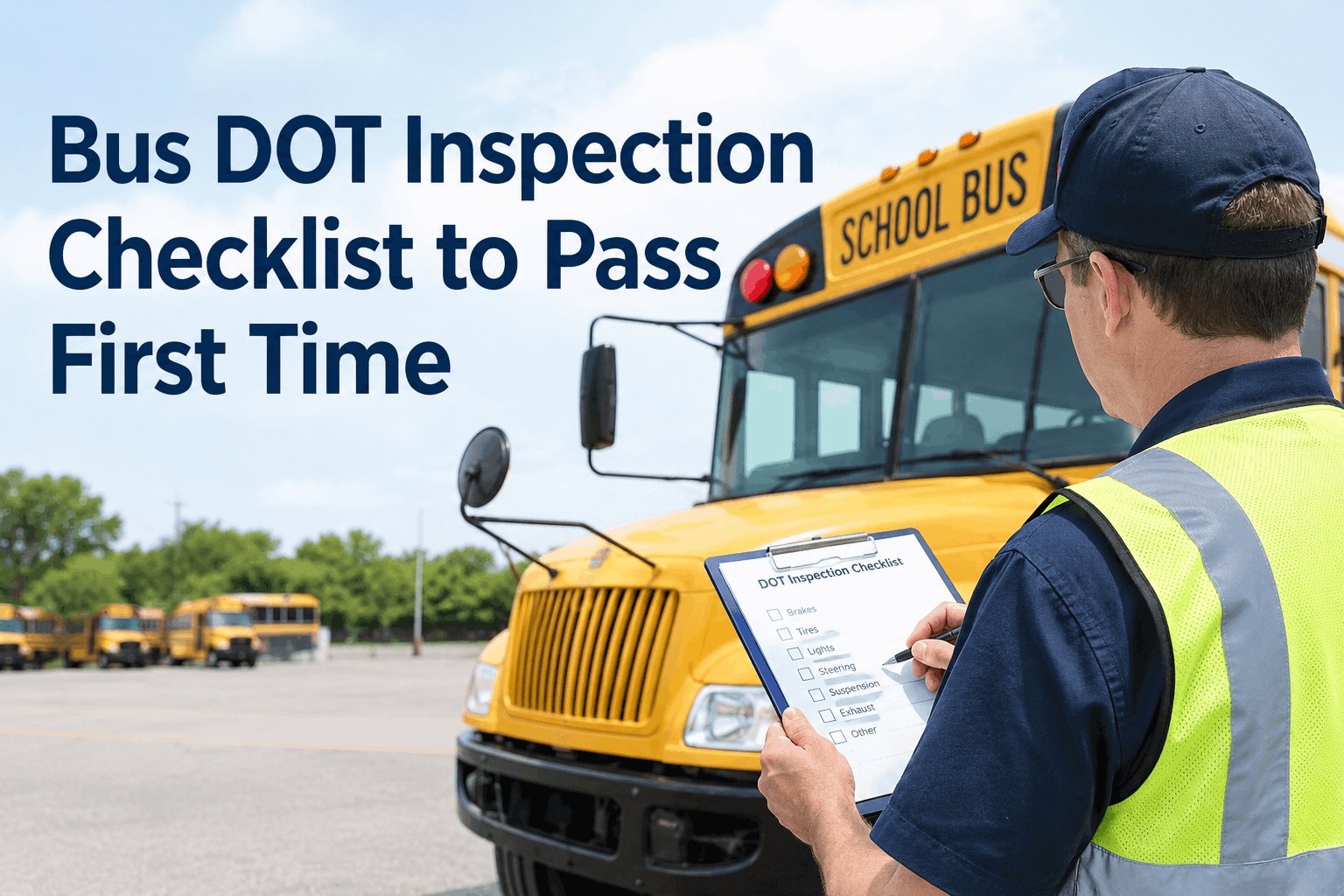
A bus can run fine all week and still come back from its annual inspection with an out-of-service sticker on the windshield. This bus DOT inspection checklist is built to stop that — so you catch every defect in your own bay before the inspector does, and your buses pass the first time.
DOT INSPECTION READINESS · FMCSA 396.17
The Bus DOT Inspection Checklist That Passes First Time
Annual periodic inspection, roadside enforcement, state DOT — the bus either rolls out with a decal or sits with an out-of-service order. Here is the item-by-item checklist that decides which.
95%+
first-time pass rate
Typical fleet ~70% — 3 in 10 buses bouncedChecklist-run fleet 95%+ — inspection day is boring
Where a First-Time DOT Inspection Failure Actually Comes From
A failed bus DOT inspection is almost never a part that broke that morning. It is a defect that was already there — one your crew either never checked, checked and never logged, or logged and never closed out. The annual inspection under 49 CFR 396.17 holds your bus to the CVSA North American Standard Out-of-Service Criteria — the same criteria a roadside officer uses. The only question is who finds the defect first: you, or the inspector.
396.17Annual inspection, every 12 months, by a qualified inspector
~133KAnnual-inspection citations a year — a top FMCSA audit finding
#1 & #2Brakes and tires drive most out-of-service orders — both catchable on a walk-around
STAGE 1Never checkedA rushed pre-trip skips the under-bus look. The leaking slack adjuster sat there for weeks.
STAGE 2Found, not written downA driver mentions a soft brake "last week." No paper, no work order, never reached the shop.
STAGE 3Logged, never closedIt is in a binder somewhere. Nobody assigned it, nobody fixed it, no proof it was corrected.
RESULTOOS stickerThe inspector finds what your records should have.
Passing first time is a records problem as much as a wrench problem — the inspector checks the bus and the paperwork, and both have to be clean.
The Bus Inspection Checklist, Walked by System
Walk the bus the way the inspector does — by system, with a clear fail line on each item. Run this bus DOT inspection checklist in your own bay first, and every out-of-service defect becomes a work order you control. The items marked BUS-ONLY are exactly where a generic truck template falls short and where enforcement concentrates — you can see each of these items as a pre-loaded bus DVIR in a quick demo.
Brakes & air system#1 OOS CAUSE
Service brakes within adjustmentFAIL: 20%+ brakes defective = immediate OOS
Steer-axle brakes functionalFAIL: any single steer-axle brake defect
No air leaks or chafed linesCheck build-up, governor, low-air warning
Parking brake holds under loadMust hold the bus on a grade
Tires & wheels#2 OOS CAUSE
Steer tire tread depthFAIL: below 4/32" on a steer axle
All other tire tread depthFAIL: below 2/32" on any other axle
No cuts, bulges, exposed cordIncludes flats and mismatched duals
Passing first time is a schedule, not a scramble. Work backward from the inspection date and the big defects surface while there is still time to order parts and fix them. Here is how a clean month runs.
30days out
Dry-run the full checklist
Run every bus as if it were the real inspection. Log each defect as a work order — brakes and tires first, since they drive most OOS orders.
21days out
Order long-lead parts
A back-ordered slack adjuster or lift part can park a bus on inspection day. Get orders in against your defect list now, not the week of.
10days out
Close every work order & re-verify
Fix, sign off, re-check each item. A corrected defect with no record of the fix is still an audit problem.
0day of
Records in hand, bus clean
Prior annual report, DVIR history, inspector qualification — all pulled and ready. The inspection confirms what you already know.
OPEN LOOPDefect noted on a sticky note, mentioned in passing, lost in a binder — and found by the inspector.
CLOSED LOOPEvery defect becomes a tracked work order, assigned, fixed, and documented — with a record to prove it.
The difference between a shop that passes DOT inspections and one that sweats them is that closed loop — and it is exactly what BusCMMS automates for bus fleet compliance. Here is the loop, step by step.
1Defect found on DVIR
2Work order auto-created
3Assigned & repaired
4Correction documented & retained
Pre-loaded bus DVIRs
Inspection forms built for buses on day one — stop arms, crossing gates, emergency exits, lifts, student mirrors — not a trucking template you have to rebuild.
Auto work orders from failures
A failed inspection item becomes a tracked work order automatically, so no defect slips from a driver's note into the gap before the inspector arrives.
Audit-ready records
Annual reports, DVIR history, and closed-defect proof retained and pulled in seconds — FMCSA, FTA, and state DOT records ready when the auditor is.
Key Takeaways for Passing DOT Inspection First Time
A bus DOT inspection checklist only works if you run it before the official inspection and close every defect it surfaces. Four things to carry out of this.
01
Brakes and tires fail most buses
They drive most OOS orders and are both visible on a walk-around. Check them first, hardest.
02
Records are half the inspection
Closed DVIRs, prior annual report, inspector qualification — clean paper, not just a clean bus.
03
Run a dry inspection a month out
Find the defects yourself with time to order parts and fix them before decal day.
04
Close the defect-to-fix loop
Every defect becomes a tracked, documented, corrected work order — no gaps.
Run the bus DOT inspection checklist as a monthly habit backed by records — so the inspector only ever confirms what your shop already proved.
FAQ
Bus DOT Inspection Checklist: Common Questions
How often does a bus need a DOT inspection?+
Every commercial bus needs a periodic (annual) inspection at least once every 12 months under 49 CFR 396.17, done by a qualified inspector. It runs alongside daily DVIRs and the 90-day emergency-exit check, so a bus is on three inspection cadences at once.
What are the most common reasons a bus fails a DOT inspection?+
Brakes and tires cause most out-of-service orders. A 20% brake-defect rate, any defective steer-axle brake, or tread below 4/32" on a steer tire will each place a bus out of service. Most of these are visible on a thorough walk-around.
What records does an inspector check besides the bus itself?+
The prior annual inspection report (retained 14 months), daily DVIRs with defects documented as corrected, and proof the inspector was qualified under 49 CFR 396.19. A clean bus with missing records can still produce an audit finding.
What happens if a bus is placed out of service?+
An out-of-service sticker goes on and the bus cannot run on public roads until the flagged defects are repaired and corrected. That means a parked asset, a route to cover, and a violation on your record — which is what running the checklist early avoids.
How does BusCMMS help a fleet pass DOT inspections first time?+
It ships with pre-loaded bus-specific DVIRs covering every checklist item, auto-creates work orders from failed items, and keeps corrected defects documented and retained. That gives you an audit-ready record and a closed defect-to-fix loop, so the inspector only confirms what you already fixed.