A bus driver coaching program is the workflow that turns AI-detected safety events into a short, documented conversation that changes how a driver drives, and then measures whether it actually did. This guide gives you the build sequence, which events are worth a supervisor's time, a weekly coaching cadence you can staff, the four-minute conversation structure, the KPIs that prove it worked, and how the whole thing sits inside your Agency Safety Plan under 49 CFR Part 673. If you already run scoring, a driver safety scorecard tells you who to coach, and this program tells you how. If you would rather see the whole workflow than build it from scratch, book a demo and we will run your own events through a live coaching queue.
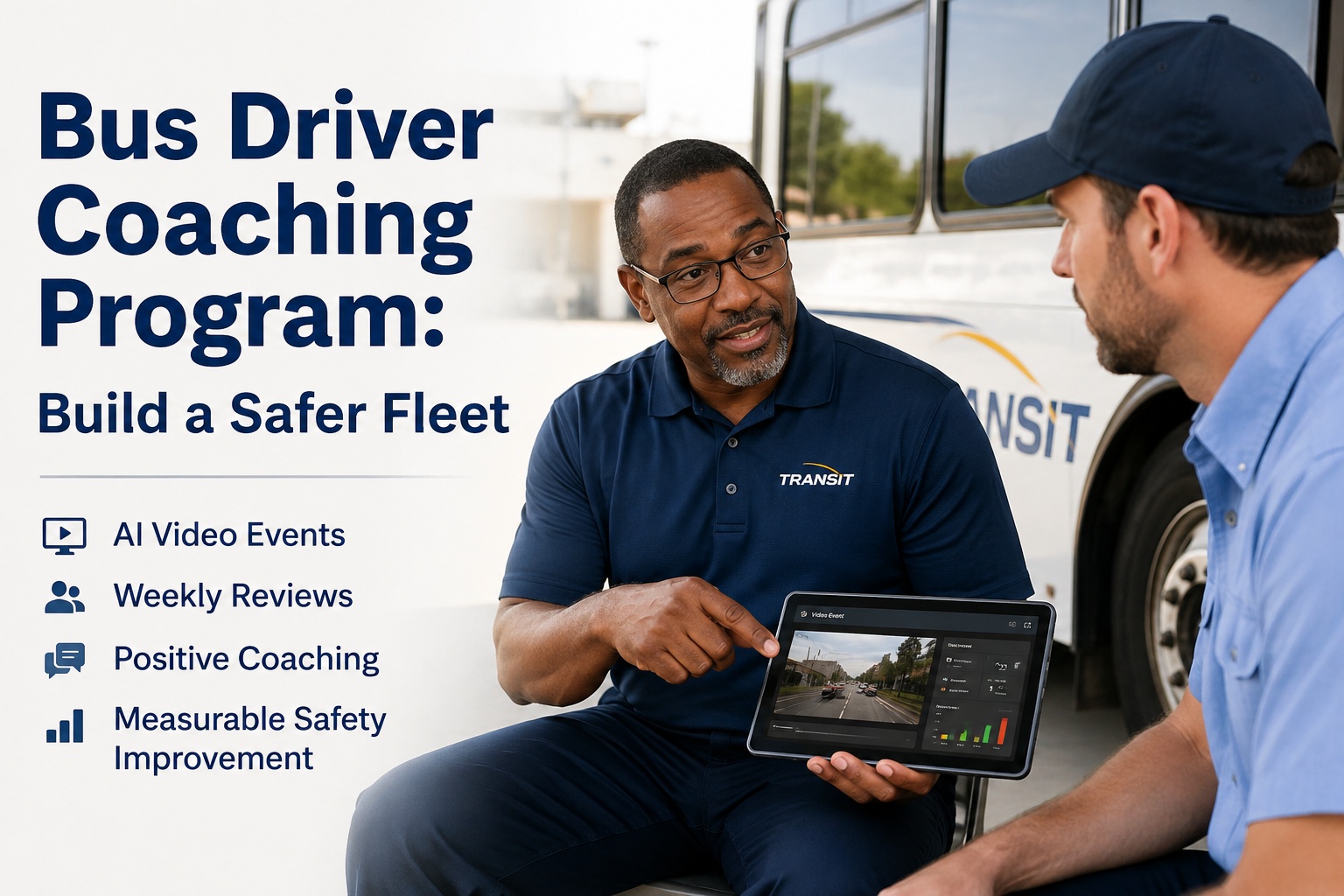
Bus Driver Coaching Program: Build a Safer Fleet
Turn AI video events into documented coaching and measurable behavior change, without drowning your supervisors in alerts or turning the camera into a surveillance archive.
- 2,400Raw AI events flagged
- 180Survive severity & confidence filter
- 30Confirmed by human review
- 9Become coaching conversations
What a Bus Driver Coaching Program Actually Is
Four things get muddled together the moment cameras go on a bus, and treating them as one is why so many programs collapse. Coaching is not training, it is not discipline, and it is not a scorecard. It is the loop between them.
Training
Builds the skill up front and at intervals: CDL prep, defensive driving, refreshers. Scheduled, not event-driven.
Discipline
A separate HR process with its own evidence standard. Coaching is not a disciplinary step, and mixing them kills trust.
Scorecard
Tells you who is drifting and on which behavior. It is the input that decides who gets coached this week.
Coaching
A short clip-based conversation that confirms the event, agrees the safer behavior, documents it and sets a re-measure date. This is what you build.
Here is the rule that governs everything below: AI video supports the coaching process, it does not replace human judgment. The camera flags a candidate. A person confirms it, has the conversation, and owns the outcome. A program that lets an unreviewed AI label drive a coaching action has already lost the drivers. Book a demo to see AI events routed into a human review step, not straight to the driver.
Which Events Should Trigger Coaching
Not every flagged event deserves a conversation. Severity and context decide, not raw counts. A bus scorecard has to carry events a trucking system has never heard of, and those bus-specific ones carry your real exposure. Sort them into what always coaches, what coaches on a pattern, and what mostly stays in the driver's own in-cab alert.
- Collision or near-collision
- Pedestrian in the danger zone
- Stop-arm run-by, student crossing
- Door on a boarding passenger
- Phone in hand
- Following distance
- Signal violation
- School-zone speeding
- Unsafe turn
- Lane departure
- Yard backing, no spotter
- Single harsh brake
- Harsh acceleration
- Harsh cornering
- Minor speed exceedance
The right column is where most fleets go wrong. One harsh brake at a downtown light is not a coaching event, it is a Tuesday. It belongs in the driver's own in-cab alert so they self-correct in the moment, and it only escalates to a conversation when it becomes a repeating pattern. Send every harsh brake to a supervisor and the queue turns to noise inside two weeks. Book a demo to see which events auto-route to coaching and which stay in the driver's in-cab alert.
How AI Video Detection Fits, and Where It Stops
AI video earns its place by doing the triage a human cannot do at volume: watching every mile, attaching the clip, and cutting the pile of 2,400 events down to the 180 worth a second look. What it cannot do is decide. Every consequential step still runs through a person.
- AI HANDLES
- Flags candidate events across every mile
- Attaches the video clip and metadata
- Assigns a provisional type and severity
- Ranks by confidence so review starts at the top
- A PERSON OWNS
- Confirms, reclassifies or dismisses the event
- Judges route context the model cannot see
- Runs the coaching conversation
- Decides any escalation
Configurable rules and false-positive handling are what keep the funnel trustworthy. A confidence threshold tuned for an express run will fire constantly downtown; if you cannot tune it per route class, supervisors learn to ignore the whole queue. And a shadow flagged as a pedestrian gets logged as a false positive, not waved away, because that log is how the model gets better. Book a demo to see confidence thresholds and false-positive logging tuned per route class.
A Weekly Coaching Cadence You Can Actually Staff
The reason most video-based programs stall has nothing to do with the technology. It is that nobody owns the review, the alerts pile up in a dashboard, and within a few weeks the queue is treated as noise. A fixed weekly rhythm with a named reviewer fixes that. Here is a cadence sized for one supervisor over a 40-bus depot.
- MON
Review & triage
Work the filtered queue, confirm or dismiss, tag by severity and recurrence.
45 min - TUE–THU
Coaching sessions
Short one-to-ones on the confirmed events. Three to four drivers a day, not a backlog.
15 min each - FRI
Trend check
Scan repeat-event rate and route hotspots. Flag anyone due a 30-day re-measure.
30 min - MONTHLY
Fleet report
Roll individual results into a fleet-level safety picture for the committee.
1 hr
The number that matters here is time from event to coaching. A clip reviewed on Monday and coached by Thursday still lives in the driver's memory. The same clip coached three weeks later is a paperwork exercise, the intersection is forgotten, and the conversation feels like an ambush. Book a demo to see the review queue and coaching cadence set up for your depot. Sign up free and start logging coaching against real event records this week.
The Four-Minute Coaching Conversation
A good coaching session is short, clip-based and collaborative. Show the event, ask before you tell, agree the safer behavior, and write it down. The driver should leave knowing exactly what to do differently and when you will look again.
- 1
Show the clip
Watch it together. The footage is the fact, so nobody argues about whether it happened.
- 2
Ask for context
"What was happening here?" A cut-off, a jaywalker, a glare. The why matters as much as the event.
- 3
Name the risk
One specific behavior, not a lecture. "Following distance into signalized stops," not "drive safer."
- 4
Agree the fix
A concrete change the driver states back in their own words. Agreement, not instruction.
- 5
Document & date it
What was shown, what was agreed, and the 30-day re-measure. Blank here means the loop never closed.
Lead with the good where you can. If the driver handled a hard merge well earlier that week, show that clip first. A program that only ever surfaces the bad footage trains drivers to dread the conversation, and dread does not change behavior. Book a demo to see a coaching session logged from clip to signed follow-up.
Worked Example: One Driver, 30 Days, a Real Improvement
This is what the funnel and the cadence produce on one operator. Driver M-22 runs a downtown loop and showed up in Monday's queue three weeks running. Here is what the supervisor actually did, and what happened next.
- WEEK 19 following-distance events
- COACHED15-min session: clip shown, agreed to hang back 2 seconds into signalized stops, re-measure set
- WEEK 25 events
- WEEK 33 events
- WEEK 42 events · recognized in the safety brief
Notice what was not done. The supervisor did not coach all nine events, did not mention the two harsh brakes that also flagged that week, and did not wait for a monthly review. One behavior, coached fast, measured at 30 days. That is the entire program in one driver. Book a demo to see event-rate trends tracked per driver automatically.
Measure Behavior Change, Not Event Volume
Raw event counts tell you almost nothing. A busy urban route will always show more events than a quiet suburban one, and a fleet that only counts events ends up coaching its hardest routes for being hard. These are the KPIs that actually show whether coaching is working.
- Repeat-event rateSame driver, same behavior, after coaching. The single best signal that a session landed.
- Events per 100 hoursNormalized by exposure so dense and light routes compare fairly. Better for buses than per-mile.
- Time to coachingEvent to conversation in days. Under a week or the clip is already stale.
- Coaching completionShare of assigned sessions actually done. A queue that never closes is not a program.
- Time to improvementHow long the behavior takes to drop after coaching. Tells you which fixes stick.
- Sustained-improvement rateDrivers holding the gain past 90 days. This is the number for the board.
Normalize by exposure before you compare anyone. A driver on a dense downtown loop faces more pedestrians, boardings and signalized stops per hour than one on a suburban express, and comparing their raw counts side by side is both unfair and useless. Events per 100 operating hours, grouped by route class, is the honest comparison. Book a demo to see repeat-event rate and time-to-coaching tracked for you.
Fairness, Recognition and Driver Acceptance
You will hear the surveillance objection in week one, and it is fair. Monitoring introduced as surveillance produces defensive drivers who learn where the camera's blind spots are. Coaching introduced as support produces drivers who ask to see their own clips. The difference is entirely in how you set it up.
- Publish the rules. Which events coach, how they are reviewed, what happens next. No black box.
- Give drivers their own login. Their clips, their trend, a dispute button, from day one.
- Weigh route context. Density, school zones and traffic change event frequency before skill does.
- Recognize the good. Surface improvement and safe-driving streaks, not only the bad footage.
Recognition is not a nicety, it is half the mechanism. A driver who gets pulled aside only when something goes wrong hears the program as a threat. One who also gets a note when their event rate drops for three straight weeks hears it as coaching. Same data, opposite reception. Book a demo to see driver-facing scorecards and improvement recognition.
Where Coaching Fits Your SMS and PTASP
If you take Urbanized Area Formula funding under 49 U.S.C. 5307, you already maintain an Agency Safety Plan documenting Safety Management System processes under 49 CFR Part 673, and you already set annual safety performance targets on the National Public Transportation Safety Plan measures. Coaching is not a separate compliance burden; it feeds the SMS you already run.
Turn Camera Footage Into a Safer Fleet
A spreadsheet coaching log works fine at small scale: one route type, a supervisor who reviews clips personally, a handful of drivers. The switch point is not fleet size, it is when the clip lives in the vendor's camera portal, the coaching note in a spreadsheet, and the bus's maintenance history somewhere else entirely, so nothing connects.
A driver braking hard again and again. Schedule coaching.
Brake wear on that one bus trending past spec. Schedule an inspection.
That is the BusCMMS difference. In BusCMMS, a camera event lands on the same chronological record as the bus's inspections, defects, repairs, parts and fuel history, tied to the driver's own profile alongside CDL and coaching history. So a following-distance pattern that is really a failing brake system is visible, not two disconnected problems you solve halfway. Book a demo to see a camera event open a work order and a coaching note at once. BusCMMS reports customer results averaging around $2,800 in savings per bus annually alongside 95+% fleet availability, figures published from its own customers rather than independent audit.
A bus driver coaching program works when the funnel is real, the queue has an owner, the conversation is short and documented, and every session ends with a re-measure date. Start with a filtered weekly queue, coach one behavior fast, and track repeat-event rate rather than raw counts. That is the difference between a fleet with a coaching program and a fleet with a very large video archive. Sign up free and turn your next week of events into documented coaching, or book a demo to see coaching and scoring work together so you know who to coach first.
What is a bus driver coaching program?
A bus driver coaching program is a structured workflow that turns safety events into short, documented conversations that change driving behavior. An effective program reviews meaningful events, validates each one, discusses it with the driver using video, records the coaching action and measures whether the behavior improves over time. AI video supports the process by flagging and prioritizing events, but human judgment confirms the event and runs the conversation. It is distinct from training, which builds skills up front, and from discipline, which is a separate HR process.
How do you coach bus drivers using video?
Watch the clip together, ask the driver for context before you tell them anything, name one specific risk, agree a concrete safer behavior in their own words, then document what was shown and agreed with a follow-up date. The whole session takes about four minutes. Leading with a positive clip when possible keeps the conversation collaborative rather than adversarial. The footage removes the argument over whether the event happened, so the conversation can focus on why and what to do next time.
How often should bus drivers receive safety coaching?
Coaching should be event-driven, not calendar-driven, and delivered fast. A practical cadence is a weekly review of the filtered event queue, coaching sessions within the same week for confirmed events, and a 30-day re-measure of the coached behavior. The key metric is time from event to coaching: under a week keeps the event fresh in the driver's memory. Do not coach every event, and do not batch coaching into a monthly session, which drains the clip of all relevance.
What driving events should trigger coaching?
Severity and context decide, not raw counts. High-severity events always coach: collisions and near-collisions, danger-zone and stop-arm events, door events with a boarding passenger, and phone-in-hand. Moderate events coach on a pattern: following distance, signal violations, school-zone speeding, unsafe turns and yard backing. Low-severity high-frequency events like a single harsh brake mostly belong in the driver's in-cab alert for self-correction, escalating only when they repeat.
How do you measure whether driver coaching works?
Track behavior change, not event volume. The best single signal is repeat-event rate: the same driver triggering the same behavior after coaching. Support it with events per 100 operating hours normalized by route class, time from event to coaching, coaching completion rate, time to improvement, and the share of drivers holding the gain past 90 days. Raw event counts are misleading because busy urban routes always produce more events than quiet suburban ones, regardless of driver skill.