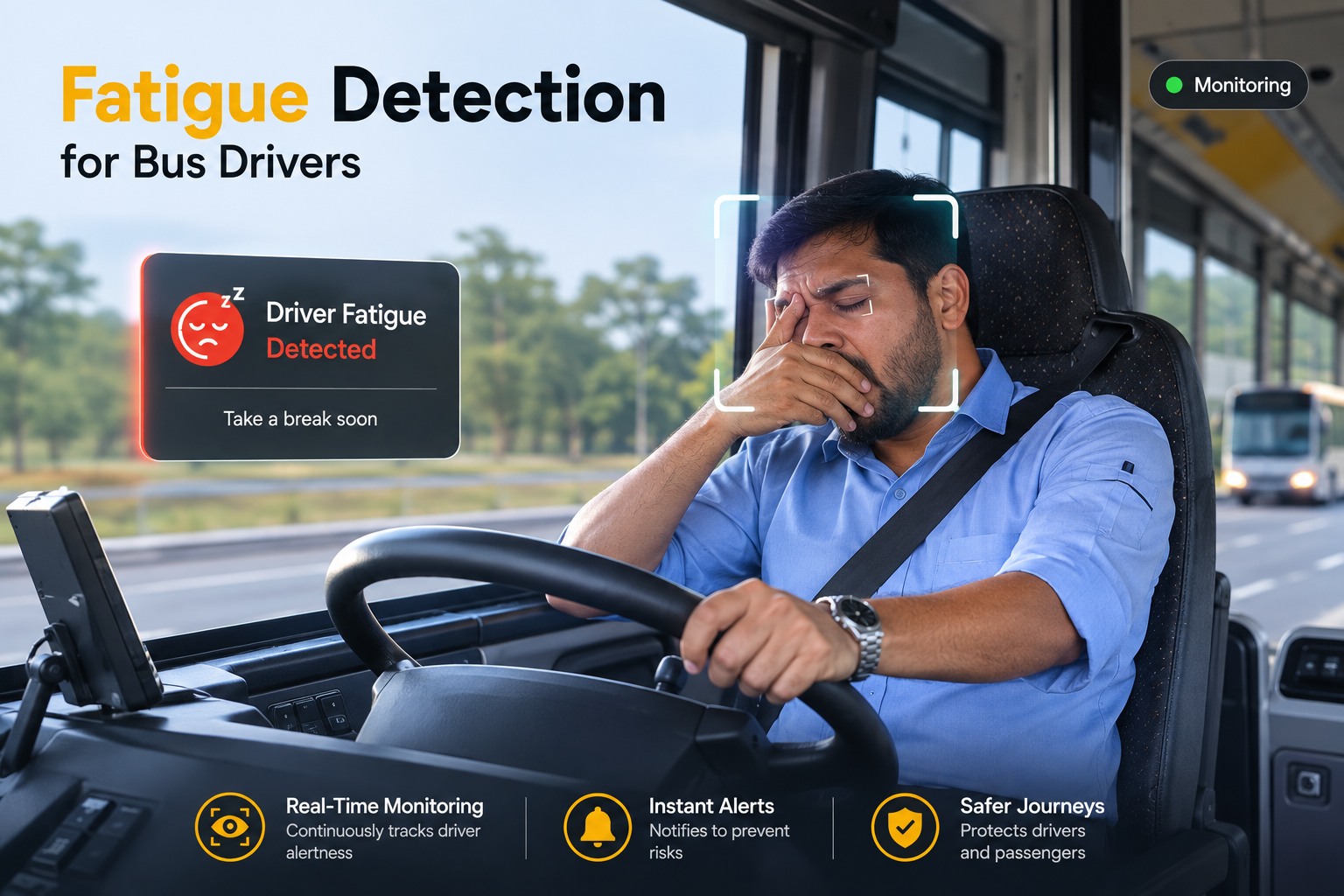
School bus driving isn't one continuous shift — it's a morning route, hours of downtime, then an afternoon route, and that split pattern creates a fatigue signature most fleet safety systems were never built to catch. Driver fatigue detection uses onboard AI to watch for microsleep and prolonged eye closure in real time, flagging the moment attention actually lapses rather than waiting for a hard braking event to reveal it after the fact. See how a fatigue event becomes a tracked work order in BusCMMS.
Fatigue Detection for Bus Drivers
The split-shift fatigue pattern unique to school transport, how microsleep detection actually works, and what needs to happen the moment a fatigue event fires mid-route.
route
gap
route
late trip
The Split-Shift Pattern Unique to School Transport
A trucking hours-of-service model doesn't map onto this schedule.
Most fatigue-management frameworks are built around continuous duty periods — drive, rest, drive again — the kind of schedule a long-haul trucking operation runs. School bus driving typically splits into a morning route, a multi-hour gap, and an afternoon route, sometimes followed by an activity or athletic trip that runs well into the evening. That midday gap isn't guaranteed rest; for many drivers it's a second job, childcare, or simply broken, non-restorative time off. Fatigue can build across that split structure in ways a continuous-shift model was never designed to predict, which is exactly why in-cab detection matters more for this workforce than a schedule-based assumption alone.
How Microsleep and Eye-Closure Detection Actually Works
Catching the lapse itself, not just its downstream consequences.
In-cab AI systems track eye closure duration and blink patterns in real time, distinguishing a normal blink from a prolonged closure that signals a microsleep episode — a brief, often unnoticed lapse in consciousness that can last just a second or two but is long enough to be dangerous at any speed. Detection needs to fire in the moment the eyes close too long, not rely on downstream signals like lane drift or harsh braking that only show up after the lapse has already happened. That immediacy is what separates genuine fatigue detection from a system that's really just inferring fatigue from its consequences.
What to Do With a Fatigue Event Mid-Route
The response has to happen in minutes, not at the end of the day.
A genuine fatigue event mid-route needs an immediate, defined response, not a note for later review. That typically means an in-cab alert loud and immediate enough to interrupt the lapse, paired with a real-time notification to dispatch so a supervisor knows it happened while the bus is still on the road. For a single isolated event, that alert plus a brief check-in at the next stop may be enough. For a repeated pattern within the same shift, the plan needs an actual off-ramp — a relief driver, a safe pull-over point, or ending the route early — decided in advance, not improvised in the moment.
The Objection Worth Naming: Footage Overwritten Before Review
A fatigue pattern found too late can't be reviewed with the driver.
Here's the failure that quietly undermines a fatigue program's usefulness: a supervisor hears about a concerning event a few days later, and by the time they go looking for the clip to review with the driver, the standard retention window has already overwritten it. This isn't a detection failure — the alert may have fired correctly — it's a retention policy gap. Flagged fatigue events need an automatic retention hold that pulls the clip out of the normal overwrite cycle immediately, so a delayed conversation with the driver still has something concrete to point to.
A Scenario From a Real Bus Operation
A repeated afternoon pattern traced back to a second job.
A school district running 80 buses saw one driver flagged three times within a single month, always on the afternoon route, never on the morning one. Retained clips showed genuine eye-closure events, not false triggers from glare or sunglasses. A direct, non-disciplinary conversation revealed the driver had picked up a second job during the midday gap that was cutting into actual rest. The district adjusted that driver's route assignment to avoid the longest afternoon run and connected them with an EAP resource; no further fatigue events were logged for that driver over the remainder of the semester.
Our first assumption was that the driver just wasn't taking the job seriously. Turned out the midday gap we thought was rest time was actually a second job. Once we knew that, it wasn't a discipline conversation anymore, it was a scheduling and support conversation. That's the difference having the actual footage made.
Not sure if your fatigue event footage is being retained long enough to actually act on? That's worth checking. Talk to the team about a retention review →
One Platform, Not Two Portals
The wedge BusCMMS solves that a standalone camera vendor can't.
BusCMMS is an AI-native bus fleet operations platform where camera data isn't a separate system bolted onto maintenance. A fatigue event doesn't sit in a vendor's camera dashboard waiting to be noticed — it attaches to that bus's asset record alongside its DVIR history and can generate a work order or driver coaching record automatically, all in one place instead of two vendors' portals.
Frequently Asked Questions
Why is fatigue different for school bus drivers than long-haul truckers?
School bus driving typically splits into a morning route, a multi-hour midday gap, and an afternoon route, rather than one continuous duty period. That midday gap isn't guaranteed rest — it can involve a second job or family obligations — creating a fatigue pattern that standard continuous-shift hours-of-service models don't capture well.
How does AI actually detect driver fatigue in real time?
In-cab systems track eye closure duration and blink patterns, flagging a prolonged closure that signals a microsleep episode as it happens, rather than inferring fatigue afterward from downstream signals like lane drift or harsh braking.
What should happen immediately after a fatigue event fires mid-route?
A defined escalation policy should trigger an immediate in-cab alert and a real-time notification to dispatch. A single isolated event may only need a brief check-in, while a repeated pattern in the same shift should trigger a pre-planned response like a relief driver or safe pull-over.
Do federal hours-of-service rules apply to school bus drivers?
49 CFR Part 395 governs hours of service and includes electronic logging device provisions under Subpart B, but school bus operations carry specific exceptions under that same part, so applicability differs from long-haul trucking rules.
Why does fatigue event footage sometimes go missing when a supervisor reviews it?
A concerning event may not get reviewed for several days, by which point the standard retention window has already overwritten the clip. Flagged fatigue events need an automatic retention hold to pull that clip out of the normal overwrite cycle right away.