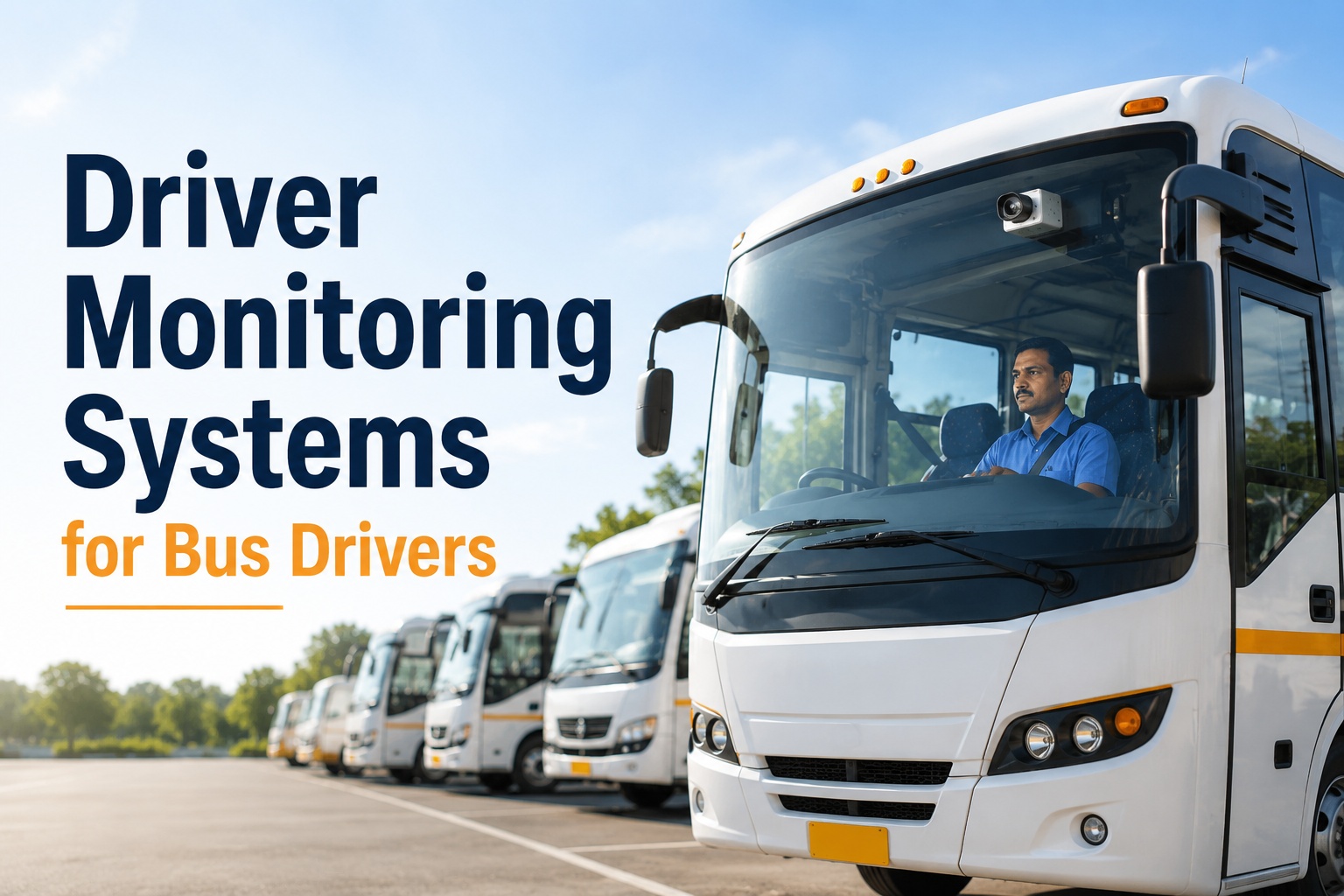
You've got a driver who's been solid for six years, but lately she is pulling into the yard fifteen minutes late on the same route, and you've heard from two other drivers she's been rubbing her eyes at the morning muster. Nobody's filed anything. Nothing's happened — yet. A bus driver monitoring system exists for exactly this gap: catching fatigue, distraction, or a seatbelt slip before it becomes an incident report, not after. The short answer on what it actually does — detects fatigue, distraction, phone use, and seatbelt compliance in real time, alerts the driver in-cab first, and only escalates to your office if the pattern repeats.
What a bus driver monitoring system is actually built to catch
"Driver monitoring" gets thrown around loosely enough that it's worth being specific. A real DMS on a school bus or transit vehicle is watching for four things: fatigue (eyelid closure duration, head nodding patterns), distraction (phone use, extended eyes-off-road time), seatbelt compliance, and — depending on the unit — smoking or unauthorized behavior in the cab. It's not a general surveillance tool. It's a narrow set of behaviors tied to a specific safety outcome, scored against a threshold, not just recorded on a loop.
This matters more on a bus than it does on a long-haul truck, and the stakes explain why. In the 2025 NASDPTS one-day survey, 114,239 school bus drivers across 36 states and DC reported 67,258 illegal stop-arm passes in a single day — extrapolated to roughly 39.3 million a year nationally (NASDPTS, released July 2025). That's not a driver-fatigue statistic specifically, but it's the same environment: split-second decisions around children, at low speed, with almost no margin for a driver whose attention has drifted. A monitoring system's entire value is catching the moment before it becomes one of those incidents, not after. You can see how this actually runs on a live route during a BusCMMS driver monitoring demo.
In-cab alerts vs. back-office review — and why the difference decides whether drivers accept it
This is the part most vendors skip past, and it's the part that determines whether your drivers see this as a coaching tool or a surveillance tool aimed at them. There are two very different ways a monitoring event can play out:
In-cab alert, first
A soft audio or visual cue tells the driver directly — "eyes on road," a seatbelt chime. Most events end here. The driver corrects, nothing gets escalated, nobody in the office even sees it.
Pattern threshold crossed
If the same driver trips the same alert repeatedly — say, three fatigue flags in a week — the event escalates to a review queue instead of staying silent.
Back-office review, with an owner
A named supervisor — not "the system" — reviews the clip, has a coaching conversation, and logs the outcome to the driver's file.
Skip step 1 and go straight to recording everything for someone to review later, and you've built a surveillance system your drivers will resent and your union will push back on. Skip step 3 and you've built an expensive alert system that never actually changes behavior. Both halves matter, and you can walk through exactly how BusCMMS splits this on a pilot demo before committing fleet-wide.
The failure nobody talks about: no owner named for reviewing events
Here's the objection worth addressing head-on instead of glossing over: districts install a DMS, it starts generating alerts and clips, and six months later nobody can tell you who's supposed to be reviewing them. The system records everything and changes nothing. This isn't a hypothetical — it's the single most common way these rollouts quietly fail, and it usually isn't a technology problem. It's an ownership gap.
Before you turn a DMS on, name the person — by title, not "the safety team" — who owns the review queue, how often they check it, and what the escalation path looks like when a pattern shows up. If that answer is vague when you're evaluating a vendor, that's a sign the platform is built to generate data, not close the loop on it. A monitoring system tied into your maintenance and compliance platform at least makes sure the events land somewhere accountable instead of a standalone dashboard nobody's assigned to open.
Talk to the BusCMMS team about a pilot on ten buses.
See real fatigue and distraction alerts on your own routes before deciding on a full rollout.
Driver acceptance and union considerations — the conversation you can't skip
If your fleet is unionized, or even if it isn't, rolling out driver-facing cameras without a clear conversation up front is how you get a grievance filed before you get a single useful safety insight. The framing that tends to work: this system exists to catch fatigue and distraction before an incident, not to build a case against any individual driver. That's not just a talking point — it should be true in how the system is actually configured.
Concretely, that means: clips aren't reviewed unless a threshold is crossed, drivers know exactly what triggers a review, and the coaching conversation happens before any disciplinary action, not instead of one. Districts that have gone through this well typically loop driver representatives into the rollout early — showing them the actual alert thresholds, not just a sales pitch about "safety technology." A driver who understands the system is trying to catch a bad morning before it becomes a bad outcome reacts very differently than one who feels like they're being filmed for a file.
Privacy-first configuration: consent laws, FERPA, and retention policy
This is where a lot of well-intentioned rollouts get legally sloppy, and it's worth naming the actual rules rather than a general "privacy matters" statement. Onboard audio recording is governed by state wiretap and two-party consent statutes — some states require all parties in a recorded conversation to consent, which affects whether interior audio can be captured at all, and how it needs to be disclosed if it is. This varies by state, so a monitoring rollout needs to be configured per jurisdiction, not deployed with one national default.
Separately, because students are on the bus, FERPA considerations apply to how video and any identifiable student information is stored, accessed, and shared — footage isn't just a safety record, it can touch on protected education records depending on what's captured and how it's used. On top of both of those, your own district's video retention policy sets how long footage sits before it's purged, and that policy needs to be consistent with both the state consent rules and FERPA rather than set independently by whichever vendor's default settings you accepted at signup.
None of this means don't monitor — it means configure deliberately. A platform that lets you set retention windows, control who has access to driver-facing footage, and adjust for your state's consent rules is doing the privacy-first part of this correctly. One that ships with a single global default and calls it a day is setting you up for a records request you can't answer cleanly.
A scenario from a real bus operation
A transit agency running 60 buses piloted driver monitoring on ten vehicles for eight weeks. In-cab fatigue alerts fired 43 times across the pilot — most self-corrected within seconds, no escalation needed. Four drivers crossed the repeat-pattern threshold (three or more fatigue alerts in a rolling seven days), and each got a direct coaching conversation from their supervisor, not an automated write-up. Two of those four turned out to be shift-scheduling issues — drivers pulling early routes after late ones — which the agency fixed at the scheduling level, not the driver level. That's the outcome a monitoring system is actually supposed to produce: not a stack of disciplinary files, but a signal that pointed to a real operational fix.
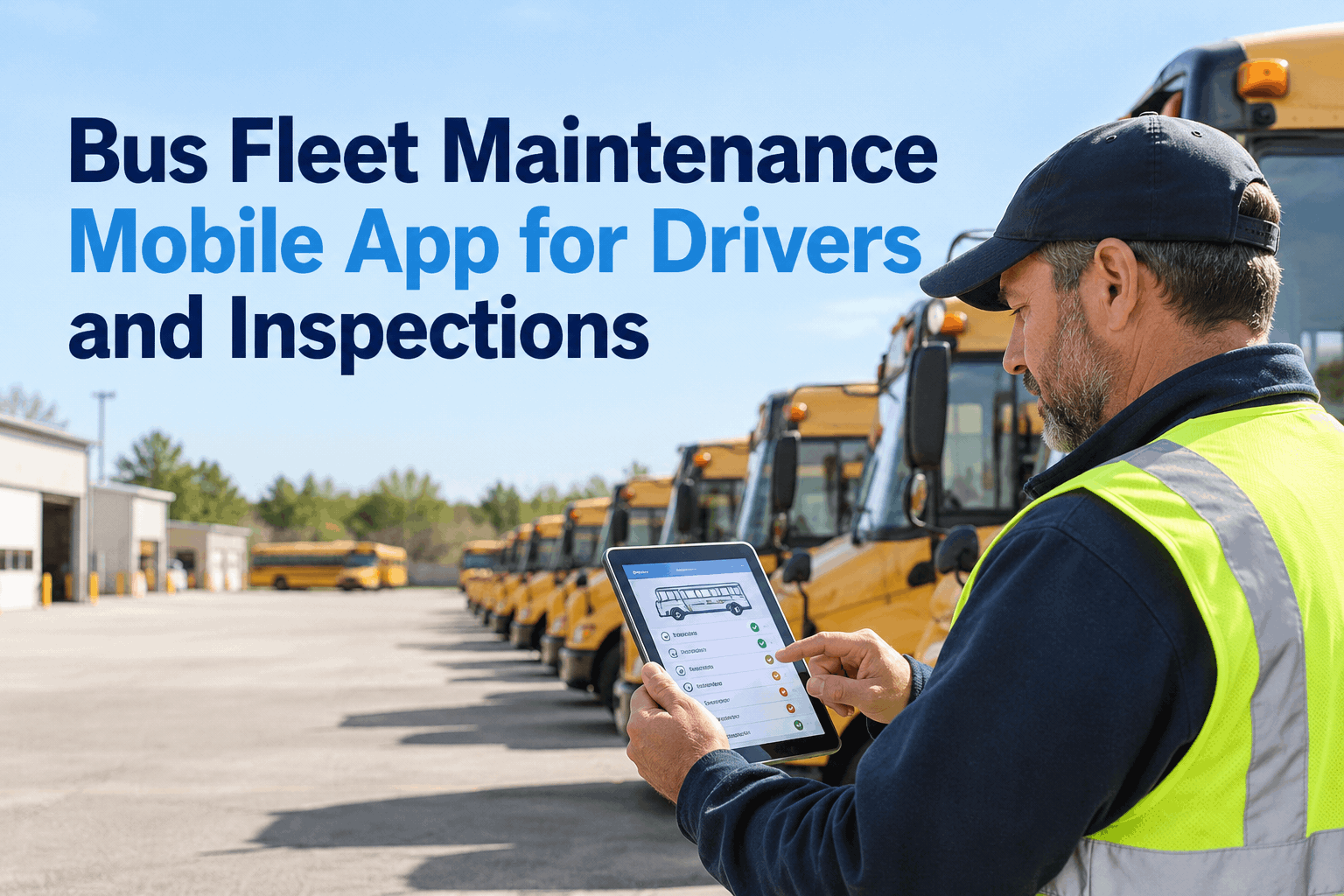
See how photo and clip capture fits into the walk-around, not bolted on after.
BusCMMS was built mobile-first — drivers and technicians capture what matters as part of the inspection itself.
The bottom line on bus driver monitoring systems
A bus driver monitoring system is worth the investment when it's built around three things: in-cab alerts that give the driver a chance to self-correct first, a named owner for reviewing escalated events so patterns actually get acted on, and configuration that respects your state's consent laws and FERPA rather than a one-size-fits-all default. Get those three right, and you've got a tool that protects both your students and your drivers — not a surveillance system that generates data nobody acts on. See how a bus-specific operations platform handles driver monitoring alongside maintenance and compliance, instead of as a bolted-on add-on.
Updated August 2026
Frequently asked questions
What does a bus driver monitoring system actually detect?
A DMS built for buses typically detects fatigue (eyelid closure duration, head-nodding patterns), distraction (phone use, extended eyes-off-road time), seatbelt compliance, and sometimes unauthorized cab behavior like smoking. It's a narrow, defined set of safety-relevant behaviors scored against a threshold — not general surveillance footage reviewed after the fact.
Is onboard audio recording legal on a school bus?
It depends on your state. State wiretap and two-party consent statutes govern onboard audio recording, and a meaningful number of states require all parties in a recorded conversation to consent — which affects whether and how interior audio can be captured and disclosed. Configuration needs to be set per state rather than deployed with a single national default.
Does FERPA apply to bus driver monitoring footage?
Because students are present on the bus, FERPA considerations can apply to how video and any identifiable student information captured in that footage is stored, accessed, and shared. Footage isn't automatically just a safety record — depending on what's captured, it can touch on protected education records, which should factor into your retention and access policy.
How does BusCMMS prevent a driver monitoring rollout from becoming pure surveillance?
The design separates in-cab alerts, which let a driver self-correct in the moment without anyone reviewing footage, from back-office review, which only triggers when a repeat pattern crosses a threshold. Every escalated event is routed to a named reviewer rather than sitting in an unowned queue, which is the most common way these systems fail to change driver behavior.
How many illegal stop-arm passes happen nationally each day?
In the 2025 NASDPTS one-day survey, 114,239 school bus drivers across 36 states and DC reported 67,258 illegal passes in a single day, extrapolated to roughly 39.3 million per year nationally (NASDPTS, released July 2025). 2026 survey results were still pending as of August 2026.