Every bus operating under a USDOT number requires a Driver Qualification File (DQF) with 10 specific documents per driver under 49 CFR §391.51 — and incomplete DQFs are the single most common critical violation in FMCSA compliance reviews. This 2026 guide covers the 10-document requirement, annual MVR review under §391.25, expiration tracking, and where fleet operations software fits when an auditor walks in and asks for a specific driver's file. See BusCMMS track DQF completeness per driver with expiration alerts → book a 20-min demo.
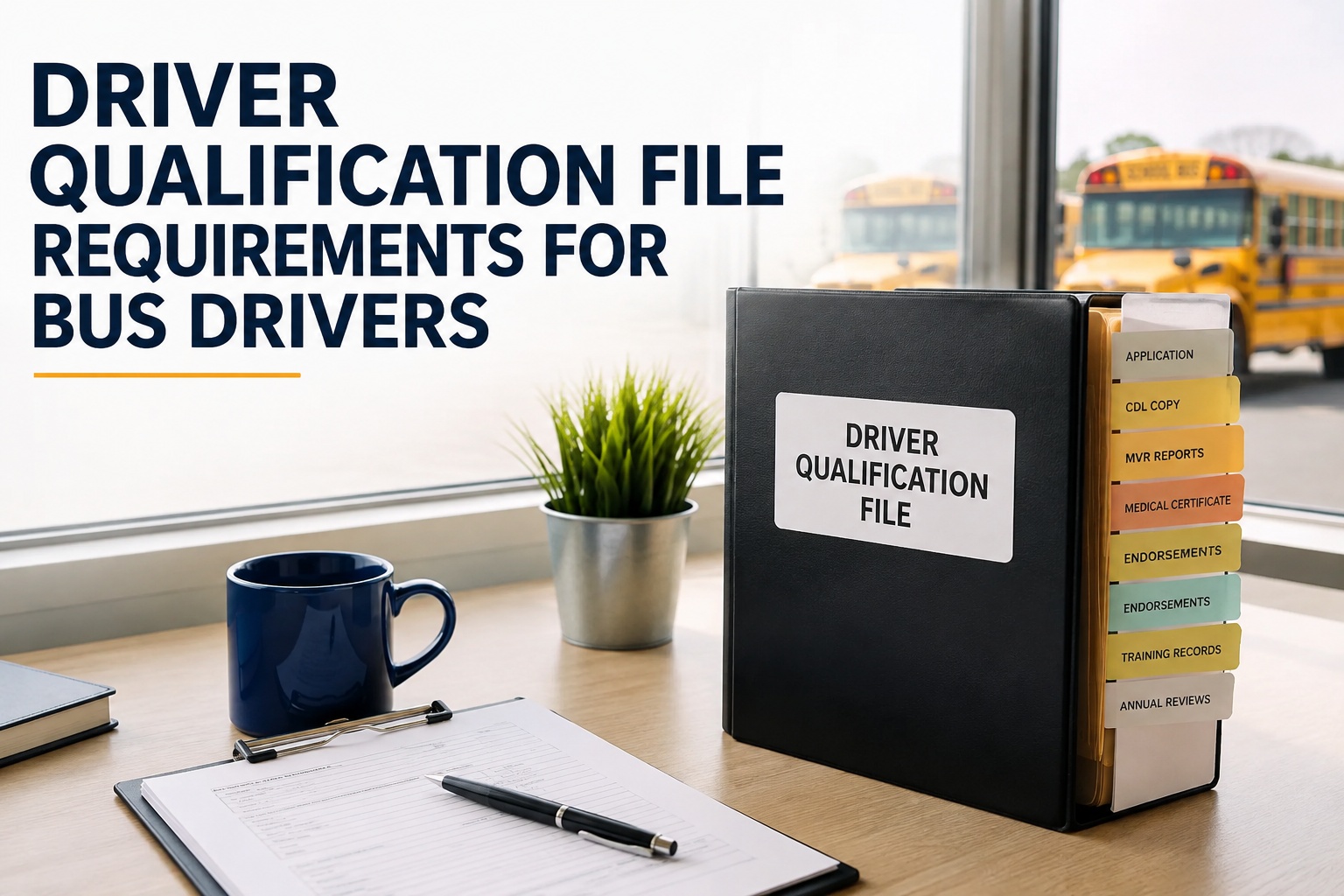
The 10-Document DQF Requirement
Every driver operating a bus under a USDOT number requires all 10 of these documents in their qualification file — per 49 CFR §391.51. Missing any one of them is a separate FMCSA violation during a compliance review. This is the complete list.
Employment application
Signed by driver; includes 3-year employment history
Inquiries to previous employers
Investigation of 3-year employment history
Inquiry to State agencies
MVR from every state driver held license in past 3 years
State MVR at application
Motor Vehicle Record obtained at time of hire
Annual MVR inquiry
Updated MVR pulled once every 12 months
Annual review note
Signed review documenting driver remains qualified
Road test certificate
Or equivalent (CDL for the vehicle class operated)
Medical examiner's certificate
Or CDLIS MVR for CDL drivers with medical cert data
Medical examiner listing verification
Note verifying examiner on National Registry
Disqualifying offenses acknowledgment
Driver acknowledgment of disqualifying offense list
Who Needs a Driver Qualification File
Every bus driver operating a commercial motor vehicle under a USDOT number falls under 49 CFR Part 391 driver qualification requirements — with important distinctions for pupil transportation.
Any driver operating a bus that meets the federal Commercial Motor Vehicle definition under a motor carrier's USDOT number must have a Driver Qualification File under 49 CFR Part 391. That includes school bus drivers where school district operations fall under FMCSA jurisdiction, transit bus drivers at agencies operating in interstate commerce, and charter and motorcoach drivers universally. State-operated school bus programs vary in how they're regulated — some states exempt intrastate school bus operations from certain federal DQF elements, others adopt equivalent state requirements that mirror §391 closely, and district policies frequently add school-bus-specific records on top of federal requirements. The three-audience decision below is what determines your baseline compliance surface.
SCHOOL DISTRICTS
Federal DQF requirement: Depends on state adoption of federal rules for intrastate pupil transportation. Interstate school bus operations (extracurricular trips crossing state lines) fall under full federal Part 391.
State layer: Nearly universal state DQF or equivalent driver qualification requirements plus school-bus-specific state training and certification.
District layer: Local policy adds background checks, physical performance tests, and continuing education records.
TRANSIT AGENCIES
Federal DQF requirement: Full Part 391 compliance for agencies operating in interstate commerce or receiving FTA funding requiring FMCSA-equivalent standards.
State layer: State DOT and public utility commission requirements typically layered on top.
Agency layer: PTASP driver qualification standards and collective bargaining agreement provisions often extend beyond federal minimums.
CHARTER / MOTORCOACH
Federal DQF requirement: Full Part 391 compliance universally. Interstate operation is the default assumption.
State layer: State passenger carrier requirements vary; some states require additional endorsements or safety training.
Operator layer: Insurance carrier requirements often mandate DQF elements beyond federal minimums.
Verify your specific requirements against primary regulatory sources — 49 CFR Part 391 for federal, your state DOT for state-specific rules, and your district or agency policy documents. Never assume another operator's DQF checklist matches yours. See BusCMMS configure DQF requirements per audience type → book a demo.
The 5 Expiration Windows That Kill DQF Compliance
Missing documents cause one type of violation. Expired credentials cause the other. These are the 5 time-sensitive windows every DQF program must track.
DQF violations come in two shapes. The first is missing documents — the file never contained the required item in the first place. The second, and more common in day-to-day operations, is expired documents — the file did contain the item, but it has since aged out and nobody caught the expiration before an audit, a dispatch event, or an accident investigation. The five windows below are the credential clocks every bus driver DQF is running against. Miss any one of them and the driver is technically unqualified even though every original document is still in the file.
Annual MVR review
Regulation: 49 CFR §391.25 — carrier must review each driver's MVR at least once every 12 months. "Annual" means within 12 months of the previous review, not by calendar year end.
Medical examiner's certificate
Regulation: 49 CFR §391.43 — maximum medical examiner's certificate validity is 24 months. Many drivers receive shorter certifications based on health conditions (12 months, 6 months, 3 months).
CDL and endorsements
Regulation: 49 CFR Part 383 — CDL and Passenger (P), School Bus (S) endorsement validity set by state, typically 4-8 years. School bus endorsement often requires periodic refresher training under state law.
State school bus certification
Regulation: State department of education or DOT rules — most states require initial school bus driver certification plus recurring refresher training. Windows vary widely by state (annual to every 3-5 years).
Disqualifying events
Regulation: 49 CFR §383.51 — certain MVR entries disqualify a CDL driver immediately: DUI, leaving the scene of an accident, felony use of a CMV, and others. Continuous MVR monitoring is increasingly adopted vs annual-only reviews.
Track all 5 windows per driver in a single system with automated alerts. Manual spreadsheet tracking is where compliance goes to die. Sign up free and set expiration alerts across all 5 windows →
The Federal + State + District Requirements Layer
DQF compliance is never just federal. School bus operations especially face 3 stacked layers of driver record requirements. Confusing them creates gaps and duplicated effort.
The most common compliance failure in a pupil transportation DQF audit is not knowing which layer a specific requirement comes from. A district that treats every state and district requirement as federal ends up with an over-engineered file that still misses actual federal elements. A district that treats state and district requirements as "nice to have" fails state audits and gets sued when a documented policy requirement was skipped. The 3-layer diagram below is how disciplined compliance officers organize their DQF thinking.
FEDERAL — 49 CFR PART 391
The 10 documents from §391.51. Annual MVR review under §391.25. Medical examiner requirements under §391.43. Disqualifying offense standards under §383.51. This layer applies universally to any bus operating under a USDOT number in interstate commerce.
STATE-SPECIFIC PUPIL TRANSPORTATION
State school bus driver certification, initial and refresher training under state department of education or state DOT rules, state-specific medical examination requirements beyond federal minimums, background check requirements (state and FBI), and state-specific disqualification standards.
DISTRICT POLICY REQUIREMENTS
Local board of education policies: additional background checks, physical performance testing, continuing education tracking, uniform requirements, ride-along observation records, parent complaint history, and any collective bargaining agreement provisions covering driver qualifications.
A DQF that tracks all 3 layers with clear source attribution passes federal audits, state audits, and district internal reviews. See BusCMMS track federal + state + district DQF layers separately per driver → book a demo.
The Audit-Ready Retrieval Workflow
An FMCSA compliance officer arrives Tuesday morning and requests DQFs for 15 randomly selected drivers. What happens in the next 4 hours determines your safety rating for the next 24 months.
The single most predictive test of DQF program health is how long it takes to produce a complete, audit-ready file for a specific driver on demand. Programs running well can produce a full DQF in under 5 minutes with all 10 documents, all 5 expiration windows current, and full audit trail. Programs running poorly take hours — and often discover mid-retrieval that a document is missing, expired, or filed on paper in a cabinet nobody has opened since the last audit. The 6-step workflow below is what disciplined districts run when an audit request arrives.
- 01MINUTE 0
Auditor requests driver list
FMCSA compliance officer, state auditor, or internal safety review requests DQFs for specific drivers. Names captured, timestamp logged, requested documents specified.
- 02MINUTE 5
System pulls all 10 documents per driver
Every document from §391.51 retrieved with document date, expiration date, and source verification. Missing documents flagged before auditor sees them.
- 03MINUTE 15
Expiration windows verified
All 5 credential clocks checked per driver: annual MVR review current, medical cert unexpired, CDL/endorsements valid, state certification current, no disqualifying events. Any red flag surfaces before auditor sees the file.
- 04MINUTE 30
Corrective action initiated for any gap
Missing document requested from original source. Expired credential flagged for immediate renewal. Corrective action logged with responsible staff and expected completion time.
- 05MINUTE 60
Audit-ready package assembled
Clean PDF export per driver with all 10 documents, current expiration window summary, and audit trail of any recent corrective actions. Delivered to auditor within stated response window.
- 06POST-AUDIT
Findings documented + program improvements logged
Auditor findings recorded. Program gaps identified become improvement action items. Full audit history preserved for future FMCSA compliance reviews and district record.
Districts that can execute this 6-step workflow in under an hour rarely face rating downgrades. Districts that cannot execute it at all discover their gaps during the audit itself. See BusCMMS produce audit-ready DQF exports per driver in under 5 minutes → book a demo.
Where BusCMMS Fits Driver Qualification Compliance
Camera systems capture events. Fleet operations software tracks maintenance. BusCMMS also tracks the driver credential and qualification records that determine whether that driver can be dispatched today.
10-Document DQF Tracker
Every driver record shows all 10 required documents from §391.51 with completion status, document date, source verification, and any known gaps.
5-Window Expiration Monitoring
MVR review 12-month clock, medical cert 24-month clock, CDL/endorsement renewal windows, state certification cycles, and disqualifying event monitoring all tracked per driver.
Federal / State / District Tagging
Every record tagged by requirement source so federal audit prep, state audit prep, and district internal review can each pull the correct filtered view.
Qualification Status Before Dispatch
Driver dispatch dashboard shows current qualification status per driver. Expired credentials or missing documents prevent dispatch until resolved.
One-Click Audit-Ready DQF Export
Full driver qualification file assembled and exported as a clean PDF package with all 10 documents, expiration summary, and audit trail. Ready for FMCSA compliance officer within minutes.
Complete Credential History
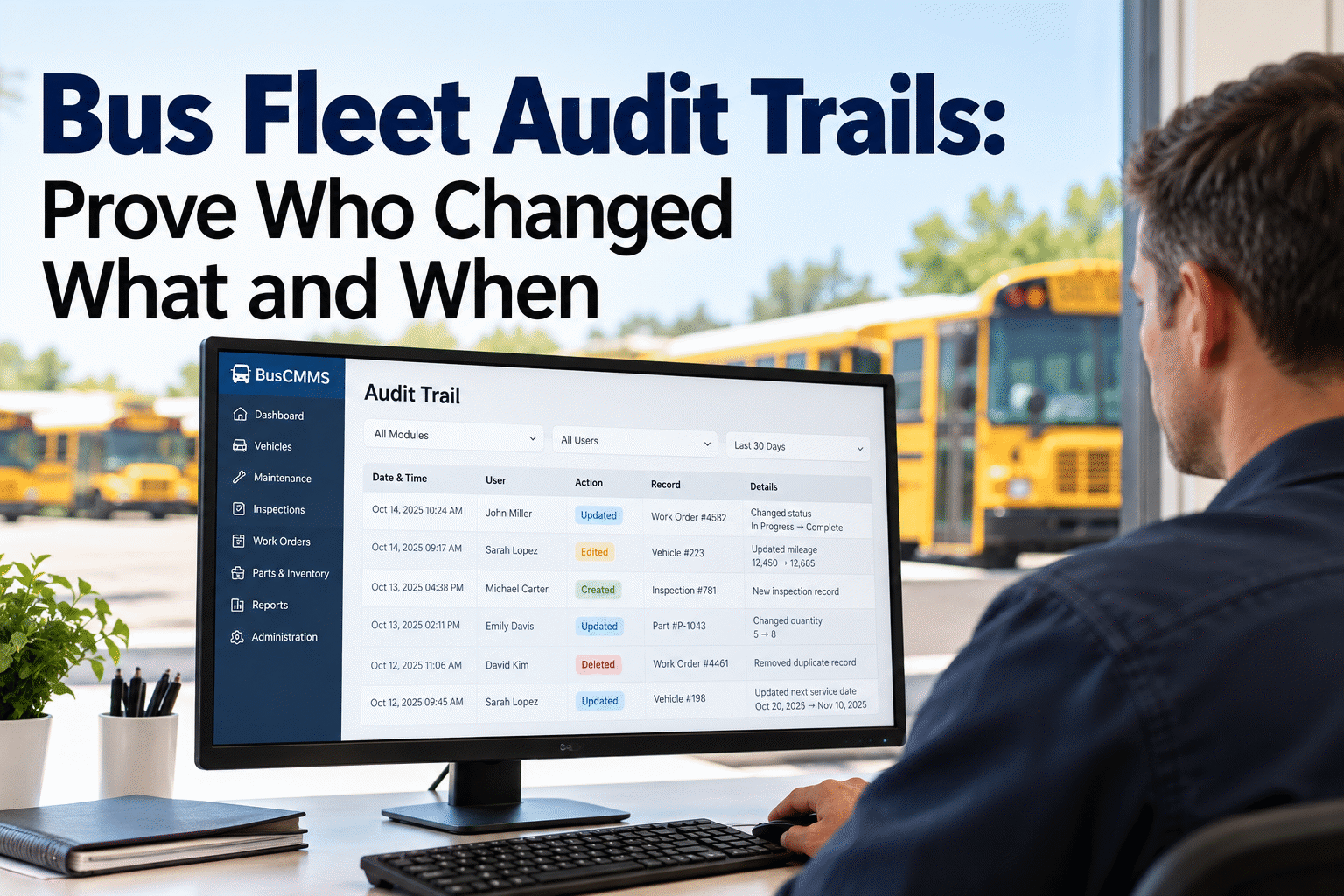
Every credential renewal, MVR review, medical cert update, and corrective action preserved with timestamp and responsible staff. Chain of custody survives staff turnover.
We are a 112-driver school district transportation operation running a mix of interstate extracurricular routes and intrastate daily pupil transportation. Before BusCMMS: our DQF program lived in a combination of paper files in the transportation office, a shared spreadsheet nobody trusted, and individual driver folders on the HR shared drive. An FMCSA compliance review in early 2024 identified 23 DQF completeness gaps across 18 drivers — missing annual MVR reviews, expired medical certs that nobody had flagged, and state school bus certifications that had lapsed 8 months earlier. Our safety rating dropped to Conditional. Working our way back took 14 months. We put BusCMMS underneath the whole driver qualification program in September 2024. Every driver now has a complete 10-document DQF tracker with all 5 expiration windows monitored, federal + state + district layer tagging, and one-click audit-ready export. Our follow-up FMCSA review in June 2026 identified zero DQF violations across 40 sampled driver files. Rating restored to Satisfactory. Same drivers, same regulations, different operational system.
Related driver compliance pillars: CDL P & S endorsements, full compliance hub, and BusCMMS fleet operations overview.
Frequently Asked Questions
What is a driver qualification file?
A Driver Qualification File (DQF) is the federally-required set of records under 49 CFR §391.51 that every motor carrier must maintain for each driver operating a commercial motor vehicle under its USDOT number. The DQF documents that the driver meets all federal qualification standards under Part 391: completed employment application, verified prior employment history, motor vehicle record from every state the driver held a license in during the past 3 years, current annual MVR review, valid medical examiner's certificate (or CDLIS MVR data for CDL drivers), completed road test or equivalent CDL, and driver acknowledgment of disqualifying offense standards under §383.51. For bus operations specifically, the DQF applies to school bus operations where the district falls under FMCSA jurisdiction, transit agencies operating in interstate commerce or under FTA funding requiring FMCSA-equivalent standards, and universally to charter and motorcoach operators. Incomplete DQFs are the single most common critical violation identified in FMCSA compliance reviews, and missing a required document across enough driver files can contribute to a safety rating downgrade from Satisfactory to Conditional. Retention window is employment period plus 3 years from termination, with drug and alcohol testing records following separate retention rules under §382.401.
What documents must be in a driver qualification file?
Ten documents are required per driver under 49 CFR §391.51: (1) the signed employment application from §391.21 with 3-year employment history; (2) inquiries to previous employers under §391.23; (3) inquiry to state agencies for motor vehicle records from every state the driver held a license in during the past 3 years; (4) the state MVR obtained at time of application; (5) the annual MVR inquiry under §391.25 pulled once every 12 months; (6) the signed annual review note under §391.25(c)(2) documenting the driver remains qualified; (7) the certificate of driver's road test from §391.31 or equivalent (typically the CDL for the vehicle class operated); (8) the medical examiner's certificate under §391.43 or the CDLIS MVR containing medical certification data for CDL drivers; (9) the note verifying medical examiner listing on the National Registry of Certified Medical Examiners under §391.23(m); and (10) driver acknowledgment of the §383.51 disqualifying offense list. State-specific pupil transportation requirements and district policy add records on top of these 10 federal documents.
Do school bus drivers need a DOT qualification file?
It depends on the specific operation. School bus drivers operating in interstate commerce — for example, extracurricular trips crossing state lines — universally require a full federal DQF under 49 CFR Part 391. For intrastate pupil transportation, requirements vary by state: some states have adopted federal Part 391 standards for all school bus operations, some have adopted equivalent state requirements that mirror federal DQF elements closely, and some maintain separate state driver qualification frameworks for intrastate school bus service. Nearly every state adds pupil-transportation-specific requirements on top of the federal DQF: state school bus driver certification, initial and periodic refresher training, additional background checks (state and FBI), and school-bus-specific medical or physical performance standards. Districts should verify their specific federal + state + local layer stack against 49 CFR Part 391, their state department of education or DOT rules, and their local board policies rather than assuming another district's DQF checklist applies. Charter and motorcoach operators serving schools face full federal Part 391 requirements regardless of route type because interstate operation is the default assumption for commercial passenger carriers.
How often must a driver's MVR be reviewed?
At least once every 12 months per 49 CFR §391.25. Important nuance: "annual" means within 12 months of the previous review, not by calendar year end. If a driver's last MVR review was completed March 15, 2026, the next one must be completed by March 14, 2027 — not by December 31, 2026. Missing this deadline for any driver is a separate violation counted per-driver during FMCSA compliance review. The annual review requires the carrier to pull an updated MVR from the state DMV or through an authorized MVR provider (for drivers licensed in multiple states during the review period, an MVR must be pulled from each state), review the record covering at least the preceding 12 months while giving "great weight" to serious offenses like reckless driving or DUIs, have a designated carrier official sign the review confirming the MVR was examined and the driver remains qualified, and place both the MVR and signed review in the driver's DQF within the 12-month window. Some carriers now use continuous MVR monitoring services alongside or in place of annual-only reviews to detect disqualifying events between annual review dates — particularly valuable for catching convictions in the 51 weeks between annual reviews that would otherwise sit undocumented.
How should a school district organize driver qualification records?
Through a single digital system that tracks all 10 required documents per driver, monitors all 5 credential expiration windows automatically, tags requirements by source layer (federal / state / district), and produces audit-ready export on demand. Paper files, shared spreadsheets, and disconnected HR databases are where DQF compliance goes to die: documents get filed inconsistently, expiration dates go untracked between annual audits, and audit-response time stretches from minutes to days. The 6-step audit-ready retrieval workflow is what disciplined districts execute when an FMCSA compliance officer arrives: driver list requested (minute 0), all 10 documents pulled per driver (minute 5), all 5 expiration windows verified (minute 15), corrective action initiated for any gap (minute 30), audit-ready package assembled (minute 60), and post-audit findings documented (ongoing). BusCMMS provides this exact operational layer: 10-document DQF tracker per driver, 5-window expiration monitoring with automated alerts, federal/state/district layer tagging, driver qualification status shown before dispatch, one-click audit-ready DQF export, and complete credential history preserved across staff turnover. One 112-driver Great Lakes district reported restoring their FMCSA safety rating from Conditional back to Satisfactory after implementing this system — from 23 DQF violations across 18 drivers to zero DQF violations across 40 sampled files at follow-up review.