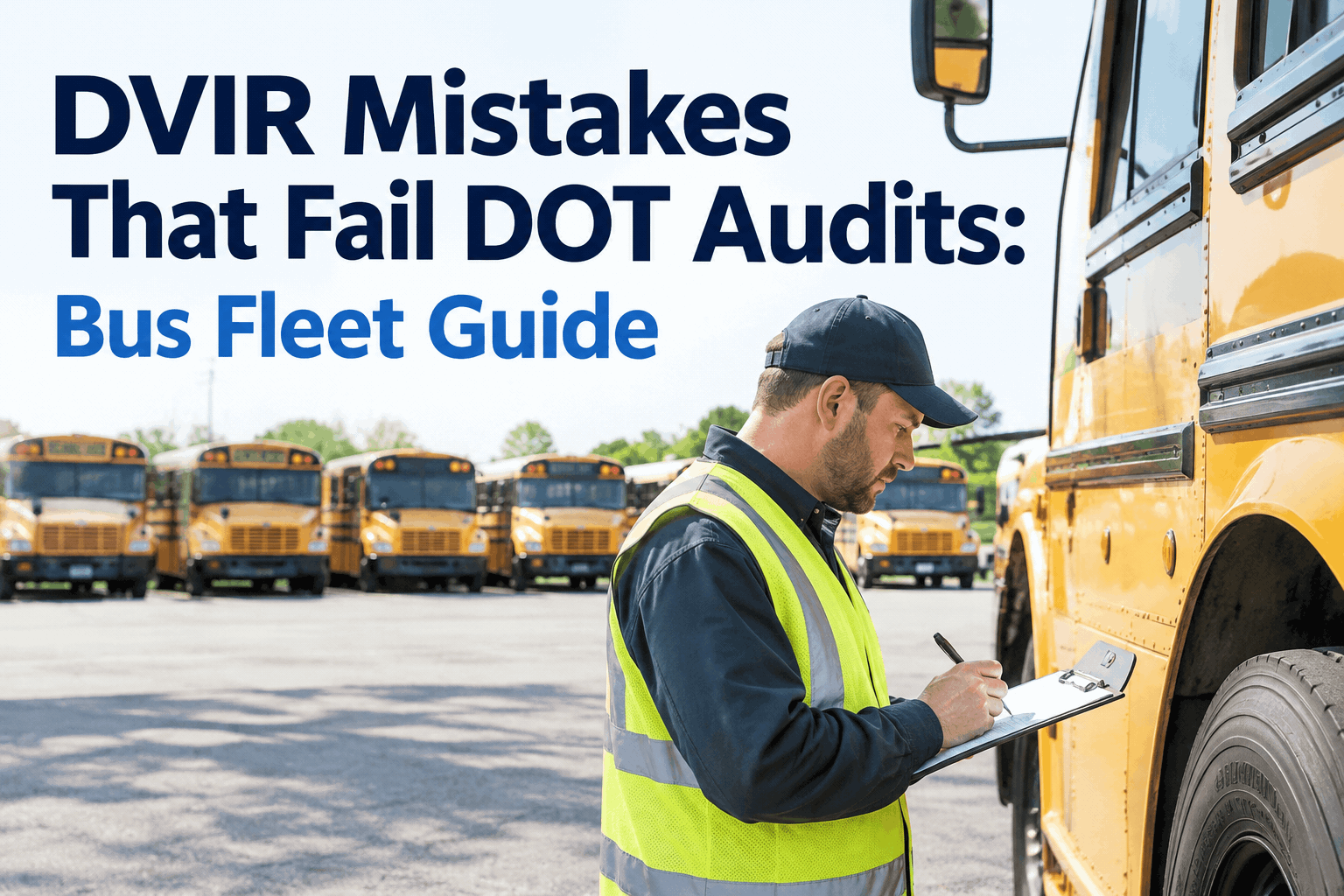
The DVIR binder looks fine until an auditor starts flipping pages — and then the gaps show. A defect logged with no repair signed. Two weeks of “no defects” on a bus you know had a bad marker lamp. These DVIR mistakes are what fail DOT audits for bus fleets, and almost all of them are paperwork, not wrenches — you can see how the right system closes these gaps in a quick demo.
DVIR Mistakes That Fail DOT Audits in Bus Fleets
An auditor does not watch your buses run — they read your records. These are the DVIR mistakes that turn a clean fleet into an audit finding and the fix for each one.
Why DVIR Mistakes Fail DOT Audits So Often
A driver vehicle inspection report is not one signature — it is a chain. Under 49 CFR 396.11, the driver reports a defect, the carrier certifies it was repaired or that no repair was needed, and the next driver reviews and signs before the bus goes back on a route. Break any link and the record is incomplete and an incomplete record is exactly what an auditor writes up. The bus can be mechanically perfect; the paperwork is what passes or fails.
For a bus fleet the stakes are higher still: your DVIRs have to cover items a generic truck form never asks about — emergency exits, the stop arm, the wheelchair lift, student mirrors. Miss those lines and you are non-compliant before the signatures even come up. You can see a bus-specific DVIR that includes all of them in a short demo.
The 5 DVIR Mistakes That Fail DOT Audits
Every one of these is common, and every one is avoidable. Here is the mistake, why an auditor flags it, and the fix that closes it for good.
Defect logged, repair never certified
Most common audit findingA driver writes up a bad brake, the bus keeps running, and no one ever signs that it was fixed. An open defect with no correction is the finding auditors reach for first.
Every reported defect auto-creates a work order that can't be closed without a repair certification attached.
Blanket “no defects” every single day
Triggers deeper reviewAn aging bus with 200,000 miles and a spotless DVIR every day reads as rushed or falsified pre-trips — and auditors cross-check it against repair invoices.
Timestamped digital entries per item make a real inspection visible, and defects flow straight into the maintenance record.
Missing a signature in the chain
Each one a separate violationDriver signed, repair certified — but the next driver never reviewed and signed. Each missing signature in the 396.11 chain is a separate citable violation.
The workflow won't let a flagged bus dispatch until all three sign-offs are recorded against it.
Bus-specific items left off the form
Non-compliant by designA generic truck DVIR never asks about the stop arm, crossing gate, emergency exits, or wheelchair lift — so the items that matter most on a bus go unchecked and undocumented.
Pre-loaded bus DVIRs include every bus item from day one — nothing to configure, nothing to forget.
Records lost, scattered, or past retention
Counts as missingThe report is in one binder, the repair cert in another, and some are already past 90 days. If you can't produce all three together on 48 hours' notice, it counts as missing.
All three documents stored together per bus and retained automatically, pulled in seconds by date or unit.
Every one of these fails for the same reason — a person was supposed to remember a step. Put the system in charge of remembering and all five simply stop happening.
See It Close These Gaps Live →Your Pre-Audit DVIR Checklist
Run this against your own DVIR records before an auditor does. Any line you can't check cleanly is a finding waiting to happen — and your fix list for the week.
-
Every reported defect has a matching repair certificationNo open defect sitting without a documented correction.CRITICAL
-
All three signatures present on defect reportsDriver, repair certification, next-driver review — the full chain.CRITICAL
-
Bus-specific items are on the formStop arm, crossing gate, emergency exits, wheelchair lift, student mirrors.CHECK
-
DVIR entries look like real inspectionsTimestamped, varied, consistent with repair history — not a daily copy-paste.CHECK
-
All three documents kept together, 3 monthsRetained per 396.11(a)(4) and retrievable by bus and date.CRITICAL
-
You can produce any record in under 48 hoursPulled on demand, not reconstructed during the review window.CHECK
The three critical lines are where audits are actually lost. You can walk this checklist against your own records with our team in a demo.
How BusCMMS Removes These DVIR Failure Modes
Every mistake above comes down to a human being expected to remember a step. BusCMMS makes the system remember instead — so DOT audit readiness is a status you can see, not a hope on review day. You can sign up free and see each of these failure modes closed off for your fleet.
Pre-loaded bus DVIRs
Every bus item — stop arms, crossing gates, emergency exits, lifts, student mirrors — on the form from day one. No generic truck template, nothing left off.
Defect-to-repair, enforced
A reported defect becomes a work order that can't close without a repair certification, and a flagged bus can't dispatch until the chain is signed.
Records retained & retrievable
DVIR, repair cert, and driver review stored together per bus and retained automatically — produced in seconds for an FMCSA or state DOT review.
That is the difference between dreading a records request and answering it the same afternoon. You can sign up free and build your first audit-ready bus DVIR today.
A Transportation Director's Take
Key Takeaways on DVIR Mistakes and DOT Audits
DVIR mistakes fail DOT audits because the record is incomplete, not because the bus is unsafe. Four things to carry out of this.
The open defect is the killer
A reported defect with no repair certification is the most common finding. Close every one.
The chain is three signatures
Driver, repair cert, next-driver review — each missing one is its own violation.
Bus items must be on the form
Stop arm, lift, exits, mirrors — a generic truck DVIR leaves them off.
If you can't produce it, it's missing
Keep all three together, 90 days, retrievable in under 48 hours.
Fix the DVIR mistakes that fail DOT audits before review day — let the system hold the chain, so the record is complete whether anyone remembered or not.