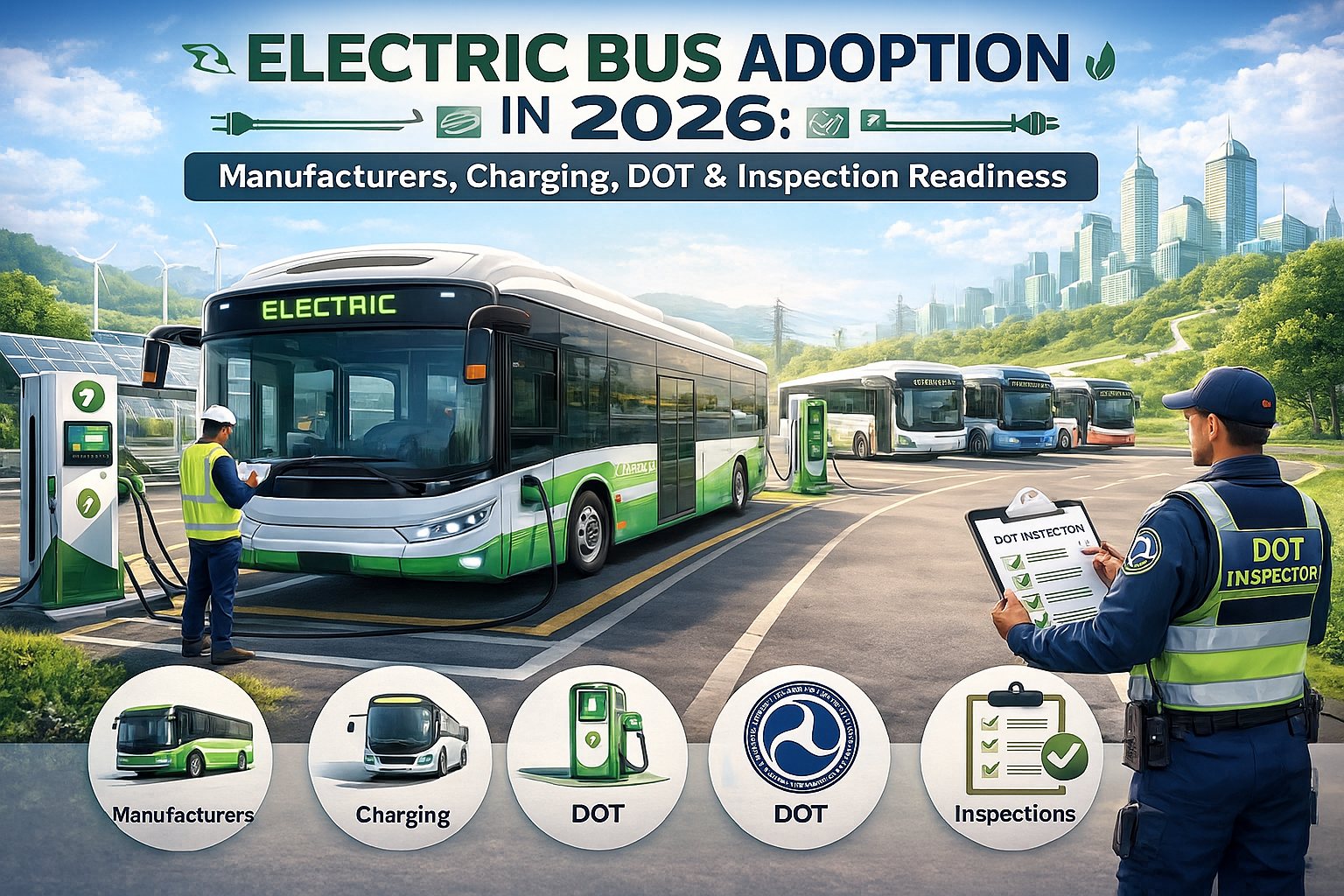
The electric school bus market has crossed a critical threshold. What was once experimental technology is now mainstream, with over 5,100 electric school buses on U.S. roads transporting 265,000 students daily. Blue Bird has delivered its 2,000th electric bus. Thomas Built launched its second-generation Jouley in January 2025. Federal funding continues flowing—though with more uncertainty than ever.
For fleet managers planning electric bus adoption in 2026, the question has shifted from "should we go electric?" to "how do we do this right?" The technology is proven. The economics increasingly favor electrification. But successful deployment requires navigating manufacturer selection, charging infrastructure planning, technician training, and inspection protocol development—all while maintaining DOT compliance throughout.
This guide breaks down each critical decision point, from comparing the major electric bus manufacturers to understanding how DOT inspections differ for battery-electric vehicles. Whether you're ordering your first electric bus or scaling an existing pilot program, this is your compliance-ready roadmap for 2026 adoption.
5,100+
Electric school buses on U.S. roads (up from 415 in 2020)
8,500+
Buses funded through EPA Clean School Bus Program
130-150
Miles range per charge (vs. 34-mile average school route)
~20
Parts in electric motor (vs. 2,000+ in diesel engine)
The Major Electric Bus Manufacturers: 2026 Comparison
Three manufacturers dominate the U.S. electric school bus market: Blue Bird Corporation, Thomas Built Buses, and Lion Electric. Each offers distinct advantages depending on your fleet size, existing relationships, and operational requirements. Understanding their current offerings—and announced 2025-2026 developments—helps inform procurement decisions made today for buses delivered next year.
Blue Bird Corporation
Fort Valley, Georgia
Current Model: Vision Electric (Type C)
Battery: 196 kWh
Range: Up to 130 miles
Charging: CCS1 connector, 80 kW fast charging
Powertrain Partner: Cummins Accelera
Market leader with 2,000+ electric buses delivered. Received $80M federal grant for new Type D manufacturing facility. V2G capable.
Thomas Built Buses
High Point, North Carolina
Current Model: Saf-T-Liner C2 Jouley Gen 2 (Type C)
Battery: 226 kWh
Range: Up to 138 miles
Charging: CCS1 DC fast charging (60 kW min)
Powertrain Partner: Cummins Accelera (14Xe eAxle)
Daimler Truck subsidiary. 1M+ miles logged. Launching Type D "Wattson" (246 kWh, 150-mile range) in late 2026. Infrastructure consulting included.
Lion Electric
Saint-Jérôme, Quebec (U.S. facility: Joliet, IL)
Current Models: LionC (Type C), LionD (Type D)
Battery: 126-252 kWh (configurable)
Range: Up to 155 miles (configuration dependent)
Charging: SAE J1772, CCS1 DC fast charging
Integration: Turnkey programs with charging/training
All-electric focused manufacturer. Configurable battery packs. Integrated fleet management software. Financial challenges in 2024-2025 paused U.S. manufacturing.
Other Manufacturers to Consider
GreenPower Motor Company (West Virginia) – Specializes in Type D "BEAST" electric school buses. Focus on western state markets.
IC Bus (Navistar) – Developing electric offerings under Navistar's TRATON Group umbrella. Watch for 2025-2026 announcements.
Collins Bus / Micro Bird – Smaller Type A electric options for special needs and low-capacity routes.
Charging Infrastructure: The Make-or-Break Decision
Charging infrastructure often determines electric bus deployment success more than the buses themselves. Understanding the two primary charging strategies—and their implications for your depot, grid connection, and operations—is essential before committing to any manufacturer.
Depot Charging vs. Opportunity Charging
Depot Charging (Overnight)
Lower infrastructure cost ($10K-$50K per charger)
Simpler grid planning (predictable overnight load)
Off-peak electricity rates
5-8 hour charging windows fit school schedules
Requires larger battery packs (full-day range)
Need 1:1 charger-to-bus ratio for full fleet
Best for: School districts with predictable routes under 100 miles
Opportunity Charging (En-Route)
Higher infrastructure cost ($75K-$300K+ per charger)
Complex grid requirements (high-power demand)
Peak electricity rates may apply
Enables smaller battery packs (lighter bus)
Extended route flexibility
Pantograph or plug-in options (150-600 kW)
Best for: Transit operations with long routes or high-frequency service
For most school bus operations, depot charging is the practical choice. The typical school bus route averages just 34 miles—well within the 130-150 mile range of current electric models. Overnight charging during off-peak hours (typically 9 PM to 6 AM) aligns naturally with school transportation schedules and takes advantage of lower electricity rates.
Charging Infrastructure Planning Checklist
✓ Utility Assessment: Engage your electric utility early. Grid capacity upgrades can take 12-24 months.
✓ Electrical Service: Most depot charging requires 480V three-phase service. Verify existing capacity.
✓ Charger Quantity: Plan for at least 1 charger per 2-3 buses initially (rotating overnight charging).
✓ Charging Management Software: Smart charging systems balance loads and optimize electricity costs.
✓ Future Expansion: Size electrical infrastructure for future fleet growth, not just initial deployment.
✓ V2G Consideration: Vehicle-to-grid capability can generate revenue and provide backup power.
Managing a mixed fleet of diesel and electric buses? BusCMMS handles both with specialized maintenance protocols, battery lifecycle tracking, and automated compliance documentation for every vehicle type.
Getting Started Book a DemoDOT Inspections for Electric Buses: What Changes, What Stays the Same
Here's the good news: electric buses are subject to the same FMCSA inspection requirements as diesel buses. The regulatory framework under 49 CFR Part 396 applies equally to all commercial motor vehicles regardless of propulsion type. Your annual DOT inspections, pre-trip/post-trip requirements, and roadside inspection protocols remain structurally identical.
The nuance lies in what you're inspecting and the specialized knowledge required. Electric buses eliminate dozens of diesel-specific inspection points (fuel system, exhaust, transmission) while introducing new high-voltage components that require different safety protocols. A modern fleet management CMMS should include electric-specific inspection checklists to ensure nothing gets missed.
Electric Bus Inspection: Eliminated vs. New Components
Eliminated Inspection Points
Engine oil level and condition
Transmission fluid
Fuel filters and fuel system
Exhaust system leaks and mounting
Spark plugs / glow plugs
Radiator coolant (most EV systems)
Drive belts (alternator, AC, etc.)
Emission control systems
New/Modified Inspection Points
Battery state of charge and health indicators
High-voltage cable condition and routing
Battery thermal management system
Charging port condition and safety
Regenerative braking system function
Pedestrian warning sound generator
12V auxiliary battery (still required)
Battery contactors and isolation systems
Critical Safety Protocol: High-Voltage Lockout
Before performing any maintenance on an electric bus, technicians must disable the high-voltage battery system. Electric bus batteries remain energized even when the vehicle is "off." Failure to follow proper lockout/tagout procedures can result in serious injury or death.
Every maintenance task requiring access to drivetrain components, undercarriage work, or any potential contact with high-voltage cables requires battery isolation protocol—verified with a multimeter before work begins.
Pre-Trip Inspections: Electric Bus Additions
Drivers performing daily pre-trip inspections on electric buses will follow the same overall framework required by FMCSA—checking brakes, tires, lights, mirrors, emergency equipment, and safety systems. However, several electric-specific items should be added to your standard checklist:
Electric Bus Pre-Trip Additions
State of Charge
Verify sufficient battery charge for planned route plus 20% reserve. Dashboard display should show SOC before departure.
Charging Cable Disconnection
Confirm charging cable is disconnected and properly stowed. Check charging port cover is closed and latched.
Dashboard Warnings
No battery fault codes, thermal warnings, or high-voltage system alerts. Clear any non-critical notifications.
Pedestrian Warning Sound
Verify low-speed warning sound generator is functioning (required since electric buses are nearly silent).
Regenerative Braking
Brief test of regenerative braking function during initial movement. System should engage smoothly.
HVAC Operation
Test heating/cooling system—electric HVAC draws significant battery power, especially in extreme temperatures.
Technician Training & Certification Requirements
The transition to electric buses demands specialized technician training that most diesel-focused maintenance teams don't currently possess. High-voltage safety training isn't optional—it's essential for protecting your workforce and maintaining compliance.
Required Training Levels
ASE xEV Level 1: Electrical Safety Awareness
Who needs it: All personnel who may encounter electric buses—drivers, dispatchers, facilities staff, supervisors
Coverage: Hazard identification, safe distances, emergency procedures, when to call qualified technicians
Cost: ~$39 | Format: Online
ASE xEV Level 2: Technician Electrical Safety
Who needs it: Technicians performing maintenance on or near high-voltage systems
Coverage: Battery isolation procedures, high-voltage safety protocols, lockout/tagout, de-energization verification
Cost: ~$50 | Format: Online with practical assessment
TÜV Level 3: High-Voltage Qualified
Who needs it: Lead technicians performing diagnostic work and repairs on energized systems
Coverage: Live-work procedures, advanced diagnostics, battery pack service, emergency response
Cost: $1,500-$3,000 | Format: Multi-day in-person with hands-on
OEM-Specific Training
Who needs it: Technicians maintaining specific bus models
Coverage: Model-specific diagnostics, warranty requirements, proprietary systems, software updates
Cost: Often included with bus purchase | Format: Varies by manufacturer
The World Resources Institute maintains an Electric Vehicle Technician Training Database covering programs across 22 states. Community colleges increasingly offer EV technician certificate programs that provide foundational knowledge transferable to school bus applications. For tracking technician certifications and training compliance, create your free BusCMMS account to manage credentials alongside maintenance records.
Maintenance Scheduling: What Changes with Electric
Electric buses require fundamentally different preventive maintenance schedules than diesel. Many traditional PM tasks simply don't exist—no oil changes, no transmission service, no exhaust system repairs. But new maintenance categories emerge around battery health, thermal management, and high-voltage systems.
Preventive Maintenance: Diesel vs. Electric
| Maintenance Task | Diesel Bus | Electric Bus |
|---|---|---|
| Engine oil change | Every 5,000-10,000 miles | Not applicable |
| Transmission service | Every 30,000-50,000 miles | Not applicable (single-speed) |
| Fuel filter replacement | Every 15,000-30,000 miles | Not applicable |
| Exhaust system inspection | Every PM interval | Not applicable |
| Brake pad replacement | Every 30,000-50,000 miles | Every 100,000+ miles (regen braking) |
| Coolant service | Engine and transmission cooling | Battery thermal management only |
| Battery health check | 12V starting battery only | High-voltage pack + 12V auxiliary |
| High-voltage system inspection | Not applicable | Annual minimum (cables, contactors) |
| Charging system maintenance | Not applicable | Quarterly port/connector inspection |
The net result: electric buses require approximately 30-50% less maintenance labor than diesel equivalents. But the maintenance they do require demands specialized skills, dedicated diagnostic equipment, and rigorous safety protocols. Fleet managers transitioning to electric must adapt their CMMS categories, work order types, and parts inventory accordingly.
Ready to track electric bus maintenance alongside your existing fleet? BusCMMS provides specialized workflows for battery health monitoring, high-voltage safety checklists, and DOT compliance documentation—all in one platform. Create your free CMMS account here or schedule a demo to see electric bus features in action.
Funding & Procurement Timeline for 2026 Deployment
If you're targeting electric bus deployment in the 2026-2027 school year, procurement decisions need to happen in early-to-mid 2025. Lead times for electric school buses currently range from 6-18 months depending on manufacturer and configuration. Charging infrastructure installation adds another 6-12 months once utility approvals are secured.
Realistic 2026 Deployment Timeline
Q1 2025
Utility engagement, grid capacity assessment, manufacturer RFP development
Q2 2025
Manufacturer selection, purchase orders, grant applications (if applicable)
Q3-Q4 2025
Charging infrastructure design, permitting, utility interconnection agreements
Q1 2026
Infrastructure construction, technician training programs begin
Q2 2026
Bus delivery, commissioning, driver training
Fall 2026
Revenue service begins with new school year
Available Funding Sources (2025-2026)
EPA Clean School Bus Program: $5 billion authorized over 5 years. Priority funding for high-need districts. Check epa.gov/cleanschoolbus for current rebate rounds. Note: Approximately $1B in reimbursements frozen as of mid-2025 due to administrative disputes—monitor program status.
State Incentive Programs: California, New York, Massachusetts, and others offer additional rebates stacking with federal funds. Check your state environmental or energy agency.
Utility Programs: Many utilities offer EV infrastructure incentives, make-ready programs, or special commercial EV rates. Engage your utility early in the planning process.
Volkswagen Settlement Funds: Some states still have remaining Environmental Mitigation Trust funds available for diesel replacement projects.
The Bottom Line: Is 2026 the Right Time?
For most fleet operations, the answer is yes—but with caveats. Electric school bus technology has matured significantly. Range anxiety is largely resolved for typical school routes. Maintenance cost savings are real and documented. Air quality and health benefits for students are meaningful.
But successful deployment requires:
• Infrastructure planning that begins 12-18 months before bus delivery
• Workforce development ensuring technicians are trained before buses arrive
• Updated CMMS systems capable of tracking electric-specific maintenance requirements
• Realistic expectations about total cost of ownership (TCO favors electric over 12-year life, not year one)
• Pilot program mindset starting with a few buses before full fleet conversion
The fleets succeeding with electric buses in 2025-2026 aren't just buying new vehicles—they're transforming their entire maintenance operation. That transformation is more manageable with the right tools, training, and timeline. Start your electric fleet transition with BusCMMS today.
Transform your fleet maintenance for the electric era. BusCMMS provides the specialized CMMS capabilities you need: battery lifecycle tracking, high-voltage safety protocols, mixed-fleet management, and complete DOT compliance documentation. See why fleet managers choose BusCMMS for their electric transition.
Getting Started Book a DemoFrequently Asked Questions
Q: What DOT inspections are required for electric school buses?
A: Electric school buses are subject to the same FMCSA inspection requirements as diesel buses under 49 CFR Part 396. This includes annual DOT inspections, pre-trip and post-trip driver inspections, and compliance with roadside inspection criteria. The inspection framework is identical—only the specific components being inspected differ (battery systems instead of fuel systems, for example).
Q: How much does electric bus charging infrastructure cost?
A: Depot charging infrastructure typically costs $10,000-$50,000 per charger for Level 2 and lower-power DC fast charging (40-80 kW). Higher-power opportunity charging (150-350 kW) can cost $75,000-$300,000+ per installation. Total infrastructure costs also depend on electrical service upgrades, which can add $50,000-$200,000 or more depending on existing utility capacity at your depot.
Q: What technician certifications are needed for electric bus maintenance?
A: At minimum, technicians working on electric buses need ASE xEV Level 2 certification for high-voltage safety. Lead technicians performing diagnostic work should pursue TÜV Level 3 or equivalent training. All staff who may encounter electric buses—including drivers and dispatchers—should complete ASE xEV Level 1 awareness training. OEM-specific training is typically included with bus purchases.
Q: How does electric bus maintenance differ from diesel?
A: Electric buses eliminate many diesel maintenance tasks: no oil changes, no transmission service, no fuel filters, no exhaust system repairs. They require approximately 30-50% less maintenance overall. However, they introduce new maintenance categories including battery health monitoring, high-voltage system inspections, charging port maintenance, and thermal management system service. Regenerative braking extends brake pad life by 3-5x compared to diesel.
Q: Which electric school bus manufacturer should I choose?
A: The three major manufacturers—Blue Bird, Thomas Built, and Lion Electric—each have strengths. Blue Bird leads in installed base and has strong federal support. Thomas Built (Daimler) offers the largest battery capacity and comprehensive infrastructure consulting. Lion Electric provides configurable battery options and integrated fleet software. Consider your existing dealer relationships, regional service availability, and specific operational requirements when selecting a manufacturer.