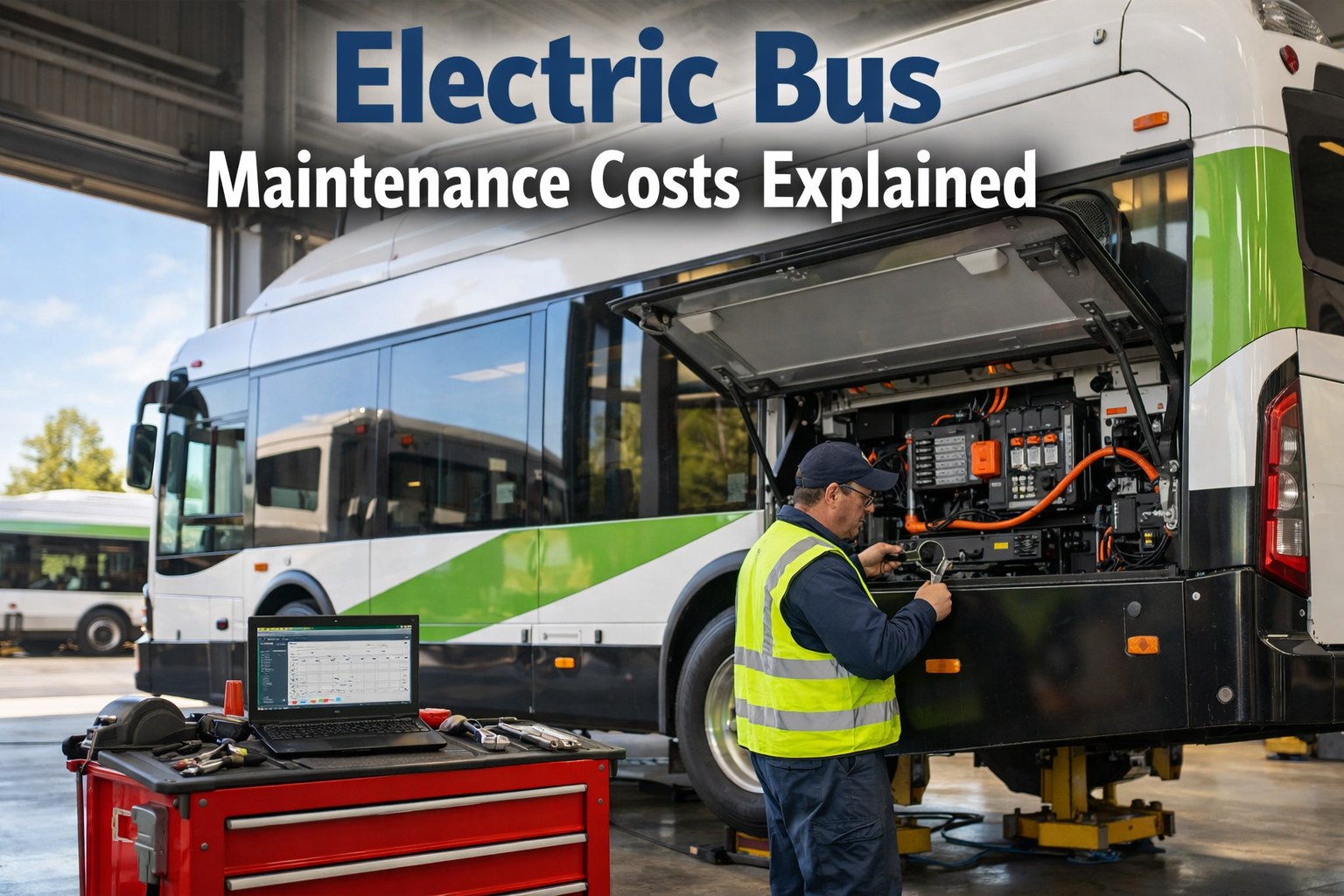
Electric buses cost 40-60% less to maintain than diesel—but only if you manage them right. This guide breaks down exactly where your money goes, compares real costs category by category, and shows how CMMS software helps you maximize savings from day one.
Whether you're running 10 electric school buses or planning a 500-vehicle transit transition, understanding these numbers is essential for budgeting and proving ROI to stakeholders. Many agencies start with a platform demo to see how cost tracking works before making the switch.
Where Does the Money Go?
Electric bus maintenance costs break into five main categories. Here's how each compares to diesel annually:
← Swipe to see full table →
The only area where EVs cost more? HVAC. Without waste engine heat, electric buses need dedicated heating systems that work harder in cold climates. Everything else tilts heavily in favor of electric. Fleet managers using modern CMMS platforms track these costs by category to identify exactly where savings come from.
The Battery Question
Everyone asks: "What about battery replacement?" Here's the truth:
12+
Years Expected Lifespan
Modern lithium-ion packs last 500,000+ miles before hitting 70% capacity
$80-150K
Replacement Cost
But most are covered under 10-year OEM warranties—check your contract
$500-1.5K
Annual Diagnostics
Thermal checks, cell balancing, state-of-health monitoring—routine stuff
The battery isn't a hidden cost bomb—it's actually one of the most predictable expenses. Agencies that implement battery health monitoring see degradation trends months in advance and know exactly when warranty claims are needed.
10-Year Total Cost Comparison
Over a 12-year, 500,000-mile lifespan, here's what you'll spend on maintenance:
Electric Bus
$125,000
Powertrain $6K • Brakes $6K • HVAC $12K • Battery $10K • Tires $50K • Labor $41K
Diesel Bus
$350,000
Engine $85K • Brakes $18K • HVAC $8K • Fluids $22K • Tires $50K • Labor $167K
$225,000
Saved per bus over 12 years
For a 50-bus fleet, that's $11.25 million in maintenance savings
Labor: The Hidden Variable
Parts only tell half the story. Labor is 50-60% of total maintenance cost—and this is where electric buses really shine:
Oil Change
EV: Not needed
Diesel: 45 min, every 6 weeks
Brake Service
EV: 2x per year
Diesel: 5-6x per year
Transmission Work
EV: None (no transmission)
Diesel: 8-12 hours annually
Diagnostic Time
EV: 30 min (digital)
Diesel: 2+ hours (physical inspection)
The catch: You need HV-certified technicians ($2,000-5,000 training per person) and specialized tools ($10,000-25,000 per shop). But most fleets recover this investment within 12-18 months through labor savings. Schedule a demo to see how labor tracking works for EV fleets.
How CMMS Cuts Costs Further
Electric bus savings aren't automatic—you need the right systems to capture them. Here's what CMMS specifically does for EV fleets:
Battery Health Tracking
Spot degradation early, extend pack life 15-20%, catch warranty issues before they expire
EV-Specific PM Schedules
Auto-adjust intervals for regenerative braking wear patterns and eliminate unnecessary diesel-style services
Cost-Per-Mile Analytics
See exactly what each bus costs—identify outliers, prove ROI to stakeholders
Charger Integration
Manage charging infrastructure alongside buses—track uptime, schedule maintenance, monitor energy
Real Fleet Results
"After transitioning 30 buses to electric, our maintenance cost dropped from $0.72/mile to $0.31/mile. Annual savings: $615,000."
— 75-Bus Transit Fleet, Midwest
"Battery health tracking through CMMS identified 3 buses needing warranty repairs before problems became expensive. Saved an estimated $45,000."
— 120-Bus School District, California
Results like these are typical for fleets that implement digital maintenance tracking from day one of their EV transition.
Budget Planning by Year
Year 1
$3,500-5,000/bus
Training costs, tool investment, learning curve. May approach diesel levels.
Year 2-3
$2,500-3,500/bus
Team trained, processes optimized. 30-40% savings begin.
Year 4-8
$2,000-3,000/bus
Peak efficiency. 50-60% below diesel. Full ROI realized.
Year 9-12
$3,000-4,000/bus
Battery reserve needed. Still 40%+ savings vs diesel lifecycle.
Ready to Optimize Your EV Fleet Costs?
Join transit agencies saving 50%+ on maintenance with Bus CMMS.
Schedule Demo Start Free AccountFrequently Asked Questions
How much does it cost to maintain an electric bus per year?
$2,000-4,000 per bus annually after the first year, compared to $8,000-12,000 for diesel. This translates to $0.25-0.40 per mile for electric versus $0.60-0.90 per mile for diesel.
What's the biggest maintenance expense for electric buses?
Day-to-day, HVAC systems cost the most since EVs lack waste engine heat. Long-term, battery replacement ($80K-150K after 10-12 years) is the largest potential expense—but most are warranty-covered.
Do electric buses need special technicians?
Yes—high-voltage certification is required. Training costs $2,000-5,000 per tech, plus $10,000-25,000 in shop tools. Most fleets recover this within 12-18 months through labor savings.
How long do electric bus batteries last?
12+ years or 500,000+ miles before dropping below 70% capacity. Most manufacturers warranty batteries for 10+ years. Proper charging and thermal management extends life 15-20%.
How does CMMS reduce EV maintenance costs?
Through battery health monitoring, EV-specific PM schedules, cost-per-mile tracking, charger integration, and warranty management. Fleets report 15-25% additional savings beyond inherent EV advantages.







