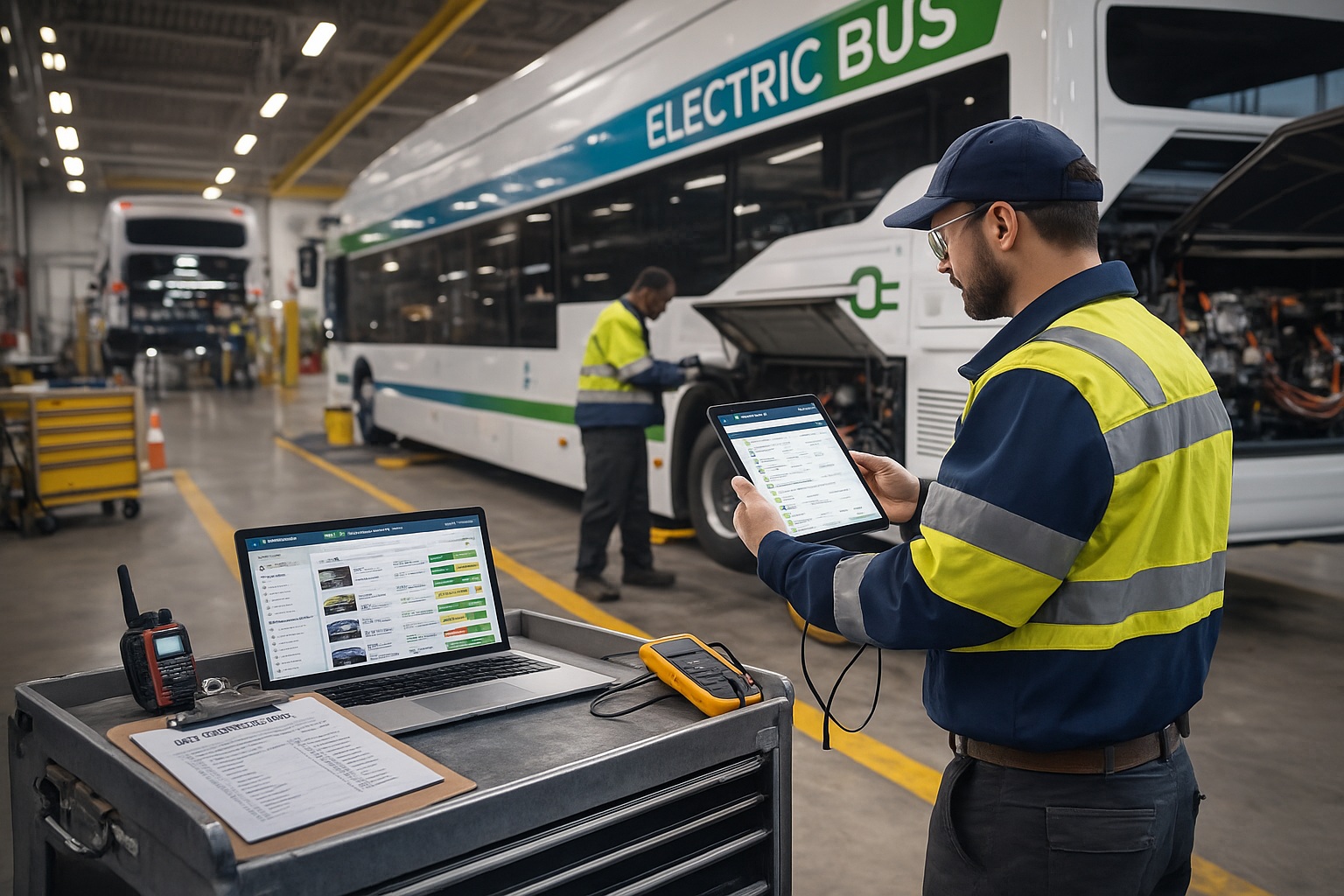
Electric buses require a fundamentally different maintenance approach than diesel. The 2,000+ moving parts in a diesel drivetrain compress down to roughly 20 in an electric motor. Oil changes, transmission service, exhaust repairs, and DEF management disappear entirely. But what replaces them demands new expertise: high-voltage safety protocols, battery thermal management, regenerative braking systems, and charging infrastructure maintenance.
The good news: electric buses require 30-50% less maintenance overall. The challenge: the maintenance they do require is safety-critical and demands specialized training, dedicated procedures, and proper documentation. DOT inspections still apply. Pre-trip requirements still apply. But the checklist changes,and your CMMS needs to adapt accordingly.
This guide provides the practical framework for managing electric bus maintenance at scale: what to inspect, when to schedule PM, how to configure your CMMS, and where the common failure points emerge. Whether you're transitioning your first electric buses or optimizing an existing fleet, these protocols will help you maintain compliance, maximize uptime, and control costs.
Electric Bus Maintenance: What Changes, What Stays the Same
Eliminated from Maintenance
Added to Maintenance
Remains the Same
DOT Inspection Requirements for Electric Buses
Electric buses are subject to the same Federal Motor Carrier Safety Administration (FMCSA) requirements as diesel buses under 49 CFR Part 396. This means annual DOT inspections, daily pre-trip and post-trip inspections, and compliance with roadside inspection protocols. The regulatory framework is identical—but the specific inspection points differ significantly.
CVSA inspectors receive specialized training for high-voltage commercial motor vehicles. According to FMCSA guidance, inspectors should only conduct visual inspections of electric vehicles and must avoid touching orange-colored high-voltage cables or conduits. Vehicles displaying "High Voltage Fault" or "Stop Hybrid" warnings should not be inspected or operated until cleared by qualified technicians.
Annual DOT Inspection: Electric-Specific Items
High-Voltage System Visual Check: Inspect all accessible high-voltage cables, conduits, and connectors for damage, wear, or improper routing. Orange cables must be intact with no exposed conductors or damaged insulation.
Battery Enclosure Inspection: Check that covers and access panels are secure. Look for fluid leaks, corrosion, or physical damage to the rechargeable energy storage system (RESS) housing.
High-Voltage Warning Labels: Verify all required warning labels and high-voltage symbols are present and legible on relevant compartments and components.
Charging Port Condition: Inspect charging inlet for damage, debris, corrosion, or loose connections. Verify port cover operates properly.
Dashboard Warning Indicators: Confirm no active high-voltage fault codes or system warnings. Red warning lights for isolation faults require immediate attention.
Eliminated Inspection Points
The following traditional diesel inspection items no longer apply to electric buses:
• Engine oil level and condition
• Transmission fluid level and condition
• Fuel system leaks and filter condition
• Exhaust system mounting and leaks
• Emission control systems (DPF, SCR, EGR)
• Engine coolant system (most EVs use separate battery thermal systems)
• Drive belts (alternator, AC compressor)
• Diesel exhaust fluid (DEF) system
⚠ Critical Safety Protocol: High-Voltage Lockout
High-voltage lockout is required before any maintenance work that involves potential contact with drivetrain components, undercarriage systems, or high-voltage cables. Electric bus batteries remain energized even when the vehicle is "off." Failure to follow proper lockout/tagout procedures can result in serious injury or death.
Every maintenance task requiring access to high-voltage areas must follow this sequence: (1) De-energize vehicle, (2) Remove service disconnect/MSD, (3) Wait for capacitor discharge (minimum 10 minutes or per OEM spec), (4) Verify zero voltage with rated multimeter, (5) Document verification before work begins.
Daily Pre-Trip Inspection Protocol: Electric Bus Additions
Pre-trip inspections for electric buses include all standard safety items plus electric-specific checkpoints. Drivers should be trained to recognize high-voltage warning indicators and understand when to report issues versus when to take the bus out of service immediately.
State of Charge Verification
Confirm sufficient battery charge for planned route plus 20% reserve minimum. Know your route distance and vehicle's real-world range under current weather conditions.
Charging Cable Disconnection
Verify charging cable is fully disconnected and properly stowed. Confirm charging port cover is closed and latched securely. Never depart with cable attached.
Dashboard Warning Check
Scan for any battery fault codes, thermal warnings, or high-voltage system alerts. Red isolation fault warnings require immediate reporting—do not operate the vehicle.
Pedestrian Warning Sound
Test that low-speed warning sound generator is functioning. Electric buses operate nearly silently—this federally-required safety feature alerts pedestrians to vehicle presence.
Regenerative Braking Test
During initial movement, verify regenerative braking engages properly when releasing accelerator. Note any unusual behavior or reduced regeneration.
HVAC System Operation
Test heating and cooling system function. Electric HVAC draws significant battery power in extreme temperatures—confirm system operates without excessive drain indicators.
Streamline your pre-trip inspections with digital checklists customized for electric buses. BusCMMS provides mobile-friendly inspection forms with photo documentation, instant defect notifications, and automatic work order generation. Create your free account to digitize your inspection workflow.
Preventive Maintenance Scheduling: Electric Bus PM Intervals
Electric bus PM schedules look fundamentally different from diesel schedules. Without oil change intervals driving the PM cycle, maintenance shifts to time-based and condition-based triggers. Most manufacturers recommend quarterly comprehensive inspections with specific component checks at various mileage intervals.
The key principle: electric buses require fewer PM events but each event requires specialized expertise. Your technicians need appropriate high-voltage safety training before performing any maintenance beyond basic visual inspections and non-high-voltage components.
Recommended Electric Bus PM Schedule
Daily
Pre-trip inspection (electric-specific items + standard safety)
Post-trip inspection and charging connection verification
State of charge documentation
Monthly
Tire pressure check and adjustment
12V auxiliary battery voltage test
Windshield washer fluid level
Exterior lighting function test
Visual inspection of charging equipment
Quarterly (Every 3 Months)
Battery state of health diagnostic check
Thermal management system inspection
High-voltage cable visual inspection
Charging port and connector cleaning/inspection
Brake pad measurement (expect extended life due to regen braking)
Suspension component inspection
HVAC filter replacement
Every 6,000-10,000 Miles
Tire rotation
Comprehensive brake system inspection
Steering component inspection
Coolant level check (battery thermal system)
Annually
DOT annual inspection
Comprehensive high-voltage system inspection (certified technician required)
Battery health analysis with capacity verification
High-voltage contactor inspection
Complete safety system verification
OEM software/firmware updates
EVSE annual inspection and maintenance
Every 25,000-50,000 Miles
Brake fluid flush (if applicable to model)
Battery thermal system coolant service
Reduction gear lubricant check (model-dependent)
Note: Always defer to manufacturer-specific maintenance schedules. The intervals above represent general industry guidance—your OEM documentation takes precedence. Operating conditions (extreme temperatures, high-duty cycles, terrain) may require adjusted intervals.
CMMS Configuration for Electric Bus Fleets
Your Computerized Maintenance Management System (CMMS) needs specific configuration to properly track electric bus maintenance. Standard diesel-oriented CMMS setups miss critical electric-specific requirements while tracking irrelevant items. Proper configuration ensures compliance, optimizes scheduling, and provides accurate cost tracking.
Essential CMMS Features for Electric Bus Management
Asset Type Classification
Create separate asset categories for electric vs. diesel buses. This enables differentiated PM schedules, work order templates, parts catalogs, and reporting. Mixed fleets require this separation for accurate cost comparison and compliance tracking.
Custom PM Templates
Build electric-specific PM checklists that include battery health checks, high-voltage system inspections, and charging equipment verification. Remove diesel-only items from templates to avoid confusion and wasted time on inapplicable checks.
Technician Certification Tracking
Track which technicians hold required high-voltage certifications (ASE xEV Level 2, TÜV Level 3, OEM-specific). CMMS should prevent assignment of high-voltage work orders to uncertified personnel.
Battery Health Monitoring
Configure fields to track battery state of health (SOH), capacity degradation, charging cycles, and thermal events. This data supports warranty claims and replacement planning. Integrate with OEM diagnostic tools where possible.
Charging Infrastructure as Assets
EVSE (Electric Vehicle Supply Equipment) requires its own maintenance tracking. Create asset records for chargers with PM schedules covering cable inspection, connector cleaning, and electrical system verification.
High-Voltage Work Order Protocols
Configure work order templates that require documented lockout/tagout verification before high-voltage tasks. Include mandatory fields for isolation confirmation and zero-voltage verification.
CMMS Data Fields to Add for Electric Buses
Battery Pack Serial Number
Warranty tracking, recall management
Initial Battery Capacity (kWh)
Baseline for degradation monitoring
Current State of Health (%)
Replacement planning, range prediction
Charging Cycles Count
Battery life prediction
Thermal Events Logged
Early warning indicator
OEM Software Version
Update compliance tracking
Assigned Charger ID
Infrastructure correlation
HV Certification Expiry (Technician)
Compliance enforcement
BusCMMS comes pre-configured for electric bus fleet management with built-in PM templates, battery health tracking, and certification management. No complex setup required—start managing your electric fleet in minutes. Schedule a demo to see electric-specific features in action.
Technician Training and Certification Requirements
High-voltage systems demand qualified personnel. Working on electric buses without proper training creates serious safety risks—and liability exposure. The industry has established clear certification pathways that fleet managers should understand and enforce.
Level 1: Electrical Safety Awareness
Required for: All personnel who may encounter electric buses (drivers, dispatchers, facilities staff, supervisors)
Coverage: Hazard identification, safe distances, emergency procedures, when to call qualified technicians
Certification: ASE xEV Level 1 (~$39, online)
Level 2: Technician Electrical Safety
Required for: Technicians performing maintenance on or near high-voltage systems
Coverage: Battery isolation procedures, lockout/tagout, de-energization verification, high-voltage safety protocols
Certification: ASE xEV Level 2 (~$50, online with practical assessment)
Level 3: High-Voltage Qualified
Required for: Lead technicians performing diagnostics and repairs on energized systems
Coverage: Live-work procedures, advanced diagnostics, battery pack service, emergency response
Certification: TÜV Level 3 ($1,500-$3,000, multi-day in-person with hands-on)
OEM-Specific Training
Required for: Technicians maintaining specific bus models
Coverage: Model-specific diagnostics, warranty requirements, proprietary systems, software updates
Certification: Varies by manufacturer (often included with bus purchase)
The World Resources Institute maintains an Electric Vehicle Technician Training Database covering programs across 22 states. Community colleges increasingly offer EV technician certificate programs with foundational knowledge transferable to school bus applications. Budget for ongoing training—this isn't a one-time expense as technology evolves.
Common Electric Bus Maintenance Challenges
Transitioning to electric bus maintenance creates predictable challenges. Understanding these in advance helps fleet managers prepare appropriate responses and set realistic expectations with stakeholders.
Challenge: Battery Thermal Events
Battery thermal management systems work continuously to maintain optimal operating temperature. In extreme heat or cold, HVAC and battery conditioning compete for energy—reducing effective range. Thermal events (overheating) require investigation and documentation.
Response: Track thermal events in CMMS. Establish protocols for extreme temperature operation. Consider depot heating/cooling strategies for overnight conditioning. Monitor battery health trends for early degradation indicators.
Challenge: Charging Infrastructure Reliability
Charger failures directly impact fleet availability. Issues range from cable damage to communication errors between charger and vehicle. EVSE equipment requires its own maintenance program.
Response: Create asset records for each charger with PM schedules. Stock spare cables and connectors. Establish relationships with EVSE service providers. Track charger utilization to identify stressed equipment.
Challenge: Parts Availability
Electric bus components may have longer lead times than diesel equivalents. High-voltage parts often require OEM sourcing. Aftermarket options are more limited.
Response: Build inventory of common wear items and high-failure-rate components. Establish relationships with OEM parts departments. Configure CMMS reorder points based on actual lead times. Consider consignment inventory arrangements with suppliers.
Challenge: Diagnostic Equipment Investment
Electric bus diagnostics require specialized tools: high-voltage rated multimeters (CAT III 1000V minimum), insulation testers, battery analyzers, and OEM-specific diagnostic software.
Response: Budget for diagnostic equipment as part of fleet transition. Verify technicians are trained on proper tool use. Establish calibration and inspection schedules for safety-critical test equipment. Consider mobile diagnostic service contracts during transition.
Challenge: Mixed Fleet Complexity
Running both diesel and electric buses creates parallel maintenance paradigms. Technicians must switch between fundamentally different systems. PM schedules, parts inventory, and work procedures all differ.
Response: Configure CMMS with clear asset type separation. Consider dedicating specific technicians to electric fleet. Develop clear documentation distinguishing electric vs. diesel procedures. Track cost per mile separately to validate ROI assumptions.
Optimizing Electric Bus Fleet Operations
Beyond compliance, well-managed electric bus maintenance delivers measurable operational benefits. The fleets achieving best results combine proper procedures with data-driven optimization.
Route-Based PM Scheduling
Coordinate maintenance windows with route schedules. Electric buses require less frequent PM but similar downtime when service is needed. Schedule quarterly inspections during natural service gaps—summer breaks, holiday periods, or low-demand seasons. This maximizes availability when buses are needed most.
Predictive Battery Management
Track battery state of health trends over time. Degradation typically follows predictable curves—significant deviation indicates potential issues. Use CMMS data to predict replacement timing and budget accordingly. Batteries showing accelerated degradation may warrant warranty claims before coverage expires.
Charging Strategy Optimization
Monitor charging patterns and energy consumption. Smart charging during off-peak hours reduces utility costs. Track charger utilization to right-size infrastructure. Battery longevity benefits from moderate charging rates and avoiding extreme state-of-charge levels (keeping between 20-80% when possible).
Integrated Telematics Data
Connect CMMS with vehicle telematics for automated maintenance triggers. Real-time battery data, fault codes, and performance metrics flow directly into maintenance systems. This enables condition-based maintenance that addresses actual needs rather than arbitrary schedules.
Take control of your electric bus maintenance with purpose-built CMMS tools. Digital inspections, automated PM scheduling, battery health tracking, and compliance documentation—all in one platform designed for the unique requirements of electric fleet operations.
Getting StartedBook a Demo
Frequently Asked Questions
Q: What DOT inspections are required for electric buses?
A: Electric buses are subject to the same FMCSA requirements as diesel buses under 49 CFR Part 396, including annual DOT inspections and daily pre-trip/post-trip inspections. However, the specific inspection points differ—electric buses require high-voltage system visual checks, battery enclosure inspection, charging port condition verification, and warning label compliance, while traditional diesel items like oil levels, exhaust systems, and fuel filters are eliminated.
Q: How often should electric buses receive preventive maintenance?
A: Electric buses typically require quarterly comprehensive inspections (every 3 months), with specific component checks at various mileage intervals. Daily pre-trip inspections include electric-specific items like state of charge and charging cable disconnection. Annual comprehensive high-voltage system inspections by certified technicians are recommended. Electric buses require 30-50% fewer PM events than diesel but each service requires specialized expertise.
Q: What certifications do technicians need to work on electric buses?
A: Technicians need appropriate high-voltage safety certifications: ASE xEV Level 1 (awareness) for all personnel who encounter electric buses, ASE xEV Level 2 (technician safety) for those performing maintenance near high-voltage systems, and TÜV Level 3 or equivalent for technicians performing diagnostics and repairs on energized systems. OEM-specific training is also required for model-specific maintenance and warranty compliance.
Q: How should CMMS be configured for electric bus fleets?
A: CMMS should include separate asset categories for electric vs. diesel buses, custom PM templates with electric-specific checklists, technician certification tracking to prevent unqualified work assignments, battery health monitoring fields (SOH, capacity, charging cycles), charging infrastructure as separate tracked assets, and work order protocols requiring documented lockout/tagout verification for high-voltage tasks.
Q: What are the most common electric bus maintenance challenges?
A: Common challenges include battery thermal events requiring monitoring and documentation, charging infrastructure reliability issues, longer parts lead times for electric-specific components, diagnostic equipment investment requirements (high-voltage rated tools and OEM software), and mixed fleet complexity when operating both diesel and electric buses. Successful fleets address these through proper CMMS configuration, training investment, and established supplier relationships.