Bus #22 pulled 68,000 miles on its original brake pads last year and the mechanic thought that was a win. This year, the same pads are glazed from underuse, the rotors are pitted with surface rust, and the caliper slides on the right rear are seizing. Total repair: $2,400. On a diesel that never happens. On an electric bus, regenerative braking cut friction brake wear by 80% -- and quietly created a whole new set of maintenance problems your old checklist was never built to catch.
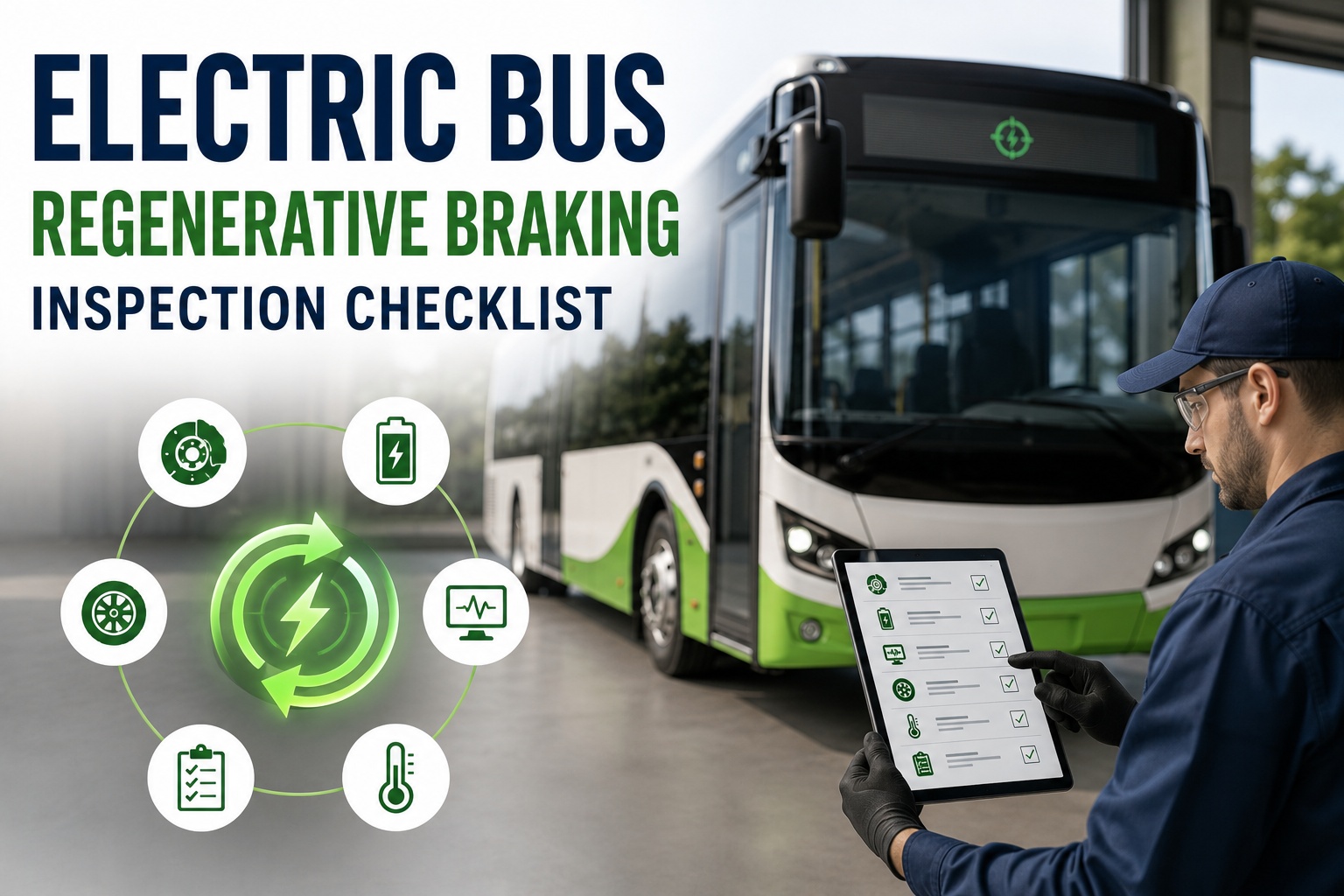
Electric Bus Regenerative Braking Inspection Checklist
The inspection items EV buses actually need -- from regen function tests to caliper corrosion checks -- that diesel checklists were never designed to cover.
- Regen function tests
- Corrosion + seize checks
- HV-safe procedures
The EV Brake Paradox: Less Wear, More Inspection
Regenerative braking recovers kinetic energy back into the battery and handles 70-80% of every stop. That is fantastic for pad life -- and terrible for pads and rotors that never get worked hard enough to keep themselves clean. The maintenance program you built for diesel does not just get shorter for EV. It gets fundamentally different.
High wear, self-cleaning
- Pads at 15,000-25,000 mi
- Rotors run hot, stay clean
- Fluid cooks moisture out
- Calipers cycle constantly
Low wear, new failure modes
- Pads at 150,000-200,000 mi
- Rotors corrode from underuse
- Fluid absorbs moisture (no heat)
- Caliper slides seize dry
The result: fleets that copy diesel PM intervals onto their EV buses end up replacing brake components that have plenty of material left, while missing corrosion damage that should have been caught six months earlier. Book a demo to see an EV-specific brake PM template running on real fleet data.
Understanding the Regenerative Braking System
Regen is not one component -- it is a system that lives across HV electronics, drive motor, battery, and the friction brake pedal itself. Understanding what is actually working keeps your inspection focused on the right places.
-
Drive Motor / Generator
Runs in reverse during deceleration, converting kinetic energy into current.
-
Inverter / Motor Controller
Directs recovered current back to the battery. Declining efficiency = early warning.
-
Battery Acceptance
Full battery or cold pack (below 32 F / 0 C) cannot accept regen, forcing friction brakes to work harder.
-
Brake Blend Controller
Software that decides how much regen vs friction to apply at every pedal press.
-
Friction Brake Fallback
Pads, rotors, calipers, fluid. Underused -- but must still stop the bus alone in a regen failure.
-
ABS Integration
During ABS activation, regen must cut cleanly to friction. A bad handoff loses energy and stresses pads.
Each component can drift independently. Only tracking one -- say, pad wear -- misses the other five. Book a demo to see all six regen components tracked per bus.
The Complete Regen Brake Inspection Checklist
Below is the full checklist organized by system zone. Every item ties back to a specific failure mode EV buses actually see. Sign up free and load this as an auto-triggered EV PM template.
-
01 DriverRegen Function Test
Daily pre-trip · ~1 min
- Lift off accelerator at 15 mph -- feel initial deceleration
- One-pedal driving mode responds smoothly
- No regen fault warning on dash
- Report if bus feels friction-only at pedal lift
-
02 Any techCorrosion & Wear Zone
Weekly visual · ~10 min
- Rotor surface rust check (all four corners)
- Uneven pad wear pattern (signals seized caliper)
- Road salt / winter debris buildup visible
- Any signs of brake drag on wheel spin
-
03 HV-awareRegen Efficiency Trend
Monthly BMS review · ~15 min
- Regen kWh recovered per route logged
- Trend vs baseline -- declining = inverter warning
- Cold-weather regen derate log (below 32 F)
- BMS fault codes tied to regen circuit
-
04 Any techFriction Brake Service
Quarterly · ~1 hr per bus
- Caliper slide lubrication (EV-rated grease)
- Pad thickness measure (replace at 3 mm)
- Rotor cleaning drive (hard brake application)
- Parking brake function verify
-
05 HV-certifiedAnnual Systems Audit
Yearly · documented
- Brake fluid moisture test (EV fluid rarely heats)
- Full regen brake calibration test
- ABS-to-regen handoff verification
- BMS firmware / brake blend software update
- Annual DOT inspection items for brakes
The 5 EV Brake Failures Every Fleet Sees
These are the failure modes that show up in EV bus shops -- and none of them appear on a diesel brake PM. Every one has a specific checklist item that catches it early.
-
01Costs range
Seized Caliper Slides
Symptom: Uneven pad wear, brake drag, 3-8% range loss.
Prevention: Caliper slide lube every 12 months regardless of miles.
-
02Costs range
Rotor Surface Corrosion
Symptom: Pitted braking surface, initial-application vibration.
Prevention: Weekly visual, monthly hard-brake drive to clean surface.
-
03Silent damage
Brake Fluid Moisture Uptake
Symptom: No visible sign until pedal feel changes or ABS acts up.
Prevention: Annual moisture test regardless of pad wear or miles.
-
04Efficiency loss
Declining Regen Efficiency
Symptom: One-pedal drive gets weaker over time; kWh recovered drops.
Prevention: Monthly BMS trend. 6-8 weeks warning before driver notices.
-
05Cold-weather
Regen Cutout at Low Temperature
Symptom: Below 32 F, cold battery cannot accept charge; friction takes over.
Prevention: Battery preconditioning + more frequent winter friction checks.
A failed regen system falls back to 100% friction braking -- and if nobody catches it, pads and rotors that were supposed to last 200,000 miles start wearing at diesel speed. Book a demo to see regen efficiency trending flag inverter drift 6 weeks out.
How BusCMMS Automates Regen Brake Inspections
A checklist on paper gets photocopied and forgotten. A checklist that fires on the right interval, routes to the right technician certification, and logs measurements per bus -- that is a program.
-
01
EV-Specific PM Templates
Ships with regen brake checks, corrosion inspections, and HV items pre-loaded.
-
02
Regen Efficiency Trending
Monthly kWh recovered per bus plotted vs baseline. Drift surfaces early.
-
03
Certification-Based Routing
HV items go to ASE Level 2 techs only. Standard brake work goes to any tech.
-
04
Cold-Weather Alert Logic
Ambient temp drops below 32 F -- friction brake inspection frequency auto-increases.
-
05
Pad + Rotor Wear Log
Measurements logged per wheel position over time. Replace on actual wear, not schedule.
-
06
Warranty-Grade Records
Every inspection timestamped, signed, retained per 49 CFR 396 requirements.
Fleets on the platform typically report pad replacement intervals extending 30-50% beyond OEM baseline once regen and friction sides are tracked together. Book a demo to see EV brake analytics on your actual bus model.
What EV Fleet Managers Say
We assumed EV brakes were a set-it-and-forget-it deal. Then two buses came in with seized calipers within a month of each other -- $1,800 repairs on pads that still had 60% material left. Once we added weekly rotor-and-slide visuals to the PM template, that failure mode disappeared inside a quarter.
Our regen efficiency trend caught a soft inverter about six weeks before the driver would have noticed one-pedal drive getting weaker. Warranty covered it because we had the monthly kWh log -- would have been a $9K out-of-warranty repair otherwise.
How do you inspect regenerative braking on an electric bus?
During a pre-trip check, lift off the accelerator at about 15 mph and feel for initial deceleration before touching the brake pedal -- that deceleration is regen. If the bus feels like it is only using friction brakes when you lift off, that is a defect. On the shop side, pull the kWh recovered per drive cycle from the BMS or telematics and trend it monthly. Declining regen kWh recovered across successive cycles is an early warning of inverter degradation or brake-blend calibration drift, often visible 6-8 weeks before a driver notices weaker one-pedal driving.
Do EV brake pads and rotors really last 3-5 times longer than diesel?
Yes. Because regenerative braking handles 70-80% of every stop, the friction brakes only do the final 20-30% of stopping force. Diesel buses typically need pads every 15,000-25,000 miles. Electric buses commonly go 150,000-200,000 miles on the same pads. The catch is that the extended life is only real if the friction system stays healthy -- seized calipers, corroded rotors, or moisture in the brake fluid all cut that life short. And if the regen system fails, the bus falls back to 100% friction and wears out pads at diesel speed.
What new brake failures happen on EV buses that do not happen on diesel?
Five main failure modes. First, seized caliper slides from lack of movement (lube every 12 months regardless of miles). Second, rotor surface corrosion from underuse (weekly visual, monthly hard-brake drive to clean). Third, brake fluid moisture uptake because EV brake fluid rarely heats above 80 C to cook the moisture out (annual moisture test). Fourth, declining regen efficiency from inverter aging or blend-calibration drift. Fifth, cold-weather regen cutout below 32 F when the cold battery cannot accept charge, forcing friction brakes to work harder.
Who can perform regenerative brake inspections?
It depends on the item. Standard friction brake work -- pads, rotors, calipers, hydraulic lines, fluid, parking brake -- can be performed by any trained mechanic. Any work involving the high-voltage regen path -- inverter, drive motor, HV cables to the battery, brake-blend software -- requires an HV-certified technician. Industry uses ASE Level 1 (HV-aware) and ASE Level 2 (HV-certified) as the common credentials. A CMMS should route work orders based on required certification and track cert expiry dates alongside the schedule.
How often should the regen brake system be tested?
Daily: driver pre-trip regen feel test on the accelerator pedal. Weekly: visual rotor and caliper check for corrosion and seize signs. Monthly: BMS regen efficiency trend review, kWh recovered per route logged. Quarterly: caliper slide lubrication, pad thickness measurement, hard-brake cleaning drive. Annually: brake fluid moisture test, full regen calibration test, ABS-to-regen handoff verification, and brake-blend software update. All annual items require documentation for warranty defense and FMCSA record retention.