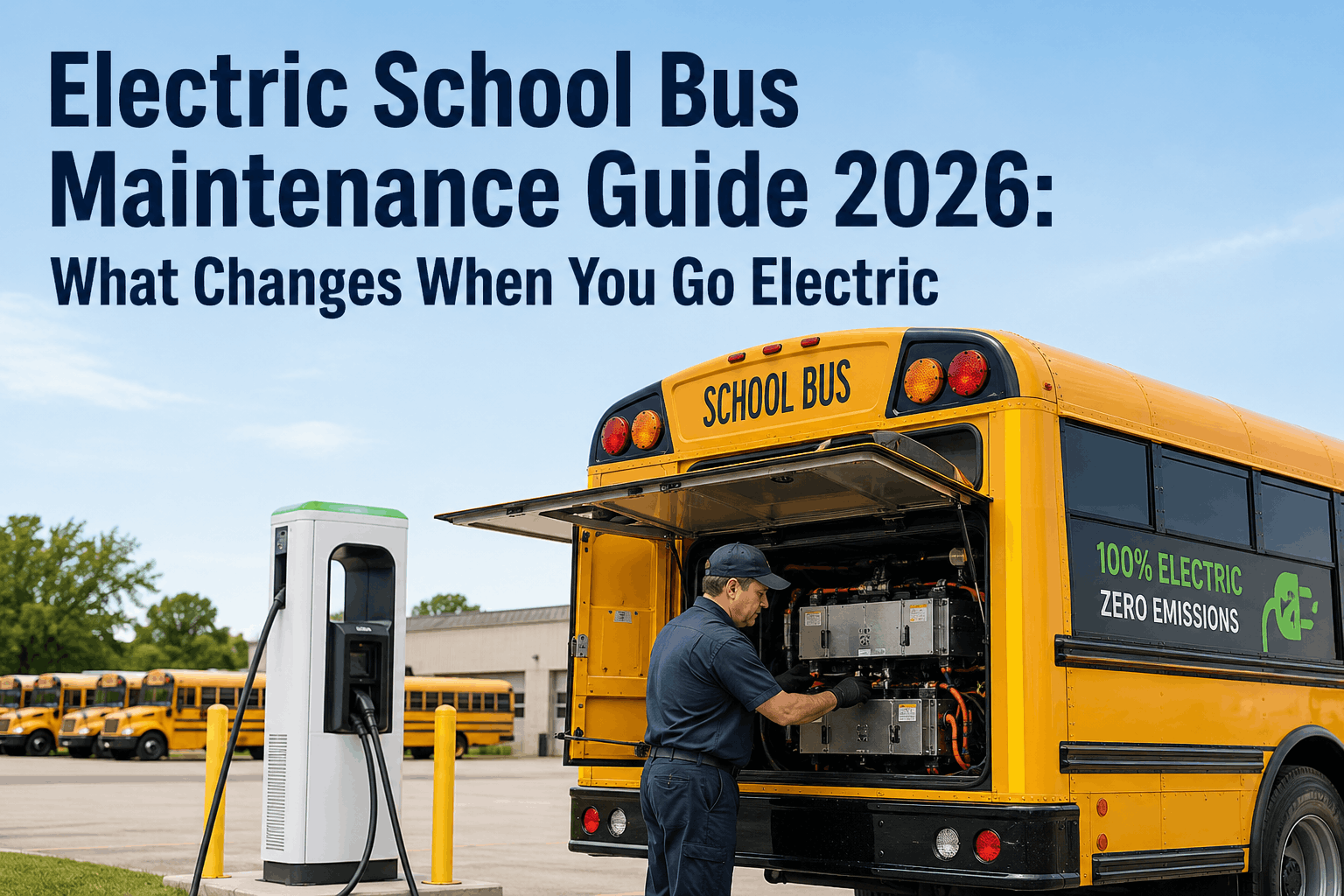
Electric school buses powered by lithium-ion battery packs eliminate engine oil, transmission fluid, spark plugs, and diesel combustion entirely, but introduce battery state-of-health monitoring, thermal management systems, regenerative braking circuit maintenance, and high-voltage electrical safety protocols that require completely redesigned maintenance procedures. A 2026 school bus fleet transitioning to electric vehicles will operate with 60% lower annual maintenance costs than diesel equivalent, but only if maintenance teams understand battery chemistry, regenerative braking wear patterns, charging infrastructure requirements, and the electric drivetrain diagnostics that traditional diesel bus mechanics have never encountered. This complete electric school bus maintenance guide covers every aspect of EV bus service scheduling, battery health monitoring through your CMMS, charging infrastructure integration, brake system differences, electrical safety procedures, cost analysis comparing electric to diesel, and how BusCMMS manages electric bus fleets differently from internal combustion vehicles.
Electric School Bus Maintenance Guide 2026: What Changes When You Go Electric
Comprehensive guide to EV school bus maintenance, battery health monitoring, charging systems, regenerative braking maintenance, and cost comparison with diesel buses for USA-based school districts and fleet operators.
Electric vs Diesel Bus Maintenance
What Maintenance Tasks Disappear When You Eliminate the Internal Combustion Engine
An electric school bus powered by a 150–300kWh lithium-ion battery pack and direct-drive electric motor requires zero engine oil changes, zero transmission fluid service, zero spark plug replacement, zero fuel filter maintenance, and zero diesel emission system service. For a typical school district operating 50 buses, this elimination of engine-centric maintenance represents 180–240 PM work orders per year that simply no longer exist in your maintenance schedule. That is not a minor efficiency gain; it is a fundamental restructuring of your fleet's maintenance labor demand. A technician who spent 40% of billable hours performing engine-related service on diesel fleets will perform substantially different work on electric buses — primarily battery thermal management, charging system diagnostics, regenerative braking circuit inspection, and high-voltage electrical systems maintenance.
Your CMMS must reflect this shift. When you configure PM templates for electric buses in BusCMMS, the system removes oil change triggers, transmission service intervals, coolant flushes, EGR system cleaning, diesel particulate filter regeneration, and all other diesel-specific maintenance. In place of that labor, you add battery health monitoring inspections quarterly, thermal coolant (cooling fluid for the battery pack, not engine coolant) level checks, high-voltage cable and connector inspections, regenerative braking system diagnostics, and charging infrastructure integration monitoring. The total labor hours per bus per year drop from an average of 24–32 hours on diesel buses to 12–16 hours on electric buses — a 50% reduction in scheduled maintenance demand.
The second major shift is safety protocol. An electric school bus contains a 300–400V high-voltage DC battery system that delivers 300–600kW of power to the motor. Working on any component connected to this system without proper lockout-tagout procedure, high-voltage PPE, and electrical safety training creates electrocution hazard. Your maintenance team needs immediate retraining on high-voltage safety, arc flash protection, and proper insulated tool usage before touching any electric bus electrical system. BusCMMS compliance modules should include mandatory high-voltage safety training checkpoints and require certification completion before technicians can be assigned to electric bus electrical work.
Battery Health Monitoring: The Core PM for Electric School Buses
The battery pack is the most expensive component on an electric school bus — representing 40–50% of the vehicle's total acquisition cost — and monitoring its state-of-health is the central PM concern for electric bus operations. Lithium-ion battery packs degrade over time through two mechanisms: cycle aging (the battery loses capacity slightly with every charge/discharge cycle) and calendar aging (the battery loses capacity simply by existing, even if not being used). A typical school bus battery pack starts with 100% rated capacity and degrades to 80% over 8–10 years of typical school bus operation — that is normal and expected. What your maintenance team must monitor is whether degradation is happening at the normal rate or at an accelerated rate indicating a developing problem.
BusCMMS battery monitoring integrates with your electric bus fleet's battery management system (BMS) — the onboard computer that monitors cell voltage, cell temperature, current flow, and cell balancing in real-time. The BMS communicates data to your CMMS through CAN-bus protocol, transmitting the battery's state-of-health (SOH) percentage, state-of-charge (SOC), temperature, and any fault codes. Your CMMS tracks this data monthly and flags any of three warning conditions: SOH degrading faster than expected (more than 3% annual loss instead of normal 5–8% per decade), any individual cell's voltage drifting above or below the normal range indicating cell failure, or temperature cycling outside acceptable bounds suggesting thermal management system failure. When any warning triggers, the system generates a battery diagnostic work order for a qualified technician to investigate and potentially perform cell balancing or thermal system service.
The PM schedule for electric school bus batteries follows a different logic than diesel engine maintenance. Instead of fixed mileage intervals, battery health monitoring is calendar-based and SOH-based. Every bus gets a quarterly battery health inspection regardless of miles driven — 20 minutes to plug a diagnostic scanner into the high-voltage connector, read BMS data, and verify all cell voltages and temperatures are within specification. If SOH drops below 85%, a more intensive diagnostic is performed. If SOH reaches 70%, the bus is flagged for potential replacement or battery pack warranty service. For buses equipped with vehicle-to-grid (V2G) charging capability, the battery is additionally monitored for the stresses introduced by V2G cycling, which can accelerate degradation if not carefully managed.
Charging Infrastructure Maintenance: Vehicle Chargers, Depot Equipment, and Electrical Safety
Charging infrastructure represents 30–50% of the total capital cost for a school district transitioning to electric bus fleets. A DC fast-charging depot installation includes utility interconnection, transformer upgrades, charging pedestals or wall-mounted chargers, vehicle-to-charger connector ports, battery energy storage systems (if using demand charge management), and backup power systems. All of this equipment requires PM and has failure modes that impact bus availability. If a charger fails, buses cannot charge overnight and cannot operate the next day. Your CMMS must manage charging infrastructure maintenance as rigorously as bus maintenance.
BusCMMS integrates with major charging infrastructure providers — Chargepoint, EVgo, Electrify America, and proprietary school district systems — to pull real-time charger operational data. The system monitors charger uptime percentage, power output consistency, connector wear cycles, and any error codes reported by the charger. When a charger falls below 98% uptime, the system flags it for preventive service. When connectors report excessive wear, a replacement is scheduled before failure. For demand charge management systems, battery energy storage state-of-health is tracked just like vehicle batteries — ensuring that the depot-level storage system is also being monitored for degradation.
Charging cable and connector inspection is a critical safety task on electric buses. High-voltage connectors on CCS (Combined Charging System) or Megawatt connectors can develop arcing faults if they accumulate moisture, corrosion, or carbon deposits. Your CMMS should require quarterly inspection of all charging connector ports on every bus — a 5-minute visual and functional check to ensure the connector seals are intact, there is no visible corrosion, and the connector physically locks and releases properly. Any connector showing wear, corrosion, or functional issues is flagged for replacement before it causes a charging failure or arc hazard.
Electric Bus Charging System Maintenance Schedule
Battery BMS Health Scan
Quarterly (every 90 days)
20 minutes per bus
High-Voltage Connector Inspection
Quarterly
5 minutes per bus
Thermal Coolant Level Check
Semi-annually (2x per year)
10 minutes per bus
Depot Charger Performance Audit
Monthly (all chargers)
30 minutes per charger
Regenerative Brake System Test
Semi-annually
45 minutes per bus
High-Voltage Cable Insulation Test
Annually
60 minutes per bus
Regenerative Braking Maintenance: Why Electric Bus Brakes Last 2-3x Longer
Electric buses use regenerative braking to capture kinetic energy during deceleration and convert it back into electrical energy stored in the battery. This reduces mechanical brake wear by 70–80% compared to conventional diesel buses. A diesel school bus stopping from highway speed to a complete stop dissipates all of that kinetic energy as heat in the brake rotors and pads. An electric bus captures most of that energy through the electric motor running in reverse (generator mode), and only uses mechanical friction brakes for the final 20–30% of stopping force. The result: mechanical brake pads and rotors on electric buses typically last 200,000+ miles compared to 80,000–120,000 miles on diesel buses.
However, regenerative braking introduces new maintenance concerns. The regenerative braking circuit includes high-voltage contactors, power electronics, and software logic that must function correctly to engage regen braking. If the system fails, the bus falls back to 100% mechanical braking, reducing fuel efficiency and accelerating brake wear. Your CMMS must schedule semi-annual regenerative braking system tests — a technician drives the bus through controlled deceleration testing to verify the system is engaging regen braking and disengaging mechanical brakes appropriately. The test is performed using onboard diagnostics that measure motor current, battery charge rate, and brake pressure during the test. Any deviation from specification indicates a regen system fault requiring repair.
Mechanical brake maintenance on electric buses is minimal but still necessary. Brake fluid still requires periodic flushing (every 3 years instead of every 2 years for diesel buses) because electric buses generate less heat in the brake system, reducing fluid degradation. Brake pads still need occasional replacement when they wear below minimum thickness — but that replacement happens every 150,000+ miles instead of every 80,000 miles. Your CMMS should track brake pad wear by measuring remaining friction material thickness during every PM inspection, and schedule replacement only when thickness reaches the 3mm replacement threshold — not on a fixed schedule that might remove pads that still have 50,000 miles of service remaining.
Electric Buses Require 50% Fewer PM Visits. BusCMMS Manages the Difference.
Battery health monitoring, charging infrastructure integration, regenerative braking diagnostics, and high-voltage electrical safety are completely different from diesel bus maintenance. BusCMMS includes pre-configured electric bus PM templates covering every EV-specific service, with automatic alerts when battery state-of-health degrades or charging infrastructure requires service.
High-Voltage Electrical Safety: Training, PPE, and Lockout-Tagout Procedures
Any technician performing work on an electric school bus's electrical system must complete specialized high-voltage electrical safety training covering arc flash hazard assessment (NFPA 70E), insulated tool usage, personal protective equipment (PPE) requirements, and lockout-tagout (LOTO) procedures specific to high-voltage DC systems. This is not optional. Federal OSHA regulations require documented training for any employee working on circuits over 50V. Electric school buses contain 300–400V systems, far exceeding that threshold. A single uncontrolled contact with a 400V battery terminal can deliver 40,000+ watts of instantaneous power, causing third-degree burns in milliseconds and cardiac arrest.
BusCMMS compliance and training modules should track high-voltage safety certifications for every technician, with mandatory renewal every 24 months. When work orders for high-voltage electrical systems are generated, the system checks that the assigned technician has current high-voltage safety certification — if not, the work order is flagged for reassignment. For technicians performing major high-voltage work (battery pack replacement, motor controller service, charging system installation), annual skills assessment and hands-on practical testing should be required, not just classroom certification.
LOTO procedures for electric buses require de-energizing the high-voltage battery pack before any work begins. The high-voltage disconnect switch must be physically moved to the off position, the battery terminals must be shorted together to dissipate residual charge, and a LOTO device must be placed on the disconnect switch preventing anyone from re-energizing the battery. This procedure typically takes 10–15 minutes but is mandatory safety protocol. BusCMMS work orders for high-voltage systems should include a pre-work checklist requiring the technician to document that LOTO procedure has been completed and witnessed by a second qualified person before actual service work begins.
Cost Analysis: Electric Bus Lifetime Maintenance vs. Diesel Equivalent
A new diesel school bus costs $150,000–$180,000 and requires $4,200–$6,800 per year in maintenance over a 13-year lifespan — totaling $54,600–$88,400 in accumulated maintenance. A new electric school bus costs $220,000–$280,000 (higher acquisition cost, offset by EPA Clean School Bus grants covering 50–100% for eligible districts) and requires $1,800–$2,800 per year in maintenance — totaling $23,400–$36,400 in accumulated maintenance. The electric bus eliminates $31,200–$52,000 in lifetime maintenance costs compared to diesel equivalent, even accounting for battery replacement (which is often covered under manufacturer warranty for 8–10 years).
The maintenance cost advantage for electric buses comes from two sources: (1) elimination of engine maintenance (oil changes, transmission service, fuel filters, emission system cleaning), and (2) extended component lifespan (brake pads lasting 2–3x longer, reduced wear on suspension and bearings due to lower engine vibration). For a 50-bus school district, transitioning to 50% electric buses (25 vehicles) saves $390,000–$650,000 in cumulative maintenance costs over the fleet's lifespan. This savings can be used to fund charging infrastructure maintenance, technician high-voltage training, and specialized diagnostic equipment without increasing the overall maintenance budget.
One cost consideration often overlooked: battery replacement. While most electric buses are warranted against capacity loss below 70% for 8–10 years, replacement batteries cost $60,000–$120,000 per pack when warranty expires. This represents a major expense late in the bus's life. However, many second-life battery applications — stationary energy storage, grid support systems — create a secondary market for EV batteries, potentially recovering 30–50% of replacement costs through battery resale. As EV adoption accelerates across school districts, a robust used battery market will emerge, reducing net replacement costs significantly.
10-Year Maintenance Cost Comparison: Electric vs. Diesel School Bus
Technician Training: From Diesel Mechanics to EV Service Specialists
A school district transitioning to electric buses will face technician skill gaps. A diesel bus mechanic has expertise in internal combustion engines, fuel systems, transmissions, and emission control systems — none of which exist on electric buses. High-voltage electrical systems, battery management systems, motor controllers, and regenerative braking circuits represent an entirely new technical domain. Your maintenance team will need comprehensive retraining before electric buses enter service.
Mandatory training topics include: electric bus architecture and subsystems overview (2 days), high-voltage electrical safety and NFPA 70E compliance (2 days), battery management systems and battery health diagnostics (2 days), charging systems and infrastructure (2 days), regenerative braking system operation and diagnostics (1 day), vehicle electrical systems and CAN-bus diagnostics (2 days), and hands-on service labs with actual electric bus components (3 days). Total training requirement: 14 days per technician before they can be assigned to electric bus service work independently. BusCMMS should track completion of each training module for every technician and prevent work order assignment until training is current.
For your first electric buses entering service, I recommend assigning one or two "lead technicians" to complete more intensive training (20–30 days including certification programs) and then have them lead on-the-job training for the broader maintenance team. This creates internal expertise and reduces long-term reliance on vendor-provided training. Many electric bus manufacturers — Lion Electric, Proterra, Thomas Built Buses — offer comprehensive technician certification programs that award credentials recognized across the industry and improve technician retention.
Frequently Asked Questions: Electric School Bus Maintenance and Operations
How often does an electric school bus battery need replacement?
Most electric buses are warranted against capacity loss below 80% for 8–10 years. Replacement is typically needed only if capacity degrades abnormally, not at fixed intervals. Normal end-of-life batteries degrade to 70–80% capacity over 10+ years of operation.
Do electric buses require oil changes?
No — electric buses have no internal combustion engine, so zero oil changes are required. The only fluid maintenance is thermal coolant level checks (cooling the battery pack) and brake fluid flushing every 3 years.
How much training do technicians need before servicing electric buses?
Approximately 14 days of comprehensive training covering high-voltage safety, battery systems, charging infrastructure, and regenerative braking is required before independent service work. Ongoing skills development and annual refresher training recommended.
What happens to electric bus brake pads compared to diesel buses?
Regenerative braking reduces mechanical brake usage by 70–80%, extending brake pad lifespan from 80,000–120,000 miles (diesel) to 200,000+ miles (electric). Pads are replaced based on wear measurement, not fixed schedule.
Can BusCMMS manage mixed fleets of diesel and electric buses?
Yes — BusCMMS maintains separate PM templates and trigger logic for diesel, CNG, and electric buses. Each vehicle type has its own maintenance schedule managed in a single unified CMMS platform.
What is a battery management system (BMS) and how does it connect to CMMS?
The BMS is the onboard computer monitoring battery health, charging, and temperature. BusCMMS integrates with BMS via CAN-bus protocol to receive real-time battery state-of-health data and flag maintenance alerts when battery degradation accelerates.
Are electric buses more reliable than diesel buses?
Electric buses have fewer moving parts and no engine, reducing unplanned failure rates by 40–50%. Reliability depends on proper battery and charging infrastructure maintenance, not engine condition.
What is regenerative braking and why does it matter for maintenance?
Regenerative braking converts deceleration into electrical energy, reducing mechanical brake wear by 70–80%. The system must be tested semi-annually to ensure it engages correctly and reduces fuel consumption.
When we deployed our first 12 electric buses, I was worried about technician skill gaps and unknown repair costs. But after six months of operation, we've actually done less maintenance per bus than our diesel fleet — no oil changes, no transmission service, no fuel system work. The biggest expense is training, not repairs. BusCMMS made the transition manageable by giving us a clear PM schedule for electric buses that our technicians could follow immediately. Now we're adding 15 more electric buses to the fleet next year.
Electric Buses Eliminate Engine Maintenance. BusCMMS Handles the Difference.
Electric school buses require 50% fewer PM visits than diesel equivalents, but demand different maintenance expertise — battery health monitoring, charging infrastructure management, regenerative braking diagnostics, and high-voltage electrical safety. BusCMMS includes pre-built electric bus PM templates, battery state-of-health integration, charging system monitoring, and technician certification tracking for high-voltage work. Transition to electric with confidence.