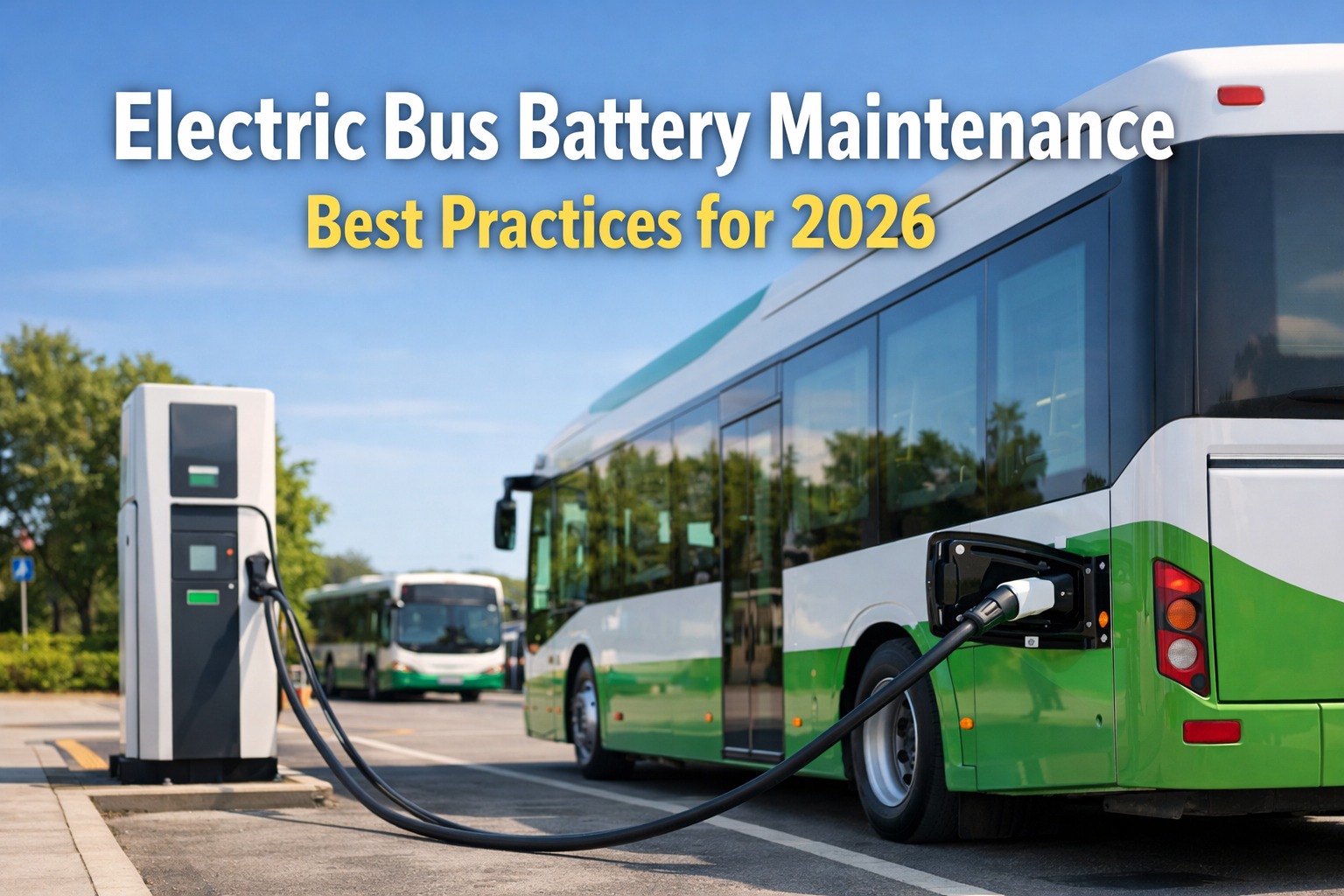
Electric bus battery maintenance in 2026 requires a strategic approach that goes far beyond basic charging. This electric bus battery maintenance guide delivers the proven protocols, monitoring techniques, and care practices that extend battery life from 8 years to 15+ yearsprotecting your $150,000 to $250,000 battery investment in each vehicle.
Electric bus battery maintenance 2026 best practices are now backed by real fleet data: buses following optimized battery maintenance protocols show just 7.2% capacity loss after five years. This comprehensive electric bus battery maintenance guide covers charging management, thermal control, health monitoring, and lifecycle planning—the complete battery maintenance framework that separates high-performing electric bus fleets from those struggling with premature degradation and unexpected failures.
Battery Health Metrics for Maintenance
Effective electric bus battery maintenance starts with understanding two critical metrics. SOC tells you what charge you have right now; SOH tells you how much capacity you're losing over time—both essential for battery maintenance decisions.
How much energy is currently stored—like a fuel gauge. Changes with every charge and discharge cycle.
Current maximum capacity vs. original capacity. This only goes down—it's what "degradation" measures.
Here's why both matter for battery maintenance: A bus at 92% SOH charged to 80% SOC has effectively 73.6% of original range (0.92 × 0.80). As SOH declines, you need higher SOC to maintain the same operational range—creating a balancing act that intelligent battery maintenance CMMS platforms help you manage automatically.
5 Battery Maintenance Factors That Control Longevity
Electric bus battery maintenance success depends on controlling five key factors. Master these battery maintenance fundamentals, and you maximize your investment.
Charging Speed
Level 2 charging (≤19.2kW) extends battery life significantly. Frequent DC fast charging accelerates degradation—reserve it for operational emergencies only.
Operating Temperature
Batteries perform best between 15-35°C (59-95°F). Outside this range, chemical reactions accelerate that permanently reduce capacity.
SOC Operating Range
Operating between 20-80% SOC minimizes stress on battery cells. The 20-80 rule isn't arbitrary—it's based on lithium-ion chemistry.
Storage State
High SOC during extended storage accelerates calendar aging. For buses parked 48+ hours, target 50-60% SOC—not full charge.
Cycle Depth
Shallow cycles (30-70%) cause less wear than deep cycles (0-100%). Each full cycle counts against total battery life.
Managing all five battery maintenance factors manually is nearly impossible across a growing fleet. Sign up for BusCMMS to automate battery maintenance tracking and get real-time alerts when any factor drifts outside optimal ranges.
Battery Maintenance: Charging Best Practices
Charging management is the most critical aspect of electric bus battery maintenance. The 2025 Geotab study of 22,700 EVs proved what battery maintenance experts suspected: charging strategy alone creates a 12-point SOH difference after eight years.
8-Year Battery Health by Charging Strategy
Source: Geotab 2025 analysis of 22,700 electric vehicles
Charging Protocol Checklist
Smart charging isn't just about battery maintenance—time-of-use rates can vary 300% between peak and off-peak hours. Start tracking battery maintenance charging costs with BusCMMS →
Battery Maintenance: Thermal Management
Temperature control is essential for electric bus battery maintenance. Lithium-ion cells perform best and degrade slowest within a specific window—proper thermal maintenance prevents chemical reactions that permanently reduce capacity.
Battery Operating Temperature Zones
Cold Weather Strategies
- Pre-condition batteries before departure
- Store buses in heated depots when possible
- Reduce fast charging frequency in extreme cold
- Remember: cold capacity loss is temporary, not permanent
Hot Weather Strategies
- Park in shade during layovers
- Charge during cooler evening hours
- Monitor thermal management system alerts closely
- Ensure cooling system maintenance is current
Want to see how temperature tracking works in practice? Schedule a 15-minute demo to see BusCMMS thermal monitoring dashboards and automated alert systems that protect your battery investment.
Automate Your Battery Maintenance Program
BusCMMS monitors SOC, SOH, temperature, and charging patterns for every bus in your fleet. Get automated battery maintenance alerts when metrics drift—before problems become expensive repairs.
Battery Maintenance Monitoring
Effective electric bus battery maintenance requires consistent monitoring. Modern battery management systems track dozens of parameters, but fleet managers should focus on the metrics that predict maintenance needs.
Cell Voltage Balance
Uneven voltages indicate degradation. Keep spread within 50mV across cells.
Temperature Spread
Variation across pack indicates cooling issues or uneven loading.
SOH Trend Analysis
Track monthly. Sudden drops (>2%/month) require investigation.
Charge Cycle Count
Most batteries rated 2,000-5,000 cycles. Track against warranty.
Internal Resistance
Rising resistance reduces efficiency. Compare against baseline readings.
BMS Fault Codes
Track and correlate with maintenance events. Patterns reveal systemic issues.
Tracking these six metrics manually across a fleet of 20, 50, or 100+ buses is overwhelming. That's why leading fleet managers sign up for BusCMMS—our battery maintenance dashboard consolidates all metrics in one view with automated alerts when values exceed thresholds.
Advanced battery maintenance monitoring systems can detect capacity degradation as small as 0.5%, enabling proactive maintenance before performance impacts become noticeable. See how BusCMMS battery maintenance analytics work →
Battery Maintenance Lifecycle Planning
Smart electric bus battery maintenance includes planning for the entire lifecycle—from commissioning through potential second-life applications.
Commissioning
Verify BMS calibration, establish SOH baseline, document warranty terms
Peak Performance
Expect 92-95% SOH. Focus on optimizing charging and thermal management
Managed Decline
SOH typically 80-92%. May need route reassignment for faster-degrading buses
End of Vehicle Life
SOH approaches 70% threshold. Evaluate second-life or recycling options
Battery Maintenance Second-Life Opportunity
Batteries reaching 70% SOH through proper battery maintenance aren't suitable for demanding transit operations but remain valuable for stationary energy storage. Many fleets now partner with energy companies to monetize retired batteries rather than paying for disposal—turning a battery maintenance cost center into a revenue stream.
Planning for battery lifecycle requires accurate historical data. Schedule a demo to see how BusCMMS tracks degradation trends and generates Remaining Useful Life (RUL) projections that support warranty claims and replacement budgeting.
Battery Maintenance Schedule
Swipe to view full table →
Following this battery maintenance schedule consistently is what separates fleets achieving 15-year battery life from those replacing batteries at year 8. Start your free BusCMMS trial and let automated reminders ensure no battery maintenance task falls through the cracks.
Automate Your Electric Bus Battery Maintenance
Stop tracking battery maintenance in spreadsheets. BusCMMS automates SOH monitoring, sends battery maintenance alerts when metrics drift, and generates the reports you need for warranty claims and lifecycle planning.
Electric Bus Battery Maintenance: The Bottom Line
Electric bus battery maintenance in 2026 isn't complicated—it's consistent. Proper battery maintenance means charging smart (Level 2 when possible, 80% target), managing temperature (15-35°C), monitoring health metrics monthly, and planning for the full lifecycle. Fleets following these battery maintenance practices achieve 29% better longevity and eliminate range anxiety. Your battery maintenance investment will reward the attention you give it.
Electric Bus Battery Maintenance FAQs
What is the expected battery lifespan with proper maintenance?
With proper battery maintenance, electric bus batteries typically last 12-15 years before reaching the 70% SOH replacement threshold. Real-world data from 847 buses shows average degradation of just 7.2% after five years when following recommended battery maintenance protocols. Most batteries will outlast the typical 12-year bus replacement cycle with optimized charging and thermal management practices.
How does charging affect battery maintenance?
Charging management is the most critical battery maintenance factor. Charge to 100% only when your route absolutely requires full range. For daily operations, targeting 80% SOC as part of your battery maintenance routine extends battery life significantly while providing adequate range for most routes. If you size your fleet for 150% of required daily range, you'll rarely need full charges.
Does cold weather require special battery maintenance?
Cold weather battery maintenance focuses on understanding that capacity loss is temporary, not permanent. A bus showing 85% capacity at -10°F will return to 98% capacity at 70°F. However, proper battery maintenance requires pre-conditioning batteries before charging in freezing temperatures to prevent permanent damage.
When does battery maintenance indicate replacement is needed?
Battery maintenance monitoring should trigger replacement discussions when SOH reaches 70%—the industry standard threshold. However, if a bus can't complete its assigned route with comfortable margin, your battery maintenance data may indicate earlier replacement or route reassignment. Track SOH trends monthly as part of battery maintenance to predict replacement timing 6-12 months in advance.
Is fast charging bad for battery maintenance?
Frequent DC fast charging complicates battery maintenance by accelerating degradation. Data shows buses using primarily high-power DC charging reach 76% SOH after eight years, while those following battery maintenance best practices with Level 2 charging maintain 88% SOH—a 12-point difference. Reserve fast charging for emergencies and use Level 2 chargers for depot overnight charging.