Your electric bus rated 140 miles in June. By January it's holding 90. Cabin heat draws 4 kW continuous. DCFC on a cold-soaked battery charges 40% slower. This 2026 guide covers what happens to EV buses in cold weather -- and the fleet playbook that keeps them on route through February. Track winter range per bus in BusCMMS → book a 20-min demo.
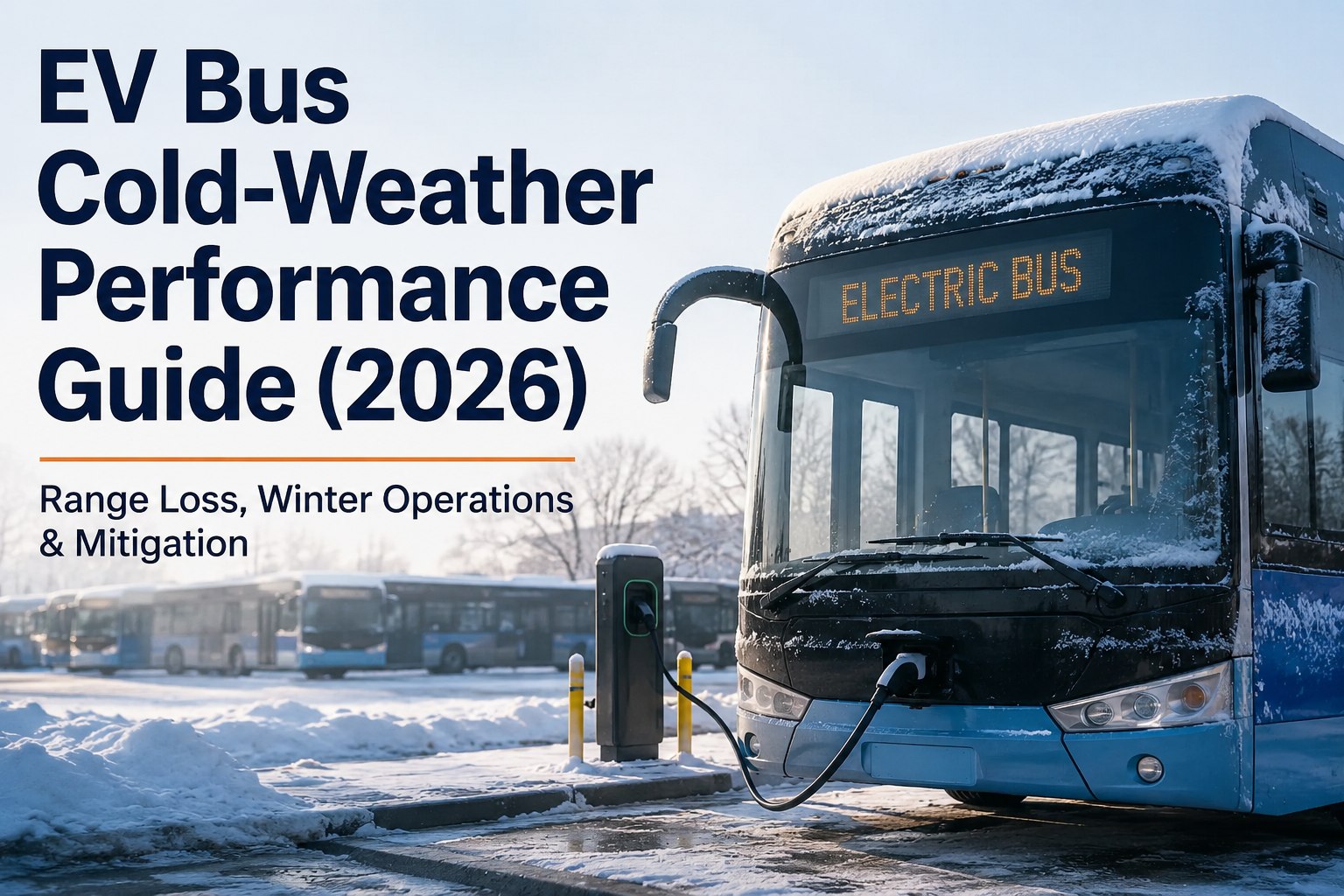
EV Bus Cold-Weather Performance Guide
Range loss, thermal management, preconditioning, and winter charging -- everything districts need to keep electric buses running when the mercury drops.
Where the Missing Kilowatts Actually Go
Cold weather doesn't drain the battery -- three specific systems do.
70°F Baseline
20°F Reality
Cornell/TCAT finding: Half of cold-weather energy loss goes to the battery heating itself. A resistive cabin heater alone pulls 3–5 kW continuously -- roughly the same as driving 30 mph on a flat road.
Cabin Heat: 3 Ways to Warm the Bus
Your heater choice defines your winter range.
Resistive Electric
- Standard on most 2018–2022 EV buses
- Direct battery energy conversion
- Simple, cheap, reliable
- Biggest winter range killer
Heat Pump
- Standard on 2023+ premium EV buses
- 2–3x efficiency of resistive
- Efficiency drops below 5°F
- Best winter range preservation
Auxiliary Fuel Heater
- 5–gal diesel or biodiesel tank
- Deployed in 7+ IL districts (2020)
- Battery reserved for propulsion
- Emissions still 90%+ lower than diesel bus
Auxiliary heaters need PM tracking like any fuel-fired appliance. See aux heater PM built into your EV bus schedule → book a demo.
Preconditioning: The Single Biggest Win
Warm the battery and cabin while plugged in -- not off the pack.
Plugged In & Charged
Bus finishes charging on L2 or DCFC overnight. State of charge sits at 90–100%.
Precondition Scheduled
60–90 min before route start, warm-up cycle begins. Battery heats to 60°F, cabin to 65°F.
Energy from the Grid
All the warming energy pulls from the charger, not the battery. State of charge stays at 100%.
Route Starts Warm
Bus leaves the depot with a warm pack and warm cabin. Winter range loss cut by up to 30%.
Daimler's "Ready to Run" and equivalent OEM features do this automatically -- but only if the bus is still plugged in. Districts that unplug at 5am and let buses cold-soak until 6:30am route start lose the benefit entirely.
Real District Performance in Real Cold
What actually happens when the mercury drops.
-30°F to 5°F winter mornings
One of the coldest districts in Colorado. Director of transportation reports the EV bus is the best-performing bus in the fleet, with much lower operating costs than diesel counterparts.
Vermont mountain winters
A 25% range reduction against rated capacity -- still more than 2x headroom above daily route needs. DEC evaluation confirmed reliable winter service.
Buffalo lake-effect winters
NYSERDA data across dozens of districts. Documented complaints where drivers turned off cabin heat to preserve range -- a preconditioning + aux heater problem, not an EV problem.
Winter range varies by bus even in the same fleet. Log actual mi/kWh per bus per cold day → sign up free.
Route Planning by Temperature Band
Your route buffer isn't the same in July as in January.
Baseline Operation
Full rated range available. Standard route length applies.
Mild Cold
Cabin heat kicks in. Battery still efficient. Precondition recommended.
Standard Winter
Battery TMS active. Cabin heat continuous. Precondition mandatory.
Deep Cold
Aux fuel heater helps if equipped. Watch charging speed.
Extreme Cold
Buses stored indoors overnight. Route swaps to shorter runs.
Plan winter routes at 50–70% of rated range -- not 90%. See per-bus winter range logged in BusCMMS → book a demo.
Winter Charging: What Changes When It's Cold
Cold batteries don't just discharge slower -- they charge slower too.
Overnight L2 in Cold
- Slower L2 charging keeps battery cool & healthy
- Bus stays plugged in for preconditioning window
- Depot power draw stays predictable
- Battery cycles gently, extending life
Midday DCFC Top-Up
- Cold-soaked battery accepts DCFC 30–50% slower
- Battery TMS must warm pack before full charge rate
- Precondition battery on the drive in
- Plan an extra 15–20 min buffer
DCFC on Cold-Soaked Pack
- Charging a <20°F battery at full DCFC stresses cells
- Repeated cold DCFC accelerates degradation
- Cabin heat drawn from grid, not pack, during charge
- Warm the pack first, then push amps
Battery degradation warning: Repeated fast-charging cold-soaked packs is one of the fastest ways to shorten EV bus battery life. Warranty coverage may exclude damage from cold-charging misuse.
Cold-charging protocol needs to be a daily task, not tribal knowledge. See EV winter protocols in your dashboard → book a demo.
Where BusCMMS Fits an EV Fleet in Winter
Preconditioning, charging, aux heater PM -- one dashboard.
Preconditioning Schedule
Daily task per bus with alerts on missed cycles. Verified against actual departure time.
Winter Range Tracking
Actual mi/charge logged per bus per temperature band. Route planning gets real data.
Aux Heater PM
5-gallon fuel-fired heaters need filter and glow-plug service. Templated in the schedule.
Charger Uptime
Chargers tracked as maintained assets. No more surprise 6am dead bus.
Battery Health Log
SOC, SOH, thermal alerts pulled from OEM APIs into work orders.
Cold-Weather Playbook
Winter DVIR items, extreme-cold protocols, indoor storage flags -- pre-loaded.
First winter with the electric buses, we lost half our range in the first cold snap and everyone panicked. Board thinking we'd made a $340K mistake. Turns out we were unplugging at 4:30am and letting the buses cold-soak until 6am route start. Added preconditioning to the daily task list in the CMMS -- driver checks the bus preheated on the wake-up cycle. Winter range came back to 85%. Same buses, same weather, same batteries. Just a workflow fix.
Frequently Asked Questions
How much range does an EV bus lose in cold weather?
Typical winter range loss for electric school and transit buses runs 15–30% depending on temperature, heater type, and route conditions. NYSERDA data shows EV buses hold 70–80% of rated range in standard cold weather and 50–60% in extreme conditions. A U.S. Department of Energy study on a battery-electric transit bus showed a 33% range decrease at 25°F versus its 55–60°F ideal. A Cornell/TCAT study of transit buses over two winters found 48% more energy consumption between -4 and 0°C (roughly 25–32°F). Districts in Colorado operating at -30°F still report only 10–15% capacity loss on the pack itself, with the rest of the winter range hit coming from cabin heating and battery thermal management.
Can electric school buses actually operate in cold-weather climates?
Yes, and they already do reliably. West Grand County School District in Colorado has run electric school buses through -30°F to 5°F winter mornings since 2020 and reports the EV bus is the best-performing vehicle in their fleet. Barre, Vermont buses average 74–78 winter miles per charge against 32–37 mile daily route needs -- more than 2x headroom. Buses are running in Michigan, Utah, Minnesota, upstate New York, and across cold-climate Canada. Success comes from proper operational planning: preconditioning while plugged in, aux fuel heaters where fitted, winter route buffers, and indoor overnight storage in extreme conditions. The buses themselves are not the limitation.
What is EV bus preconditioning and why does it matter?
Preconditioning is warming the battery pack and cabin to operating temperature while the bus is still plugged into the charger, so that heating energy comes from the grid rather than the battery. A cold-soaked pack at 20°F needs to warm itself and heat the cabin off its own capacity, which can consume 15–25% of the pack before the bus leaves the depot. A preconditioned bus starts its route with a warm pack, a warm cabin, and 100% state of charge -- cutting winter range loss by up to 30% versus a cold-start departure. Daimler's "Ready to Run" feature and equivalent OEM automations do this on a schedule, but only if the bus remains plugged in until preconditioning finishes.
Do heat pumps or resistive heaters work better for EV buses in winter?
Heat pumps use 2–3x less battery energy than resistive electric heaters, typically drawing 1–2 kW continuously versus 3–5 kW for resistive. That translates directly into extended winter range. However, heat pump efficiency drops sharply below approximately 5°F, which is why premium EV bus specs increasingly pair a heat pump with an auxiliary fuel-fired heater (typically a 5-gallon diesel or biodiesel unit) for deep-cold operations. Districts that specified resistive-only heaters in 2018–2022 orders can retrofit auxiliary fuel heaters as a range-preservation upgrade -- deployed successfully in seven Illinois districts starting in 2020.
Is it safe to fast-charge an EV bus in cold weather?
A cold-soaked battery pack accepts DC fast charging 30–50% slower than a warm pack and repeated fast-charging of a cold battery accelerates degradation. Best practice is to precondition the battery on the drive to the charger or through the vehicle's thermal management system before initiating a high-rate charge. Overnight Level 2 charging is preferred in winter because it warms the battery gently, keeps the bus plugged in for morning preconditioning, and produces predictable depot power draw. DCFC top-ups mid-route are workable but need a 15–20 minute buffer built into the schedule, and warranty coverage may exclude damage from repeated cold-battery fast charging.