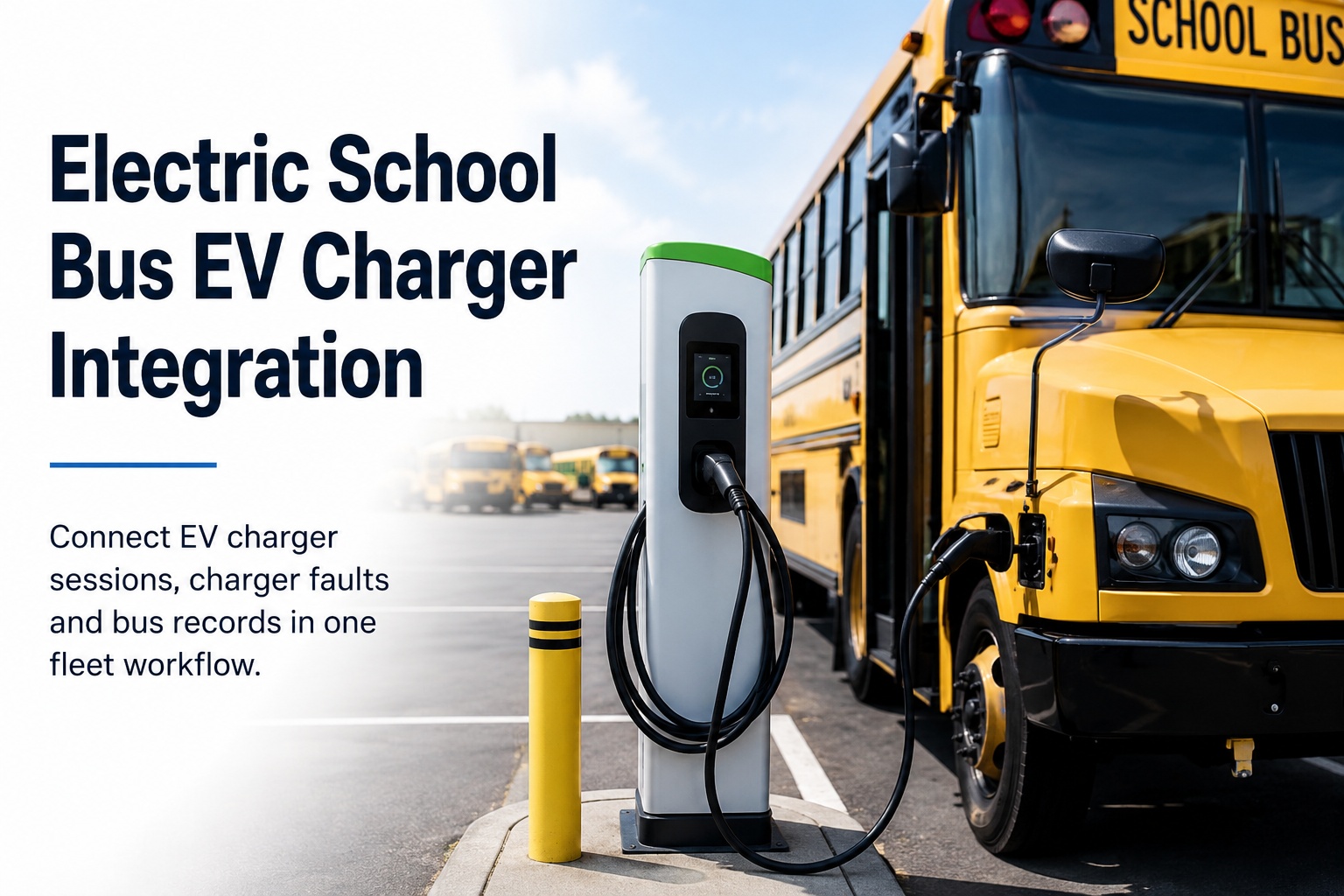
EV charger integration for fleets connects charging infrastructure data with the fleet system tracking each bus — so a failed overnight session or charger fault doesn’t sit in a separate portal until morning. Done right, a charger event lands on the correct bus record alongside that bus’s DVIRs, defects, and maintenance history, triggering an alert or work order before the vehicle is missed on the route board at 5:30 AM. This guide walks the data flow, the identifier-mapping problem that trips up most first attempts, the architecture options your IT team should ask about, and a 10-bus pilot framework with measurable gates. Book a walkthrough to see charger events on a live bus record.
Electric School Bus EV Charger Integration
A technical integration guide for district IT teams, fleet technology managers, and electric bus program leads — what data flows between charger, telematics, and fleet systems, why identifier mapping matters, and how to pilot the connection before scaling.
Why One Bus Timeline Beats Four Separate Portals
Electric school bus adoption is moving fast enough that the electric school bus fleet software integration question can’t wait. According to WRI’s Electric School Bus Initiative, more than 8,500 electric school buses were operating nationwide as of June 30, 2026, with 14,146 total committed across 49 states, DC, four U.S. territories, and more than 20 Tribal Nations. That’s the point where isolated charger portals stop being tolerable — a district with 40 electric buses across four separate tracking systems creates a full-time reconciliation job operations doesn’t have.
- 05:42DVIRPre-trip inspection submitted, no defects
- 14:18CAMERAStop-arm event flagged, video attached
- 15:20DVIRPost-trip inspection, defect noted on aux battery
- 22:15CHARGECharging session started on Charger 4B
- 02:47FAULTSession interrupted, communication error, 62% charge
- 03:00ALERTBus not ready for AM route, work order auto-created
Read the timeline. Every event above happened to the same vehicle in a 24-hour window — inspections, camera flag, charging session, fault interrupting that session at 2:47 AM, and the 3:00 AM alert that this bus needs a swap before the 6 AM run. Without integration, those six events live in four separate systems. Nobody notices bus 2841 isn’t ready until the driver climbs in at 5:30 AM. Book a walkthrough to see the unified bus timeline live.
The Identifier Mapping Problem — Where Most Integrations Fail
Ask any team that’s attempted EV charger integration for fleets or school bus telematics integration what broke first — the answer is nearly always identifiers. The bus your CMMS calls “Bus 2841” is “VIN 1BAKG..” to the telematics provider and “asset A-847-EV” to the charging platform. Every event has to reconcile against those three identifiers reliably, or events land on the wrong bus or nowhere at all. This is the technical crux of electric school bus charger integration.
- FLEET CMMS→Bus 2841
- TELEMATICS→VIN 1BAKG...
- CHARGER PLATFORM→Asset A-847-EV
- MAPPING TABLE=All three → Bus 2841
A good integration establishes one canonical identifier per bus (typically the VIN) and maintains a mapping table connecting whatever the charger and telematics platforms use. Every incoming event runs through the table before landing on a bus record. It breaks the first time a charger is swapped, a bus retired, or a VIN typed wrong. Ask each vendor how they handle these cases. Book a walkthrough to see the identifier mapping model.
Charger Fault to Work Order — The Operational Workflow
The point of charger telematics integration isn’t just visibility — it’s that a charger fault at 2:47 AM becomes a resolvable maintenance event inside your electric bus maintenance software before the AM route board goes red. Five steps, each automated where the integration is designed correctly.
- 1
Charger detects fault
Communication error, incomplete session, or ground fault. Charger platform records the event with charger ID and timestamp.
- 2
Event flows to fleet system
Via API, webhook, or scheduled sync. Fault plus session data lands in fleet CMMS via identifier mapping.
- 3
Alert generated for readiness risk
If the fault interrupts a session below a readiness threshold, an alert routes to operations before AM route dispatch.
- 4
Technician review, work order created
Technician reviews the fault. If it requires bus-side inspection or charger diagnosis, a work order attaches to the vehicle record.
- 5
Resolution logged on asset timeline
Repair, replacement, or resolved-no-action becomes part of the bus’s permanent history. Next similar fault has context.
The most common failure across districts running electric buses without integration is Step 3 — the alert never happens because nobody watched the charger portal at 3 AM. By 6 AM the driver reports the bus dead and the route disrupts. Integration turns overnight into daylight. Book a walkthrough to see the fault-to-work-order flow on your fleet setup.
Integration Architecture — What to Ask Vendors For
Four architectural approaches cover most EV fleet charging integration scenarios. Which fits depends on real-time requirements, IT capacity, and what your charger vendor exposes. Ask each vendor which they support and how their approach handles failure modes.
-
01 API-to-API
Direct connection between charger platform and fleet CMMS. Real-time or near-real-time data flow both ways. Highest fidelity, requires both vendors to expose APIs and maintain them.
BEST FOR: Districts needing readiness alerts before AM dispatch, both vendors offer stable APIs
-
02 Webhook / Event-Based
Charger platform pushes event notifications to fleet system as they happen. Lower resource overhead than polling. Requires webhook support on the source side.
BEST FOR: Fault and session-end events specifically, charger platforms that support outbound webhooks
-
03 Middleware Layer
A middleware service (custom or platform) sits between systems, normalizing formats and handling identifier mapping. Adds cost and a component to maintain, but shields both endpoints from each other’s changes.
BEST FOR: Multiple charger brands on the same fleet, older systems without modern APIs
-
04 Scheduled File Exchange
Charger platform exports session data on a schedule (typically overnight or hourly). Simpler to build, but fundamentally reporting-oriented rather than operational. Alerts always lag by the sync interval.
BEST FOR: Historical reporting only, districts not yet ready for real-time operational alerts
Note approach four. Districts starting an EV program often accept scheduled file exchange because it’s cheapest to build — then six months in, the first missed AM route traces to an overnight fault that arrived in the daily export six hours after dispatch. That’s the difference between reporting integration and the operational integration real electric bus fleet management requires. Industry protocols like OCPP standardize charger-side exchange, but actual support varies by vendor and firmware — verify what your provider supports before scoping. Sign up free to explore the fleet-side of the integration.
Data Quality Checklist — Test Before Deployment
Every EV charger integration for fleets eventually surfaces the same data quality problems. Test for them during the pilot, not after go-live. If a vendor can’t answer these clearly, that’s the answer.
Identifier mapping accuracy
Every charging session lands on the correct bus record every time. Zero orphaned sessions after 30 days.
Fault code fidelity
Charger fault codes transmit intact and map to consistent categories on the fleet side. No lost detail.
Timestamp consistency
Event timestamps arrive in a consistent timezone, matched to your operational clock. No UTC-vs-local drift.
Duplicate prevention
Retries and reconnects don’t create duplicate session records. Idempotent event handling on the fleet side.
Synchronization latency
Measure actual event-to-visible time under real conditions. If the SLA says 60 seconds and the test says 15 minutes, that’s the number.
Historical data completeness
Confirm what happens when a session or fault is missed. Backfill mechanism exists and works.
Failure mode visibility
When the integration itself breaks, someone knows within an hour. Silent failures are the enemy.
Data export and ownership
You can export integrated data on demand, and you retain rights to it if either vendor is replaced.
The 10-Bus Pilot — Gates That Have to Pass
A structured 60-90 day pilot on 10 electric buses with associated charging infrastructure is the right entry point. Not a proof-of-concept slide deck — a real, measured pilot with clear gates. If the pilot doesn’t hit these, don’t scale.
- Identifier mapping accuracy100% over 30 days
- Charging session capture rate>98% of sessions logged
- Fault-to-alert latencyUnder 5 minutes
- Duplicate rateZero duplicates in 30 days
- Work-order creation on qualifying faults100% automated where configured
- AM readiness accuracyZero surprise not-ready buses
That’s the failure mode nobody plans for and everybody hits once. Silent failures are worse than loud ones because operations trusts the data until it breaks the schedule board. Design pilots to test failure paths. BusCMMS approaches charger integration as one part of connecting operational and maintenance data around the individual bus rather than replacing your charger management system — the charger platform stays authoritative for electrical load control; the fleet system becomes authoritative for how charger events affect the bus record. Book a walkthrough to scope a 10-bus integration pilot.
This page is fleet-management and integration guidance — not legal, procurement, or utility engineering advice. No single federal mandate requires a specific EV charger integration platform; reference 49 CFR Part 396 where relevant to vehicle maintenance records, and separate applicable federal, state, and utility requirements from district policy. Verify charger, telematics provider, protocol, and API compatibility directly with each vendor before scoping any integration.
What is EV charger integration for fleets?
EV charger integration for fleets connects charging infrastructure data with the fleet system tracking each bus, so charging sessions, status, faults, energy delivered, and readiness information flow to the correct vehicle record automatically rather than living in a separate charger portal. The most useful integration ties each event to the specific bus it happened to, alongside that bus’s DVIRs, defects, and maintenance history. A charger fault at 2:47 AM triggers an operational alert before the AM route board goes red rather than surfacing in a next-day export.
Why do electric school bus fleets need charger integration?
Without integration, charger data and fleet maintenance data live in isolated systems. Operations may not know a bus failed to charge overnight until the driver reports it dead at 5:30 AM. Charger faults never become maintenance events on the correct bus record, and reconciling charger IDs, vehicle IDs, and timestamps by hand becomes daily work as the electric fleet grows. Integration converts charger events into actionable maintenance workflows tied to the specific bus.
What charging data should flow into fleet software?
Typical data includes vehicle and charger identifiers, session start and end times, charging status, energy delivered, duration, connection status, faults, failed sessions, and readiness status. What’s actually available depends on the specific charger provider and API method. Battery-related and vehicle-telematics fields typically require a separate telematics integration and vary substantially by bus manufacturer and model. Verify field-level availability with each vendor before scoping.
How do charger faults connect to maintenance workflows?
A properly designed integration turns qualifying faults into maintenance events automatically. A fault triggers an alert to operations, a technician reviews it and determines whether it requires bus-side inspection or charger diagnosis, a work order attaches to the correct vehicle or infrastructure asset, and resolution logs on the asset timeline. Alert thresholds are typically configurable so minor issues don’t page on-call staff but readiness-blocking faults reach the right person within minutes.
How should a district test an EV charger integration before scaling?
Run a 60-90 day pilot on approximately 10 electric buses with measurable gates: 100% identifier mapping accuracy, over 98% session capture rate, fault-to-alert latency under five minutes, zero duplicates over 30 days, 100% automated work-order creation on qualifying faults, and zero surprise not-ready buses at AM dispatch. Test failure paths as deliberately as happy paths — firmware updates, network outages, identifier changes. Silent failures are what ruin production integrations.