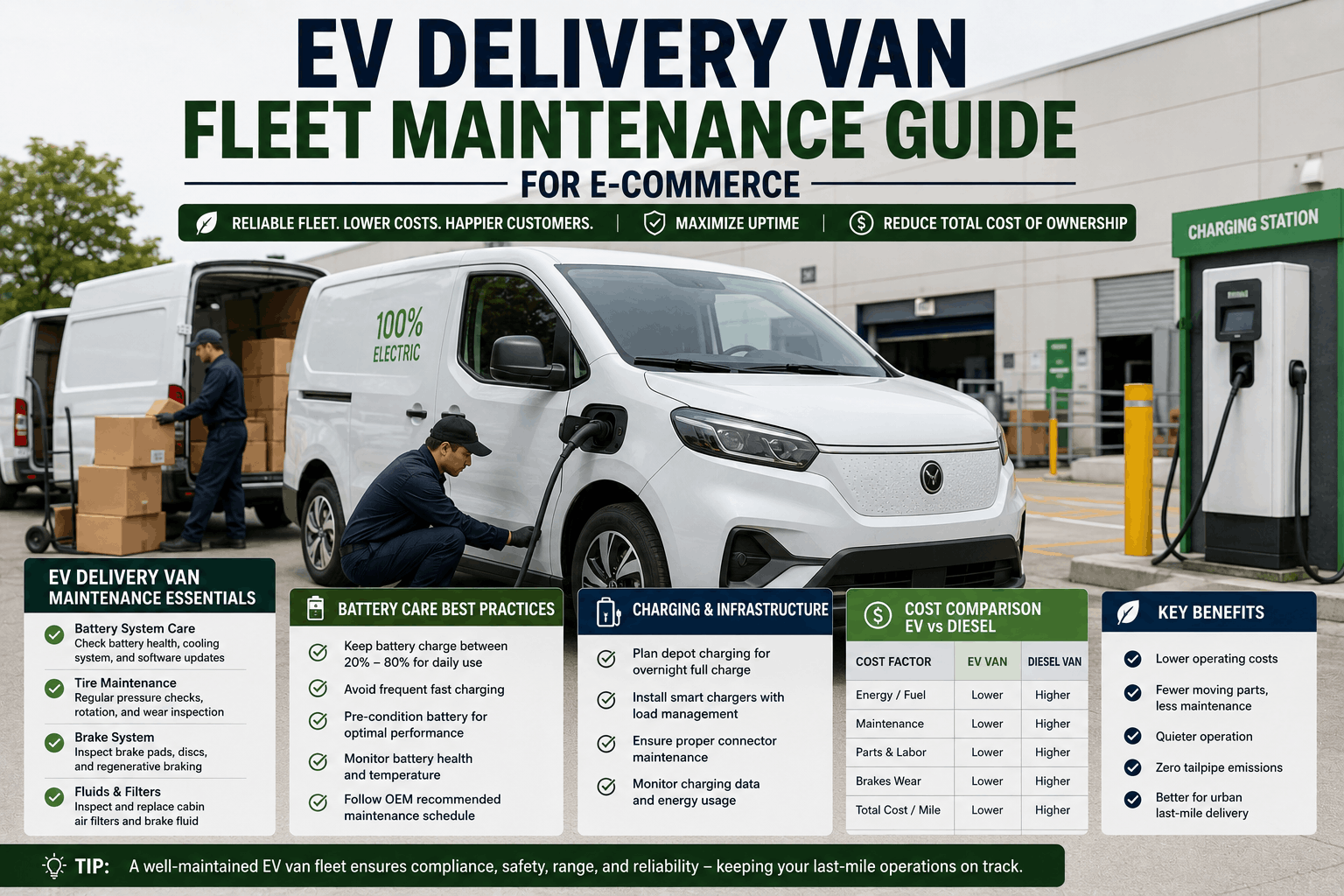
Electric delivery vans are replacing diesel in last-mile logistics. They're quiet, zero-emission, and have dramatically lower fuel costs. But they require completely different maintenance. No oil changes, no transmission fluid, no spark plugs. Instead: battery thermal management, high-voltage electrical safety, EV motor maintenance, charging system health. Technicians trained on diesel are often confused by EV systems. A maintenance mistake on a 400V EV system can be dangerous or fatal. This guide covers EV van maintenance fundamentals, battery care, charging system servicing, thermal management, safety protocols, and total cost of ownership comparison vs diesel.
Electric vans reshape last mile. Learn maintenance, battery care, charging, and true cost vs diesel delivery vans.
EV Van vs. Diesel: Maintenance Cost Comparison
While the initial acquisition cost of an electric delivery van is typically higher than an internal combustion engine counterpart, the operational lifecycle costs tell a completely different story. Below is a realistic breakdown of real-world fleet expenditures per vehicle over a 30,000-mile service year.
High-Voltage Electrical Safety & LOTO Protocols
Modern electric delivery vans run on high-voltage architectures ranging from 400V to 800V DC. Shops transitioning from ICE fleets must establish rigid safety perimeters before opening any vehicle hoods.
Insulated Tooling Requirements
Technicians must use hand tools rated up to 1,000V and testing equipment designed for safe high-voltage diagnostics.
Lockout/Tagout Procedures
Before servicing powertrain lines, the high-voltage disconnect must be removed, locked, and tagged to prevent accidental re-energization.
PPE Visual Inspection
Insulating gloves and protective guards should be checked before every shift for punctures, tears, or wear.
Battery Pack Optimization & Thermal Management
The lithium-ion battery pack represents a major part of an electric commercial vehicle’s asset value. Protecting battery health is essential for maximizing fleet lifespan.
The 20-80% State of Charge Rule: For standard local routes, avoid charging delivery vans to 100% or running them below 20%.
Liquid Cooling Loops: EV batteries rely on specialized cooling systems. Clogged lines or degraded coolant can create hot spots and cell imbalance.
Cell Balancing via Telematics: CMMS software can monitor battery state-of-health and flag voltage variance across modules.
Regenerative Braking Systems & Chassis Maintenance
Electric vans recover stopping energy through regenerative braking. This reduces brake wear but creates new maintenance checks for rotors, calipers, tires, and chassis parts.
Friction Component Oxidization
Because friction brakes are used less often, calipers can seize and rotors can collect surface rust.
Increased Tire Wear
Heavy battery packs and instant torque can accelerate tire wear, making monthly sidewall and tread checks important.
Preventive Maintenance for Charging Infrastructure
An electric van is only as productive as the charging system that supports it. Depot charging stations need preventive maintenance to avoid route delays.
| Charging Station Element | Inspection Interval | Critical Action |
|---|---|---|
| CCS1 / Type 2 Connectors | Weekly | Inspect pins, contacts, and water entry. Clean with non-conductive contact cleaner. |
| Cooling Intake Filters | Monthly | Clean dust filters on DC fast charger cabinets to prevent current de-rating. |
| Cable Strain Reliefs | Bi-Monthly | Check retractor cables and inspect charging cable jackets for cuts or exposed wiring. |