The electric vehicle revolution is transforming how US manufacturing companies manage their fleet operations. As more organizations transition from traditional diesel buses to electric alternatives, the complexity of fleet maintenance has evolved significantly. Today's manufacturing professionals need sophisticated tools that go beyond basic vehicle tracking – they need comprehensive EV telematics and battery analytics integrated seamlessly within their Computerized Maintenance Management System (CMMS).
Electric bus fleets present unique challenges that traditional maintenance approaches simply cannot address. Battery degradation patterns, charging optimization, thermal management, and predictive maintenance requirements demand a new level of operational intelligence. This is where advanced Bus CMMS platforms with integrated EV telematics become game-changers for manufacturing operations seeking maximum fleet efficiency and minimal downtime.
Key Insight: Manufacturing companies using integrated EV telematics within their CMMS report up to 35% reduction in maintenance costs and 42% improvement in vehicle uptime compared to traditional fleet management approaches.
Real-Time Battery Health Monitoring: The Foundation of Predictive Maintenance
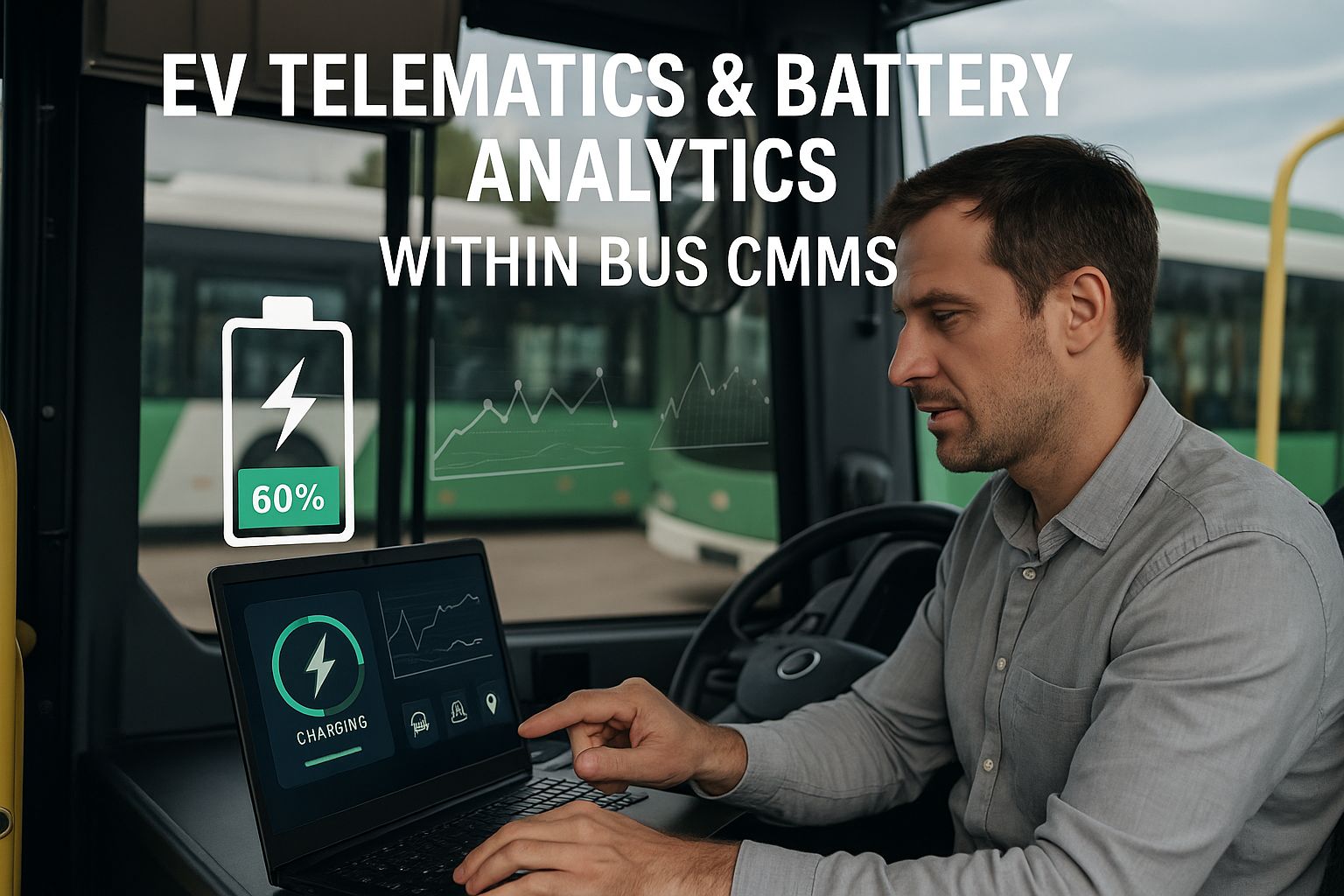
Battery health monitoring represents the cornerstone of effective electric bus fleet management. Unlike traditional vehicles where engine diagnostics provide maintenance insights, electric vehicles require continuous monitoring of battery cells, thermal conditions, charging cycles and capacity degradation. Modern Bus CMMS platforms now integrate sophisticated telematics systems that capture this critical data in real-time.
Manufacturing operations benefit tremendously from predictive analytics that forecast battery replacement needs months in advance. These systems analyze charging patterns, temperature fluctuations, voltage irregularities, and capacity trends to predict when batteries will fall below operational thresholds. This proactive approach eliminates unexpected breakdowns that can disrupt critical manufacturing logistics and employee transportation schedules.
- State of Charge (SOC) Monitoring: Continuous tracking of battery charge levels to optimize route planning and prevent range anxiety
- State of Health (SOH) Analysis: Long-term battery degradation tracking to schedule replacements before failure occurs
- Thermal Management Intelligence: Temperature monitoring to prevent overheating and extend battery life
- Charging Cycle Analytics: Data-driven insights into optimal charging schedules and infrastructure utilization
Comprehensive Fleet Performance Analytics for Manufacturing Efficiency
Manufacturing professionals understand that operational efficiency directly impacts bottom-line results. EV telematics integrated within Bus CMMS provides unprecedented visibility into fleet performance metrics that directly correlate with manufacturing productivity. These systems capture granular data about vehicle utilization, route efficiency, driver behavior, and energy consumption patterns.
Advanced analytics platforms process this telematics data to identify optimization opportunities that traditional fleet management approaches miss entirely. For instance, the system might detect that certain routes consistently drain batteries faster due to elevation changes or traffic patterns, enabling route optimization that extends vehicle range and reduces charging requirements.
Energy consumption analysis becomes particularly valuable for manufacturing operations managing large fleets. The CMMS can correlate energy usage with operational factors like passenger load, weather conditions, and driving patterns to establish baseline performance metrics. Deviations from these baselines trigger automated alerts that help maintenance teams identify potential issues before they impact operations.
Automated Maintenance Scheduling Based on Telematics Intelligence
Traditional maintenance scheduling relies heavily on time-based intervals or mileage thresholds that often result in unnecessary maintenance or, worse, unexpected failures. EV telematics revolutionizes this approach by enabling condition-based maintenance scheduling that responds to actual vehicle performance rather than arbitrary timelines.
Modern Bus CMMS platforms analyze telematics data to automatically generate work orders based on predictive algorithms. These systems consider factors like brake pad wear (influenced by regenerative braking usage), tire condition (based on acceleration patterns and route characteristics), and cooling system performance (derived from thermal management data). This intelligent approach reduces maintenance costs while improving vehicle reliability.
Manufacturing Impact: Automated maintenance scheduling based on telematics data reduces unplanned downtime by up to 60% while optimizing maintenance resource allocation across multi-site manufacturing operations.
The integration also enables dynamic maintenance prioritization based on vehicle criticality and operational requirements. During peak manufacturing periods, the system can defer non-critical maintenance on essential vehicles while prioritizing repairs on backup units, ensuring operational continuity without compromising safety or compliance requirements.
Regulatory Compliance and Safety Monitoring Integration
Manufacturing operations face stringent regulatory requirements regarding fleet safety, emissions reporting, and operational compliance. EV telematics within Bus CMMS platforms provides automated compliance monitoring that reduces administrative burden while ensuring adherence to federal and state regulations.
The system automatically tracks and documents safety-critical parameters such as battery temperature excursions, charging anomalies, and vehicle diagnostic trouble codes. This comprehensive documentation supports DOT inspections, environmental reporting requirements, and insurance claims processing. For manufacturing companies operating across multiple states, the platform can adapt compliance reporting to meet varying regulatory requirements automatically.
Driver behavior monitoring integrated with vehicle telematics provides additional safety insights. The system tracks acceleration patterns, braking behavior, and speed compliance to identify training opportunities and reduce liability risks. This data integration helps manufacturing HR departments develop targeted driver training programs that improve safety while extending vehicle component life.
Cost Optimization Through Intelligent Energy Management
Energy costs represent a significant operational expense for electric bus fleets, particularly for manufacturing operations running multiple shifts with continuous transportation requirements. Advanced EV telematics within Bus CMMS platforms provide sophisticated energy management capabilities that optimize charging schedules, reduce peak demand charges, and maximize renewable energy utilization.
The system analyzes historical route data, passenger loads, and operational schedules to predict energy requirements for each vehicle. This predictive capability enables intelligent charging scheduling that takes advantage of off-peak electricity rates while ensuring adequate charge for operational requirements. For manufacturing facilities with on-site renewable energy generation, the platform can prioritize vehicle charging during periods of excess solar or wind production.
Charging infrastructure optimization represents another significant cost-saving opportunity. The CMMS analyzes charging patterns across the fleet to identify bottlenecks, optimize charger utilization, and plan infrastructure expansion. This data-driven approach prevents over-investment in charging equipment while ensuring adequate capacity for fleet growth.
Ready to Transform Your Fleet Management?
Discover how EV telematics integration within Bus CMMS can revolutionize your manufacturing fleet operations. Our platform delivers the predictive analytics, automated maintenance scheduling, and cost optimization tools your organization needs to maximize electric vehicle performance.
Getting StartedBook a Demo
Conclusion: The Future of Manufacturing Fleet Management
The integration of EV telematics and battery analytics within Bus CMMS represents more than just technological advancement – it's a fundamental shift toward intelligent, data-driven fleet management that aligns with the operational excellence demands of modern manufacturing. Organizations that embrace these integrated platforms position themselves for sustained competitive advantage through reduced operating costs, improved reliability, and enhanced operational flexibility.
As electric vehicle technology continues evolving and regulatory requirements become more stringent, manufacturing professionals need fleet management solutions that adapt and scale with their operational needs. The combination of sophisticated telematics data, predictive analytics, and automated maintenance orchestration provides the foundation for fleet operations that support rather than constrain manufacturing productivity.
The question for manufacturing leaders isn't whether to adopt EV telematics integration within their CMMS – it's how quickly they can implement these capabilities to capture the operational and financial benefits that define industry leadership. The organizations that act decisively today will establish the operational advantages that define tomorrow's manufacturing success stories.