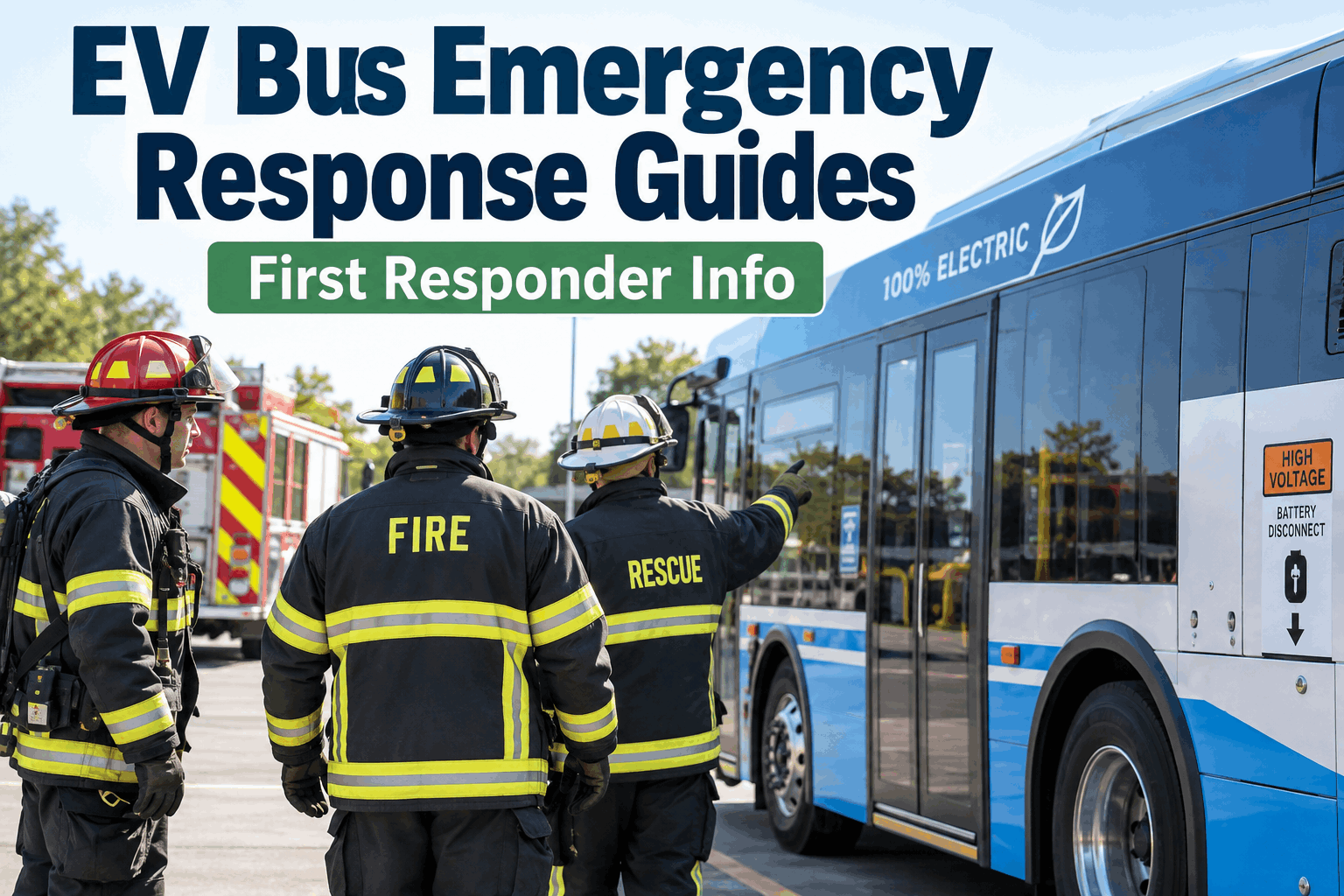
When a firefighter arrives at a crashed electric bus, the first question is where to cut and where not to. The answer lives in that bus's emergency response guide — if the version on file matches the bus on the ground. Keeping the EV bus first responder guide current, per VIN, is a safety-coordinator job that most agencies handle with a binder that went stale two bus orders ago.
Keeping EV Bus First Responder Guides Current
Isolation points, cut-loop locations, battery chemistry,and rescue-sheet versions — kept accurate per VIN, so responders never work from the wrong document.
Why the EV Bus First Responder Guide Is a Safety-Critical Document
An electric bus presents hazards a firefighter or EMT will not find on a diesel. High-voltage systems run at hundreds of volts. Lithium-ion battery packs can enter thermal runaway, ignite, and — the part that surprises responders — reignite hours or even days after the initial fire is knocked down. Stranded energy can remain in a damaged pack even after the vehicle appears dead. And every make and model routes its high-voltage cabling, isolation points, and cut loops differently. There is no universal "shut it off" procedure.
Electric Shock & Arc Flash
High-voltage systems (defined as >60V DC under ISO 6469) can deliver fatal shock or arc flash if a responder cuts or contacts an energized HV cable.
Thermal Runaway
A damaged or overheated cell can cascade through the pack, producing intense, self-sustaining fire that is difficult to extinguish with water alone.
Ignition & Reignition
Battery fires can reignite hours or days after being knocked down — even in a tow yard or storage lot. Responders must plan for delayed re-ignition, not just the initial event.
Stranded Energy
A damaged pack can retain dangerous voltage even when the bus appears powered down. Isolation confirmation from the correct guide is what makes extrication safe.
The National Transportation Safety Board flagged these exact risks in its 2020 report on lithium-ion battery fires in electric vehicles, recommending improvements to emergency response guides. The document that answers "where do I cut" and "how do I isolate" is not paperwork — it is the difference between a safe extrication and a responder injury. Which makes keeping it current, per bus, a genuine safety obligation. Book a walkthrough to see per-VIN responder documents tied to each bus in your fleet.
The Standards Behind Electric Bus Emergency Response
Electric bus emergency response documentation is not a free-for-all. A stack of federal agencies and standards bodies define what a responder guide should contain and how it should be labeled. A safety coordinator who knows this stack can tell a compliant guide from an incomplete one at a glance.
Federal ERG Repository
Manufacturers submit emergency response guides and rescue sheets to NHTSA for covered electric buses. Filterable by make and model at nhtsa.gov — the authoritative source for the current OEM document.
2020 Safety Recommendation
NTSB's report on lithium-ion battery fires recommended ERGs comply with ISO 17840 for standardized, responder-usable information across every make.
ISO 17840
Road Vehicles — Information for First and Second Responders. Standardizes labels, colors, symbols and graphics so responders read any guide the same way, under stress.
SAE J2990
Hybrid and EV first- and second-responder recommended practice — the technical foundation for how HV systems should be documented for emergency handling.
Emergency Field Guides
NFPA's single-page, double-sided quick-reference guides (via evsafetytraining.org) distill critical response info into a format a responder can use on scene.
The practical takeaway for a transit safety coordinator: the OEM guide filed at NHTSA is the source of truth, ISO 17840 is the format responders are trained to read, and the version on your bus needs to match the bus's actual build. When a bus is delivered, mid-life updated, or repowered, the guide can change — and the document local fire departments hold needs to change with it. Sign up free and start attaching the correct ERG version to each bus record.
ERG vs Rescue Sheet: What Each Document Does
Two documents matter, and they serve different moments. The full emergency response guide is the detailed reference. The rescue sheet is the abbreviated, on-scene quick-reference. A responder pulls the rescue sheet at the crash; the ERG backs it up. Both need to be present, current, and matched to the specific bus.
- In-depth, vehicle-specific reference
- Fire, submersion, fluid leakage procedures
- Towing & storage guidance (reignition watch)
- Full HV system architecture
- Used in training and back at the station
- Single-page abbreviated version
- Vehicle construction at a glance
- Cut-zone & do-not-cut markings
- HV disconnect & isolation points
- Used at the scene, under time pressure
The critical detail: both documents are vehicle-specific. A rescue sheet for a 2021 model-year electric bus with one battery configuration may not match a 2024 unit of the "same" model with a revised pack layout or a different chemistry. Responders trained to trust the rescue sheet are put at risk if the sheet does not match the bus. That is exactly the failure mode a per-VIN document system prevents. Book a demo to see rescue sheets matched to each VIN's actual build.
Where First Responder Guides Go Stale
The problem is rarely that an agency never had the guides. The problem is drift — the fleet changes, the documents do not. Here is what the binder-in-a-drawer approach looks like versus a live per-VIN record.
- New buses delivered; ERGs never added to the binder
- OEM issues a revised guide; nobody replaces the old one
- Buses repowered or retrofitted; documents still describe the old build
- Local fire department holds a 3-year-old packet
- Nobody owns the update; it happens when someone remembers
- At the scene, the sheet does not match the bus
- Every bus carries its current ERG version on its asset record
- Revised guide flagged; old version archived, new one attached
- Repower or retrofit updates the document automatically
- Fire department packet regenerates from live data
- A named owner and a review cadence, not luck
- The sheet always matches the bus on the ground
The difference is not effort — it is ownership and a system. A live per-VIN record turns "is this guide current?" from a question nobody can answer into a field on the bus's record that anyone can check in seconds. And when the local fire department asks for updated packets before an annual training, the safety coordinator generates them from current data instead of reconstructing a binder from memory.
The Per-VIN Document Lifecycle
A responder document should move through four stages tied to the bus itself — not to a binder, a shared drive folder, or one person's memory. Each stage keeps the guide matched to the physical bus.
Attach at Delivery
When a bus is added to the fleet, its OEM ERG and rescue sheet (pulled from NHTSA or the manufacturer) attach to the VIN record, with battery chemistry, voltage, HV disconnect and cut-loop points captured as data fields.
Flag on Revision
When the OEM issues a revised guide, or an ERG-revision feed surfaces an update, the bus record flags the change. The old version is archived, the new one becomes current, and the responder packet is marked for regeneration.
Update on Modification
If a bus is repowered, retrofitted, or has its battery configuration changed, the document set updates with it — because a changed build means a changed rescue sheet, and responders must have the current one.
Distribute to Responders
Generate current packets for local fire and EMS on demand — before an annual training, after a fleet change, or on request. Every sheet reflects the live fleet, not a snapshot from two orders ago.
Stage four is where the safety relationship with the local fire department actually lives. Departments want to pre-plan for the EV buses running through their district, and they run periodic EV response training. An agency that can hand them a current, accurate, ISO 17840-formatted packet on request is a partner; an agency that hands them a stale binder is a liability the department has to work around. Sign up free and generate your first current responder packet this week.
How BusCMMS Keeps Responder Documentation Current
Because BusCMMS is the system of record for the whole bus — asset data, work orders, modifications, and compliance documents — it is the natural place for responder documentation to live and stay current. The features below turn a stale-binder problem into a managed process.
-
Per-VIN Document Records
ERG, rescue sheet, battery chemistry, HV disconnect, and cut-loop data attached to each bus's asset record — not a shared binder.
-
Revision Alerts
Flag when an OEM issues a revised guide so the current version is always the one attached — old versions archived, never deleted.
-
Responder Packet Generation
One-click current packets for local fire and EMS — accurate to the live fleet, formatted for on-scene use.
-
Modification Tracking
Repowers and retrofits update the document set automatically, because the CMMS already tracks the modification work order.
-
Review Cadence & Owner
Assign a named owner and a recurring review so "is this current?" is answered by a system, not by luck.
-
QR / Digital Access
Link the current rescue sheet to a per-bus record responders can reach quickly, so on-scene access is not dependent on a paper copy being present.
Because the documentation lives on the same platform that already tracks each bus's work orders and modifications, currency becomes a byproduct of normal fleet operations rather than a separate manual chore. When a repower work order closes, the responder document is already flagged for update. That linkage is what a general-purpose document folder can never provide.
The Safety Coordinator's View
That is the whole case in one story. The documents existed; they were just not current, not matched to VINs, and not owned. The fix is not more binders — it is a live record that keeps responder documentation as current as the fleet it describes. Book a walkthrough to see the full safety-records workflow on a fleet like yours.
The Bottom Line on EV Bus First Responder Guides
The EV bus first responder guide is a safety-critical document, not a filing formality. Electric buses carry hazards — high-voltage shock, thermal runaway, reignition, stranded energy — that responders can only handle safely with a guide matched to the specific bus. Keeping that guide current per VIN, aligned with NHTSA-filed OEM documents and ISO 17840 formatting, and generating accurate packets for local fire and EMS on demand, is the job. Do it with a live per-VIN record instead of a binder, assign a named owner, and the document at the scene will always match the bus on the ground. That is what safe EV bus response actually depends on. Sign up free and put your responder documentation on a live record this week.