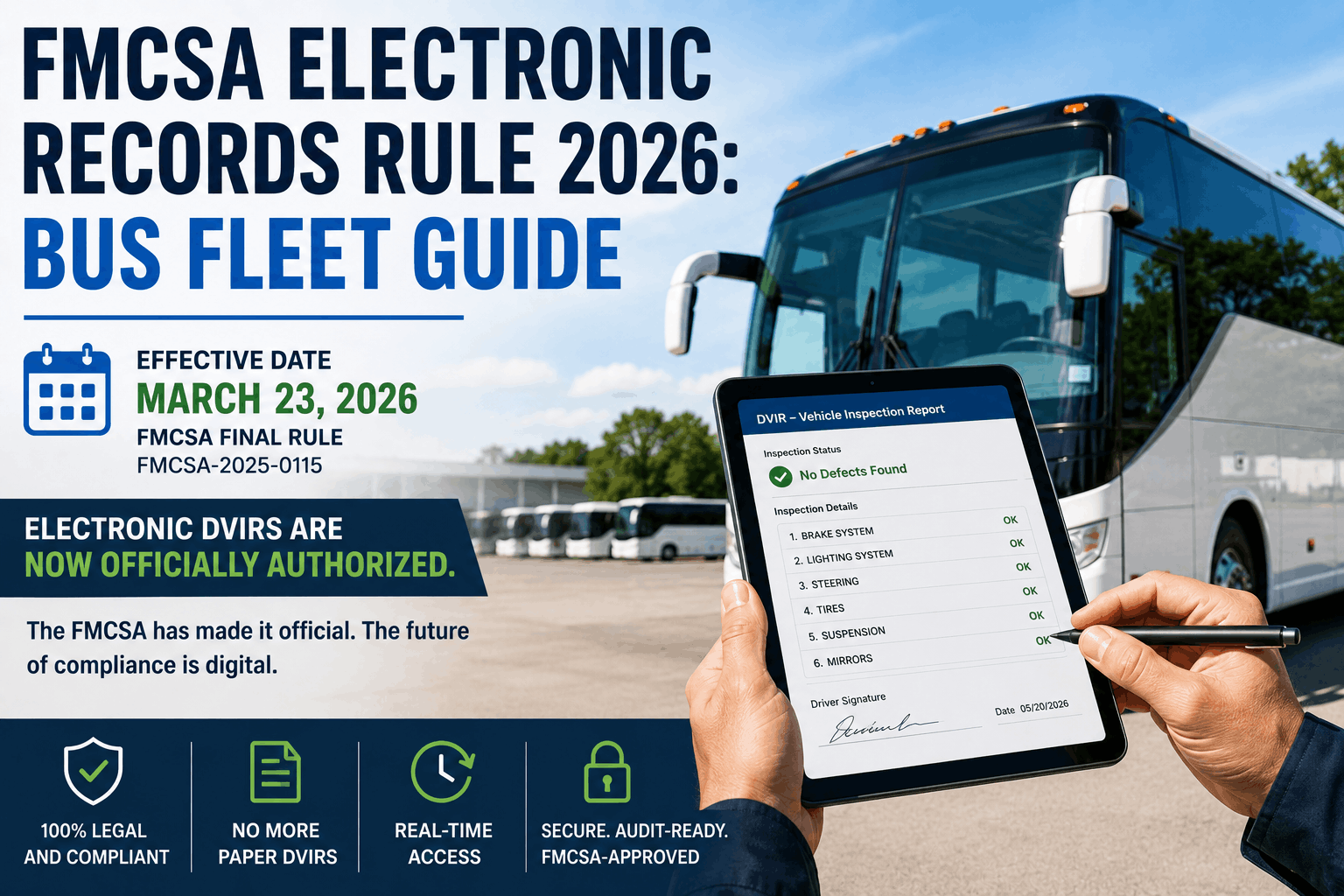
For eight years, bus fleet managers operating on digital inspection platforms lived with a compliance grey area. Electronic records had been permitted under 49 CFR 390.32 since 2018 -- but the specific language of 49 CFR 396.11 and 396.13 governing DVIRs still referenced physical documentation. Legal teams at school districts and transit agencies gave conflicting guidance. Some fleets ran hybrid systems: digital inspections logged on tablets, then printed and physically signed at the end of every shift. On February 19, 2026, FMCSA published final rule FMCSA-2025-0115 in the Federal Register. On March 23, 2026, it became effective. The grey area ended. Electronic DVIRs are now explicitly authorized under 49 CFR 396.11 and 396.13 by name, not just by general electronic record permission. Digital signatures are equal to wet-ink signatures. Cloud storage satisfies retention requirements. Photo evidence and GPS timestamps are explicitly valid. The rule does not require any fleet to switch from paper -- but it removes every remaining legal reason not to. This is the complete guide to what FMCSA-2025-0115 changes, what stays the same, what your eDVIR system must include to comply, and how to become fully compliant within 30 days. BusCMMS eDVIR was built around FMCSA-2025-0115 before the ink on the Federal Register was dry.
See FMCSA-2025-0115-compliant eDVIR in a live demo -- book 20 minutes now
FMCSA Electronic Records Rule 2026: Complete Bus Fleet Guide to eDVIR Compliance
Final rule FMCSA-2025-0115 explicitly authorizes electronic DVIRs under 49 CFR 396.11 and 396.13. What changed, what stayed the same, what your system must include, and how to transition your bus fleet within 30 days.
Understanding why FMCSA-2025-0115 matters requires understanding the 8-year regulatory gap it closed. From 2018 to 2026, electronic DVIRs existed in a zone of general permission without specific authorization -- permitted broadly but never named in the DVIR-specific regulations. The timeline below shows every step from paper-only to fully explicit eDVIR authorization.
Paper-Only Era
DVIRs must be completed on physical paper forms and signed in wet ink. No digital alternative exists under 49 CFR 396.11. Fleets managing 50 buses and 60 drivers generate thousands of physical DVIR forms annually. 73% never reach the maintenance office intact. The 3-signature chain (driver, mechanic, next driver) is broken routinely with no enforcement mechanism possible on paper.
49 CFR 390.32 -- General Electronic Record Permission
FMCSA amends 49 CFR 390.32 to permit electronic records across FMCSA regulatory documents. Technically, DVIRs may now be electronic under this general authorization. However, 49 CFR 396.11 and 396.13 -- the DVIR-specific regulations -- still contain physical document language, creating legal ambiguity. Fleet legal teams give conflicting guidance. Most school districts and transit agencies stay on paper to avoid compliance risk.
The Grey Area Years: Implicit Permission, Explicit Uncertainty
Digital fleet management platforms build eDVIR functionality on the implicit permission of 390.32. Some forward-thinking fleets adopt them -- largely trucking and private carriers. Transit agencies, school districts, and passenger carriers serving the public stay conservative. FMCSA receives petitions from ATA, OOIDA, and industry groups requesting explicit eDVIR authorization in the DVIR-specific regulations to eliminate ambiguity and encourage adoption.
Notice of Proposed Rulemaking (NPRM)
FMCSA publishes an NPRM proposing to add explicit eDVIR authorization language directly to 49 CFR 396.11 and 396.13. Industry response is broadly supportive. ATA and OOIDA submit formal comments in favor. Some transit agency associations request additional clarification on the 3-signature chain in digital systems. FMCSA notes that eDVIRs reduce per-inspection time by 60-75% and create superior audit trails compared to paper.
Final Rule Published -- FMCSA-2025-0115
FMCSA publishes the final rule in the Federal Register, amending 49 CFR 396.11 and 396.13 to explicitly authorize electronic DVIRs. The rule preserves all existing requirements -- 3-signature chain, 11 required fields, 90-day retention, 48-hour audit production -- while removing wet-ink and physical-form requirements. Digital signatures with timestamps are declared equal to wet-ink signatures. Cloud storage satisfies retention requirements. Photo evidence and GPS verification are explicitly recognized as valid documentation.
EFFECTIVE DATE -- Zero Ambiguity. Zero Grey Area.
FMCSA-2025-0115 becomes effective. Electronic DVIRs are now unambiguously and explicitly legal under the specific DVIR regulations -- not just under general electronic records permission. Paper DVIRs remain legal and are not prohibited. Fleets using compliant eDVIR platforms are explicitly, definitively compliant with 49 CFR 396.11 and 396.13. The 8-year grey area ends. BusCMMS eDVIR was already FMCSA-2025-0115 compliant before the effective date -- built around the final rule's requirements from the NPRM stage.
Sign up free -- BusCMMS eDVIR is FMCSA-2025-0115 compliant from day one
FMCSA-2025-0115 changed the legal status of eight specific elements of DVIR compliance. For each element, the rule moved from implicit permission or physical requirement to explicit digital authorization. Understanding exactly what changed -- and what stayed the same -- determines whether your current eDVIR system is compliant or needs updating. Book a demo to verify BusCMMS meets every item in the table below.
FMCSA-2025-0115 did not relax any safety or documentation requirement. Every operational and content requirement for DVIRs remains identical to what was required under the paper system. Fleet managers who interpret "eDVIR now legal" as "less documentation required" will fail their next compliance review. The rule changed the medium, not the message.
3-Signature Chain Still Required
The driver, mechanic (for defect-noted DVIRs), and next driver must still all sign. The new rule makes these signatures digital -- it does not eliminate any of them. A DVIR with only a driver signature and no mechanic repair certification on a defect-noted form is still a violation. BusCMMS enforces the complete 3-signature digital chain and blocks dispatch until all signatures are captured.
11 Required Fields Still Mandatory
All 11 FMCSA-required DVIR fields under §396.11 must still be present in every eDVIR: vehicle identification number, date of inspection, driver name, carrier information, defect report (or no-defect certification), driver signature, mechanic repair certification (where applicable), and next-driver acknowledgment. Any missing field = incomplete DVIR violation at $1,270 per day.
90-Day Retention Requirement Unchanged
DVIR records must still be retained for a minimum of 90 days (3 months) under §396.11. The new rule permits cloud storage as the retention mechanism -- it does not shorten the retention period. BusCMMS stores DVIRs indefinitely beyond the 90-day minimum, which provides significantly stronger audit protection when FMCSA requests records from periods beyond the minimum window.
48-Hour Audit Production Window Unchanged
FMCSA can still request DVIR records with a 48-hour production window during a compliance review. The new rule permits electronic export as the production method -- it does not extend the timeline. Fleets using BusCMMS can produce any requested DVIR record set for any date range in under 30 seconds, meeting and significantly exceeding the 48-hour requirement.
No-Defect DVIR Not Required for Property Carriers
Despite industry requests, FMCSA confirmed it will not reinstate a mandatory no-defect DVIR requirement for property-carrying CMVs even with eDVIRs making completion faster and easier. Defect-noted DVIRs must always be filed. No-defect DVIR submission remains voluntary for property carriers -- though BusCMMS recommends routine pre-trip documentation as evidence of systematic safety management during compliance reviews.
Defect Repair Before Redispatch Still Mandatory
Any bus with a defect-noted DVIR cannot be redispatched until the defect is repaired and the mechanic has certified that repair in the DVIR chain. The new rule makes this certification digital -- it does not make dispatch with an unrepaired defect legal. Dispatching a bus with an unrepaired reported defect: $15,420 fine per vehicle, plus OOS order at next roadside inspection.
Not every app that calls itself an "eDVIR" system meets FMCSA-2025-0115 compliance requirements. The rule specifies that electronic DVIRs must contain all required information, have the capacity for all required signatures, be producible for audits, and meet the retention timeline. Below is the complete compliance checklist for any eDVIR platform your bus fleet considers using. BusCMMS meets every item. Book a demo and verify each requirement live.
BusCMMS meets every requirement in this checklist -- verify live in a 20-minute demo
A bus fleet can complete the paper-to-digital DVIR transition in 30 days without disrupting operations. The key is sequencing: configure the system before touching driver workflow, run a pilot before eliminating paper, and verify compliance before declaring the transition complete. Sign up free and follow this exact sequence from your first login.
Import your vehicle inventory and driver roster into BusCMMS via CSV. Configure the FMCSA-compliant school bus DVIR template -- BusCMMS pre-loads this template covering all 11 required fields plus the bus-specific items (stop arm, emergency exits, crossing gate, student mirrors, wheelchair lift, child check). Set up user accounts for every driver and mechanic. Configure the 3-signature chain workflow. Set dispatch lockout rules so no bus can leave until the DVIR chain is complete. Test the entire workflow end-to-end with one bus before training anyone else.
Install the BusCMMS driver app on every driver smartphone. Run a 30-minute group training covering: app installation, guided walk-around sequence, how to document a defect with photo capture, digital signature process, and what happens when a defect is reported (automatic work order routing to maintenance). For maintenance staff, run a separate 60-minute session on digital work order receipt, repair documentation, and mechanic certification in the DVIR chain. Each driver should complete one practice DVIR with supervision before the pilot begins.
Deploy the digital DVIR workflow to 10-15 buses. Maintain paper DVIR backup during this pilot period only. Track 3-signature completion rates daily -- any chain that is broken or skipped requires immediate retraining of the driver or mechanic involved. Monitor average completion time: most drivers complete BusCMMS DVIR in 2-5 minutes versus 10-15 minutes for paper. By day 21, you should have 100% 3-signature chain completion rates and zero paper backup usage for pilot buses. This is the verification gate before full fleet rollout.
Deploy digital DVIR to all remaining buses and drivers. Discontinue paper DVIR for all buses on the BusCMMS system. Retain the physical paper DVIR archive for 90 days from the last paper DVIR date to satisfy the retention requirement for any records created during the transition. By day 30, run a simulated audit readiness check: request a full 14-day DVIR export and verify every bus shows complete 3-signature chains, zero broken chain instances, and all defects have corresponding work orders. Congratulations -- you are now fully FMCSA-2025-0115 compliant with a digital audit trail superior to anything paper produced. Sign up free and start day 1 today.
"We held off on going digital for three years because our district legal team said the paper-specific language in 396.11 created exposure. The moment FMCSA-2025-0115 became effective on March 23rd, we called BusCMMS. We were fully live with digital DVIR on all 43 buses within 19 days. DVIR completion time dropped from about 12 minutes per driver to under 4. Our first roadside inspection after the transition the inspector asked for the DVIR and I showed him the export on my phone in about 30 seconds. He said it was the best-documented DVIR he had seen on a school bus route stop. We have not had a single DVIR violation since going digital. Before -- three in two years, all from broken paper chain signatures."
General CMMS platforms like OxMaint handle work orders and preventive maintenance across multiple asset types. When FMCSA-2025-0115 was published, no general CMMS automatically became compliant -- because they were never built around DVIR requirements in the first place. OxMaint has no FMCSA school bus DVIR template, no 3-signature chain enforcement, no dispatch lockout on incomplete DVIR chains, and no 90-day retention architecture designed for §396.11 requirements. Bus fleets that attempt to implement eDVIR compliance through a general CMMS are configuring compliance from scratch -- with no validation that their configuration actually meets §396.11 requirements. BusCMMS was built around §396.11 before FMCSA-2025-0115 made eDVIR explicit. The rule confirmation meant our platform was already compliant -- it just removed the last legal argument for paper.
FMCSA-2025-0115 closed an 8-year regulatory grey area on March 23, 2026. Electronic DVIRs are now explicitly and unambiguously legal under the DVIR-specific regulations -- not just under general electronic records permission. Nothing changed about what a DVIR must contain or document. Everything changed about how it can be created, signed, stored, and produced. The 3-signature chain is still required -- it is now digital, enforced by software, and impossible to skip. The 90-day retention window still applies -- records are now stored in the cloud and retrievable in seconds rather than filed in binders and retrieved in hours. BusCMMS eDVIR is fully compliant with FMCSA-2025-0115. The 30-day transition is straightforward. The reason to wait no longer exists.
FMCSA Said Yes to eDVIR on March 23, 2026.
Your Fleet Can Go Digital This Month.
FMCSA-2025-0115-compliant eDVIR. Bus-specific DVIR templates. Enforced 3-signature chain. GPS-timestamped signatures. Photo defect capture. 30-second audit export. 90-day minimum retention exceeded. Built for USA bus fleets. No hardware required.