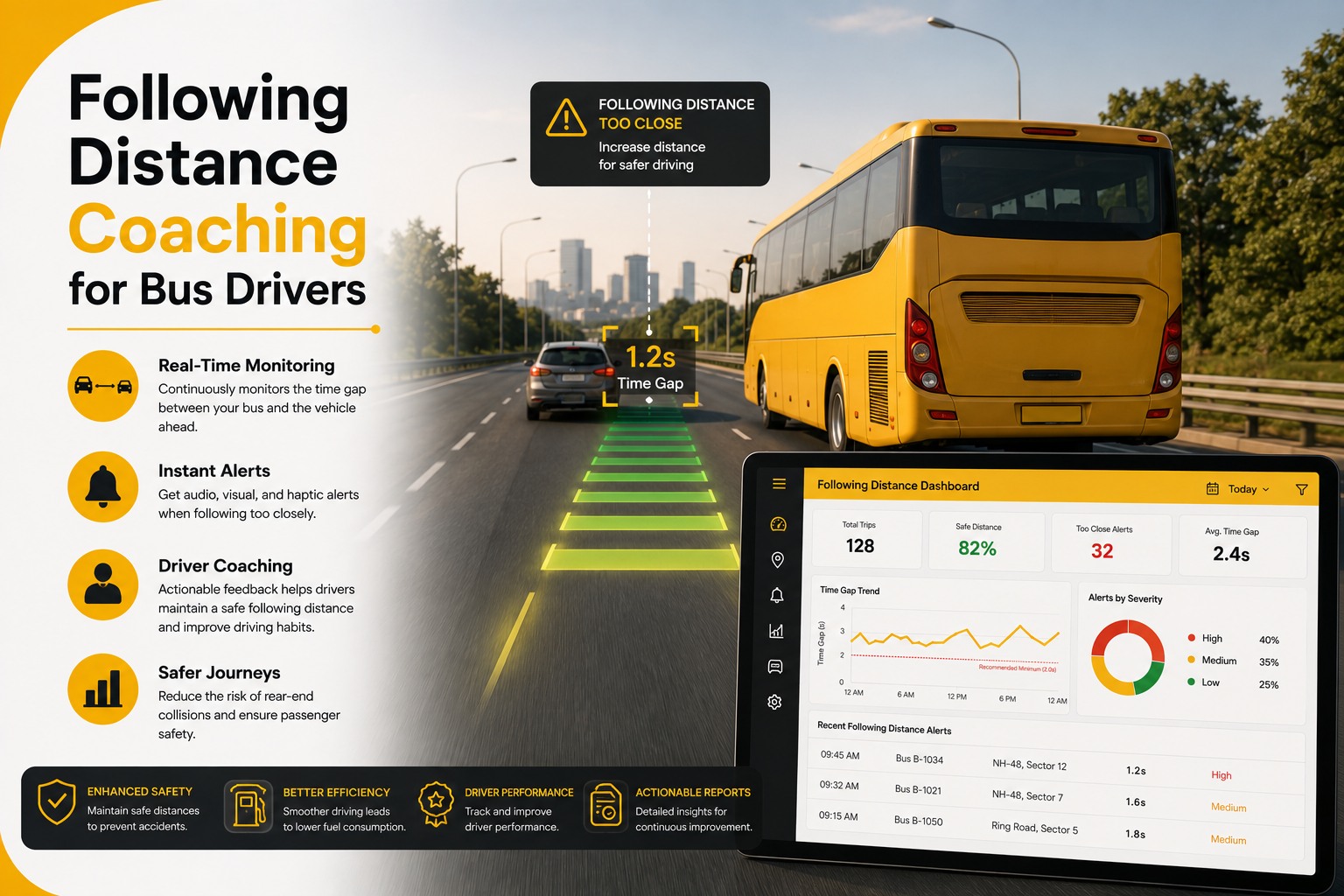
A three-second following distance that's safe for a car in dry conditions isn't safe for a loaded bus, and it's even less safe on wet pavement. Following distance bus coaching sets headway thresholds around actual bus stopping distance, adjusts for weather, and uses real video clips — not just a numeric score — to make the coaching conversation concrete enough for a driver to actually change. See how a following distance event reaches a work order in BusCMMS.
Following Distance Coaching for Bus Drivers
Why bus headway thresholds differ from passenger vehicles, how weather changes the safe gap, and why a clip beats a score in an actual coaching conversation.
Why One Prevented Crash Justifies the Program
The math behind why this is a budget line, not a nice-to-have.
An average injury crash is widely cited at $148,279 using FMCSA crash-cost figures, as referenced across 2026 industry sources — worth re-verifying against FMCSA directly before publishing externally. Following distance events are among the most common precursors to rear-end collisions, one of the most preventable crash types on the road. Against that cost figure, one avoided injury crash covers a following-distance coaching program across dozens of buses — the case for investing in this isn't a soft safety argument, it's a budget argument.
Headway Thresholds Built for Bus Stopping Distance
A car-length gap isn't a bus-length gap.
A loaded bus needs meaningfully more distance to stop than a passenger car at the same speed, which means a headway threshold copied from automotive defaults will flag following distances that are actually too close for a bus, or worse, miss genuinely risky gaps that a car-tuned system considers fine. Thresholds need to scale with the vehicle's actual loaded weight and typical route speed, and they need a separate, tighter setting for wet or icy conditions, since stopping distance on a loaded bus increases substantially on compromised pavement.
The Objection Worth Naming: Footage Overwritten Before Review
A clip that's already gone can't be used to coach anyone.
Here's the failure that quietly guts a following distance program's usefulness: an event gets flagged, but by the time a supervisor sits down to review it — days later, after a busy week — the standard retention window has already overwritten the clip, and there's nothing left to actually show the driver. This isn't a detection failure, it's a workflow failure. Flagged following-distance events need an automatic retention hold that pulls the clip out of the normal overwrite cycle the moment it's flagged, so a delayed review doesn't run into a dead end.
A Scenario From a Real Bus Operation
A term-long coaching cadence cut events by more than half.
A transit agency running 55 buses started a following distance coaching pilot on ten vehicles for one academic term. In month one, the pilot group logged a baseline rate of close-following events per driver per week. Rather than sharing a monthly score alone, supervisors reviewed one specific flagged clip with each driver in a five-minute weekly check-in. By month four, the same group's event rate had dropped by more than half compared to baseline, and the agency expanded the coaching cadence to the rest of the fleet the following term.
Handing someone a score every month didn't change anything. Sitting down and showing them the actual clip — here's the gap, here's how fast it closed — that's what got through. It took five minutes a week and our close-following events dropped by half over the term.
Not sure if your following distance clips are being retained long enough to actually coach from? That's worth checking. Talk to the team about a retention review →
Works With the Camera You Already Own
The wedge BusCMMS solves that a rip-and-replace vendor can't.
BusCMMS is an AI-native bus fleet operations platform built to be hardware-agnostic — it reads events from the MDVR or AI camera system you already have installed, rather than requiring a full rip-and-replace before you can start coaching. A following distance event detected by your existing hardware attaches to that bus's DVIR and can generate a work order on the same asset record, so the coaching workflow and the maintenance workflow run off one shared timeline instead of two disconnected systems.
Frequently Asked Questions
Why do buses need different following distance thresholds than cars?
A loaded bus needs significantly more distance to stop than a passenger car at the same speed. A headway threshold copied from automotive defaults can miss genuinely risky gaps for a bus, so thresholds need to scale with the vehicle's actual weight and route speed.
Should following distance thresholds change in bad weather?
Yes. Stopping distance on a loaded bus increases substantially on wet or icy pavement, so a separate, tighter headway threshold for compromised conditions is necessary to keep the alert meaningful rather than either too loose or too noisy.
Why is coaching from a video clip more effective than a numeric score?
A score alone gives a driver no context and often feels punitive. Reviewing the actual clip with the driver centers the conversation on a specific, visible moment, which drivers can engage with and explain, making the coaching land as training rather than a scorecard.
Why does following distance footage sometimes disappear before it can be reviewed?
An event may be flagged but not reviewed for several days, by which point the standard retention window has already overwritten the clip. Flagged events need an automatic retention hold to pull that clip out of the normal overwrite cycle immediately.
Is following distance monitoring required by federal regulation for buses?
No single federal mandate governs following distance monitoring for buses. 49 CFR 396 maintenance records and district or agency policy set the general compliance bar, leaving adoption to each operation's own safety program.