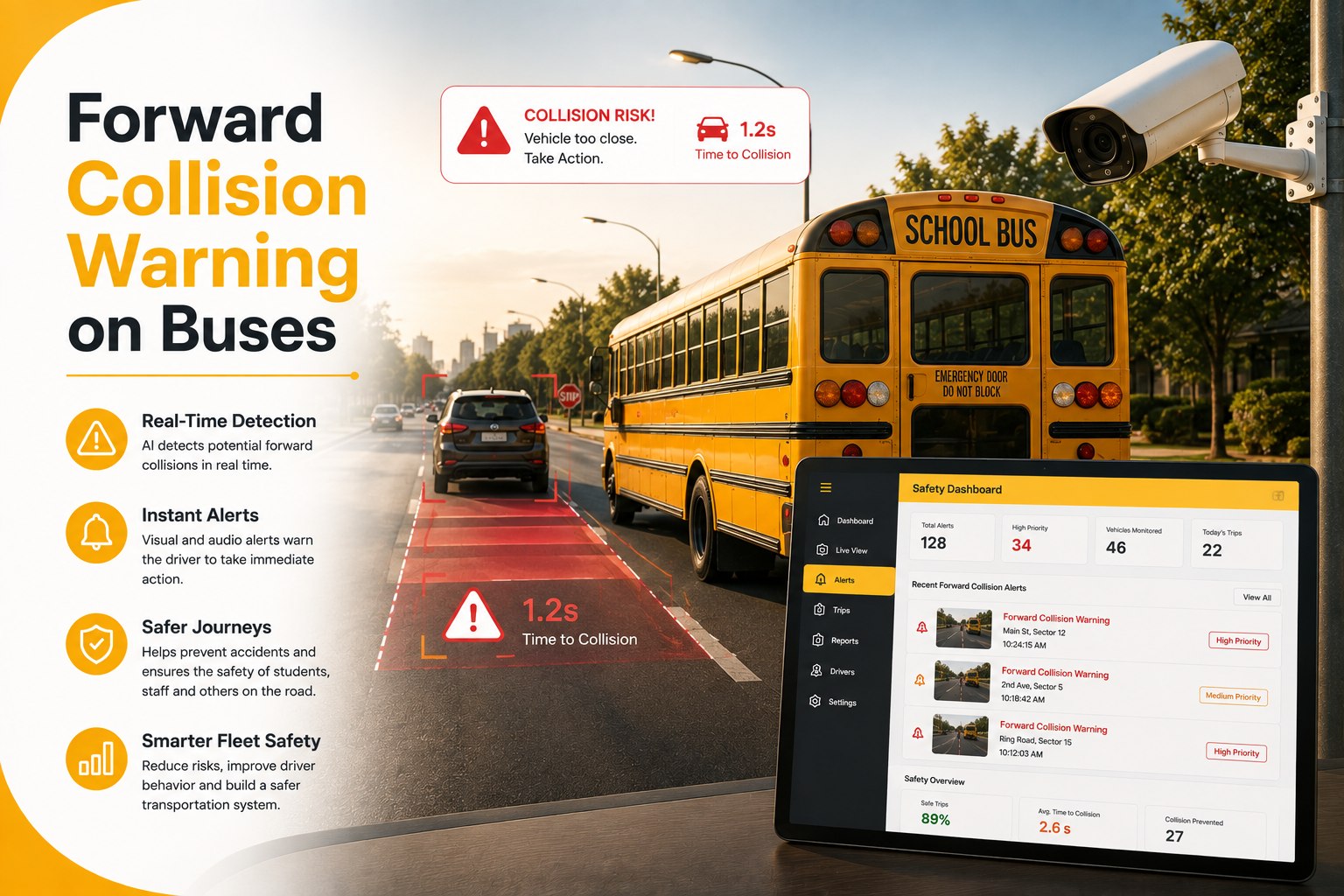
A loaded bus takes far longer to stop than a passenger car, and a warning tuned for car-length stopping distances fires too late to matter on a bus. Forward collision warning bus systems calculate warning thresholds around the vehicle's actual weight and stopping distance, adjusting by speed so the alert reaches the driver while there's still time to brake. See how a video event becomes a closed work order in BusCMMS.
Forward Collision Warning on Buses
Why a bus needs its own warning thresholds, where false positives come from on stop-and-go routes, and how to pair warnings with coaching that actually changes behavior.
Why a Bus Needs Its Own FCW Calibration
Weight and length change the physics, not just the optics.
A fully loaded school or transit bus can weigh well over ten times a passenger car and needs significantly more distance to stop from the same speed. Forward collision warning systems built for passenger vehicles or even light trucks calculate their alert timing around a much shorter stopping distance — deploy one of those systems on a bus without recalibrating the thresholds, and the warning fires after the point where braking in time is still realistic. A bus-specific system has to build its thresholds around the vehicle's actual loaded weight and length, not adapt a generic automotive default.
Where False Positives Come From on Stop-and-Go Routes
Frequent stops look a lot like near-collisions to a poorly tuned system.
A route with frequent stops — traffic signals, student pickups, transit stops every few blocks — creates exactly the kind of following-distance pattern that can trigger a poorly tuned collision warning constantly: braking hard behind a car that's also braking for the same signal, closing distance in slow traffic, pulling up to a stopped vehicle at a stop. None of these are actual near-collisions, but a system that doesn't distinguish controlled deceleration from a genuine closing-speed risk will flag all of them the same way, and it's this exact pattern that drives the alert-fatigue problem below.
The Objection Worth Naming: Alert Volume Kills the Program
Too many warnings is functionally the same as no warnings.
This is the failure mode that quietly undermines most collision-warning rollouts: alert volume climbs so high that safety staff stop reviewing footage in any consistent way, and real near-collisions drown in a flood of false positives from ordinary stop-and-go driving. A system worth deploying has to filter aggressively at the source — accounting for the bus's own braking behavior, route type, and closing-speed patterns — so the review queue stays short enough that someone actually looks at it every day, rather than becoming a backlog nobody opens.
A Scenario From a Real Bus Operation
Pairing warnings with a five-minute coaching habit cut repeat events.
A transit agency running 50 buses on dense urban routes rolled out forward collision warning fleet-wide and initially saw over 300 alerts a week — far more than the safety team could review. After tuning thresholds specifically for the agency's stop-and-go route profile, the weekly count dropped to around 40 genuinely reviewable events. The agency then added a simple post-trip habit: any driver with a flagged event got a five-minute video review with a supervisor before their next shift. Within two months, repeat events among coached drivers dropped by more than 40 percent.
Before we tuned the thresholds, the system was crying wolf constantly and nobody had time to watch three hundred clips a week. Once the alerts actually meant something, we could sit down with a driver the next morning and show them exactly what happened. That five-minute conversation does more than any policy memo ever did.
Not sure if your current FCW thresholds are tuned for your actual routes? That's worth checking. Talk to the team about a threshold review →
Built Mobile-First, From the Walk-Around Up
The wedge BusCMMS solves that a bolted-on dashboard can't.
BusCMMS is an AI-native bus fleet operations platform built mobile-first for drivers and technicians, with photo and clip capture built directly into the walk-around inspection rather than added as a separate app afterward. A collision warning event doesn't sit as an isolated notification — it can attach to that bus's DVIR and generate a work order on the same asset record, so a technician sees the flagged event right where they're already checking for defects.
Frequently Asked Questions
Why do buses need different forward collision warning thresholds than cars?
A fully loaded bus weighs far more than a passenger car and needs significantly more distance to stop from the same speed. A warning system calibrated for car-length stopping distances fires too late on a bus, so thresholds have to scale with the vehicle's actual loaded weight and length.
Why does forward collision warning generate so many false alerts on some routes?
Stop-and-go routes with frequent signals and stops create closing-distance patterns that look similar to a near-collision — braking behind another vehicle also stopping for a signal, for example. A system that doesn't distinguish controlled deceleration from genuine closing-speed risk flags all of it the same way.
Is forward collision warning required by federal regulation for buses?
No single federal mandate governs forward collision warning for buses. 49 CFR 396 maintenance records and district or agency policy set the general compliance bar, leaving collision warning adoption largely to each operation's own safety program.
How should a fleet respond to a forward collision warning event?
Pairing every flagged event with a brief post-trip coaching session — reviewing the clip with the driver soon after the event, rather than filing it for a later report — is what actually changes driving behavior and reduces repeat events over time.
Can a forward collision warning event connect to a maintenance work order?
Yes, when the camera system and maintenance platform are integrated. On BusCMMS, a flagged collision warning event can attach to the bus's DVIR and generate a work order on the same asset record, keeping the event and any resulting inspection or repair together.