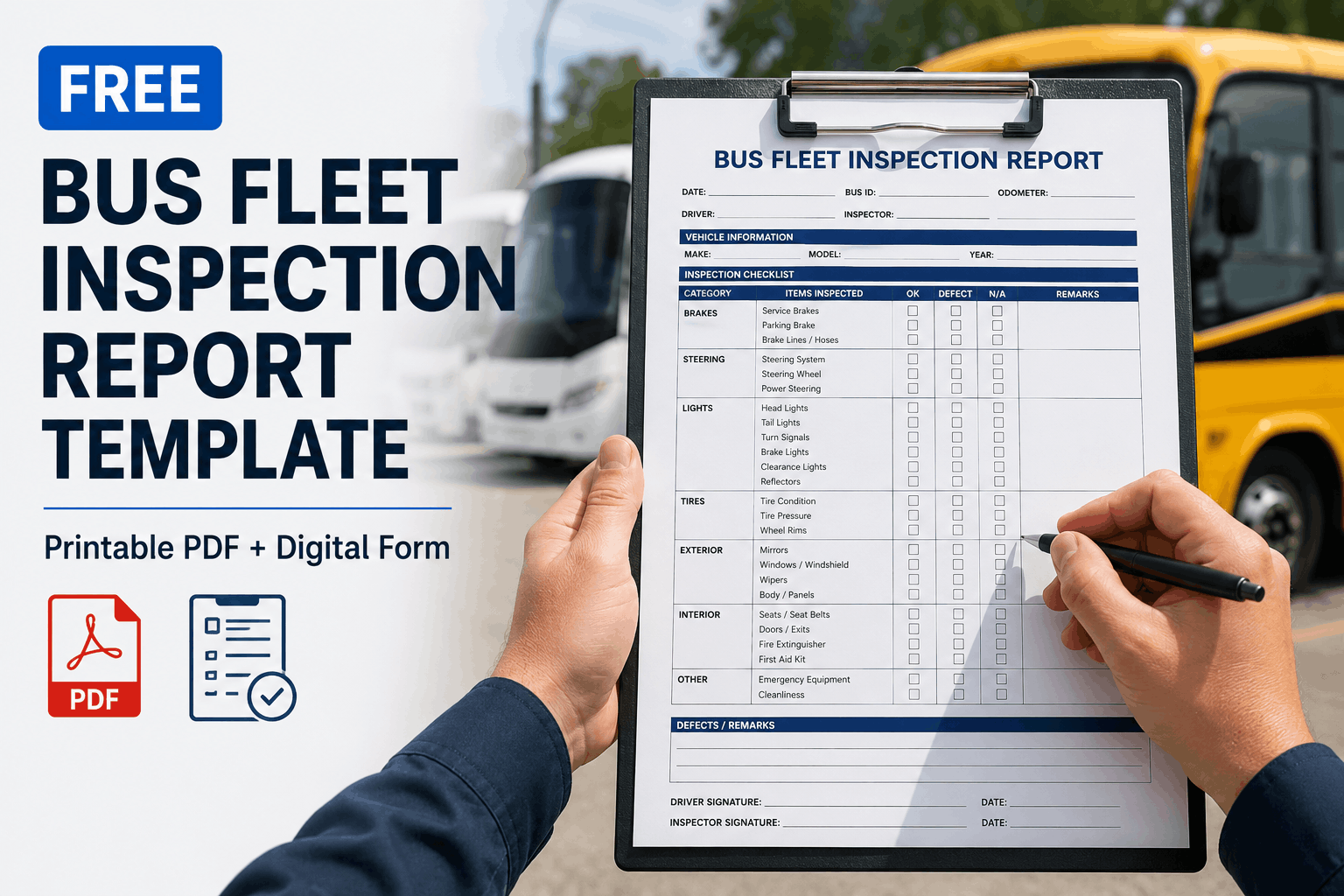
Bus fleet inspection reports are the frontline defense against catastrophic equipment failures, safety violations, and costly downtime. In the United States, the Federal Motor Carrier Safety Administration (FMCSA) mandates that every commercial motor vehicle undergo a daily vehicle inspection report (DVIR) before operation, documenting defects and safety issues that could strand a bus, injure passengers, or trigger federal penalties. A properly structured bus fleet inspection report template eliminates guesswork, ensures FMCSA compliance, captures all critical defect categories, and creates an audit-ready record that protects your fleet against liability and regulatory scrutiny. This guide covers everything you need to implement a professional bus inspection report template—both in printable PDF format and mobile-first digital form—that your technicians will actually use, that your fleet managers can track in real time, and that will hold up to FMCSA inspection and legal review. Download the complete free bus fleet inspection report template now, or continue reading to understand exactly which defect categories, technician sign-off sections, and compliance checkpoints your inspection system must include to avoid costly violations.
FMCSA-Compliant Bus Inspection Report Template Ready to Download. Printable PDF + Digital Mobile Form. Free for 30 Days.
What Every Bus Fleet Inspection Report Must Contain: FMCSA Requirements and Best Practices
A comprehensive bus fleet inspection report serves three critical functions: compliance documentation, defect capture, and maintenance scheduling. Under FMCSA regulations, every bus operating commercially must pass a pre-trip inspection before departure, and any defects discovered must be documented, categorized, and assigned for repair before the vehicle returns to service. A bus inspection report template that fails to capture these required elements exposes your fleet to citations, fines ranging from $500 to $3,000 per violation, and liability in accident scenarios where a documented defect was not addressed. The most effective bus inspection templates in use across US school districts, transit authorities, and charter operators share five critical structural components that separate compliant, enforceable systems from informal checklists that create zero legal protection.
Bus number, VIN, unit assignment, odometer reading, fuel level, and inspection date/time stamp. This section anchors the inspection to a specific vehicle on a specific date and creates the chronological record required by FMCSA for fleet compliance audits.
Organized by system: lighting (headlights, taillights, clearance lights, dashboard indicators), braking system (brake condition, parking brake function, emergency brake), steering and suspension, tires and wheels, windows and mirrors, doors and emergency exits, and interior safety equipment. Each item must be marked pass/fail with space for observed defect notes.
Out-of-service defects (vehicle cannot operate), minor defects (repair needed before next inspection), and safety concerns requiring immediate attention. Severity rating determines whether the bus returns to service or enters the maintenance queue before passenger operation resumes.
Printed name, signature, employee ID, and date/time signature of the inspecting technician. This creates legal accountability and satisfies FMCSA requirements for inspector identity verification, which is critical if the inspection is ever challenged in court or during a federal compliance audit.
Work order number, assigned technician, completion date, parts used, and supervisor verification. This closure loop proves to FMCSA auditors that documented defects were actually repaired before the bus returned to revenue service, creating an unbreakable chain of compliance.
Printable PDF Bus Inspection Templates vs Mobile Digital Forms: Which Works Best for Your Fleet
The debate between printable bus inspection report PDFs and digital mobile forms is not about preference—it is about operational reality. Paper-based bus inspection templates offer portability and work without internet connectivity, but they create critical compliance gaps: illegible handwriting, lost inspection records, no real-time alert to supervisors when out-of-service defects are discovered, and no automatic escalation for safety-critical issues. Digital bus inspection forms eliminate every one of these problems but require mobile device infrastructure and technician adoption training. The most effective US bus fleets use a hybrid approach: a downloadable printable PDF template for backup compliance documentation and a mobile-first digital form that captures inspections in real time, routes defects to the maintenance system automatically, and flags out-of-service conditions instantly to supervisors.
✓ Works without internet or apps
✓ Easy to archive and store
✓ Familiar format for older technicians
✗ Handwriting illegibility and lost forms
✗ No real-time defect alerts
✗ Manual data entry into maintenance system
✗ Supervisor cannot track inspection status
✓ Real-time defect alerts to supervisors
✓ Automatic work order generation
✓ Defect photos and location notes
✓ Legible, searchable inspection records
✓ Compliance audit trail auto-created
✗ Requires mobile device and WiFi/cellular
✗ Training time for technician adoption
The 12 Defect Categories Every Bus Inspection Report Must Track for FMCSA Compliance
FMCSA bus inspection regulations do not prescribe specific defect categories, but enforcement audits focus on eight critical areas where defects most commonly lead to accidents, failures, and citations. A comprehensive bus inspection report template must capture all of these categories with enough granularity that supervisors and technicians can prioritize repairs and that FMCSA auditors can verify that documented defects were addressed. The following twelve defect categories represent the combined requirements of FMCSA regulations, National Highway Traffic Safety Administration (NHTSA) standards, and best practices from the American School Bus Council and Transit Authority Safety Institute.
Air brake pressure loss, brake fade, uneven braking, parking brake failure, ABS light illumination, brake fluid leaks, and brake line damage. Brake defects are the single most cited category in FMCSA violations and the most likely to result in out-of-service orders.
Play in steering wheel, worn ball joints, loose tie rods, suspension sag, leaf spring damage, shock absorber failure, and steering response delay. Steering defects are classified as safety-critical and may render a bus unable to operate safely.
Headlights (low beam, high beam, brightness), taillights, brake lights, turn signals, clearance lights, marker lights, stop lamps, and interior dome lights. Every light on the bus must be functional before the vehicle departs, and defective lighting is automatically cited by FMCSA.
Tread depth below 4/32 inch (critical threshold for buses), cuts or sidewall damage, bulges, uneven wear, wheel rim damage, lug nut looseness, and valve stem leaks. Tire defects account for approximately 12 percent of all bus roadside failures and represent a leading cause of blowouts during operation.
Oil leaks, coolant leaks, transmission fluid leaks, engine knock, rough idle, transmission slip or grinding, and exhaust system damage. Engine defects are typically classified as minor (repair before next inspection) unless the bus is actively leaking fluids at a hazardous rate.
Cracked or broken windshield, side windows, or rear windows, missing or cracked mirrors (side mirrors, rearview mirror, convex mirrors), and loose glass or mirror mounts. Glass defects affect visibility and are often cited as safety violations even when the bus is technically operable.
Entry door malfunction, emergency door mechanism failure, emergency window operation failure, roof hatch damage, and security lock failure. Door defects may result in out-of-service orders if passengers cannot safely exit the bus in an emergency.
Fuel leaks, cracked fuel tank, fuel cap missing or damaged, fuel gauge malfunction, and fuel line damage. Fuel system defects are always classified as safety-critical and may result in immediate out-of-service orders.
Fire extinguisher missing or expired, first aid kit missing or incomplete, reflective triangles missing, backup alarm inoperative, and seat belt damage or missing straps. Safety equipment defects are violations under FMCSA rules and may be cited independently of the bus's mechanical condition.
Broken seats, torn upholstery, loose handrails, floor damage, interior light malfunction, heater or air conditioning failure, and contamination or odor issues. Interior defects affect passenger comfort and safety and should be documented for maintenance prioritization.
Battery discharge or corrosion, alternator failure, wiring damage, electrical component malfunction, dashboard warning lights, and loose electrical connections. Electrical defects can cascade into multiple system failures and should be investigated immediately.
Missing or incomplete inspection records, unsigned inspection forms, expired maintenance records, and failure to document previous defect repairs. Documentation defects are cited by FMCSA and indicate systemic non-compliance with federal inspection and maintenance requirements.
How to Implement a Bus Inspection Report Template in Your Fleet: 5-Step Deployment Roadmap
Review your existing inspection records (whether paper or digital) to identify which defect categories are being captured, which are being missed, and which documentation gaps exist. Identify any previous FMCSA audit findings or safety incidents related to inspection failures. This baseline assessment determines which template elements are most critical for your specific fleet.
Download the free printable PDF bus inspection report template as a backup and compliance reference. If you have mobile device infrastructure in your maintenance shop, deploy the digital mobile form to technicians' smartphones or tablets. The digital form should integrate with your CMMS to auto-generate work orders from discovered defects.
Conduct a 30-minute training session with all technicians on how to use the inspection report template, how to classify defects (out-of-service vs. minor vs. safety concern), and how to complete the technician sign-off section correctly. Emphasize that incomplete or illegible inspection forms create compliance exposure and may not hold up in FMCSA audits.
Set up automated alerts so that any defect marked as out-of-service immediately notifies the fleet supervisor and maintenance manager. These alerts should include the defect description, severity, bus number, and inspector name, allowing supervisors to make real-time decisions about bus dispatch and maintenance sequencing.
Create a documented process where every defect documented in an inspection report must be assigned a work order number, scheduled for repair, and closed with technician verification before the bus returns to service. Maintain a centralized log of all inspection defects and repairs for FMCSA compliance audits. Review monthly audit reports to identify repeat defect patterns and systemic maintenance issues.
Case Study: How a 45-Bus School District Used Inspection Templates to Eliminate 23 Federal Violations in 90 Days
A mid-sized school district in Pennsylvania with 45 buses and a six-technician maintenance shop was cited by FMCSA during a compliance audit for inadequate inspection documentation, missing technician sign-offs, and failure to document defect repairs. The audit identified 23 separate violations ranging from incomplete inspection records to evidence that out-of-service defects were not addressed before buses returned to service. The district's existing paper inspection system relied on handwritten forms filed in cardboard boxes, with no supervisor oversight of defects discovered and no systematic method for closing defect work orders. Implementation of a structured bus inspection report template (both printable PDF for compliance reference and mobile digital form for real-time capture) combined with automated supervisor alerts for out-of-service conditions transformed the district's compliance posture within 90 days. All 23 audit violations were remediated, all technicians completed inspection training, and the district established a defect closure audit trail that satisfied FMCSA requirements. The district now receives real-time notification of every defect discovered and can prove to auditors that documented defects were repaired before buses returned to revenue service.
Bus Inspection Report Template: Frequently Asked Questions
A DVIR (Daily Vehicle Inspection Report) is the FMCSA-mandated inspection performed before a bus begins operation. A pre-trip inspection is the same thing—DVIR and pre-trip inspection are interchangeable terms in US bus fleet operations.
FMCSA does not mandate a specific form template but requires that your inspection system captures all critical safety defects and defect severity classification. Any template (whether self-created or commercially available) must include vehicle identification, inspection date/time, defect categories, technician sign-off, and defect closure documentation.
FMCSA requires retention of bus inspection reports and defect repair records for a minimum of one year. Best practice is to retain records for three to five years to provide adequate documentation in case of accidents, insurance claims, or regulatory investigations.
FMCSA does not require inspections to be performed by certified technicians, but the person conducting the inspection must be trained in bus safety systems and defect identification. Many US fleets require that a qualified technician or trained driver complete daily inspections before the bus leaves the depot.
An out-of-service defect is any condition that makes the bus unsafe to operate and must be repaired before passengers board. Examples include brake failure, fuel leaks, or steering problems. A bus with an out-of-service defect cannot legally operate under FMCSA rules and must be removed from service immediately.
Yes, modern bus fleet CMMS platforms (like BusCMMS) integrate directly with digital inspection forms to automatically generate work orders from documented defects. When a technician marks a defect in the mobile inspection form, a work order is created instantly and routed to the maintenance queue based on severity classification.
Implement supervisor oversight and mobile alerts: require that all inspections be logged in your CMMS before the bus departs, flag incomplete inspections immediately, and review completed inspection reports daily. Digital inspection forms provide audit trails showing exactly when inspections were conducted and by whom.
FMCSA-Compliant Bus Inspection Report Templates Ready to Deploy. Printable PDF + Digital Mobile Form Included.
Eliminate defect documentation gaps, eliminate compliance violations, eliminate liability exposure. Download your template now and deploy in your fleet by next week.