Federal Transportation Administration regulations require every U.S. transit agency to maintain a DOT-compliant drug and alcohol testing program. Under 49 CFR Part 655, failing to test your bus drivers at the mandated random rate can result in fines up to $27,500 per occurrence, license suspension, and loss of federal funding. The regulation isn't negotiable — it's your legal floor. Yet 34% of transit agencies report using manual spreadsheets to track testing compliance, missing tests, and creating audit gaps that become expensive liabilities. Here's everything you need to know about FTA drug and alcohol testing requirements in 2026, how to build a compliant testing program, and how modern CMMS platforms turn fragmented testing data into automated, audit-ready records .
FTA Drug & Alcohol Testing for Transit Agencies: 49 CFR 655 Compliance in 2026
Random testing rates. Covered employee categories. Post-accident protocols. MIS reporting. Return-to-duty cycles. The complete regulatory framework every transit director must enforce — and the systems that make compliance automatic instead of chaotic.
FTA 49 CFR Part 655: The Complete Testing Requirements
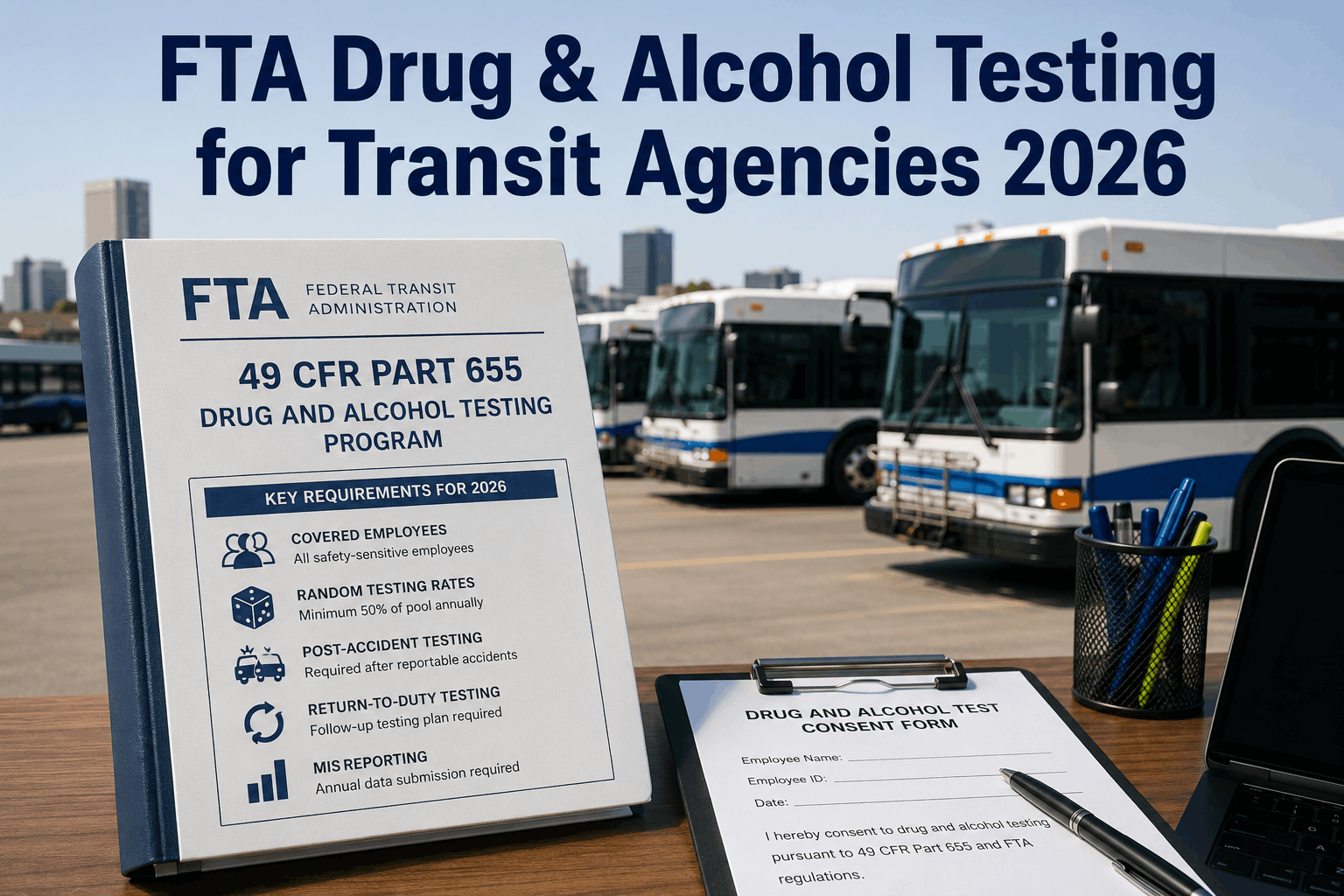
49 CFR Part 655 mandates that every transit agency operating commercial vehicles under DOT authority establish and maintain a comprehensive drug and alcohol testing program for all safety-sensitive employees. This includes bus drivers, maintenance technicians, dispatchers, and certain supervisory roles. The regulation covers three testing categories: pre-employment screening, random testing at mandated annual rates, and post-accident testing triggered by specific incident thresholds.
Random Testing Rates for 2026
Drug Testing Annual Rate:
50% of covered employees minimum (up from 25% in prior years due to industry trend increases)
Alcohol Testing Annual Rate:
10% of covered employees minimum (unchanged from previous cycles)
Post-Accident Testing Trigger:
Any bus accident resulting in injury, fatality, or damage exceeding $25,000 — driver must be tested within 2 hours for alcohol, 24 hours for drugs
Pre-Employment Requirement:
All candidates for safety-sensitive roles must clear a negative drug test before offer confirmation
Return-to-Duty Protocol:
Employees who test positive must complete an approved rehabilitation program and pass a return-to-duty test before resuming safety-sensitive duties
The FTA drug and alcohol testing regulation also mandates that transit agencies maintain a Medical Review Officer (MRO) who can interpret test results, handle legitimate medical explanations for positive results, and ensure chain-of-custody compliance throughout the testing process. Every positive result must be reviewed by an MRO before the employee is notified or any disciplinary action is taken.
See how BusCMMS automates FTA testing compliance — book a 20-minute demo
Covered Employees Under 49 CFR 655
The FTA regulation applies to all employees who perform safety-sensitive functions — meaning anyone whose error could directly endanger passengers or the public. This extends beyond drivers alone. Your testing program must cover all of these categories:
Bus Drivers
All commercial bus operators — full-time, part-time, and substitute drivers
Maintenance Technicians
Any mechanic or technician performing maintenance that affects vehicle safety, brakes, steering, or structural integrity
Dispatchers
Personnel responsible for routing, scheduling, and managing bus movements that affect passenger safety
Facility/Security Staff
Employees with responsibility for passenger or vehicle security at transit facilities
Training Instructors
Supervisors or trainers who operate or supervise safety-sensitive employees in safety-sensitive functions
Fueling/Vehicle Prep Staff
Employees responsible for vehicle fueling, pre-trip inspections, or other pre-operation duties
A common FTA audit finding: transit agencies under-identify covered employees. They test drivers and mechanics but miss dispatchers, facility managers, or part-time roles. The FTA defines "safety-sensitive" broadly — if their error could cascade into passenger injury, they must be tested. Underestimating your covered population creates compliance gaps that auditors catch immediately.
Ensure complete employee coverage — see how BusCMMS tracks all safety-sensitive roles
Post-Accident Testing: Timing & Procedures
Post-accident testing is one of the most misunderstood aspects of 49 CFR 655. The regulation requires testing within specific time windows and only in response to accidents meeting the threshold definition. Many transit agencies either test too broadly (non-qualifying incidents) or miss qualifying accidents due to unclear trigger documentation.
Post-Accident Testing Procedure Timeline
Within 2 hours
Alcohol breath test must be administered (screening test with confirmatory backup if positive)
Within 24 hours
Urine drug test collection must begin (chain of custody established, lab analysis initiated)
Within 72 hours
If the driver cannot be located or is hospitalized, documentation must show good-faith effort to test within the window
Upon return to work
If driver was off-duty at time of accident, testing must occur within 24 hours of return to service
What Qualifies as a "Reportable Accident" Under 49 CFR 655?
Any accident resulting in injury requiring immediate off-site medical attention
Any accident with a fatality
Any accident with property damage to the transit vehicle exceeding $25,000
Accidents involving other vehicles where fault is unclear or disputed
A critical detail: the regulation requires testing of the driver when an accident occurs in a bus they were operating, regardless of whether the driver was at fault. Transit agencies must document the accident, determine whether it meets the reporting threshold, and trigger testing accordingly. Many agencies delay this decision, missing the 2-hour alcohol window and creating an automatic compliance violation.
MIS Reporting: Documentation & Record Requirements
The FTA requires every transit agency to submit annual Management Information System (MIS) data reporting the drug and alcohol testing program's execution. This is not a one-time compliance step — it's an ongoing annual requirement submitted to the FTA through a standardized federal reporting system. Incomplete or inaccurate MIS reports can trigger audits and funding penalties.
What Your MIS Report Must Include
Total Covered Employees
Documented headcount of all safety-sensitive roles subject to testing
Random Tests Conducted
Actual number of drug and alcohol tests performed, broken down by category
Positive Results
Count of confirmed positive tests and refusals to test (both count as violations)
Post-Accident Tests
Number of qualifying accidents and post-accident tests administered
Return-to-Duty Completions
Employees who completed rehabilitation and passed return-to-duty testing
Testing Rate Compliance
Documentation that your random testing met or exceeded 50% drug and 10% alcohol annual rates
The FTA uses MIS data to flag agencies at risk of non-compliance. If your agency reports fewer random tests than required, the FTA initiates a compliance review. If your testing records lack chain-of-custody documentation or lab certifications, the MIS submission can be flagged as incomplete, requiring supplemental documentation and delaying reimbursement of certain federal grants.
Automate MIS reporting with complete audit trails — start your program today
Building a Compliant Testing Program: The 6-Step Framework
Compliance isn't a one-time audit — it's a system. Here's the framework every transit agency must implement to maintain continuous FTA compliance and defend against audit findings.
1
Policy & Procedure Documentation
Write and publish a formal drug and alcohol testing policy that covers all covered employees, testing procedures, confidentiality protections, and consequences for violations. The policy must be signed by every safety-sensitive employee and retained for FTA inspection.
2
Covered Employee Registry
Create and maintain an authoritative list of all safety-sensitive employees with their roles, start dates, and testing status. Update this quarterly as staff changes occur. This is your MIS foundation.
3
Random Testing Pool & Scheduling
Use a certified random selection process to choose employees for testing throughout the year. Most agencies rotate monthly or quarterly to ensure even distribution. Document every selection and test date.
4
Lab & MRO Network
Contract with a DOT-certified testing laboratory and establish a Medical Review Officer (MRO) protocol. The lab must maintain chain-of-custody records and provide certified reports for every test result.
5
Post-Accident Incident Reporting
Train dispatch and management to flag qualifying accidents within 2 hours. Document accident severity, damage estimates, and injured parties. Route immediately to testing coordinator for same-day testing authorization.
6
Record Retention & Audit Trail
Maintain secure, organized records of all test results, lab certifications, MRO review outcomes, and return-to-duty documentation for minimum 5 years. Be audit-ready at any time with a searchable, dated record system.
See BusCMMS automate all 6 steps — schedule a compliance workflow demo
Return-to-Duty Requirements & Rehabilitation Programs
Every employee who tests positive or refuses a test must complete a structured return-to-duty process before resuming safety-sensitive work. This isn't a simple pass/fail — it's a multi-stage process with specific mandates that vary by state and program type.
Return-to-Duty Process Steps
Step 1: Evaluation
Within 30 days of the positive result, the employee must be evaluated by a Substance Abuse Professional (SAP) — not the same person as the MRO. The SAP assesses substance abuse history and recommends an education or treatment program.
Step 2: Program Completion
The employee completes the recommended program (education class, outpatient treatment, inpatient rehabilitation, etc.). Program type and duration depend on SAP evaluation but typically range from 1-30 days of active participation.
Step 3: Return-to-Duty Test
After program completion, the employee must pass a negative drug/alcohol test administered by a certified lab. Both drug and alcohol testing required regardless of which substance triggered the original positive.
Step 4: Follow-up Testing
For minimum 12 months after return to duty, the employee is placed in an unannounced follow-up testing pool with increased frequency (minimum 6 tests per year, spread throughout 12 months).
The FTA permits transit agencies to design their own return-to-duty program or contract with external service providers. Some agencies partner with Employee Assistance Programs (EAPs) that provide referral, SAP evaluation, and program coordination — often at lower cost than internal administration. Regardless of approach, every step must be documented and reported to the FTA.
We went from tracking drug testing on a spreadsheet with missed random tests to automated compliance in three months. BusCMMS flagged every post-accident incident, calculated our random testing rate in real time, and gave us a complete MIS report ready for the FTA audit. We passed with zero findings for the first time in six years.
Common Audit Findings & How to Avoid Them
The FTA conducts compliance audits on a rotating basis. Transit agencies with poor testing records or incomplete MIS submissions are flagged faster. Here are the findings that show up most frequently in FTA audits and how to prevent them.
Insufficient Random Testing Rate
Agency failed to conduct testing at mandated 50% drug and 10% alcohol rates. This is the most common finding. Prevention: use automated random selection and track testing progress monthly against your annual target.
Missing Post-Accident Tests
A qualifying accident occurred but testing was not initiated within required windows. Causes: unclear accident definitions, communication gaps between dispatch and testing coordinator. Prevention: train staff on accident thresholds, establish automatic escalation protocols.
Incomplete Chain of Custody
Test samples were collected but documentation of handling/transportation was missing or incomplete. Prevention: use labs with certified chain-of-custody procedures and verify documentation at collection, not during audit.
Undocumented Covered Employees
Auditors found safety-sensitive employees not listed in the covered-employee registry, creating doubt about whether testing was complete. Prevention: audit your roster quarterly and include all part-time, substitute, and newly promoted employees.
Inaccurate or Late MIS Submission
MIS data submitted to the FTA contained errors or was submitted past the annual deadline. Prevention: use automated data aggregation and submit 30 days before deadline with internal verification step.
Review your current compliance gaps — schedule a free audit assessment
Compliance Isn't Optional. But It Can Be Automated.
Random testing pools. Post-accident automation. MIS reporting. Return-to-duty tracking. Employee registries. Lab coordination. FTA audit readiness. One system. BusCMMS guides your drug and alcohol program through every regulatory requirement, automatically generates audit-ready records, and keeps your agency 100% compliant with 49 CFR 655 in 2026.
FTA Drug & Alcohol Testing FAQs
What is the difference between 49 CFR Part 655 and DOT drug testing requirements?
49 CFR 655 is FTA-specific for transit agencies. DOT 49 CFR 382 covers general commercial drivers. FTA agencies follow Part 655, which includes specific random testing rates (50% drug, 10% alcohol) and MIS reporting unique to transit. Non-compliance with Part 655 triggers federal funding suspension, not just fines.
Can we use a random testing vendor instead of managing it in-house?
Yes. Many agencies contract with certified testing services or Employee Assistance Programs (EAPs) to manage random selection, lab coordination, and MRO review. You remain accountable for compliance, so verify the vendor maintains chain of custody and submits accurate MIS data on your behalf.
Do substitute and part-time drivers count as covered employees for random testing?
Yes. Any person who operates a bus in safety-sensitive function is covered, regardless of employment status. Part-time and substitute drivers must be included in your covered-employee count and random testing pool. Exclusion is a common audit violation.
If an employee refuses to take a drug test, does it count as a positive result?
Yes. A refusal is treated identically to a confirmed positive and triggers the same return-to-duty process. The employee is immediately removed from safety-sensitive duties and must complete SAP evaluation and rehabilitation before return to work. Refusals must be reported in MIS data.
What happens if we miss the 50% random testing rate in a calendar year?
The FTA flags this in your MIS submission and may initiate a compliance audit. Missing the rate multiple years can result in loss of certain federal grants and reputational damage. Most agencies use quarterly monitoring to stay on pace and adjust testing schedule if falling behind.
Can we test drivers before they're hired, or only after they're employees?
Pre-employment testing is allowed and recommended. Test all bus driver candidates before offering a position. This is not counted toward your random testing rate — it's a separate safety screen. Results must be reviewed by an MRO and documented in hiring records.
How long must we retain drug testing records for FTA audits?
Minimum 5 years from test date. Records include test results, lab certifications, MRO review notes, chain of custody documents, and return-to-duty completion records. Digital storage is acceptable if records are searchable and tamper-proof.
What is an acceptable Medical Review Officer (MRO) and how do we find one?
An MRO must be a licensed physician certified in substance abuse testing. You can contract with a testing lab (they often provide MRO services) or hire an independent MRO. The MRO reviews every result, investigates legitimate medical explanations, and contacts employees before results are reported to the agency.
Your FTA Compliance System Starts Now
Covered employee registries. Random testing automation. Post-accident triggering. MIS report generation. Return-to-duty tracking. All audit-ready, all in one platform built for transit agencies serious about 49 CFR 655 compliance.