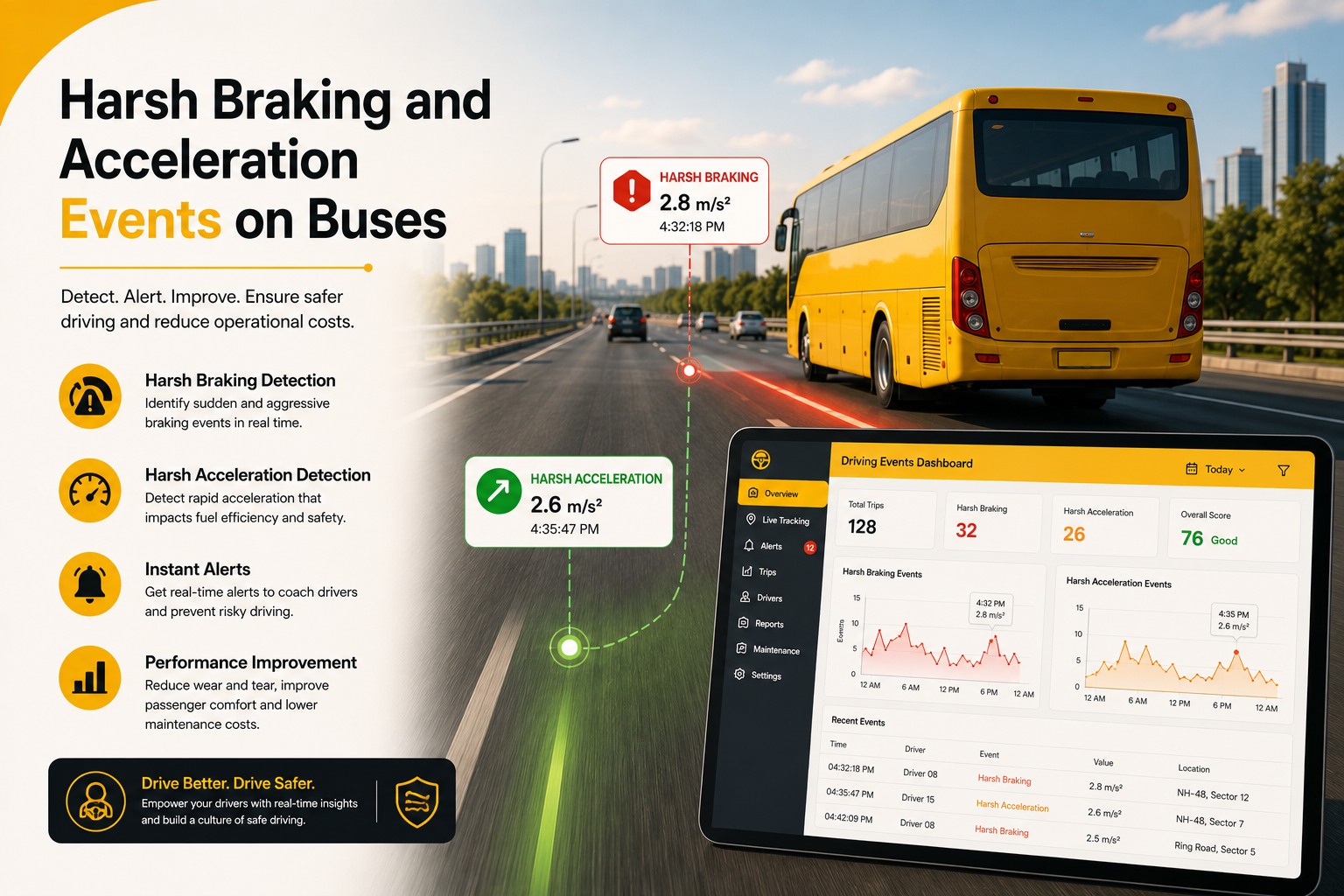
A harsh braking event on a bus isn't automatically a driving problem — it can just as easily be a worn brake component, a road hazard, or a standee who wasn't holding on. Harsh braking bus events need to be separated by cause before anyone acts on them: video shows whether the driver, the road, or the vehicle itself is behind the event, and each of those points to a completely different follow-up. See how a harsh braking event reaches a work order in BusCMMS.
Harsh Braking and Acceleration Events on Buses
What a harsh event actually indicates on a loaded bus, standee risk on transit routes, and why video is what separates a driver issue from a brake system issue.
Why This Fleet's Scale Makes Every Harsh Event Worth Reviewing
A small rate across a big fleet is still a lot of events.
About 480,000 yellow school buses carry roughly 26 million students every school day and cover some 4.4 billion miles a year — the largest passenger fleet in the United States (School Transportation News safety resources, retrieved Aug 2026). Even a small per-mile rate of harsh braking events adds up to a meaningful volume across a fleet running that many miles, and on a transit route with standing passengers, a harsh stop isn't just a data point — it's a real fall risk for someone without a seatbelt or a seated brace point.
Standee Risk on Transit Routes Changes the Stakes
A harsh stop on a full bus is a different event than on an empty one.
On a public transit route running standing passengers during peak hours, a harsh braking event carries a fall risk that a mostly-seated school bus route doesn't share in the same way. A standee has no seatbelt and often no firm brace point, so the same deceleration that's merely uncomfortable for a seated rider can be enough to knock someone off their feet. This is exactly why transit operations often weight harsh braking review more heavily during peak standee hours than during off-peak runs with a mostly seated load.
Brake System Follow-Up: When the Shop Needs to Get Involved
A pattern on one bus is a maintenance signal, not a driver signal.
When harsh braking events cluster on one specific bus across multiple drivers and multiple routes, that pattern points away from driver behavior and toward the vehicle itself — uneven brake wear, a failing component, or an alignment issue that makes the bus require harder braking than it should for a given stop. 49 CFR 396.17 governs periodic and annual inspection requirements, and 49 CFR 396.3 requires systematic inspection, repair, and maintenance records — a documented pattern of harsh events on one bus is exactly the kind of trigger that should prompt an out-of-cycle brake system inspection rather than waiting for the next scheduled interval.
A Scenario From a Real Bus Operation
Video separated a driver problem from a brake problem in one afternoon.
A public transit agency running 40 buses saw one particular bus generating harsh braking alerts nearly triple the fleet average, across three different drivers who rotated onto it. Without video, the initial assumption was inconsistent driving across the rotation. Reviewing the flagged clips showed the events weren't tied to any driver behavior pattern — the bus was consistently requiring a harder stop than normal for routine traffic slowdowns. A shop inspection found uneven front brake pad wear well ahead of the scheduled interval; once repaired, harsh braking events on that specific bus dropped to fleet average within the next two weeks, regardless of which driver was behind the wheel.
We almost coached three different drivers for the same bus's problem before we pulled the video. Turned out none of them were doing anything wrong — the bus itself needed harder pedal pressure to stop. Once we fixed the brakes, the alerts went away no matter who was driving it.
Not sure if your harsh braking alerts are pointing at drivers or at the vehicles themselves? That's worth checking. Talk to the team about a pattern review →
Proven Across Thousands of Fleets
The wedge BusCMMS solves that a generic telematics dashboard can't.
BusCMMS is an AI-native bus fleet operations platform reported in use across 5,000+ bus fleets, with fleets reporting roughly 30% lower annual maintenance cost and an average four-month payback. The reason harsh braking data actually gets acted on rather than just reported is that it lives on the same asset record as inspection history, work orders, and brake service intervals — a repeated pattern on one bus doesn't just sit in a safety dashboard, it can trigger a maintenance follow-up automatically.
Frequently Asked Questions
What does a harsh braking event actually indicate on a bus?
A harsh braking event can be caused by a road hazard, driver behavior like following too close, or a vehicle issue such as worn brake components — video review of the moment is what separates these causes, since a telematics spike alone looks identical regardless of the underlying reason.
Why does standee risk matter for harsh braking on transit buses?
A standing passenger has no seatbelt and often no firm brace point, so a harsh stop that's merely uncomfortable for a seated rider can be enough to cause a fall. Transit operations often weight harsh braking review more heavily during peak standee hours as a result.
When should a harsh braking pattern trigger a brake inspection?
When harsh events cluster on one specific bus across multiple drivers and routes, that pattern points to the vehicle rather than driver behavior. 49 CFR 396.17 periodic inspection requirements and 49 CFR 396.3 maintenance recordkeeping support triggering an out-of-cycle brake inspection in this situation.
Why do some harsh braking monitoring programs stop being useful?
Alert volume can climb high enough that safety staff stop reviewing events consistently, and real issues drown in false positives from ordinary road-cause braking. Filtering events by likely cause before they reach a reviewer keeps the queue small enough to actually act on.
Is there a federal requirement to inspect brakes after repeated harsh braking events?
There's no rule naming harsh braking events specifically, but 49 CFR 396.17 governs periodic and annual inspection, and 49 CFR 396.3 requires systematic inspection, repair, and maintenance records — a documented harsh braking pattern on one bus fits naturally into that recordkeeping and inspection framework.