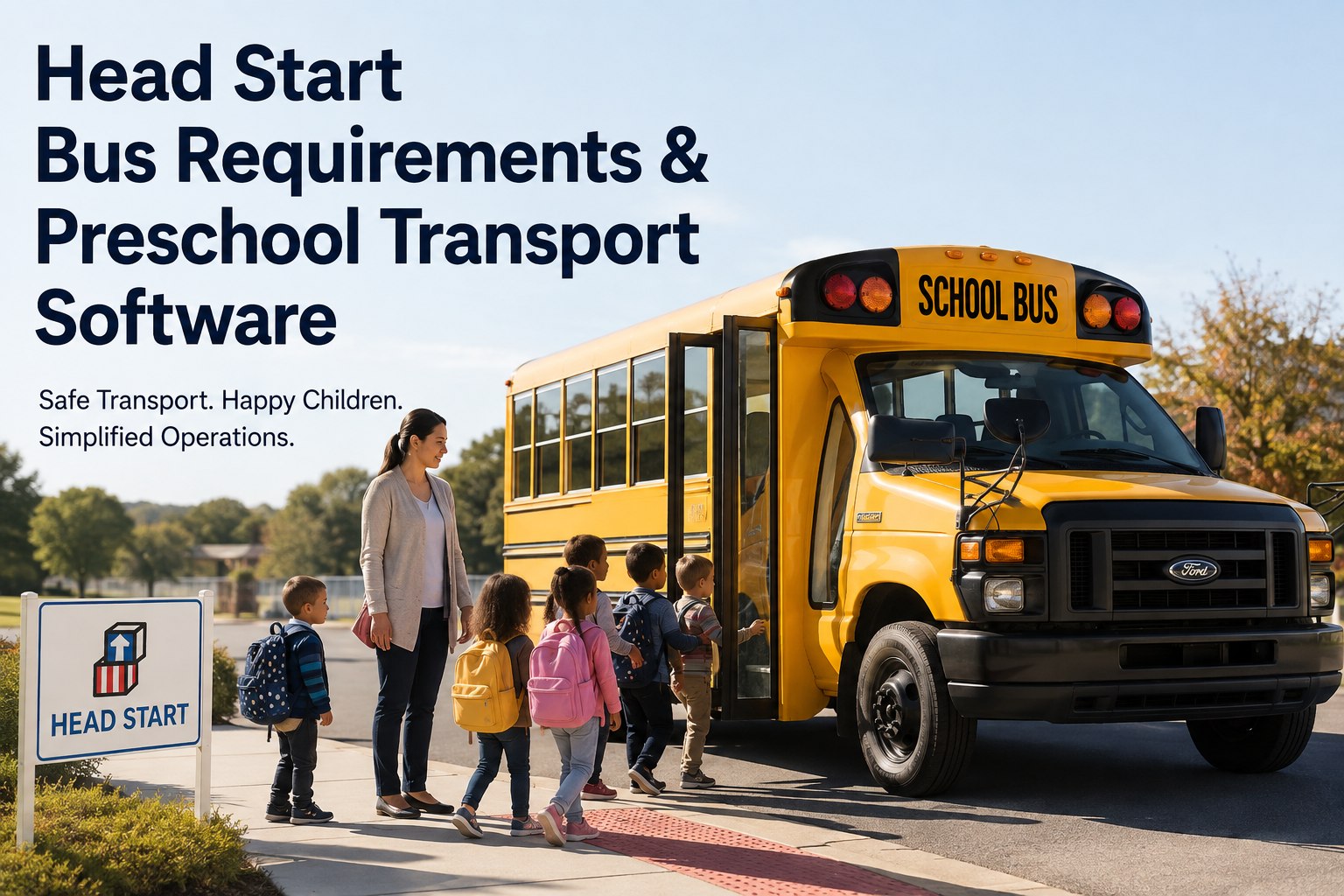
Head Start bus requirements start with 45 CFR §1303.70 — and don’t stop there. Every agency also has to meet age- and weight-appropriate child restraint rules, monitor-on-every-bus requirements, driver qualifications, child-check procedures, and applicable state pupil-transportation standards. This page walks through what those mean operationally, and how one platform holds the records that document them. Book a demo to see BusCMMS running on a Head Start fleet the size of yours.
Head Start Bus Requirements & Preschool Transport Software
BusCMMS gives Head Start agencies and preschool transportation contractors one platform for bus inspections, maintenance, child-safety workflows, camera evidence, and the records federal, state, and local requirements depend on.
-
TIER 1
Federal Head Start Rules
45 CFR §1303.70 — transportation, restraints, monitors, driver requirements
-
TIER 2
State Pupil-Transportation
Vehicle specs, inspection cycles, stop-arm enforcement, restraint rules — varies by state
-
TIER 3
Local District & Agency Policy
Child-check procedures, monitor training, boarding rules, incident reporting
What Are the Head Start Bus Requirements? A Direct Answer
If your program provides transportation, 45 CFR §1303.70 applies — whether you own, lease, or contract for the buses. The core requirements fall into four categories: the vehicle, the child restraints, the monitor, and the driver. Each generates records your program has to keep.
-
Vehicle
School bus or allowable alternate vehicle meeting federal school-bus construction standards. Maintained and inspected per applicable state pupil-transportation rules.
-
Child Restraints
Age- and weight-appropriate restraints for every Head Start passenger while in motion. FMVSS No. 213 for restraint systems. No waiver for Early Head Start (birth-3).
-
Monitor
At least one trained adult monitor on every bus transporting Head Start passengers. Responsible for boarding, riding, unloading safety and emergency assistance.
-
Driver
CDL with school-bus endorsement where required, DOT drug/alcohol testing, FBI background, TB, driving-record checks, and Head Start Performance Standards training.
Everything else on this page — child-check procedures, inspections, cameras, maintenance, waivers — sits on top of those four. State pupil-transportation rules can raise the bar in any category. Verify your state’s rules alongside 45 CFR §1303.70. Book a demo to see how BusCMMS tracks each of the four categories.
Child-Check and Post-Route Sweep Procedures
The most consequential moment in a preschool transportation day is the one after every child has been unloaded. A child left on a bus is the failure no transportation director survives professionally. Formal child-check procedures exist for that reason, and documenting that the check happened, on every bus every day, is a program-level compliance requirement. Software doesn’t perform the check — the monitor does. But the record lives in your fleet system.
The 5-Step Verified Sequence
- 01
Announce
Driver and monitor call out to any remaining passengers before leaving the driver’s seat.
- 02
Walk
Monitor walks the aisle front to back, checking every seat and floor for a sleeping child or forgotten item.
- 03
Look
Check under seats, behind seat backs, and in every restraint pod. Confirm restraints unbuckled and clear.
- 04
Verify
Rear-of-bus check switch or child-reminder system activated and confirmed (where installed).
- 05
Sign Off
Monitor and driver sign the digital post-route check. Timestamp, bus ID, and route recorded to the coach record.
Digital sign-off matters for two reasons: the check becomes non-skippable (the app doesn’t close without it), and the record is auditable later. When a state monitor asks “show me your post-route sweep records for the last 30 days,” you produce them in seconds. Book a demo to see digital child-check on your fleet.
Camera Evidence Tied to the Child-Safety Record
School bus cameras earn their keep in Head Start operations differently than in transit or motorcoach fleets. The significant events are boarding, unloading, stop-arm violations, restraint compliance, and child incidents on the bus. What matters isn’t capturing footage — it’s tying that footage to the child-safety record it documents.
-
BOARDING
Restraint-secured verification
Every child buckled in age-appropriate restraint before pull-out. Monitor visible in frame.
-
STOP-ARM
Passing vehicle captured
Stop-arm engaged, passing motorist license plate captured for local enforcement referral.
-
SWEEP
Post-route walk documented
Interior camera captures monitor walking aisle end-to-end. Ties to digital child-check sign-off.
Hardware-agnostic ingestion matters here. Most agencies already have cameras installed. BusCMMS pulls relevant events from existing MDVR or AI platforms and connects them to the bus record, route, and where applicable the child-check sign-off — without a hardware swap. Book a demo to see camera event ingestion from your specific system.
A Restraint Defect Becomes a Cleared Bus
A pre-route inspection on Bus 8 finds a lap-belt buckle that won’t latch on seat 7. That seat is out of service until fixed — and if it can’t be fixed before the run, the bus is swapped or the child re-seated in a working restraint. Here’s the workflow.
Bus 8 · Restraint Defect, AM Pre-Trip
- 01
Detection
Pre-trip DVIR flags seat 7 lap-belt buckle failed to latch. Defect logged safety-critical against Bus 8.
- 02
Route Assignment
Bus 8’s AM run includes a 3-year-old in Early Head Start — no restraint waiver available. Bus 8 held until repair.
- 03
Response
Bus 15 pulled from spare pool, restraint layout verified against route roster, monitor and driver assigned. Bus 8 to shop.
- 04
Closure
Buckle replaced within 90 minutes. Corrective action logged. Next driver acknowledges repair on pre-trip. Bus 8 back in service by PM route.
Every step generates a record: DVIR line, work order, parts issue, corrective action, next-driver acknowledgment. When a state monitor reviews defect handling later, the chain sits on one bus record — not a spreadsheet excavation. Sign up free to try the DVIR chain on your own fleet.
A Head Start Transportation Director’s View
That’s the operational payoff. Federal monitoring, state inspections, and parent inquiries all reference the same records — and when they live in one place, all three become manageable. Book a demo to see the audit-export view Head Start agencies actually use.
Head Start Transportation Compliance Checklist
Here’s the rubric a working Head Start transportation director would build for evaluating fleet software — focused on what federal monitors and state inspectors actually ask for.
Bus DVIRs pre-loaded
Stop arms, restraints, monitor seat, emergency exits — ready day one.
Digital child-check sign-off
Non-skippable post-route sweep with timestamp, bus ID, and monitor signature on the coach record.
Restraint defect tracking
Seat-level restraint status; Early Head Start waiver-eligibility awareness.
Camera event integration
Boarding, stop-arm, and sweep events tied to bus, route, and shift — works with existing MDVR or AI.
Audit-export in minutes
DVIRs, work orders, corrective actions, and child-check history exportable for federal or state review.
Role-based views
Views for director, shop supervisor, driver, monitor, and program leadership — same record.
Most generic fleet tools score two of six. BusCMMS is built for all six — because it was built for buses. This page provides operational and software-evaluation guidance and does not substitute for state or program-specific legal requirements. Book a demo to walk the audit-export view live.
What are the Head Start bus requirements?
Head Start bus requirements are set by 45 CFR §1303.70 and apply to any program that provides transportation, directly or through a contractor. Core requirements cover the vehicle (school bus or allowable alternate), age- and weight-appropriate child restraints for every Head Start passenger, at least one trained adult monitor on every bus, and qualified drivers with CDLs, DOT drug/alcohol testing, background checks, and Head Start Performance Standards training. State pupil-transportation rules apply on top and can raise the bar in any category.
Are child restraints required on Head Start buses?
Yes. 45 CFR §1303.70 requires age- and weight-appropriate child safety restraints for every Head Start passenger while the vehicle is in motion. Restraints must meet Federal Motor Vehicle Safety Standard No. 213. Limited waivers may be requested through HHS, but no waiver is available for Early Head Start children (birth to three) — they must always be in age-appropriate restraints.
Do Head Start buses need a bus monitor?
Yes. Head Start transportation regulations require at least one trained adult monitor on every vehicle transporting Head Start passengers. The monitor is responsible for child safety during boarding, riding, and unloading, and for assisting the driver in emergencies. Monitors must complete required training before beginning duties. The requirement applies whether the bus is agency-owned, an allowable alternate vehicle, or a bus run by a contracted school district or transportation provider.
What is a Head Start child-check or post-route sweep?
A child-check or post-route sweep is the end-of-route procedure that verifies no child has been left on the bus. The monitor walks the aisle front to back, checks under every seat and behind seat backs, verifies restraints are unbuckled and clear, activates any installed rear-of-bus check system, and signs off. The record is a compliance requirement in most Head Start operations and one of the first records federal or state monitors ask to see after any incident.
Can BusCMMS manage Head Start bus inspections and maintenance?
Yes. BusCMMS handles digital DVIRs with bus-specific templates pre-loaded (stop arms, restraints, monitor seat, emergency exits, lifts), PM scheduling per bus, corrective work orders auto-generated from failed inspections, parts and inventory, and full maintenance history tied to each bus. Child-check sign-off, camera event ingestion, and restraint-defect tracking all live on the same platform, so a director can produce records for federal monitoring or state review in one export.