Every transportation director gets the question from the board sooner or later: how long do school buses last, and is it time to replace that one? The honest answer is a range, not a number — and you can see how tracked lifecycle costs pin down the real answer for your fleet in a demo.
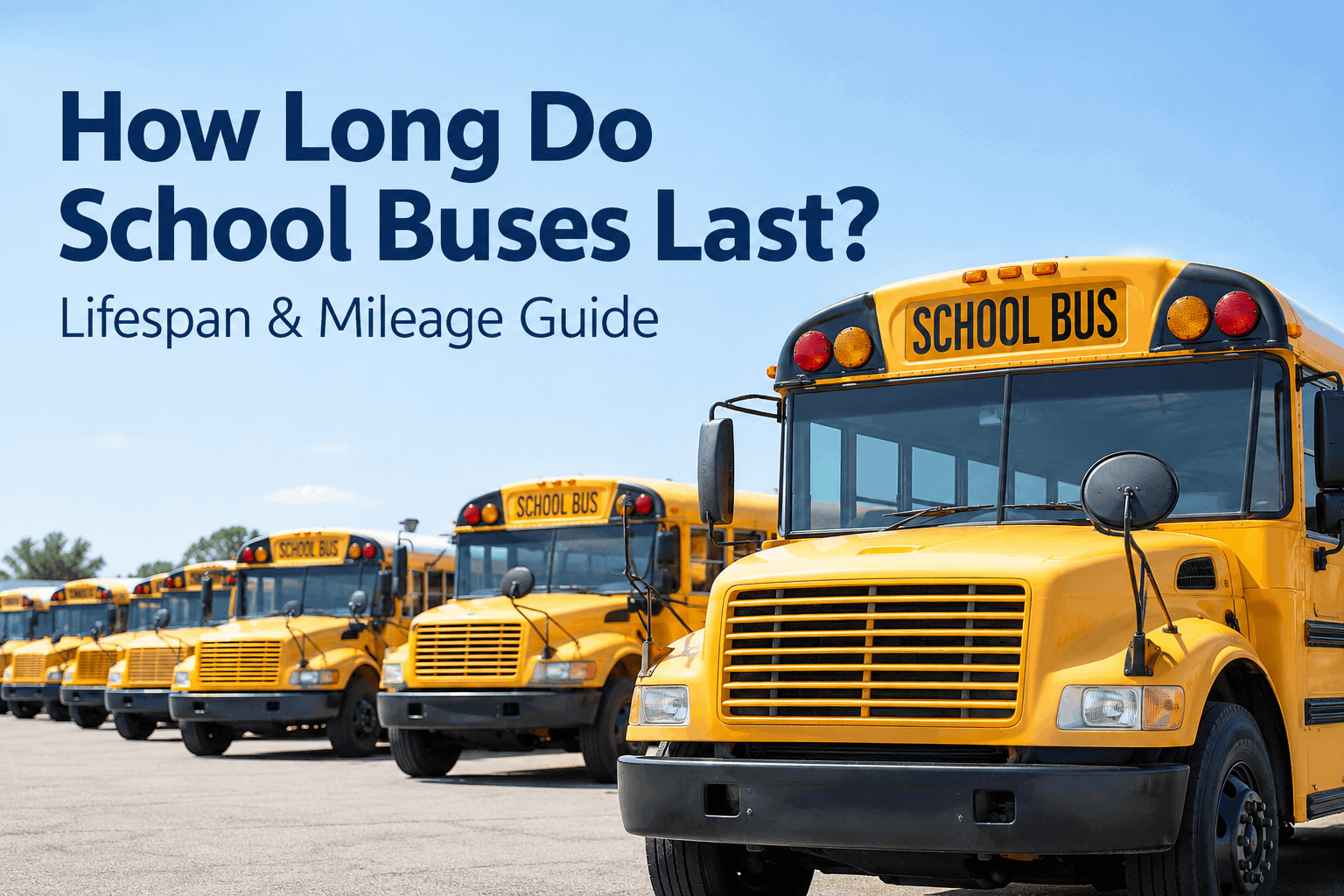
How Long Do School Buses Last? Lifespan & Mileage Guide
Most school buses run 12 to 15 years and around 250,000 miles — but the real end-of-life is when a bus costs more to keep than to replace. Here is how to find that point for each of your buses.
How Long a School Bus Lasts: The Real Range
Ask ten districts how long their school buses last and you'll get a range, because it depends on three things: the state replacement cycle, the route a bus runs, and how consistently it was maintained. As a rule of thumb, a school bus serves about 12 to 15 years or roughly 250,000 miles, whichever comes first for your operation. A bus on flat suburban routes with disciplined preventive maintenance can run past that; one on mountain grades or stop-heavy city routes, or one that skipped PM for years, hits end-of-life sooner.
That's why the mileage number alone misleads. Two buses with 230,000 miles can be in completely different places — one with a clean maintenance history and years left, one a money pit. The only way to know which is which is the record. You can sign up free and start tracking lifecycle cost on every bus.
Signs a School Bus Is Near End-of-Life
A bus rarely announces it's done — it tells you in the maintenance log first. These are the signals that a unit is crossing from aging into replace-territory, well before it strands a route.
Cost per mile keeps climbing
Repair spend per mile rising year over year is the clearest number — and the one the board understands.
Repeat breakdowns & road calls
The same bus pulling a route crew out again and again is costing more than the repair line shows.
Downtime eating availability
A bus spending more days in the bay than on routes is a spare you paid for twice.
Parts getting hard to source
When an older chassis's parts go to back-order, every repair stretches longer and costs more.
Any one of these alone is noise; together, in the record, they're a replacement case you can take to the board. You can see these signals surface automatically per bus in a demo.
Repair or Replace? The Cost-Crossover Rule
The real end of a school bus's life isn't a mileage number — it's the point where keeping it costs more than replacing it. Picture two lines: a new bus's steady cost per mile, and the old bus's rising one. Where they cross is your answer, and it lands at a different age for every unit.
You can't see that crossover without tracked cost history — which is exactly why a bus kept “because it still runs” is often the most expensive unit in the yard. You can walk your own repair-vs-replace numbers with our team in a demo.
The Lifecycle-Tracking Checklist
To answer “how long will this bus last” for your fleet — not the industry average — you need these tracked on every unit. Any line you can't check is a replacement decision you're making blind.
- Cost per mile, tracked per bus over timeThe one number that tells you when a unit crosses into replace-territory.DECISIVE
- Full repair & PM history on every unitWhat's been done, what keeps recurring — the aging story in one place.DECISIVE
- Mileage & age against your replacement cycleWhere each bus sits versus your state or district cycle.TRACK
- Availability & downtime days per unitA bus in the bay more than on routes is already costing you a spare.TRACK
- A forward replacement plan, costedWhich buses age out which year, so capital asks don't blindside the board.PLAN
The two decisive lines — cost per mile and full history — are what turn “it still runs” into a defensible decision. You can sign up free and build this lifecycle view for your fleet.
How BusCMMS Answers It for Your Fleet
“How long do school buses last” has an industry answer and a your-fleet answer — and only the second one justifies a capital request. BusCMMS keeps the record that gives you the second.
Cost-per-mile over time
Every repair and PM rolls into a cost-per-mile trend per bus, so the crossover point is visible, not guessed.
Full lifecycle history
Complete repair and PM records per unit show the aging story and what keeps recurring — the case for or against keeping it.
Replacement planning dashboards
See which buses age out which year and build a costed, board-ready replacement plan from real fleet data.
And because PM is scheduled and logged, you also get more life out of the buses you keep — the data cuts both ways, telling you which units to retire and which still have road left in them.
A Transportation Director's Take
Key Takeaways on School Bus Lifespan
How long school buses last comes down to cost, not just the odometer. Four things to carry out of this.
12–15 years is the rule of thumb
Around 250,000 miles — but it's a range, not a fixed limit.
Cost, not mileage, sets end-of-life
A bus is done when it costs more to keep than to replace.
The log warns you first
Rising cost per mile, repeat road calls, downtime — before the breakdown.
Only your records give your answer
The industry average won't justify a capital request — your data will.
How long do school buses last? As long as they cost less to keep than to replace — and only tracked lifecycle data tells you exactly when that line is crossed.