A DOT inspector walks into your shop and asks one question: "Show me the last 90-day emergency exit inspection for Bus #22." You check the binder. It's not there. The last one was 127 days ago. That's a $1,584 violation — and your bus is out of service until it's inspected and documented. Across the street, a fleet manager pulls up BusCMMS on her tablet, types "22," and hands the inspector a timestamped, photo-verified report in 30 seconds. Same regulation. Same bus type. Two completely different outcomes. The inspection requirements haven't changed — daily DVIRs, 90-day emergency exits, annual comprehensive, 14-month record retention. What's changed is whether you're tracking them manually or automatically. Here's every federal and state inspection requirement your bus fleet must meet in 2026 .
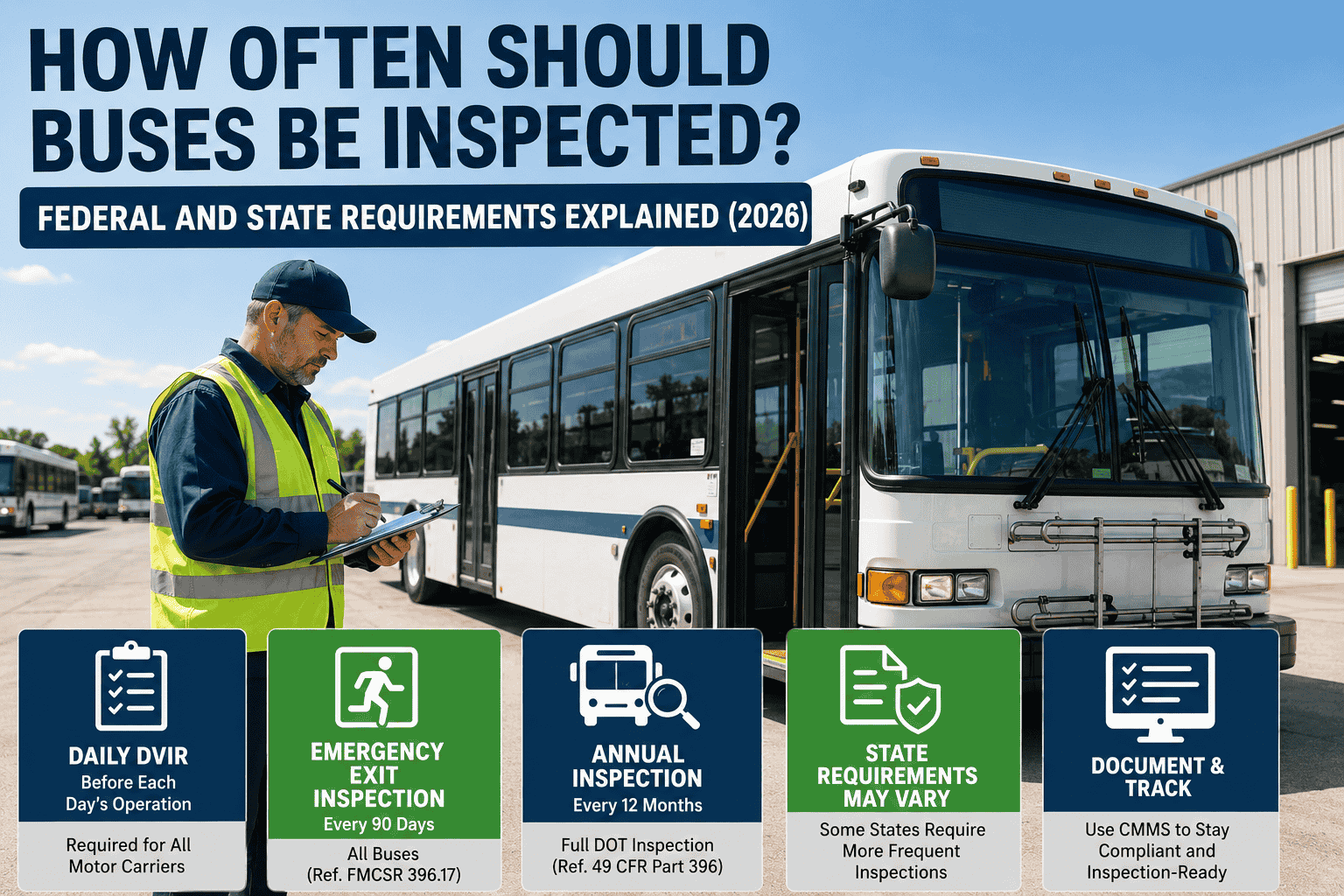
How Often Should Buses Be Inspected? Federal and State Requirements Explained (2026)
Daily DVIRs. 90-day emergency exits. Annual DOT. State variations. Record retention. Every inspection requirement in one reference — with the penalties for missing each one.
Bus Inspection Frequency at a Glance
Miss any one = violation + out-of-service risk
The 4 Layers of Bus Inspection Requirements
Bus fleets face more inspection layers than any other commercial vehicle type. Here's the complete picture — each layer, its legal authority, and what happens when you miss it:
EVERY TRIP
Driver Vehicle Inspection Report (DVIR)
49 CFR 396.11 / 396.13
Missing: $1,270/day · Falsified: $12,700 · Dispatch unrepaired: $15,420
EVERY 90 DAYS
Emergency Exit / Window / Door Light Inspection
49 CFR 396.3
Violation: $1,584/day · This is the inspection that catches fleets off guard
EVERY 12 MONTHS
Annual Comprehensive DOT Inspection
49 CFR 396.17 / Appendix A
Missing/expired: up to $23,048 · Operating under OOS: $23,048 per occurrence
VARIES BY STATE
State Periodic Inspection Programs
49 CFR 396.23 + state codes
State fines vary widely — $250 to $10,000+ per violation depending on state
BusCMMS auto-schedules all four layers simultaneously. Daily DVIR triggers are built into driver workflows. 90-day emergency exit inspections generate work orders automatically — 30/60/90-day advance alerts ensure you never go past due. Annual DOT inspections schedule 60 days before expiration. State-specific cycles configure per bus based on registration state. One dashboard. Every inspection layer. Every bus. Every deadline tracked.
Record Retention: How Long You Must Keep Every Document
When FMCSA issues a records request, you have 48 business hours. With paper, that's a panic. With BusCMMS, that's a one-click export. Every DVIR, every 90-day inspection, every annual report — timestamped, per-bus, indefinitely stored, and audit-ready in 30 seconds.
48-hour audit requests become 30-second exports — sign up free
Penalty Structure: What Each Violation Costs
$1,270
Missing DVIR
Per day missing
$1,584
Missing records
Per day per record
$12,700
Falsified DVIR
Per occurrence
$15,420
Dispatch unrepaired
Per occurrence
$23,048
Operating under OOS
Per occurrence
24 mo
CSA score impact
Per violation on record
Only 7% of carriers pass DOT audits without a single violation. The other 93% face fines, OOS orders, or CSA damage. The most common violations — missing DVIRs, overdue 90-day inspections, incomplete maintenance records — are all scheduling and documentation failures. BusCMMS eliminates every one of them automatically.
93% of Fleets Fail DOT Audits. Don't Be One of Them.
BusCMMS auto-schedules DVIRs, 90-day exit inspections, and annual DOTs. 30/60/90-day advance alerts. One-click audit exports. Digital eDVIR compliant with the 2026 FMCSA rule. Every inspection. Every bus. Every deadline tracked. Free 14-day trial.
"We got audited in February. The inspector asked for 90-day emergency exit records on 3 random buses. With paper, this would have been a 45-minute search — and honestly, I'm not sure we would have found all of them. With BusCMMS, I pulled up all 3 in under 2 minutes. Timestamped, photo-verified, signed. The inspector said it was the cleanest documentation he'd seen in a school bus fleet. Zero violations. Zero fines. Zero follow-up. That's what compliance automation looks like."
Right now, 60% of bus fleets have at least one overdue 90-day emergency exit inspection. The fine is $1,584/day. The inspection takes 15 minutes. The BusCMMS alert that prevents the overdue takes zero minutes — it fires automatically 30, 60, and 90 days before due.
Bus inspection requirements aren't complicated — they're relentless. Four layers running simultaneously: daily DVIRs, 90-day emergency exits, annual DOT, and state periodics. Each has its own interval, its own documentation, its own retention period. Managing this on paper across 50+ buses is where fleets fail. BusCMMS runs all four layers on one dashboard — auto-scheduled, auto-alerted, auto-documented. The 2026 eDVIR rule (FMCSA-2025-0115) makes digital the explicit standard. Paper isn't illegal, but it's the audit risk you don't need.
Buses must be inspected at 4 intervals: every trip (DVIR), every 90 days (emergency exits), every 12 months (annual DOT), and per state schedule (varies). The requirements are clear. The penalties are steep — $1,270 to $23,048 per violation. The 2026 eDVIR rule explicitly authorizes digital inspections. BusCMMS auto-schedules all 4 layers, sends advance alerts, stores every record indefinitely, and exports audit-ready reports in 30 seconds. Join the 7% that pass audits clean.
Every Inspection. Every Bus. Every Deadline. Automatic.
Daily DVIRs. 90-day exit inspections. Annual DOTs. State periodics. 30/60/90-day alerts. One-click audit exports. 2026 eDVIR compliant. Free 14-day trial. Set up in one afternoon.
How often must buses be inspected under federal law?
Four intervals: (1) DVIR before/after every day's operation (49 CFR 396.11), (2) Emergency exit inspection every 90 days (49 CFR 396.3), (3) Annual comprehensive inspection (49 CFR 396.17), and (4) State periodic inspections (varies). Bus drivers must file DVIRs even when no defects are found — this rule applies only to passenger-carrying vehicles.
What is the 90-day bus inspection requirement?
Under 49 CFR 396.3, pushout windows, emergency doors, and emergency door marking lights must be inspected every 90 days. This is a bus-specific requirement that does not apply to property-carrying CMVs. It's the #1 most-missed inspection — 60% of fleets have at least one overdue right now. BusCMMS auto-schedules with 30/60/90-day advance alerts.
Are electronic DVIRs legal in 2026?
Yes — explicitly. FMCSA published final rule FMCSA-2025-0115 (effective March 23, 2026) adding clear eDVIR language to 49 CFR 396.11 and 396.13. Electronic DVIRs were already permitted under 49 CFR 390.32 since 2018, but the 2026 rule removes all ambiguity. FMCSA actively encourages digital adoption.
How long must bus inspection records be kept?
DVIRs: 3 months. Roadside inspections: 12 months. Annual inspection reports: 14 months. General maintenance records: while vehicle is controlled + 6 months. Inspector qualifications: through employment + 1 year. FMCSA can request records with 48-hour turnaround during audits.
What are the penalties for missed bus inspections?
Missing DVIR: $1,270/day. Missing records: $1,584/day. Falsified report: $12,700. Dispatching with unrepaired defect: $15,420. Operating under out-of-service order: $23,048. CSA violations stay on record for 24 months. The 2026 CSA overhaul creates a separate scoring category for driver-observed violations.