how-to-write-bus-fleet-maintenance-rfp-template-evaluation-criteria

How to Write a Bus Fleet Maintenance RFP: Template & Evaluation Criteria


Writing a bus fleet maintenance RFP shouldn't take months — but picking the wrong software will cost you years. This visual guide gives you the exact RFP structure, weighted scoring criteria, and vendor demo questions that separate bus-specific CMMS from generic fleet software. Used by 200+ school districts and transit agencies to make confident, defensible procurement decisions .

RFP Guide + Template

How to Write a Bus Fleet Maintenance RFP

Template, Scoring Rubric & Evaluation Criteria

Test-drive before committing to formal procurement

YOUR 8-WEEK RFP JOURNEY WK 1-2 Draft RFP WK 3-4 Responses WK 5-6 Evaluate WK 7-8 Contract 4-6 Vendors to Evaluate 35% Weight on Features ? Tip: Test BusCMMS free BEFORE formal RFP
01

The Complete RFP Blueprint

8 sections every bus fleet RFP needs — follow this exact structure

1 Executive Summary Organization overview, fleet size, bus types, current challenges, project goals 2 Scope of Work Core functions: maintenance, inspections, compliance, reporting, parts, fuel tracking 3 Functional Requirements Feature checklist with "Must Have" vs "Nice to Have" designations 4 Technical Requirements Cloud/on-premise, mobile app, API, security standards, data migration 5 Vendor Qualifications Bus fleet experience, customer references, financial stability, years in business 6 Implementation & Support Timeline, training approach, ongoing support, SLAs for response times 7 Pricing Structure Per-vehicle vs per-user vs flat rate — always request 3-year TCO 8 Evaluation Criteria Weighted scoring rubric shared with vendors for transparency ✓ Share this structure with your procurement team
02

Bus-Specific Requirements Matrix

Features that separate real bus fleet CMMS from generic software

REQUIREMENTS CHECKLIST: MUST HAVE vs NICE TO HAVE Inspections & DVIRs Pre-trip / Post-trip DVIR MUST HAVE School bus templates (stop arms, exits) MUST HAVE Photo & digital signature capture MUST HAVE Offline mobile capability NICE Preventive Maintenance Multi-trigger PM (miles, hours, days) MUST HAVE Fuel-type schedules (diesel/propane/EV) MUST HAVE Auto-generated work orders MUST HAVE Academic calendar integration NICE Compliance & Reporting DOT annual inspection tracking MUST HAVE DVIR retention (90+ days) MUST HAVE Audit-ready compliance reporting MUST HAVE FTA compliance for transit agencies NICE Integrations GPS/telematics (Samsara, Geotab, etc.) MUST HAVE Fuel card import MUST HAVE ERP/accounting sync NICE Routing software connection NICE Must Have = Required for evaluation Nice to Have = Bonus points
03

Weighted Scoring System

The evaluation framework that removes bias from vendor selection

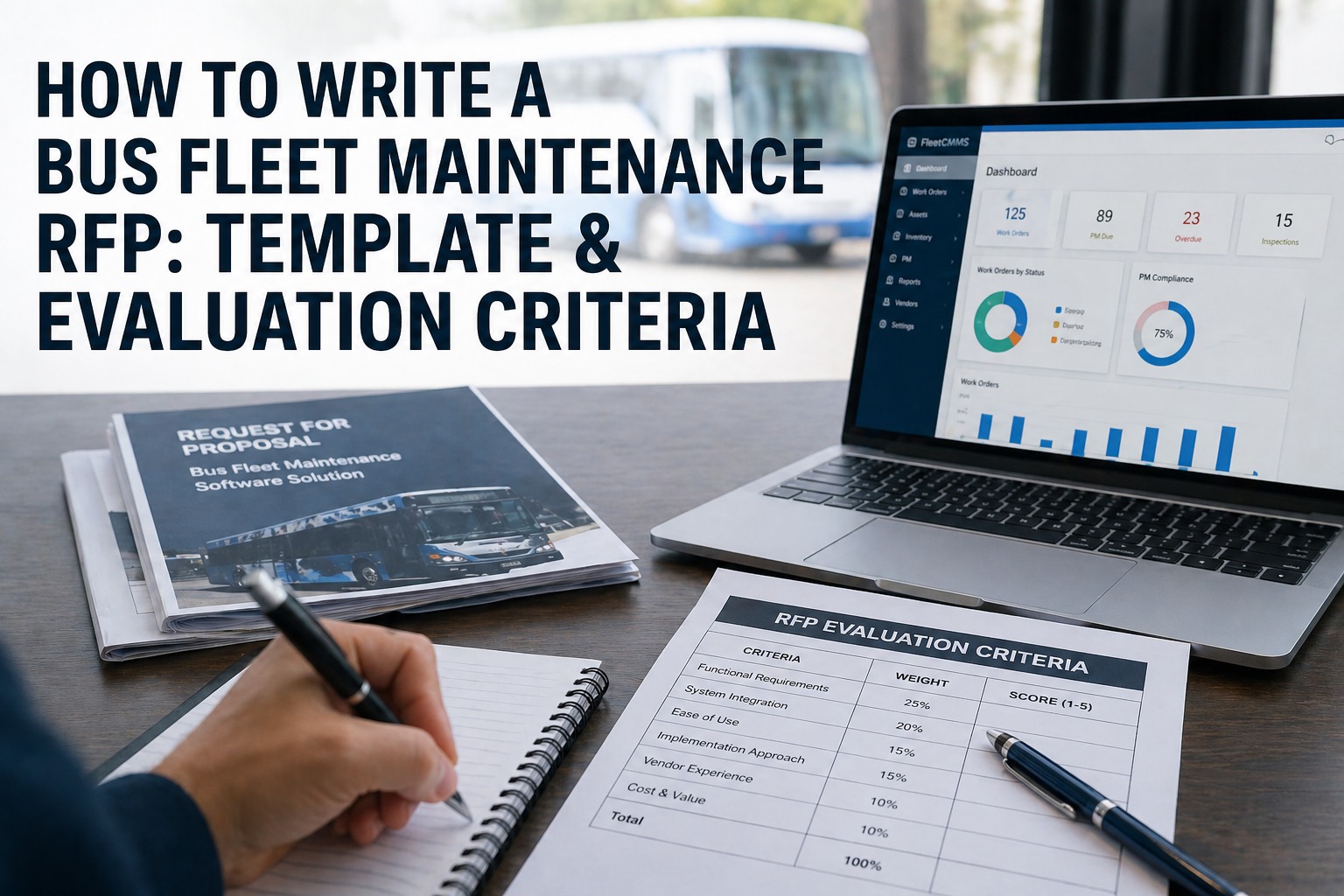
RECOMMENDED WEIGHTING FOR BUS FLEET CMMS 100% Total Score 35% Functionality & Bus-Specific Features DVIRs, PM scheduling, compliance, bus templates 20% Ease of Use & Mobile Experience Driver app, technician workflow, training time 15% Implementation & Support Timeline, training, ongoing support, SLAs 15% Vendor Experience & References Bus fleet customers, years in business, stability 15% Total Cost of Ownership (3-Year) License + implementation + training + support WARNING: Organizations that weight cost above 30% experience 40% more project failures (Deloitte CPO Survey 2025)
04

The 1-5 Scoring Rubric

Share this with all evaluators to ensure consistent, defensible scoring

5 EXCEPTIONAL Exceeds requirement with innovative approach; adds unexpected value Requires written justification 4 STRONG Fully meets requirement with evidence of bus fleet experience Shows satisfied references 3 ADEQUATE Meets minimum requirement but lacks depth or customization Generic fleet approach 2 WEAK Partial capability only; requires significant workarounds Custom dev needed 1 MISSING Does not address requirement or explicitly not available Requires written justification Require written justification for scores of 1 or 5 — creates audit trail for procurement defense

Skip the RFP Process?

Many districts test BusCMMS with a free trial before formal procurement. If it meets your needs, you can often sole-source based on demonstrated fit.

05

5 Demo Questions That Expose the Truth

What to ask when every vendor claims "Yes, we can do that"

01 "Show me your pre-built school bus DVIR template." WHAT IT REVEALS: Generic CMMS will scramble or admit they don't have bus-specific forms. A bus-focused solution shows stop arms, exits, mirrors immediately. 02 "Walk me through PM schedules for diesel vs propane vs electric buses." WHAT IT REVEALS: Different fuel types need different intervals. If they can't segment by fuel type, you'll fight the system or create workarounds forever. 03 "How does a defect flagged in a DVIR become a work order?" WHAT IT REVEALS: Manual re-entry = wasted time. Auto-generation with priority = real maintenance software. This exposes workflow maturity in seconds. 04 "Show me a DOT inspection report ready for an auditor — right now." WHAT IT REVEALS: Compliance isn't about features — it's about evidence. If they can't produce a report in under 60 seconds, they'll fail when it matters. 05 "What does implementation look like for a 50-bus fleet?" WHAT IT REVEALS: Enterprise vendors quote 6+ month timelines and expensive consultants. Bus-focused solutions should have you running inspections in 1-2 weeks with your existing staff. This single question separates partners from vendors selling you a project. ? Pro Tip: Have your actual drivers and technicians attend demos to ask real questions
06

The 4 RFP Mistakes That Kill Projects

Why most fleet software procurements go wrong — and how to avoid it

Using Generic Templates Generic fleet RFPs miss bus-specific needs: stop arm inspections, student safety, DOT passenger requirements, academic calendar alignment 70% features missed Over-Weighting Price Choosing cheapest ignores implementation costs, training time, and productivity lost fighting a poor-fit system for years. 40% more failures Skipping Live Demos Paper proposals lie. Every finalist must demo with your actual buses and staff asking questions — not a pre-recorded marketing video. 3x more surprises Ignoring Implementation A "better" enterprise system taking 6 months costs 6 months of paper- based inefficiency and compliance risk. 6mo lost productivity
07

Expert Insight

What procurement officers miss about CMMS selection

The biggest RFP mistake isn't in the scoring criteria — it's in assuming all CMMS platforms are equally adaptable. They're not. Generic fleet software treats a school bus like a delivery truck. It doesn't know about stop arms, emergency exit inspections, or the DOT annual requirements specific to passenger vehicles.

When evaluating vendors, don't ask "Can you do this?" — every salesperson says yes. Instead, ask "Show me how you do this for a bus fleet today." The difference between a configured workaround and a native feature becomes obvious in seconds.

Districts that pilot software before formal RFP save months of procurement time and often find that competitive bidding isn't required when a solution demonstrably meets the need at a fair price.

Ready to Evaluate Bus Fleet CMMS?

BusCMMS was built specifically for school and transit bus fleets. Test it with your own data before you finalize your RFP requirements.

Frequently Asked Questions
How long should we give vendors to respond to a bus fleet RFP?

Two to three weeks is standard for CMMS RFPs. Shorter windows may exclude qualified vendors who need time for thoughtful responses. Longer windows (4+ weeks) are rarely necessary unless your requirements are exceptionally complex or you're a large transit agency.

Should we share our evaluation criteria with vendors?

Yes. Sharing weighted criteria helps vendors tailor their responses to what matters most. It demonstrates fairness — important for public sector organizations. Don't share actual scores during evaluation, but criteria and weights should be in the RFP.

How many vendors should we invite to respond?

For bus fleet CMMS, 4-6 vendors is ideal. Include at least one bus-specific platform (like BusCMMS), one general fleet CMMS, and one enterprise option to see the full market range.

Can we sole-source bus fleet software without an RFP?

Many public organizations can sole-source when a product demonstrably meets unique requirements. Bus-specific CMMS with pre-built school bus DVIRs, fuel-type PM schedules, and DOT compliance may qualify. A pilot often provides documentation to justify sole-source.

What's the typical price range for bus fleet CMMS?

Bus-specific CMMS typically runs $4-10/vehicle/month. Enterprise fleet systems range $15-40/vehicle/month with longer implementation. Always ask for 3-year total cost of ownership including implementation, training, and support.

Share This Story, Choose Your Platform!