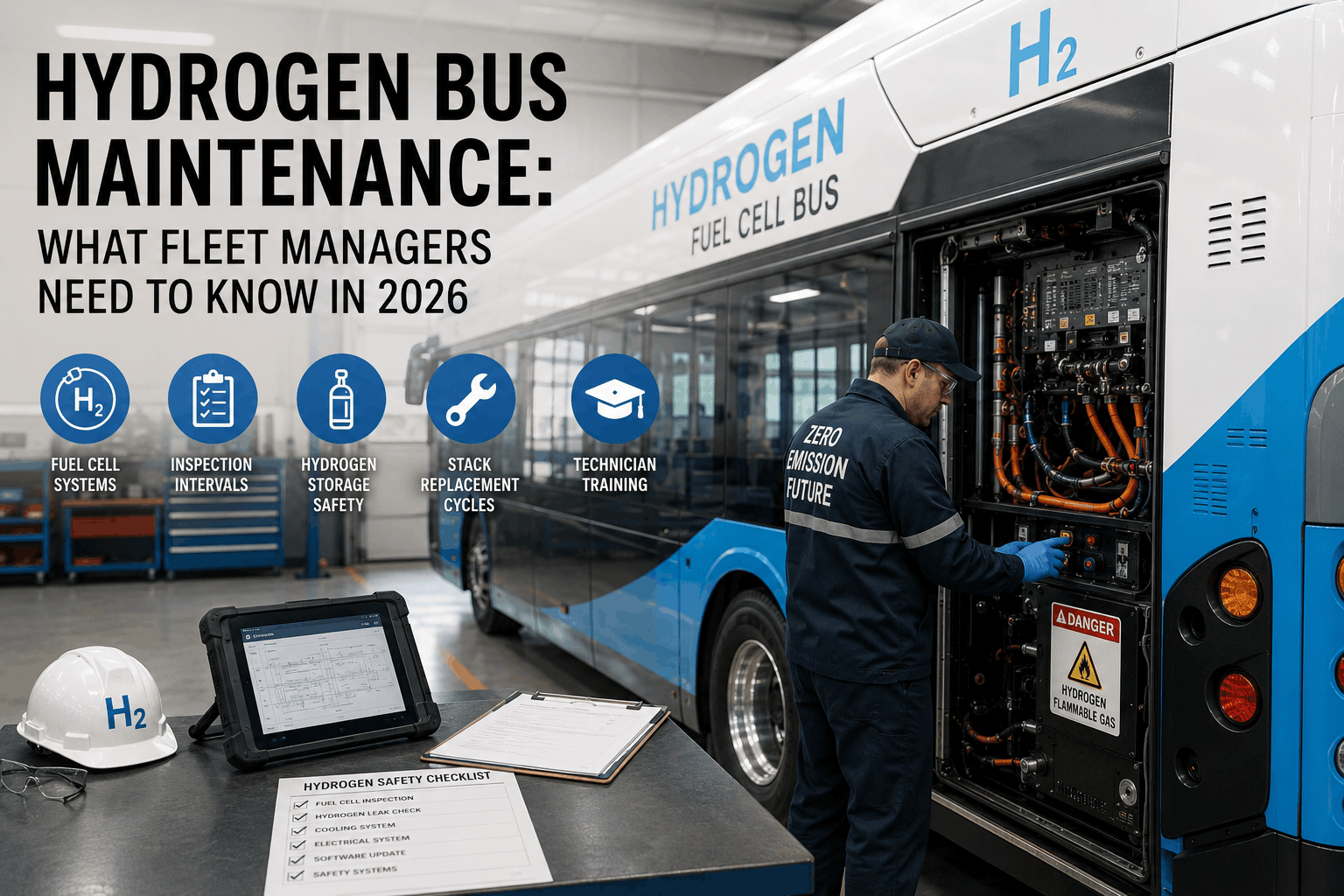
Hydrogen fuel cell buses are transitioning from experimental prototypes to production vehicles entering regular fleet service. Several hundred fuel cell buses are currently operating in transit agencies and school districts across North America and Europe, with orders and deployments accelerating. Fleet managers responsible for these vehicles face a new challenge: hydrogen bus maintenance is fundamentally different from diesel or electric bus maintenance. The fuel cell stack requires specialized inspection and maintenance. The hydrogen storage system demands unique safety protocols. The electric drivetrain components operate differently than traditional powertrains. Technicians need new skills and certifications. Maintenance schedules are different. Parts sourcing is more limited. Warranty coverage and supplier support are still evolving. A fleet manager acquiring hydrogen buses for the first time faces significant learning curves and operational challenges. However, hydrogen buses offer substantial advantages: zero emissions (appealing to environmental regulations and community preferences), excellent range (300-400 miles on a single hydrogen fill), fast refueling (5-10 minutes to full capacity), superior performance in cold climates compared to battery electric buses, and potential for lower lifetime operating costs if hydrogen infrastructure becomes more developed. Understanding hydrogen bus maintenance is essential for fleets planning to add these vehicles to their operations. Here's what fleet managers need to know about hydrogen bus maintenance in 2026 .
Hydrogen Bus Maintenance: Fleet Manager Guide 2026
Hydrogen fuel cell buses are entering regular fleet service. Learn what fleet managers need to know about fuel cell maintenance, hydrogen storage safety, technician training, and operational challenges of hydrogen buses.
1
Hydrogen Fuel Cell Technology Fundamentals: How Fuel Cells Differ from Diesel and Battery Electric
A hydrogen fuel cell bus generates electricity by combining hydrogen gas (stored in a tank on the bus) with oxygen from the air in a fuel cell stack. The chemical reaction produces electricity, which powers electric motors that drive the bus. The only emission is water vapor. A fuel cell bus is technically an electric bus, but it generates its own electricity through fuel cells rather than carrying all energy in a battery. This distinction is important for maintenance because it changes where problems occur and how they're diagnosed.
Fundamental differences from diesel buses: A hydrogen fuel cell bus has no diesel engine, transmission, or exhaust system. It has a fuel cell stack (the reactor converting hydrogen to electricity), a hydrogen storage tank (high-pressure tank holding compressed hydrogen), a power control system (managing electricity flow), and an electric motor. The elimination of engine and transmission maintenance removes many failure modes that diesel bus mechanics are familiar with. There's no oil to change, no transmission fluid, no engine timing belt, no spark plugs, no exhaust system. But there are new failure modes: fuel cell stack degradation, hydrogen system leaks, cooling system issues specific to fuel cell operation, and power electronic failures.
Fundamental differences from battery electric buses: A battery electric bus carries all its energy in a large battery pack (typically 300-500 kWh). A hydrogen fuel cell bus carries energy as compressed hydrogen gas in a tank (typically 5-6 kg of hydrogen). The fuel cell generates electricity as the bus operates, so the bus doesn't rely on a large battery to store all the energy needed for a day's operation. A battery electric bus is range-limited to 200-250 miles before requiring a 2-4 hour charge. A hydrogen bus can achieve 350-400 miles of range and refuel in 5-10 minutes. For transit agencies with long routes or limited overnight charging infrastructure, hydrogen buses overcome the range and refueling limitations of battery electric buses. However, hydrogen buses require hydrogen refueling infrastructure (production facility, compression equipment, storage, and dispensing), which is more complex and expensive to establish than electric charging infrastructure.
The fuel cell stack and its role: The fuel cell stack is the core component of hydrogen bus propulsion. It consists of individual fuel cells stacked together, each fuel cell containing a membrane that allows hydrogen molecules to separate into protons and electrons. The separated electrons create electrical current, which powers the motor. The protons combine with oxygen to produce water. The fuel cell stack is durable but not immortal. Over time (typically 5,000-10,000 operating hours, or 8-15 years of service), the fuel cell stack degrades and loses efficiency. This degradation is managed through monitoring and eventually stack replacement. Fuel cell stack replacement is expensive ($80,000-$150,000), similar to transmission or engine overhaul in a diesel bus. Therefore, fuel cell health monitoring is critical to detect degradation early and plan for replacement.
2
Hydrogen Storage System Safety and Maintenance
High-pressure hydrogen storage and safety considerations: Hydrogen is stored in the bus at extremely high pressure (typically 350 bar or 5,000 psi). This high-pressure storage is necessary to achieve usable range. A hydrogen tank on a bus is engineered to exacting safety standards—the tank itself is extremely durable and designed to withstand pressure significantly exceeding normal operating pressure. Hydrogen itself is non-toxic and odorless (trace odor is added for safety so leaks can be detected). However, hydrogen is extremely flammable and explosive if mixed with oxygen in certain concentrations. This requires careful handling and maintenance of the hydrogen system.
Hydrogen system inspections and leak detection: Hydrogen systems require regular inspection for leaks or damage to high-pressure lines and connections. A small leak in a hydrogen line isn't just a fuel loss issue—it's a safety hazard. Maintenance protocols require hydrogen system inspections at regular intervals (typically 1,000-2,000 hours of operation or monthly). Inspections include visual examination of hydrogen lines for damage, checking pressure fittings for tightness, and testing with bubble solution to identify any leaks. Specialized training is required because working with hydrogen systems demands understanding of the hazards and proper safety protocols. Mechanics must be certified specifically for hydrogen fuel cell systems.
Hydrogen tank condition monitoring: Hydrogen tanks degrade over time due to material fatigue and internal corrosion. Most hydrogen buses undergo tank inspections every 2-3 years to verify structural integrity. Inspection methods may include visual inspection, ultrasonic testing to detect internal corrosion, or pressure testing to verify the tank maintains integrity. If a tank shows signs of degradation (internal corrosion detected, cracks visible), it must be replaced. Tank replacement is expensive ($15,000-$30,000) but necessary for safety and reliability.
Hydrogen safety protocols for maintenance staff: Working on hydrogen buses requires mechanics to follow strict safety protocols. Work must be performed in well-ventilated areas to prevent hydrogen accumulation. No spark-generating tools or flame near hydrogen systems. Proper personal protective equipment. Training in emergency response if a hydrogen leak occurs. Most hydrogen buses come with safety manuals specifying maintenance and safety protocols. Transit agencies and school districts acquiring hydrogen buses must ensure all maintenance staff receive proper safety training and certification before performing any maintenance.
3
Fuel Cell Stack Maintenance and Degradation Monitoring
Fuel cell stack degradation and expected lifespan: Fuel cell stacks degrade gradually over time. The membrane in the fuel cells develops microscopic cracks and becomes less efficient at separating hydrogen into electrons and protons. The catalysts that facilitate the chemical reaction wear out. This degradation is inevitable and is one of the primary factors limiting fuel cell bus lifespan. Current fuel cell buses are expected to achieve 5,000-8,000 hours of operation before the stack requires major maintenance or replacement. For a transit bus operating 12 hours per day, 250 days per year, this represents approximately 7-11 years of service. This is shorter than the typical 12-15 year service life of a diesel or electric bus.
Preventive maintenance to slow degradation: While fuel cell degradation is inevitable, proper maintenance can slow the process. Key maintenance includes: keeping the fuel cell stack properly cooled (overheating accelerates degradation), maintaining the hydrogen supply system so the stack receives clean, dry hydrogen (contaminants accelerate degradation), avoiding extreme load cycles (operating at peak power continuously accelerates degradation), and minimizing idle time (starting up and shutting down causes stress on fuel cells). Operating procedures matter as much as maintenance procedures for fuel cell longevity.
Performance monitoring and diagnostics: Hydrogen buses have onboard diagnostic systems that monitor fuel cell stack performance, hydrogen system pressure, temperature, and electrical output. These diagnostics should be checked regularly (at least monthly) to identify degradation trends. If the fuel cell stack voltage is gradually declining, or if hydrogen system pressure is fluctuating abnormally, these are early indicators of problems that require further investigation. Modern CMMS systems can be configured to log these diagnostic values so degradation trends become visible over months and years.
Fuel cell stack replacement and major overhaul: When fuel cell stack degradation reaches a critical point (typically marked by significant loss of power output or efficiency), the stack requires replacement. Fuel cell stack replacement is a major service requiring complete removal of the stack from the bus, installation of a new stack, and recalibration of control systems. The process typically takes 5-10 days and costs $80,000-$150,000 in parts and labor. This is similar in scope and cost to a transmission overhaul in a diesel bus. Planning for fuel cell stack replacement is important for hydrogen bus lifecycle management. A bus with 7,000 operating hours should be planning for stack replacement within 1-2 years to avoid unexpected failure.
4
Electric Drivetrain and Power System Maintenance
Electric motor maintenance differences: Hydrogen buses use electric motors powered by the fuel cell, different from diesel engine maintenance. Electric motors have no oil, transmission fluid, spark plugs, timing belts, or exhaust systems. They're incredibly simple mechanically—an electric motor is essentially a coil rotating in a magnetic field. There's almost nothing to maintain. However, the motor control electronics (power inverters, motor controllers, sensors) are complex and can fail. Maintenance consists primarily of checking electrical connections, ensuring sensors are functioning correctly, and monitoring diagnostic information from the onboard computer.
Cooling system and thermal management: Hydrogen buses require cooling systems to manage heat from the fuel cell stack, power electronics, and motor. The cooling system is critical—if the fuel cell overheats, it degrades rapidly. Cooling system maintenance includes checking coolant levels, flushing coolant at specified intervals, ensuring radiators are clean, and verifying fan operation. Some hydrogen buses use liquid cooling (similar to diesel engines), while others use air cooling. Maintenance protocols should be specified by the manufacturer.
Onboard power systems and battery: While hydrogen buses don't have a large battery for energy storage, they have auxiliary batteries (12V or 24V) for starting the bus and powering accessories. They also have ultracapacitors (in some designs) that store electrical energy for peak power demands. These auxiliary systems require maintenance: battery terminals cleaned, battery tested for proper voltage and charge, ultracapacitor health monitored. The onboard computer controls and monitors all these systems—if there's an electrical fault, the computer detects it and stores a diagnostic code.
High-voltage electrical system safety: Hydrogen buses have high-voltage electrical systems (typically 400-600 volts) for the motor and fuel cell stack. These systems are dangerous and require special safety procedures. Maintenance technicians should never work on high-voltage systems without proper training and certification. Before any maintenance on high-voltage components, the system must be properly de-energized using isolation procedures specified by the manufacturer. Proper personal protective equipment is essential. Most hydrogen bus manufacturers require certification before technicians are allowed to perform high-voltage work.
5
Technician Training, Certification, and Workforce Development
Required technician certifications and training: Technicians working on hydrogen buses need specialized training and certification beyond standard bus maintenance training. Manufacturers typically require: Level 1 Hydrogen Systems Safety Training (general understanding of hydrogen and safety protocols), Level 2 Hydrogen Systems Maintenance Certification (authorized to perform maintenance on hydrogen systems), and High-Voltage Systems Training (authorized to work on electrical systems). Additionally, technicians should understand fuel cell technology fundamentals and be familiar with the specific model of hydrogen bus they're servicing.
Training availability and industry gaps: As of 2026, training and certification programs for hydrogen bus technicians are still developing. Some manufacturers provide in-house training when buses are delivered. Some community colleges and technical schools are developing hydrogen technology programs. However, the number of trained technicians significantly lags the number of hydrogen buses entering service. This creates a workforce development challenge for transit agencies and school districts acquiring hydrogen buses. They may struggle to find qualified technicians to maintain these vehicles.
Building institutional knowledge and mentoring: A transit agency receiving its first hydrogen buses should plan to: send 2-3 senior technicians to manufacturer training programs, have them develop internal training materials for other mechanics, establish a mentoring system where trained technicians supervise others, and potentially bring in manufacturer technical support for the first major maintenance procedures (until the staff is confident in their abilities). The goal is to build institutional knowledge so the agency can maintain hydrogen buses independently rather than depending on expensive manufacturer service calls.
Workforce shortage and labor implications: The shortage of hydrogen bus technicians creates both risks and opportunities for transit agencies. Risks: difficulty finding qualified technicians, potentially higher labor costs for specialized work, difficulty training new mechanics in hydrogen technology. Opportunities: mechanics willing to get hydrogen certification become more valuable and marketable, can command higher wages, skilled technicians from older diesel mechanics become less needed as hydrogen buses replace diesel (technology transition). Forward-thinking transit agencies should invest in workforce development and make hydrogen certification attractive to their technician team.
6
Operational and Infrastructure Considerations for Hydrogen Fleets
Hydrogen refueling infrastructure as a maintenance/operational dependency: Unlike diesel buses (which can refuel at any conventional gas station) or battery electric buses (which can charge at any location with electricity), hydrogen buses require dedicated hydrogen refueling stations. These are complex facilities that produce or store hydrogen, compress it to high pressure, cool it for vehicle loading, and dispense it safely. As of 2026, hydrogen refueling infrastructure in North America is limited to a few dozen stations, mostly concentrated in California and Canada. A transit agency deploying hydrogen buses must either develop its own refueling facility or have nearby public stations available. This is a significant operational constraint not faced by diesel or battery electric buses.
Hydrogen production and quality standards: Hydrogen can be produced in various ways (steam reforming of natural gas, electrolysis of water, industrial byproducts). Different production methods affect hydrogen purity. The fuel cell stack performs best with high-purity hydrogen (typically 99.99% pure). If hydrogen supplied contains contaminants, it can degrade the fuel cell stack faster. Transit agencies with on-site hydrogen production must ensure production equipment maintains proper quality standards. Agencies relying on external hydrogen suppliers should verify hydrogen purity specifications in supply contracts.
Cold weather performance and operational challenges: Hydrogen buses actually perform better in cold weather than battery electric buses. The fuel cell generates heat, which is good in cold climates. However, hydrogen gas densifies in extreme cold, affecting storage. Hydrogen buses can typically operate in temperatures down to -30°C or -40°C (colder than most diesel buses' operational limits). This advantage makes hydrogen buses attractive for school districts and transit agencies in northern climates. However, hydrogen refueling infrastructure must also be winterized and maintained to function in cold weather.
Maintenance facility requirements for hydrogen buses: Transit agencies acquiring hydrogen buses must upgrade their maintenance facilities to safely handle hydrogen vehicles. Requirements include: well-ventilated maintenance bays (to prevent hydrogen accumulation), hydrogen leak detection systems, fire suppression systems suitable for hydrogen fires, trained and certified maintenance staff, proper storage for hydrogen-specific tools and equipment, and spill containment if hydrogen fuel is transferred. These facility upgrades can cost $100,000-$500,000 depending on facility size and existing capabilities.
7
Warranty, Support, and Future Outlook for Hydrogen Buses
Warranty coverage for hydrogen buses and fuel cell stacks: As of 2026, hydrogen bus warranties are still evolving. Manufacturers typically offer 5-8 year warranties covering manufacturing defects. Fuel cell stacks are often covered under separate extended warranties extending to 10 years or 8,000-10,000 operating hours. Hydrogen system components (tanks, valves, regulators) are usually warranted for 5-8 years. Extended warranties and fuel cell stack warranty terms are important parts of the purchase agreement. A transit agency should negotiate clear warranty coverage for fuel cell stack replacement, as this is the most expensive and likely component to need replacement during the bus's service life.
Manufacturer technical support availability: Hydrogen bus manufacturers have limited service network as of 2026. There are far fewer authorized service centers for hydrogen buses than for diesel or electric buses. A transit agency in a remote location might not have access to nearby manufacturer service. This creates a need for agencies to develop in-house expertise rather than depend on manufacturer support. Negotiating service support agreements as part of the bus purchase is important—particularly agreements guaranteeing manufacturer technical assistance for major repairs or diagnostic issues that exceed the agency's expertise.
Future trajectory and technology evolution: Hydrogen bus technology is rapidly improving. Fuel cell stacks are becoming more durable (target lifespan increasing from 5,000 hours to 8,000-10,000+ hours). Manufacturing is scaling up (reducing per-unit costs as production volume increases). Hydrogen infrastructure is expanding (more refueling stations being built). Support and training are improving (more technician certification programs being developed). For a transit agency deploying hydrogen buses in 2026, it's important to understand that they're adopting a technology in rapid evolution. Buses purchased today will have different capabilities and support infrastructure than buses purchased in 2028-2030. Planning for technology evolution and workforce development is important.
Total cost of ownership analysis for hydrogen buses: The purchase price of a hydrogen bus is typically 20-40% higher than a comparable diesel bus, and 10-20% higher than a comparable battery electric bus. However, operating costs are lower than diesel and potentially lower than electric buses depending on hydrogen fuel prices and electricity prices in your region. Fuel cell stack replacement is a major cost, but when amortized over the bus's service life, it's comparable to transmission or engine overhaul costs in diesel buses. A total cost of ownership analysis comparing hydrogen to diesel and electric buses should be performed for your specific operational and fuel cost situation before making fleet deployment decisions.
Hydrogen Bus Maintenance Questions
Are hydrogen buses really safe? What if there's a hydrogen leak?
Hydrogen buses undergo rigorous safety testing and are designed to exacting safety standards. Hydrogen tanks are engineered to withstand pressure far exceeding operational levels. A small leak isn't catastrophic—hydrogen rapidly disperses in air (it's much lighter than air and rises immediately). Hydrogen gas itself is not toxic. The hazard is explosion if hydrogen concentrates and mixes with oxygen. Properly maintained hydrogen systems with trained technicians have proven to be safe in years of operation.
How often does the fuel cell stack need to be replaced?
Current fuel cell buses are expected to achieve 5,000-8,000 operating hours before the stack requires replacement. For a bus operating 12 hours per day, 250 days per year, this represents 7-11 years of service. Technology is improving and future stacks may last 10,000+ hours. Proper maintenance and operation can extend stack life. Fuel cell stack replacement is expensive ($80,000-$150,000) but is part of the expected lifecycle cost.
Do we need to build our own hydrogen refueling station if we buy hydrogen buses?
Not necessarily, but you need reliable access to hydrogen refueling. If a public hydrogen station is nearby and available for your operating schedule, you may be able to refuel there. If not, you'll need to develop on-site refueling capability. Building a hydrogen refueling station costs $1-3 million depending on throughput and complexity. For a small agency, this might not be economical without grant funding. Public-private partnerships for hydrogen infrastructure are developing in some regions.
What certifications do my mechanics need to maintain hydrogen buses?
Mechanics need hydrogen systems safety training and certification (Level 1 and Level 2 from manufacturers). High-voltage electrical system training is important. Most bus manufacturers provide training when vehicles are delivered. Some community colleges offer hydrogen technology programs. Plan to send 2-3 senior technicians to manufacturer training and have them develop in-house expertise.
How does cold weather affect hydrogen bus operation?
Hydrogen buses actually perform well in cold weather—better than battery electric buses. The fuel cell generates heat, which helps in cold climates. Hydrogen gas densifies slightly in extreme cold, affecting storage capacity slightly, but this is manageable. Hydrogen buses can operate reliably in temperatures below -30°C, making them attractive for northern regions. Refueling infrastructure must be winterized for cold operation.
Can hydrogen buses use the same maintenance facilities as diesel buses?
No, hydrogen buses require specialized maintenance facilities. Work areas must have good ventilation to prevent hydrogen accumulation. Hydrogen leak detection systems and fire suppression systems suitable for hydrogen fires are needed. Safety protocols and proper equipment storage are necessary. Most facilities require upgrades costing $100,000-$500,000 before hydrogen buses can be safely maintained.
What's the total cost of ownership comparison between hydrogen and diesel buses?
Hydrogen buses cost 20-40% more to purchase than diesel buses. Operating costs depend on fuel prices—hydrogen fuel is typically priced on a per-kg basis. Maintenance costs are lower than diesel (no oil changes, transmission fluid, complex engine maintenance). Fuel cell stack replacement is a major cost but comparable to transmission overhaul. Total lifecycle cost depends on your specific fuel prices, operating pattern, and hydrogen infrastructure situation. Analysis needed for your specific case.
Plan for Hydrogen Bus Maintenance
Hydrogen buses are the future of zero-emission transportation. Understanding hydrogen technology, planning for technician training, and preparing maintenance facilities are essential for successful fleet deployment. Schedule a consultation to discuss hydrogen bus maintenance planning for your fleet.