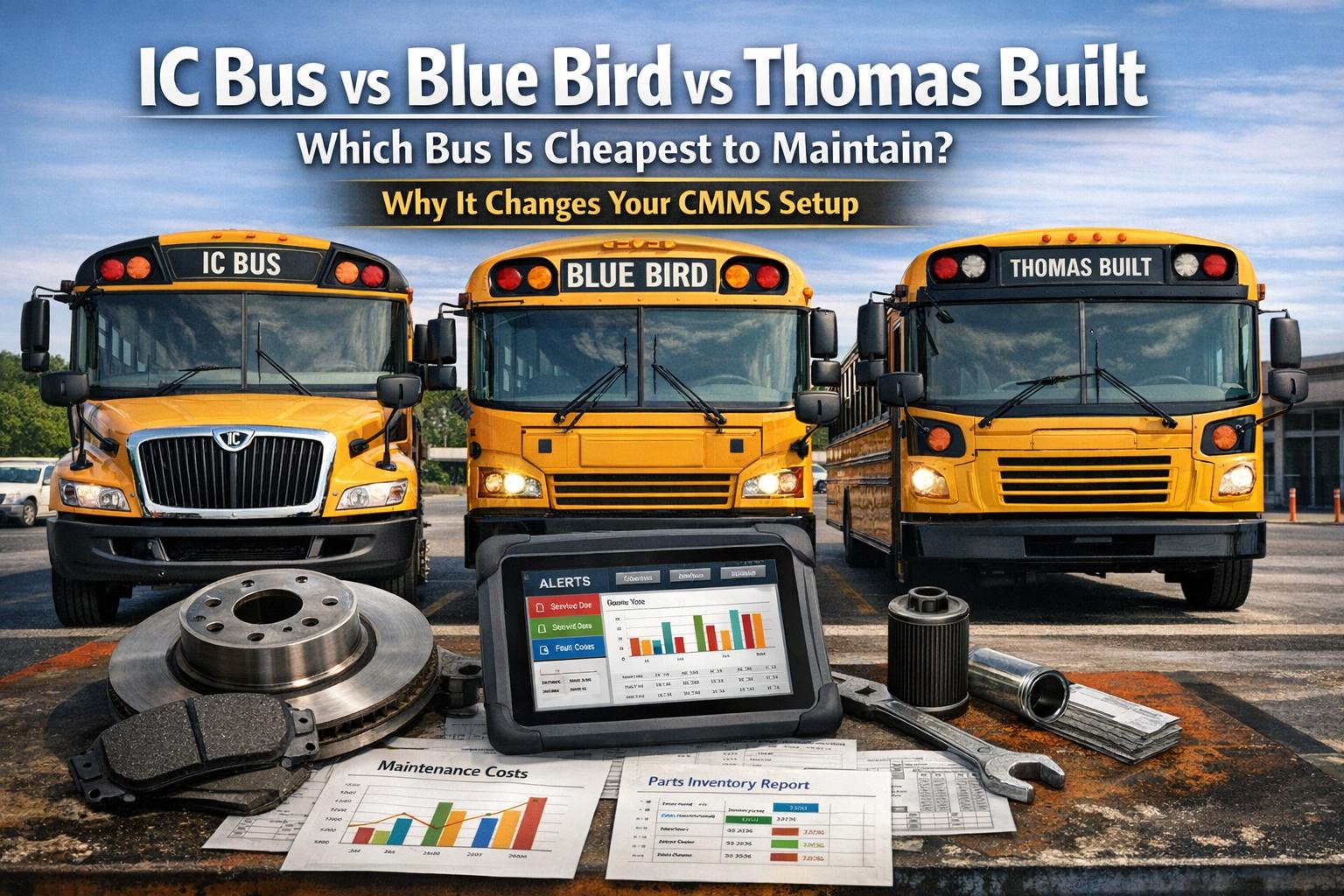
IC Bus vs Blue Bird vs Thomas Built: Which Bus Is Cheapest to Maintain and Why It Changes Your CMMS Setup
You evaluated seating capacity, fuel type, and sticker price. You checked the dealer's proximity and reviewed the warranty terms. Then you signed the purchase order. What you almost certainly did not evaluate — and what will define your maintenance budget for the next 15 years — is how differently IC Bus, Blue Bird and Thomas Built behave inside your shop. Their brake systems wear at different rates. Their electrical fault frequencies differ. Their aftertreatment systems fail on different schedules. And their telematics architectures integrate with a CMMS in measurably different ways. Before your next procurement cycle, read this.
The Procurement Math Most Fleets Miss
A bus that costs $8,000 more at purchase but saves $1,200/year in maintenance pays back in under 7 years — and then saves money every year after. Over a 15-year lifecycle, the cheapest bus to buy is rarely the cheapest bus to own.
Meet the Three Manufacturers — What Each Actually Brings to Your Fleet
IC Bus, Blue Bird, and Thomas Built together account for the vast majority of school bus sales in the United States. Each brings a distinct engineering lineage, parts network, and maintenance philosophy that directly shapes your shop's workload and annual parts spend.
IC Bus 360 — VIN-based parts, repair history, estimates
Strong telematics ecosystem. Widest engine service network of the three.
BLUE BIRD
School-bus-only focus
Blue Bird Corporation (NASDAQ: BLBD) — independent
Key Models
Vision, All American
Engine
Cummins B6.7 (diesel) or Ford/Roush (propane/CNG)
Telematics
Varies by dealer / GPS provider — not factory-standardized
Parts Network
All 50 states dealer coverage; Ford network for propane models
Fuel Edge
Market leader in propane, CNG, and electric school buses
Lowest documented total cost of ownership in multiple district studies. Propane variant cuts maintenance ~30%.
THOMAS BUILT
Daimler engineering depth
Daimler Trucks North America (Mercedes-Benz parent)
Key Models
Saf-T-Liner C2, HDX
Engine
Detroit DD5 / DD8 (Daimler / Mercedes-Benz)
Telematics
Zonar + Detroit Connect Virtual Technician — factory since 2014
Parts Network
350+ Thomas dealers + Daimler/Freightliner network
Diagnostics
Detroit Connect interprets fault codes — not just raw data
Deepest single-vehicle diagnostics. Daimler efficiency advantage on longer routes.
Maintenance Cost Breakdown: The Five Systems That Determine Your Real Spend
Purchase price is a one-time event. Maintenance cost is a 15-year commitment. These five systems account for the majority of unplanned shop hours across all three manufacturers — and they behave very differently depending on which bus you bought.
01
Aftertreatment Systems (DPF / DEF / SCR)
The single most disruptive maintenance category for diesel school bus fleets. Aftertreatment failures account for a disproportionate share of unplanned downtime — especially on short stop-start routes where DPF regeneration cycles are frequently incomplete.
IC Bus
Cummins B6.7 aftertreatment. Moderate DPF regen frequency on short routes. DEF quality sensitivity in cold climates. Cummins Insite diagnostics integrates with CMMS for regen cycle tracking.
Blue Bird
Propane variant eliminates DPF/DEF entirely — zero aftertreatment failures. Diesel variant mirrors IC Bus Cummins profile. Propane fleets report ~30% lower total maintenance cost largely due to removing aftertreatment from the equation.
Thomas Built
Detroit DD5/DD8 aftertreatment (DDEC VI) — different architecture from Cummins. Requires separate technician training. Detroit Connect Virtual Technician alerts catch regen issues before they cause roadcalls.
02
Brake Systems & Wear Rates
All three use air brake systems, but component specs, body access design, and parts sourcing differ in ways that affect your per-incident labor time and cost on every single service event.
IC Bus
Commercial truck-spec air brake components. Good parts availability through truck dealer channels. Moderate wear on stop-start routes. Standard industry access design.
Blue Bird
Purpose-built for school bus duty cycles. Lower per-incident repair cost in single-manufacturer fleet studies. Propane variant benefits from reduced brake fade due to engine braking characteristics.
Thomas Built
Daimler-spec air brakes with easy-access body design — reduces labor time per service event. Parts available through Daimler/Freightliner network. PTO provision standard on many configurations.
03
Transmission Service Intervals
All three manufacturers use the Allison 2500/3000 automatic transmission — the industry standard. Transmission cost differentials between the three are minimal. Your real cost difference comes from engine and aftertreatment, not drivetrain.
Fluid change interval: every 25,000 miles (severe duty) across all three — same Allison spec. Same parts, same training, same cost. Do not let this factor influence your procurement decision.
04
Electrical Fault Frequency
Electrical faults consume more diagnostic labor than almost any other system — yet they never appear on a bid evaluation sheet. Each manufacturer's wiring architecture produces a distinct fault pattern your shop will deal with for the life of the vehicle.
IC Bus
Diamond Logic electrical system. Body controller faults can require dealer-level tooling in rural areas. OnCommand transmits fault codes in real time — CMMS auto-generates work orders on fault trigger.
Blue Bird
Simpler multiplex electrical design due to school-bus-only focus. Lower fault frequency reported by single-manufacturer fleet operators. Parts commonality across Vision and All American reduces training requirements.
Thomas Built
Proprietary multiplex + Zonar integrated architecture. Most connected of the three — over-the-air telematics reconfiguration without rewiring. Detroit Connect interprets fault codes rather than passing raw data, reducing diagnostic time.
05
Parts Availability — What Happens at 6am When the Bus Won't Start
Parts availability never appears on a procurement scoresheet. It will determine how many school days your buses miss. Rural and semi-rural districts are most exposed to this risk — a single unplanned failure can cost $2,000–$5,000 in rental, dispatch, and overtime when parts aren't nearby.
IC Bus
3,500+ Cummins service locations — largest engine service network in the industry. IC Bus 360 VIN-based parts catalog with online estimate approvals reduces repair-to-return time significantly.
Blue Bird
All 50 states dealer coverage. Propane variant served by Ford dealership network — far wider than any school-bus-specific parts chain. Strong rural presence compared to Thomas.
Thomas Built
350+ dedicated Thomas dealers plus Daimler/Freightliner network for DD engine support. Lower rural density than IC or Blue Bird. Detroit engine parts may require longer lead times outside metro markets.
Track Maintenance Cost by Manufacturer — Not Just by Vehicle
BusCMMS captures work orders, fault codes, labor hours, and parts spend by vehicle make and model — so you can see exactly which manufacturer in your mixed fleet is costing the most. Stop guessing at procurement time. Start measuring now.
Expert Review: Telematics-to-CMMS Integration — How Each Manufacturer Compares
This is where procurement decisions made in a conference room turn into daily operational outcomes inside your shop. The quality of telematics-to-CMMS integration determines whether your maintenance team is reactive or genuinely predictive.
IC Bus
Blue Bird
Thomas Built
Telematics Platform
OnCommand Connection
Varies by dealer / GPS provider
Zonar + Detroit Connect
Factory Standard?
Yes — 5-yr subscription included
Partial — varies by config
Yes — since 2014
Fault Code to CMMS
API-based; 30+ integration partners
Manual or 3rd-party GPS export
Zonar API; Detroit Connect alerts
Auto Work Order Trigger
Yes — severity-based alerts
Requires manual setup
Yes — Virtual Technician alerts
PM Scheduling Trigger
Mileage via engine data
Odometer — manual or GPS
Engine hours + mileage via Zonar
Mixed-Fleet Capability
All-makes support built in
Limited to GPS provider coverage
Zonar multi-make; Detroit is Thomas-only
CMMS Integration Effort
Low — API well-documented
Medium — GPS partner-dependent
Low–Medium — Zonar widely supported
Reported Efficiency Gain
30% fewer unplanned events; 83% drop in service communications
Depends on GPS integration quality
Faster fault resolution via interpreted codes
The Verdict on Telematics Integration
IC Bus has the strongest mixed-fleet telematics story — OnCommand's all-makes architecture means one platform manages your IC, Blue Bird, and Thomas buses simultaneously. Thomas Built offers the deepest single-vehicle diagnostics, particularly with Detroit Connect's interpreted fault data rather than raw codes. Blue Bird lags on standardized telematics but compensates with lower baseline fault frequency and near-zero aftertreatment events on propane variants. Book a demo to see how BusCMMS integrates with OnCommand, Zonar, and third-party GPS platforms in a mixed fleet.
The 15-Year Total Cost of Ownership — Side by Side
This comparison draws on industry fleet data, U.S. school district case studies, and manufacturer-published specifications. These are real operational patterns, not marketing numbers.
IC Bus CE Series Diesel — Cummins B6.7
Purchase Price (Type C)
$110,000 – $130,000
Maintenance / Mile
~$0.68 – $0.75
Aftertreatment Events
Moderate (Cummins DPF)
Technician Training
Low — Cummins widely known
In-Service Life
12 – 15 years
Rural Parts Access
High — 3,500+ Cummins locations
Telematics → CMMS
Best — OnCommand all-makes API
Lowest Documented TCO
Blue Bird Vision Diesel or Propane
Purchase Price (Type C)
$105,000 – $125,000 (3–5% lower)
Maintenance / Mile
~$0.62 – $0.70 (propane: lower)
Aftertreatment Events
Zero (propane) / Moderate (diesel)
Technician Training
Lowest — purpose-built simplicity
In-Service Life
15+ years (+41% vs competitors per Biloxi ISD)
Rural Parts Access
High — all 50 states + Ford network
Telematics → CMMS
Moderate — GPS provider-dependent
Thomas Saf-T-Liner C2 Diesel — Detroit DD5/DD8
Purchase Price (Type C)
$115,000 – $135,000
Maintenance / Mile
~$0.60 – $0.68 (Daimler efficiency)
Aftertreatment Events
Moderate (Detroit DPF)
Technician Training
Medium — Detroit DD5/DD8 specialized
In-Service Life
12 – 15 years
Rural Parts Access
Moderate — urban dealer concentration
Telematics → CMMS
High — Zonar API + Virtual Technician
Bottom line: Blue Bird holds the documented TCO lead in most district case studies, driven by longer service life and lower baseline fault rates. Thomas Built edges ahead on per-mile operating cost on longer routes. IC Bus wins on telematics ecosystem and parts network breadth. The right answer depends on your route type, region, fuel infrastructure, and whether you run a mixed or single-manufacturer fleet. Sign up for BusCMMS to start building your own manufacturer cost data today.
How to Configure Your CMMS Differently Based on Manufacturer
The practical payoff of everything above is this: your CMMS setup should change based on which manufacturer dominates your fleet. Here is exactly what to configure differently for each.
01
IC Bus Fleet
Connect OnCommand Connection API — auto-trigger work orders on fault severity thresholds
Set engine-hour-based PM intervals synced to Cummins B6.7 schedule (15,000 mi oil / 30,000 mi coolant)
Enable IC Bus 360 repair history pull for warranty claim documentation
Create separate work order categories for Diamond Logic body faults vs. powertrain faults
02
Blue Bird Fleet
Build separate PM templates for diesel vs. propane — remove DPF/DEF fields from propane checklists entirely
Add propane fuel system inspection template: fuel line integrity, regulator check, tank inspection as standalone PM
Set brake inspections at 6,000-mile intervals for stop-start route intensity
Track in-service life separately — Blue Bird buses frequently exceed 15 years with complete records
03
Thomas Built Fleet
Integrate Zonar Ground Traffic Control data feed for real-time engine data and location
Configure Detroit Connect Virtual Technician — use interpreted fault descriptions in work orders, not raw codes
Create separate PM templates for DD5 vs. DD8 — service intervals differ between engine variants
Add technician certification tracking for Detroit DD — distinct from Cummins certification held by most shop staff
04
Mixed Fleet (All Three)
Use IC Bus OnCommand all-makes architecture as the primary telematics hub for fleet-wide data aggregation
Standardize work order categories across manufacturers — cost-per-mile comparisons must be apples-to-apples
Create manufacturer-level PM compliance dashboards to identify which brand drives the most reactive vs. preventive work
Run quarterly manufacturer cost reports to write better specs and evaluation criteria into your next bid
Your Next Purchase Order Should Be Based on Real Data — Not Gut Feel
BusCMMS tracks parts cost, labor hours, downtime days, and fault frequency by vehicle make and model. In 90 days you will have the manufacturer cost comparison that no vendor TCO tool can match.
Which school bus manufacturer has the lowest total cost of ownership?
Multiple district case studies, including Biloxi Public Schools in Mississippi, document Blue Bird as delivering the lowest total cost of ownership — driven by longer in-service life (up to 41% longer than competitors in some fleet data) and lower baseline maintenance costs. Thomas Built shows a 2–4% operating cost edge over Blue Bird in some fleet data due to Daimler engine efficiency on longer routes. IC Bus competes strongly on parts availability and telematics infrastructure. The right answer depends on your route type, region, fuel preference, and fleet composition.
How does IC Bus OnCommand Connection integrate with fleet maintenance software?
IC Bus's OnCommand Connection uses an open API architecture that integrates with most major CMMS platforms. It is factory-installed on all new IC Bus vehicles with a 5-year subscription included. The system transmits real-time fault codes, vehicle health data, GPS location, and engine performance metrics. Users report a 30% improvement in unplanned service events and an 83% reduction in service-related communications after implementing OnCommand. It also supports all-makes integration, meaning it can aggregate data from Blue Bird and Thomas Built buses in the same dashboard.
What are the biggest maintenance cost differences between Thomas Built DD engines and Cummins B6.7?
The primary cost difference is technician specialization. Detroit DD5 and DD8 engines require Daimler/Detroit-specific diagnostic tools and certification training that is separate from the Cummins Insite certification most shop technicians already hold. Parts are available through the Daimler/Freightliner network, which has lower rural density than Cummins's 3,500+ location network. On a per-mile basis, the DD5/DD8 Daimler efficiency design can produce slightly lower operating costs on longer routes, but this advantage narrows significantly on short stop-start school bus duty cycles.
Should I buy propane Blue Bird buses to reduce maintenance costs?
If your district's routes average under 150 miles per day and you have access to propane fueling infrastructure, the maintenance case is strong. Blue Bird propane Vision buses eliminate the DPF, DEF, and SCR systems that account for a significant share of diesel aftertreatment failures and shop hours. Real-world data from fleet operators shows 15 cents per mile savings on fuel alone, plus documented ~30% reductions in total maintenance cost vs. diesel in several district studies. The tradeoff is lower fuel energy density and the need for dedicated propane fueling infrastructure at your depot.
How do I configure a CMMS to compare maintenance costs by bus manufacturer for future procurement decisions?
Create a manufacturer field in your vehicle asset records and ensure all work orders, parts orders, and labor time entries tag to a specific vehicle. Configure cost roll-up reports at the manufacturer level — total maintenance spend, cost per mile, and labor hours per repair event. For IC Bus fleets, connect the OnCommand API to auto-populate fault-triggered work orders. For Thomas fleets, Zonar's API supports similar integration. After 90 days of clean data, you will have a manufacturer cost comparison more accurate than any vendor-supplied TCO model. BusCMMS is built specifically for this type of multi-manufacturer fleet analysis.