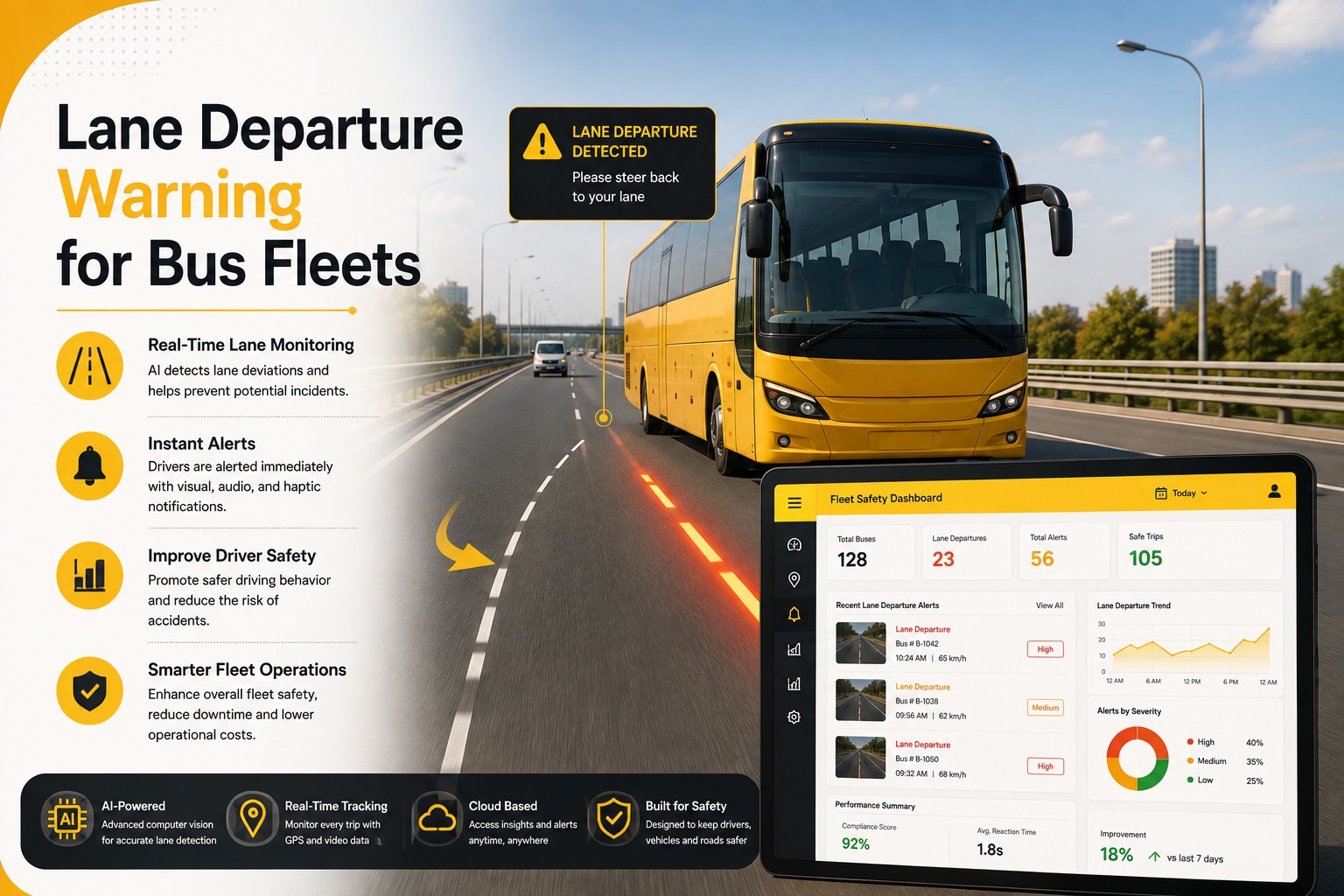
A driver drifting toward the shoulder on a long rural stretch is a different risk profile than a driver clipping the lane line while weaving through stop-and-go city traffic. Lane departure warning bus systems earn their value on rural and highway routes with sustained speed and long unbroken stretches, and need to be tuned down in low-speed, high-maneuver contexts where lane markings are crossed constantly on purpose. See how a lane departure event reaches a work order in BusCMMS.
Lane Departure Warning for Bus Fleets
Where lane departure warning actually earns its keep, where it should be tuned down, and how repeated departures on the same route tell you something worth investigating.
Why Rural and Highway Runs Are Where This Pays Off
Sustained speed and long stretches change the risk math.
On a rural or highway activity run — a field trip, an athletic event, a long charter route — a bus holds highway speed for extended stretches with fewer natural interruptions to break driver attention. A gradual, unintentional drift toward the shoulder or centerline on one of these runs is a meaningfully different event than a driver crossing a lane marking while navigating a tight turn onto a residential street. Lane departure warning is built to catch the first kind: sustained, unintentional drift at speed, which is exactly the pattern that shows up disproportionately on long, monotonous stretches of road.
Where It Should Be Tuned Down
Not every lane crossing is a warning sign.
A typical stop-and-go route through a residential neighborhood or downtown corridor involves constant intentional lane positioning — pulling toward a curb for a pickup, navigating a narrow street, swinging wide for a turn. Left at highway-tuned sensitivity, a system generates a steady stream of alerts for behavior that isn't a safety concern at all, just normal low-speed maneuvering. Fleets running mixed route types need sensitivity settings that adjust for context, rather than a single fleet-wide threshold that's either too loose for the highway routes or too noisy for the neighborhood ones.
The Objection Worth Naming: Review Without Coaching Is Just Surveillance
A logged event that never reaches the driver changes nothing.
The most common failure with lane departure programs isn't detection accuracy — it's what happens after an event is logged. Events get reviewed and filed away, but never turned into an actual conversation with the driver, so the underlying behavior never changes and the same pattern keeps recurring. When that happens long enough, the program stops feeling like a safety tool and starts feeling like surveillance, which erodes driver trust and buy-in. The fix is a short, consistent loop — flagged event, brief review with the driver, done within days — not a quarterly report that nobody outside the safety office ever sees.
A Scenario From a Real Bus Operation
Repeated departures on one route pointed to a scheduling problem, not a driving problem.
A rural school district running long-haul routes noticed one specific afternoon route generating lane departure alerts several times a week, consistently from the same driver, on the same stretch of highway. Rather than treating it as a coaching issue in isolation, the transportation director pulled the route's timing and found it ran directly after a mid-day activity trip with almost no break between shifts. Adjusting the schedule to build in a rest period before that route cut the departure alerts on that run to nearly zero within a month — the system had correctly flagged a symptom, but the real fix was a scheduling change, not a driver conversation alone.
Our first instinct was to talk to the driver about paying more attention. But when we looked at the pattern, it was the same route every time, right after a long activity trip. That wasn't a driver problem, it was a scheduling problem. Fixing the schedule fixed the alerts.
Not sure if your lane departure sensitivity is tuned for your actual route mix? That's worth checking. Talk to the team about a route review →
One Data Set, Role-Based Views
The wedge BusCMMS solves that a single dashboard can't.
BusCMMS is an AI-native bus fleet operations platform, and the wedge here is that the transportation director, the shop, the superintendent, and the board all work from the same underlying data through role-based views built for what each of them actually needs. A transportation director sees the route-level pattern behind a repeated departure; the shop sees any resulting work order; a superintendent or board member sees a summary suited to a meeting, not a raw event log. Nobody has to translate the data for someone else — it's the same record, shown differently by role.
Frequently Asked Questions
Where does lane departure warning add the most value for a bus fleet?
It earns its value on rural and highway activity runs with sustained speed and long unbroken stretches, where a gradual unintentional drift is a meaningful safety signal, rather than in urban stop-and-go routes with constant intentional lane positioning.
Why does lane departure warning generate so many alerts on some routes?
Low-speed routes with frequent turns, curb pulls, and tight maneuvering involve constant intentional lane crossings. A system tuned at highway sensitivity flags all of this normal behavior unless sensitivity is adjusted by route context.
What does a repeated lane departure on the same route usually mean?
A pattern of repeated departures by the same driver on the same route often correlates with fatigue, shift timing, or route length, rather than a one-off distraction — worth investigating the schedule alongside a direct conversation with the driver.
Is lane departure warning required by federal regulation for buses?
No single federal mandate governs lane departure warning for buses. 49 CFR 396 maintenance records and district or agency policy set the general compliance bar, leaving adoption to each operation's own safety program.
Why do some lane departure programs fail to change driver behavior?
Events often get reviewed and filed without ever becoming an actual coaching conversation with the driver, so the underlying behavior never changes and the same pattern keeps recurring. A short, consistent feedback loop closes that gap.