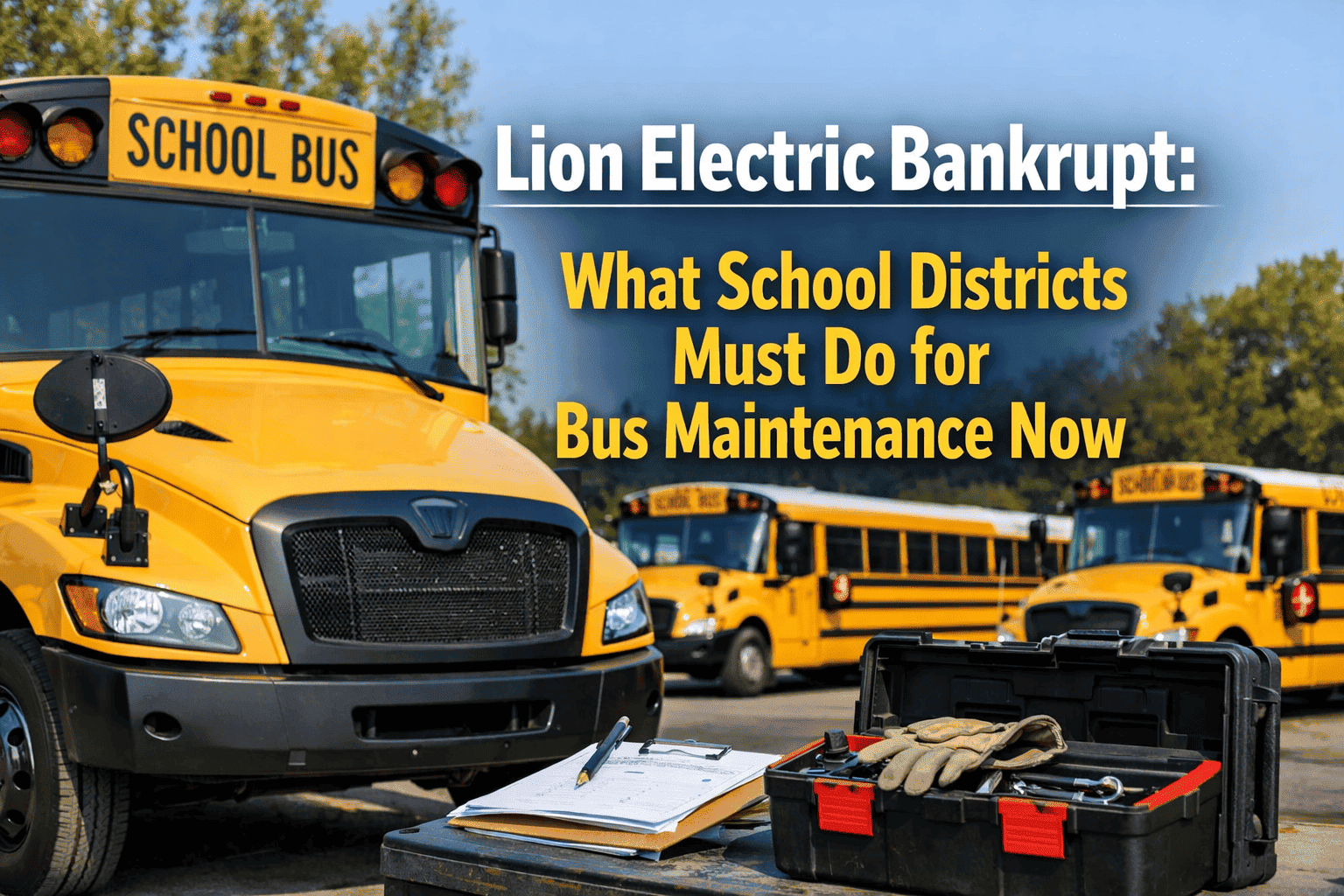
Nearly 2,000 Lion Electric school buses across the United States have lost their manufacturer warranties. In July 2025, Deloitte Restructuring confirmed that all warranties and purchase orders outside Quebec are null and void. The company's Joliet, Illinois plant — once a 900,000 sq. ft. showcase for American EV manufacturing — is permanently closed. All U.S. employees have been laid off. The rebranded LION will produce only for Quebec. Districts that received $10 million in EPA Clean School Bus grants are now paying out-of-pocket for repairs on $345,000 buses that sometimes failed within two weeks of delivery. In Yarmouth, Maine, both Lion buses sat idle all of 2024–2025. In Herscher, Illinois, 6 of 25 Lion buses need repairs with no OEM support. In September 2025, a Lion bus caught fire in Montreal — faulty wiring in the heating system, not the battery — and LION issued inspection bulletins that many U.S. districts can't execute without technical support. If you're operating Lion Electric school buses, this is the practical maintenance guide you need: what to do immediately, how to source parts, how to document maintenance for DOT compliance, and how to plan for a fleet where the manufacturer no longer exists.
Immediate Actions: Do These This Week
Whether your Lion buses are running fine today or sitting idle with error codes, these five actions protect your fleet, your compliance, and your district's options going forward.
These five actions are urgent regardless of whether your Lion buses are currently running or sitting idle. The districts handling this best started documentation and vendor outreach immediately. See how BusCMMS creates the maintenance documentation your district now depends on—book a demo.
Expert Review: What You've Lost and What You Still Control
The Lion Electric bankruptcy creates specific capability gaps in your maintenance operation. Understanding exactly what you've lost helps you prioritize what to rebuild.
The Lion Electric situation is a crisis — but the buses themselves, when maintained properly, still work. Herscher, Illinois saves $7,500 per bus per year on diesel fuel with their Lion fleet. The kids love the quiet ride. The technology isn't the failure — the manufacturer is. Districts that invest in proper maintenance documentation and third-party service relationships will keep these buses running safely for years. The ones relying on paper records and hoping for OEM resurrection will face compliance nightmares and idle buses.
The buses themselves save money, reduce emissions, and give students a better ride. The failure is the manufacturer, not the technology. Protect your investment with proper maintenance tracking. See how BusCMMS protects your maintenance records when OEM support disappears—schedule a demo.
How to Source Parts Without an OEM
The parts challenge is real but not insurmountable. Lion buses share many components with the broader commercial EV ecosystem.
Track every part sourced from every vendor with a CMMS. When you're buying from multiple suppliers instead of one OEM, inventory management and purchase documentation become your lifeline. See how BusCMMS tracks parts across multiple vendors—book a demo.
Frequently Asked Questions
Are Lion Electric bus warranties really voided?
Yes. Deloitte Restructuring confirmed in July 2025 that all warranties and purchase orders outside Quebec are null and void. The assets were transferred to a new corporation being wound up through bankruptcy. The rebranded LION will honor Quebec-only warranties and produce exclusively for the Quebec market. U.S. districts have no manufacturer warranty coverage. Protect your fleet with digital records—book a demo.
Can I still get parts for my Lion buses?
Many components are not Lion-proprietary. Brakes, suspension, tires, and 12V electrical parts come from standard commercial vehicle suppliers. HV battery cells (BMW/Samsung SDI) are available through EV battery reconditioning specialists. The Lion-specific components (inverters, motor controllers, BMS software) are harder — but former Lion technicians and CALSTART's network are connecting districts with capable service providers.
Do I still need to meet DOT compliance for these buses?
Absolutely. The manufacturer's bankruptcy doesn't change your DOT obligations. Annual inspections, daily DVIRs, maintenance record retention, and all safety standards still apply. In fact, without OEM warranty records, your own maintenance documentation becomes the only compliance evidence that exists. Digital records are essential. See DOT-ready compliance tracking—schedule a demo.
Should I switch my Lion buses back to diesel?
Not necessarily. Districts like Herscher, Illinois report their Lion buses save $7,500 per bus per year on fuel and operate well in winter weather when maintained properly. The technology works — the manufacturer failed. Evaluate each bus on its condition: if it's running well and you have service access, keep it running. If it's been idle with persistent error codes and no service path, evaluate replacement options. Track per-vehicle cost to make data-driven decisions—book a demo.
Where can I get help from other affected districts?
CALSTART has an intake form for affected districts and held a national forum. WRI's Electric School Bus Initiative is coordinating support through the Alliance for Electric School Buses. Former Lion employees are also helping some districts. Register with CALSTART and WRI immediately — collective action gets better vendor terms and shared technical knowledge. See how districts are managing Lion fleets in BusCMMS—book a demo.