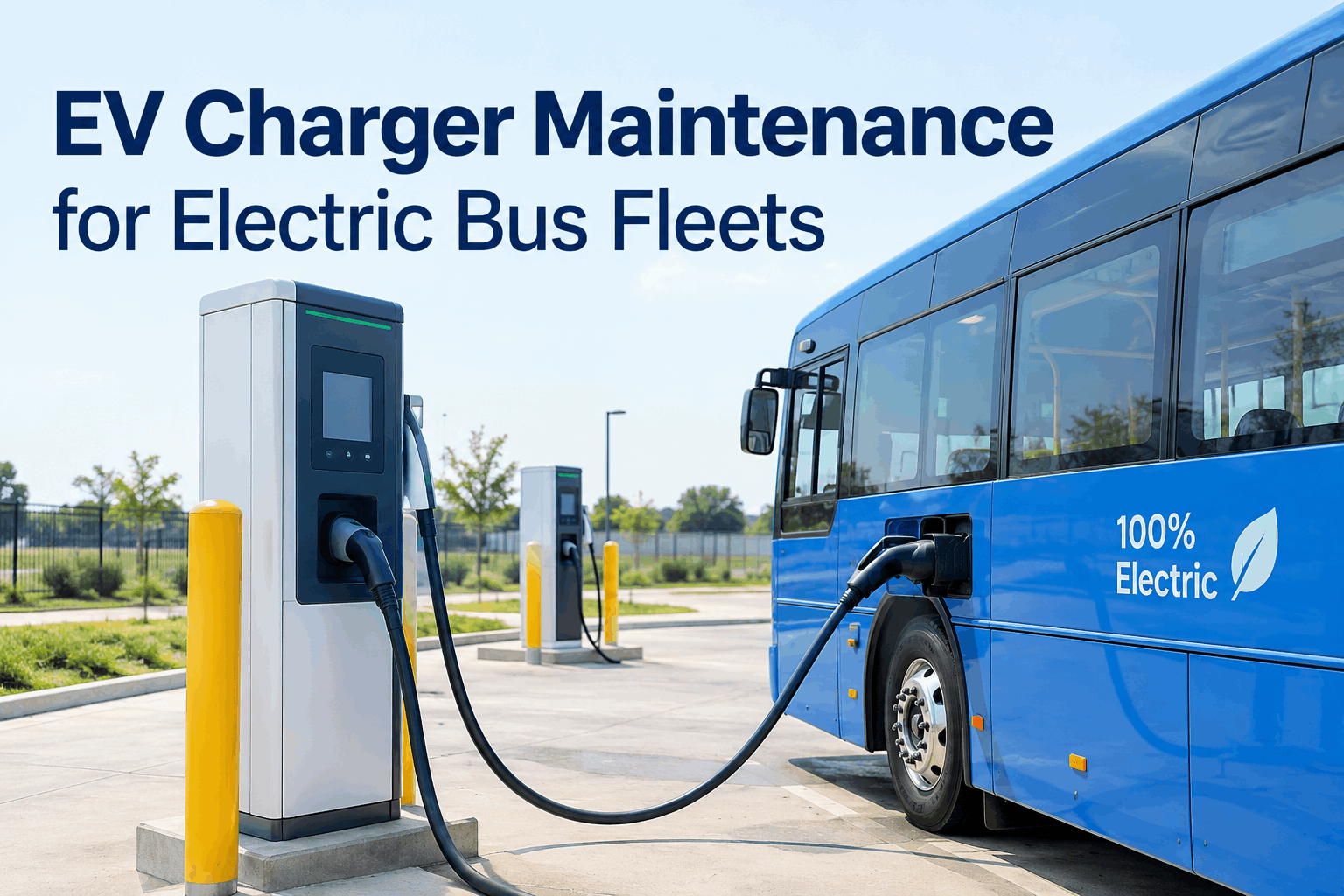
A depot with 12 electric school buses depends on 12 chargers. When one goes down at 4pm and nobody notices until the 5am pre-trip, that bus is not going out on its route. Charger uptime is now bus uptime — a lesson every fleet that has electrified is learning the hard way. This guide lays out the EV charger maintenance schedule that actually keeps chargers online, the fault modes to watch for, and how to run charger PMs on the same system as your bus PMs so nothing slips through.
EV Charger Maintenance for Electric Bus Fleets: The Uptime Playbook
The PM cadence, fault taxonomy, and service-contract decision that keeps charging infrastructure from becoming your fleet's new bottleneck.
- 97%NEVI Uptime Target
- 5PM Cadences
- 6Common Fault Modes
Why Charger Uptime Is Now a Fleet-Availability Metric
Every fleet that has electrified has run into the same thing. The bus itself needs less scheduled maintenance than the diesel it replaced — fewer fluids, no exhaust after-treatment, regenerative braking cutting brake wear roughly 80%. And then a $75,000 charger sitting in the yard becomes the reason a bus does not make its route. The math is unforgiving: if the depot has one charger per bus, charger uptime is bus uptime. There is no substitute charger to swap in the way there is a substitute bus.
NEVI federal funding requires 97% uptime on publicly accessible chargers — a threshold your depot chargers should also target because it is exactly the number that keeps a one-charger-per-bus depot from losing route coverage.
Independent studies have found "true uptime" — the rate at which a driver actually completes a charging session — regularly runs 10-15 points below what charger software reports. The ChargerHelp 2024 Reliability Report reviewing 19 million data points found roughly 26% of stations had failed charge attempts despite software showing them as available. A charger that reports "ready" and delivers 20% of rated power because of a corroded contact or thermal derate is functionally offline for a fleet trying to hit an early-morning route. The only reliable defense is a documented PM schedule that finds these conditions before the bus needs the charger. Book a walkthrough to see charger PM tasks running on the same schedule tree as the buses that depend on them.
The EV Charger PM Cadence: Daily to Annual
Charger maintenance runs on five overlapping cadences. Each layer catches a different class of failure. Skip any one of them and the fleet ends up chasing the class of fault it did not check for. The wheel below is the industry-standard cadence from NYSERDA's Electric School Bus Guidebook and manufacturer service manuals, distilled to what a fleet actually needs to run.
- Visual check of cable and connector before plug-in
- Confirm charging session starts and status LED shows normal
- Return connector to holster after session ends
- Wipe connector pins and receptacle housing
- Check for fault-code history from the previous week
- Verify cable retractor tension and cable path clear of pinch points
- Inspect connector pins for pitting, discoloration, or wear
- Check enclosure seals and ventilation intakes for debris
- Firmware version check and update as available
- Torque check on cable strain relief and mounting hardware
- Full electrical safety test — ground continuity, insulation resistance
- Contactor inspection for arcing and wear signature
- Cooling system service (DCFC): filter check, coolant level and condition
- Communications test — verify OCPP session logging to backend
- Full electrical safety inspection per IEC 60364 or equivalent
- Power module load test at rated output
- Cable and connector cycle-count review, replace if near rating
- Cabinet interior inspection, hardware recertification, service report filed
The cadence that matters most for uptime is the monthly one — that is where the drift-and-degrade failures get caught before they take a charger offline. The industry rule of thumb is simple: an emergency DCFC repair runs about 20x the cost of a scheduled monthly PM visit. Skipping monthlies is an expensive way to save an afternoon. Start a free trial and load the five-cadence PM schedule against every charger in your depot.
The Charger Component Anatomy: Where Faults Actually Live
A charger looks like a monolithic box from the outside but is really five subsystems bolted together. Failure rates are not evenly distributed across them — the connector and cable alone account for the majority of field failures across the industry. Knowing where faults live tells you where to spend inspection time.
The insight from this diagram is not the internals — it is where the inspection time goes. If the connector and cable are 40% of failures, your monthly PM should be spending more than 40% of its inspection minutes on those two items. Most fleets do not, because it feels less "maintenance-like" than opening the cabinet. The data says otherwise.
The 6 Fault Modes Every Charger PM Should Screen For
Charger failures cluster around six recognizable patterns. Once you know the taxonomy, the PM checklist writes itself — each cadence targets specific fault modes at the intervals they need to be caught. Here is what the six look like and the prevention lever for each.
Connector Pin Wear & Corrosion
Pin discoloration, pitting, or a heat-warped surface. Causes thermal derating or session failures. The single most common preventable fault mode.
Cable Sheath Damage
Runover crushing, retractor cord wear, or UV degradation. Often invisible until a ground fault appears. Cable replacement usually runs into thousands.
Thermal Derate
Delivered power drops below rated kW because cooling has degraded — blocked intake, low coolant, or fan failure. Charger reports normal but takes 2x expected time.
Communication / OCPP Faults
Charger loses network link, stops reporting sessions, or firmware falls out of sync with backend. Charger may still deliver power but session logging fails — billing and utilization data go dark.
Contactor / Power Module Failure
Internal power stage fails. Usually preceded by arcing signature audible during PM inspection or captured in fault code history. High-cost, high-impact.
Ground Fault / Insulation Breakdown
Safety trip prevents charging until resolved. Often traced back to cable damage or connector moisture ingress. Cannot be reset without root cause found.
Notice that four of the six fault modes are prevented by either the monthly or quarterly PM cadence. That is not a coincidence. The monthly and quarterly checks are the working core of a charger reliability program — the daily and weekly catches are important, but the monthly and quarterly are where you actually recover uptime hours. Book a walkthrough to see how BusCMMS turns OCPP fault codes into auto-generated work orders.
In-House, Hybrid, or Full OEM Service Contract?
The other question every electric bus fleet has to answer is who does the work. Charger maintenance sits in an awkward middle zone — too electrical for a typical bus tech to handle safely on the deep stuff, too routine for the shop to always call out the OEM. Three service models cover almost every fleet, and the right one depends on charger count, staff certification, and OEM proximity.
In-House
Who handles: daily, weekly, monthly PMs. Shop staff with basic electrical training.
Best fit: depots with 4-10 chargers, at least one tech with electrical certification.
Trade-off: lowest ongoing cost but requires investing in tech training and safety equipment. Deep faults still go to OEM.
Hybrid
Who handles: in-house team runs daily through monthly. Quarterly and annual go to certified vendor or OEM service contract.
Best fit: depots with 10-30 chargers. The efficient middle ground for most electric bus operations.
Trade-off: requires disciplined tracking of which cadence belongs to which team — exactly what a CMMS handles well and a spreadsheet does not.
Full OEM Contract
Who handles: everything above daily driver visual check. All PM and repair on OEM service agreement, usually with SLA on response time and uptime.
Best fit: large depots (30+ chargers), no in-house electrical staff, or funding structure that requires a contracted uptime guarantee.
Trade-off: highest per-charger cost. SLA response times may not meet a 6am route deadline — check contract terms carefully.
Whatever tier you land on, the vendor work still has to log into the same bus and charger records that in-house PMs feed. Otherwise the outsourced portion is invisible to your uptime data and the OEM's monthly report is the only version of the truth — which historically runs optimistic.
How BusCMMS Handles EV Charger Maintenance
Most bus CMMS platforms were built before electric buses were common, so chargers get treated as an afterthought — a note in a bus's file rather than an asset in their own right. BusCMMS treats each charger as a first-class asset on the same PM scheduling engine as the buses, so charger uptime becomes a tracked and improvable metric.
-
Multi-Cadence PM Schedules
Daily through annual charger PMs preloaded per hardware type — Level 2, DCFC, and pantograph. Auto-generates work orders on trigger.
-
OCPP Fault Code Handling
Fault codes from OCPP-connected chargers auto-create work orders with full error context, charger ID, and recommended first-response action.
-
Uptime & Reliability Dashboards
Per-charger uptime tracked against the 97% NEVI target. MTBF, MTTR, and cost-per-session trended over 12 months.
-
OEM Warranty & Contract Tracking
Warranty period, service contract SLAs, and next-scheduled OEM visit per charger. Alerts before expiry to capture eligible claims.
-
Charger-to-Bus Uptime Link
See which routes are at risk when a specific charger goes down — because the bus assignment and the charger it depends on live in the same system.
-
Vendor & Contractor Work Orders
Outsourced charger PMs and repair visits logged in the same timeline as in-house work — no more OEM report versus internal log discrepancy.
The design principle is simple: everything an electric bus fleet needs to keep chargers online lives inside the tool the shop already uses for buses. No second dashboard, no separate PM tracker, no data hidden inside the OEM's portal.
The Practitioner View: What Charger Uptime Discipline Buys
The gap between 82% and 96% uptime is roughly a full month per year of charger availability recovered. On a depot where one charger equals one bus, that is a full month of route coverage that was previously being lost. Charger PM is the highest-ROI work an electric bus fleet is not yet doing. Start free and set your first charger uptime baseline within a week.
The Bottom Line on EV Charger Maintenance
Electric bus fleets do not have a bus problem. They have a charger problem that shows up as a bus problem. The buses themselves are more reliable than the diesels they replaced. What is not reliable, in most fleets, is the charging infrastructure — and the primary reason is not the hardware, it is the absence of a structured PM program running against the chargers the same way one runs against the buses. Five cadences, six fault modes, one of three service tiers, all tracked in one system. That is the whole playbook. Book a walkthrough to see the charger uptime dashboard running on a fleet like yours.
How often do EV bus chargers need maintenance?
EV charger maintenance runs on five cadences. Daily — a visual check of cable and connector by the driver before each session. Weekly — a shop tech wipes the connector, reviews fault-code history, and confirms cable path is clear. Monthly — a certified tech inspects connector pins, checks enclosure ventilation, updates firmware, and verifies torque on strain relief. Quarterly — a full electrical safety test, contactor inspection, cooling service on DCFC units, and OCPP communications test. Annually — a full electrical safety inspection per IEC 60364 or equivalent, power module load test, and cable cycle-count review. Skipping any one cadence leaves a class of failure unmonitored.
What is the most common cause of EV charger failure?
Connector pin wear and cable damage together account for roughly 40% of preventable charger failures across the industry. Connectors accumulate pitting and thermal damage from routine cycling; cables get runover damage, retractor wear, and UV degradation. Both are caught early by monthly connector inspection and weekly visual checks, and both are prevented by bollard protection around the charging station and driver training on proper connect and disconnect. Because both categories are visually inspectable, they are the highest-ROI items on the PM checklist.
What uptime should electric bus depot chargers target?
The NEVI federal program mandates 97% uptime for publicly accessible chargers, and this is the right benchmark for depot chargers too. On a one-charger-per-bus depot, charger uptime is bus uptime — every point below 97% converts directly to route-coverage risk. Independent studies have found true uptime typically runs 10-15 points below what charger software self-reports, so a depot showing 92% in the OEM dashboard may actually be running closer to 80%. A structured PM program integrated with fault code monitoring is what closes that gap.
Should I do EV charger maintenance in-house or use an OEM service contract?
Three service models fit almost every fleet. In-house works for depots with 4-10 chargers and at least one electrically certified tech — lowest cost but requires investment in training. Hybrid is the most common: in-house handles daily through monthly PMs, and quarterly plus annual work goes to a certified vendor or OEM contract. Full OEM contracts fit depots with 30+ chargers, no in-house electrical staff, or funding requiring a contracted uptime SLA. Whichever model you pick, all vendor work should log into the same CMMS that captures in-house work — otherwise the outsourced portion is invisible to your uptime metrics.
How does BusCMMS handle EV charger maintenance?
BusCMMS treats each charger as a first-class asset on the same PM scheduling engine used for buses. Multi-cadence PM schedules preloaded per hardware type (Level 2, DCFC, pantograph) auto-generate work orders. OCPP fault codes from connected chargers auto-create work orders with full error context. Per-charger uptime is tracked against the 97% target with MTBF, MTTR, and cost-per-session dashboards. OEM warranty and service contract SLAs are tracked with alerts before expiration. And because the charger and the buses it powers live in the same system, when a charger goes down the dashboard immediately shows which routes are at risk.