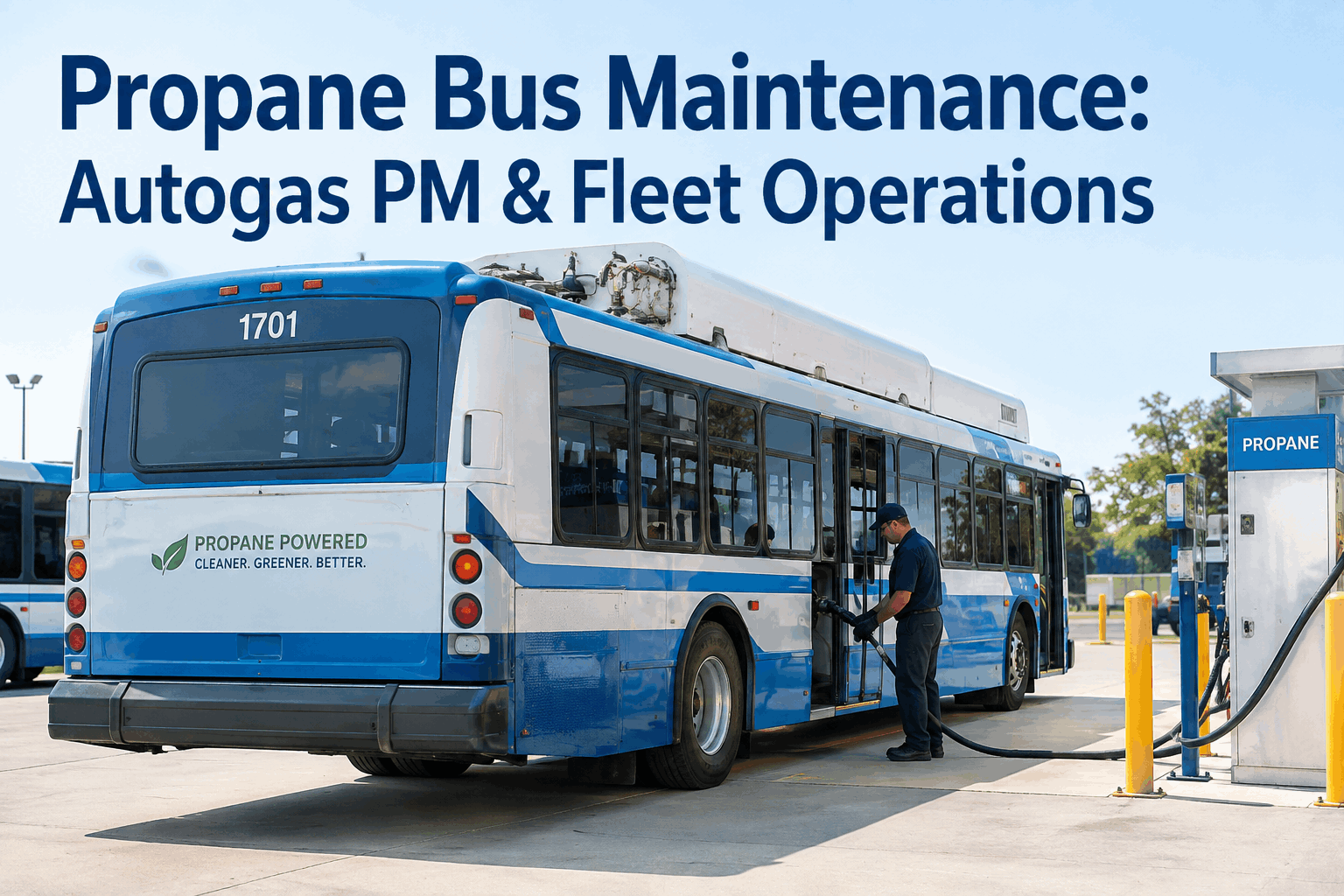
Ask a shop foreman who runs a mixed fleet what happens when a propane bus rolls in for service and you will get the same answer: nothing dramatic. Propane autogas buses are, by a wide margin, the simplest alt-fuel bus to maintain. No high-pressure cylinders. No CSA-certified inspector. No DEF, no DPF, no complex emissions after-treatment. This guide covers propane bus fleet maintenance the way a mixed-fleet shop actually runs it — PM cadence, fueling records, and how to keep propane items from disappearing into the diesel workflow.
Propane Bus Fleet Maintenance: The Autogas PM & Mixed-Fleet Playbook
The propane-specific PM cadence, fuel system anatomy, fueling log requirements, and how to run propane alongside diesel and electric buses in the same shop.
- 50K miFuel Filter Interval
- 4PM Items Unique
- $240Annual PM Savings/Bus
Why Propane Autogas Is the Easiest Alt-Fuel Bus to Maintain
Propane autogas has quietly become the second-largest alt-fuel segment in school transportation, behind electric only in press attention. There are roughly 22,000+ propane school buses on the road in the US, most of them running Blue Bird chassis with ROUSH CleanTech fuel systems — and the reason shop foremen keep recommending them is simple: they are the easiest bus in a mixed fleet to service. No DEF fluid to top off. No diesel particulate filter to regenerate. No cold-start block heaters. No emissions after-treatment fault codes at 6am.
The Derry Township School District reported their propane autogas buses cost about $240 less per bus per year in preventive maintenance than the diesel buses they replaced. Multiply that across a 30-bus propane subset and the annual PM budget shifts noticeably — before you even count the fuel savings.
The catch is that "simpler to maintain" only pays off if the propane items actually get done. In a mixed-fleet shop where 130 diesel buses drive the calendar, the 5-15 propane buses can quietly slip through with generic diesel PM checklists that do not touch the propane-specific fuel filter interval, the lock-off solenoid, or the vaporizer. Miss those and the propane advantage disappears fast. This is where fuel-type-aware PM scheduling matters. Book a walkthrough to see propane-specific PM checklists auto-trigger per bus by fuel type.
Propane Fuel System Anatomy: What's Actually Under the Bus
A propane autogas fuel system is a simple flow — five main components between the tank and the injector rail. Once a tech has seen it once, the whole thing makes sense. That is a real contrast with diesel after-treatment or CNG high-pressure systems, both of which take formal training to service confidently.
The wear items on this system are the two fuel filters (one in the fill line at the tank, one in the supply line before the vaporizer on Generation 4 systems), the lock-off solenoid, and the vaporizer itself — and even those are on 50,000-mile intervals per ROUSH CleanTech service guidance. That is the honest simplicity story: a propane fuel system needs less work than a diesel one, at longer intervals, without draining the tank.
The 4-Piece Propane-Specific PM Kit
Everything else on a propane autogas bus follows the OEM's gasoline PM schedule for the same chassis — oil, filters, spark plugs, tires, brakes, suspension. What is unique to propane is a short list of four items. Get these on the schedule, and the propane subset runs itself.
Fill-Line Fuel Filter
Located between the fill port and the tank. Catches contamination coming in from the dispenser. Serviceable without draining the tank.
Supply-Line Fuel Filter
On Generation 4 systems, sits between tank and vaporizer. Signals partial clogging via reduced fill rate — replace early if fill time creeps up vs sister buses.
Lock-Off Solenoid Test
Verifies the fuel supply cuts off when ignition is off — the primary safety valve on the propane fuel system. Bench check per manufacturer procedure.
Vaporizer / Regulator Inspection
Visual for coolant leaks (vaporizer is coolant-heated), regulator pressure verification, fuel line fittings check on the low-pressure side.
Four items. Two on mileage, two on calendar. Everything else on the bus is gasoline-engine PM — which almost every school bus tech is already comfortable with. That is why propane fleets rarely need dedicated propane techs; the general shop handles everything with a small addendum. Sign up free and load the four-item propane PM addendum on every propane bus in your fleet.
Propane vs Diesel PM: The Line-Item Delta
The propane PM advantage over diesel is real but specific. It shows up as fewer required tasks, longer intervals on some items, and no tasks at all in the emissions category. Here is where the actual dollar savings come from — not marketing claims, but the PM line items that are different or absent.
The line that most fleets do not see coming is the last one — emissions fault codes. Modern EPA-certified diesel buses generate a steady baseline of after-treatment faults that eat shop time even when nothing is really wrong. Propane autogas skips that whole category. That is where the "simpler in the shop" reputation actually comes from, more than any single line item.
Running Propane Alongside Diesel and Electric: The Mixed-Fleet Reality
Very few districts run a pure propane fleet. The common pattern is a majority-diesel operation with 5-30 propane buses added to hit clean-fuel targets, plus a few electric buses coming online. Three practices keep the mixed-fleet shop from turning into a mess.
Fuel Type on the Bus Record
Every bus's fuel type sits on the asset record, not the tech's memory. The CMMS uses that field to trigger the right PM template automatically — propane bus pulls the propane addendum, diesel bus pulls the diesel checklist. No manual selection at work-order creation.
Per-Fuel PM Compliance Dashboard
Compliance rate tracked separately for diesel, propane, CNG, and electric — not as a single fleet-wide percentage. Prevents a 95% diesel PM rate from masking a 60% propane PM rate that is being invisibly deferred inside the fleet total.
Fuel Log Segmentation
Propane, diesel, and electricity all captured in the same fueling log but tagged by fuel type. Enables side-by-side cost-per-mile comparison across the fleet subsets — the number your board wants to see when the next bus purchase decision comes up.
The compliance-dashboard practice is the one that most shops discover late. When the propane subset is 8% of the fleet, a missed PM there barely dents the overall compliance number — but it is one of the buses that was supposed to be lower-maintenance, and the missed work is where the advantage silently evaporates. Segmented dashboards make the drift visible before it costs the propane story its credibility with the board.
The Propane Fueling Log: 5 Fields That Belong on Every Fill
Propane fueling logs are simpler than CNG's — no high-pressure fill rate to record, no federally-mandated inspection cadence tied to fueling events. But five fields still belong on every fill, and skipping any of them leaves cost-per-mile analysis blind.
Date & Time
Standard for all fueling logs. Enables shift-by-shift consumption analysis.
Bus ID + Odometer
Ties the fill to the specific bus and enables MPG-drop alerts that flag potential fuel-system issues early.
Gallons Dispensed
Propane is billed in gallons (~91,500 BTU/gal). Some fleets also capture GGE for cross-fuel comparison — a propane gallon is roughly 0.73 GGE.
Fill Rate Observation
"Normal / Slow" flag from the fueler. A consistently slow fill is the earliest indicator of a clogging fill-line filter — catch it before the 50K interval if the fill rate warrants.
Fueler ID
Who did the fill. Enables anomaly investigation and matches training records if a dispensing incident occurs.
The fill-rate observation is the underrated one. Propane fill dispensers deliver at a fairly consistent rate at a given temperature and tank pressure — when a specific bus starts filling noticeably slower than its sisters, the filter is telling you it wants replacement. Capturing that as a fueler-noted field is the difference between catching it at 42,000 miles vs waiting for a 50,000-mile calendar trigger with a bus that is already underperforming on route. Book a walkthrough to see propane fill-rate anomalies flagged directly to the maintenance queue.
How BusCMMS Handles Propane Bus Fleet Maintenance
Because BusCMMS ships with fuel-type-aware PM scheduling as a core feature, running propane inside a mixed fleet does not require custom workflows. Set a bus's fuel type to Propane on the asset record, and every downstream template adjusts.
-
Propane-Specific PM Templates
Fill-line filter, supply-line filter, lock-off test, vaporizer inspection preloaded per fuel type. Auto-triggers on 50K-mile odometer or annual calendar — no manual template selection.
-
Per-Fuel Compliance Dashboards
PM compliance tracked separately for diesel, propane, CNG, and electric. Prevents a strong diesel number from masking a propane subset that is quietly slipping.
-
Fill-Rate Anomaly Detection
Slow-fill observations at fueling flow into the maintenance queue as diagnostic notes — catches clogged filters before the 50K trigger.
-
Fuel-Type Cost Comparison
Cost-per-mile broken down by fuel type — propane vs diesel vs electric in the same view. The number the board asks for at every capital planning meeting.
-
ROUSH CleanTech OEM Guidance
Preloaded PM intervals aligned with ROUSH CleanTech service documentation, the dominant propane autogas fuel system on Blue Bird buses in the US.
-
Fuel Log Segmentation
Propane gallons, diesel gallons, and electric kWh captured in one fueling module, tagged by fuel type for clean subset reporting.
Everything a mixed-fleet shop needs to run a propane subset well lives in the same system that runs the diesel majority. No side-spreadsheets, no separate propane tracker, no manual template selection every time a bus rolls in.
The Practitioner View: What a Mixed-Fleet Shop Sounds Like
That is the pattern at almost every mixed fleet: propane maintenance is not hard, but propane visibility inside a diesel-oriented workflow is where the fleets struggle. Once the CMMS knows propane is its own thing, the shop takes care of the rest naturally. Sign up free and get your propane subset visible on its own compliance dashboard within a week.
The Bottom Line on Propane Bus Fleet Maintenance
Propane autogas buses are the easiest alt-fuel bus in a shop to work on. No CSA-certified inspector requirement, no high-pressure cylinder inspection cadence, no complex emissions after-treatment, no cold-weather block heaters. What they need is a short, propane-specific PM addendum — four items, two on mileage, two on calendar — and a CMMS that will not let those items slip through a diesel-dominated workflow. Get both right and the propane subset delivers the maintenance savings the industry promises. Get either wrong and the propane advantage silently evaporates. Book a walkthrough to see your propane subset running on its own compliance track alongside your diesel fleet.
What preventive maintenance is unique to propane autogas buses?
Four items are unique to propane. Fill-line fuel filter change every 50,000 miles. Supply-line fuel filter change every 50,000 miles on Generation 4 systems. Annual lock-off solenoid test to verify fuel supply cuts off when ignition is off. Annual vaporizer / regulator inspection covering coolant leaks, pressure regulation, and low-pressure fittings. Everything else on the bus follows the OEM's gasoline PM schedule for the same chassis — oil, spark plugs, tires, brakes, suspension all match standard gasoline-engine intervals.
How does propane bus maintenance compare to diesel?
Propane maintenance is generally simpler and less expensive than diesel. Real districts have reported roughly $240 per bus per year in PM savings over diesel. Propane skips DPF regeneration and ash service, DEF fluid top-off and tank service, cold-start block heaters, fuel conditioners in winter, and most of the frequent emissions after-treatment fault codes that generate baseline shop hours on modern EPA-certified diesel buses. Fuel filter intervals are longer (50K vs ~15K miles). Injection pressure is dramatically lower (~150 PSI vs 30,000-40,000 PSI). And propane buses can be serviced in the same shop with the same diagnostic tools as gasoline vehicles — no separate certification required.
Do propane bus cylinders need federally-mandated inspection like CNG?
No. Propane autogas tanks operate at much lower pressure (~150-250 PSI) than CNG cylinders (~3,600 PSI) and are not subject to the FMVSS 304 / ANSI NGV-2 detailed inspection cadence that CNG requires. Standard propane tank service follows OEM guidance and general commercial-vehicle inspection practice. This is one of the largest operational differences between propane and CNG fleets — propane does not require CSA-certified inspectors, formal cylinder inspection intervals, or the audit-heavy compliance records CNG fleets must maintain.
How do I manage propane buses alongside diesel in the same shop?
Three practices keep a mixed-fleet shop from letting propane items slip through. First, put fuel type on the bus asset record so the CMMS automatically triggers the propane PM addendum instead of the diesel template. Second, track PM compliance per fuel type rather than as a single fleet-wide number — a 95% fleet compliance rate can easily hide a 60% propane subset if the propane buses are a small percentage of the total. Third, segment the fueling log by fuel type so cost-per-mile can be compared cleanly between propane, diesel, and electric subsets. These three practices are what make propane's simplicity advantage stick in the real shop workflow.
How does BusCMMS handle propane bus fleet maintenance?
BusCMMS ships with fuel-type-aware PM scheduling as a core feature. Setting a bus's fuel type to Propane triggers preloaded PM templates for the four propane-specific items — two fuel filters at 50K intervals, annual lock-off test, and annual vaporizer inspection — aligned with ROUSH CleanTech service documentation. Per-fuel compliance dashboards track PM completion separately for diesel, propane, CNG, and electric buses to prevent subset drift from being masked by fleet totals. Fill-rate anomalies captured at fueling flow into the maintenance queue as early filter-replacement indicators. And fuel-type cost comparison shows cost-per-mile broken down by subset — the number board members ask for when the next capital purchase decision comes up.