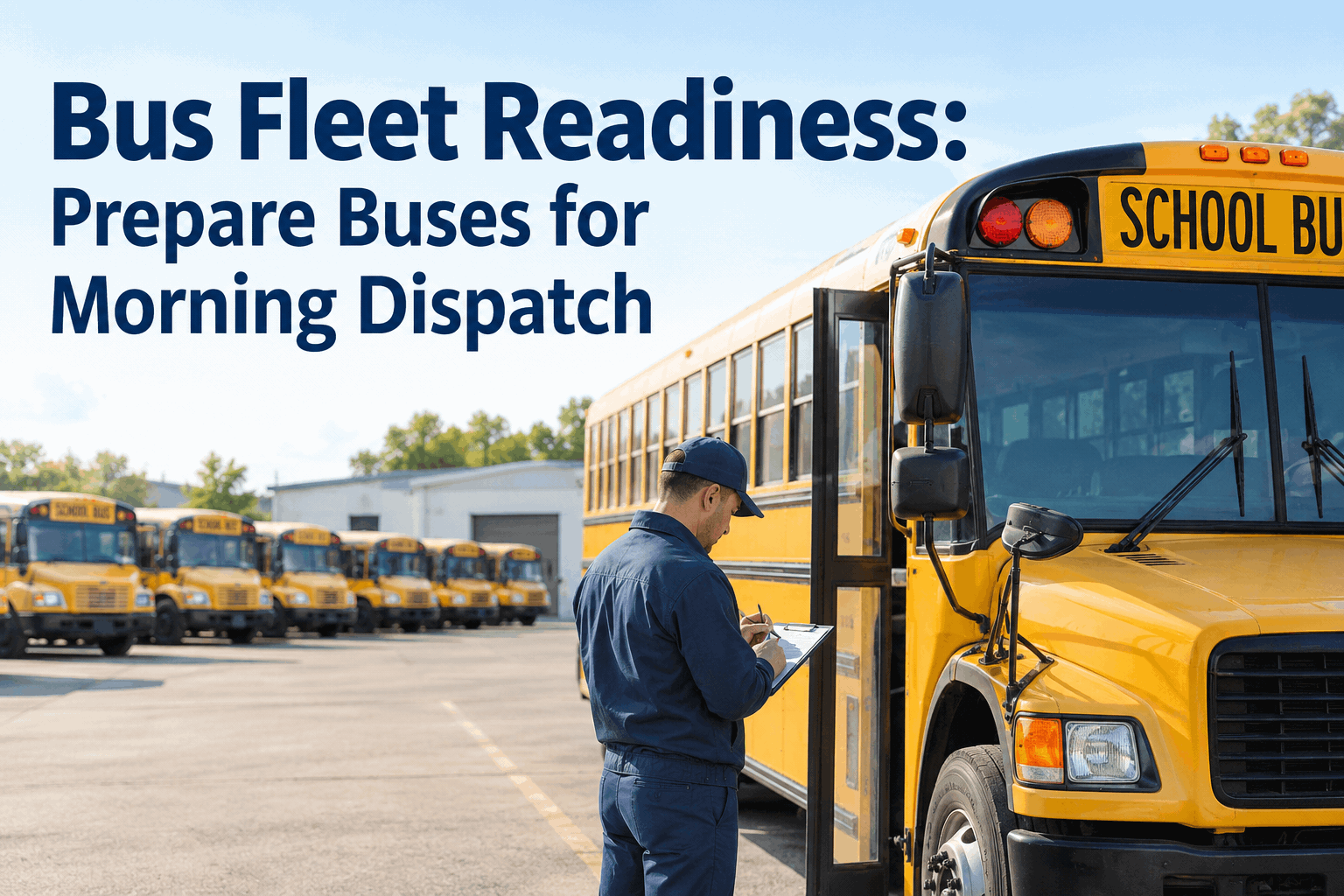
At 5:45 AM, your first driver is already pulling out. By 6:30 AM, 40 buses are gone. By 7:15 AM, you have no idea how many of those inspections were actually completed — and whether anyone flagged the brake issue on Bus 37. If you manage 100+ buses, this is not a bad morning. This is every morning .
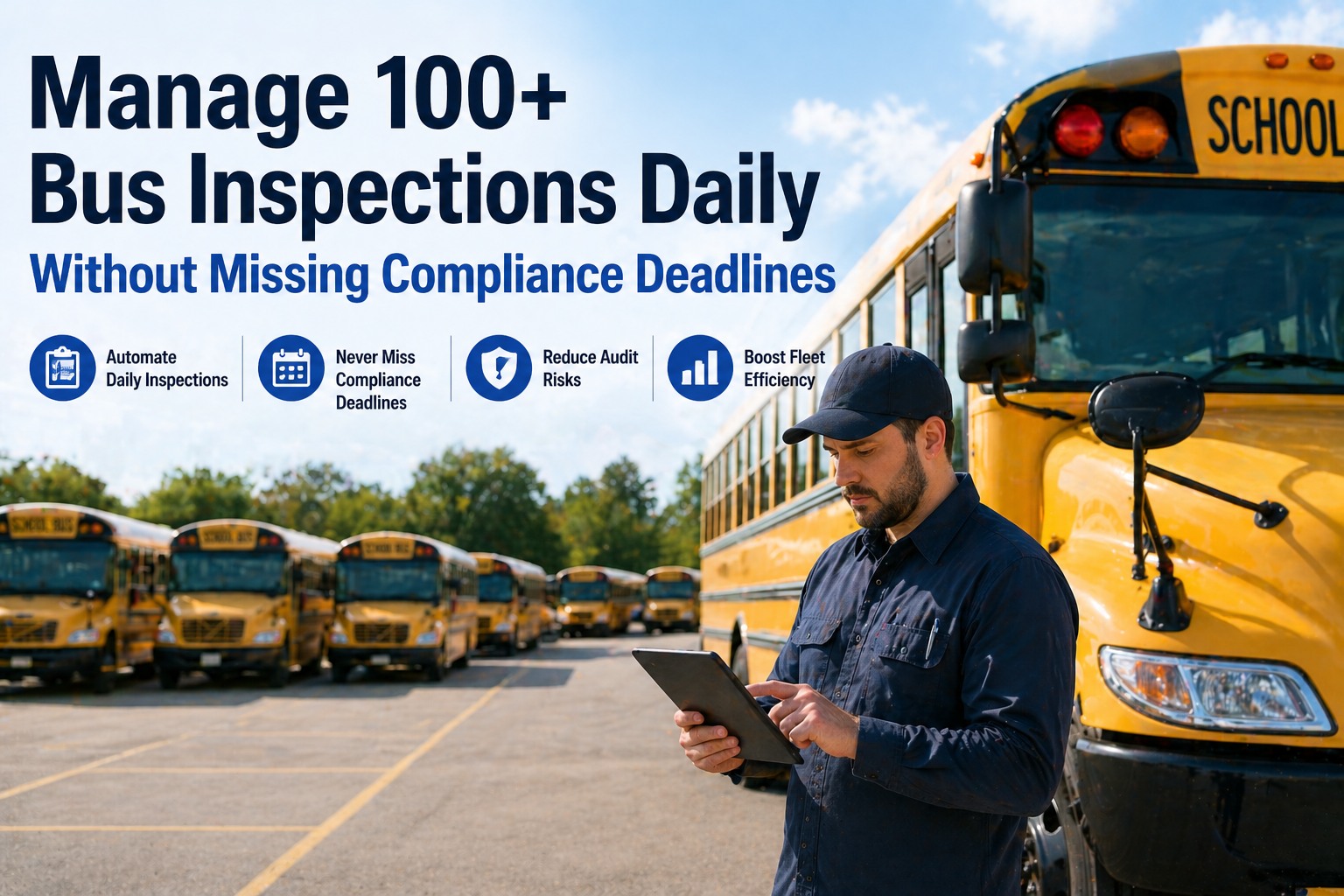
Manage 100+ Bus Inspections Daily Without Missing Compliance Deadlines
The operational system that lets you run daily inspections across every bus, catch every defect, and walk into any audit fully prepared — without adding headcount
120 hrs
Lost per year to manual inspection data entry (30 min/day)
43%
Of buses have critical issues missed on paper checklists
$8,500
Average cost of one unplanned breakdown your inspection should have caught
67%
Faster inspections with digital vs. paper — time your drivers get back daily
Why Inspection Management Breaks at Scale
A paper-based inspection process that works for 15 buses becomes a compliance liability at 50 — and collapses entirely at 100+. This is not an exaggeration. The math does it.
The Daily Time Math on a 100-Bus Fleet
A 100-bus fleet doing 2 inspections daily saves 50,000+ driver-hours annually by switching to digital — equivalent to 24 full-time positions worth of productive time.
The issue is not that your drivers are irresponsible. It is that paper inspection management was never designed for a fleet of this size. At 100 buses, the administrative overhead alone is a full-time job — and still produces incomplete data. start your free fleet inspection setup in BusCMMS and see how many gaps your current process is hiding.
The 5 Points Where Large Fleet Inspection Processes Break
Every fleet manager running 100+ buses on paper or disconnected systems hits the same five failure points. These are not edge cases — they are structural problems that scale with your fleet size.
1
No visibility across depots or shifts
When Bus 54 leaves from Depot B at 6 AM and Bus 54's paperwork is at Depot A, you have no idea what happened this morning. Multi-depot, multi-shift fleets need inspection data centralized in real time — not collected at the end of the day when it is too late to act.
2
Compliance deadlines tracked in spreadsheets — or not at all
At 100 buses, your compliance calendar has 100 annual DOT inspections, 400 quarterly emergency exit checks, 36,500 daily DVIRs, and dozens of PM intervals running simultaneously. A spreadsheet does not alert you when Bus 23's 90-day emergency exit inspection is due tomorrow. It just sits there.
3
Defects lose priority in the shop queue
A mechanic who sees 12 paper defect forms on Monday morning has no way to prioritize which is safety-critical versus cosmetic. Without severity scoring and auto-routing, a brake defect from Bus 67 and a cracked mirror from Bus 12 sit in the same pile. One of them needs to stop that bus from leaving the yard.
4
Inspection quality varies wildly by driver
On a 100-bus fleet with 80 drivers, you have 80 different inspection approaches. Some are thorough. Some take 4 minutes and tick every box from the driver's seat. Paper has no enforcement mechanism — digital guided checklists require each item to be addressed before the form submits, creating consistent quality regardless of who is driving.
5
Audit preparation is a multi-day emergency
When an FMCSA auditor or state inspector shows up and asks for the last 90 days of DVIRs for Bus 34 and Bus 78, you have two options: pull it in under 60 seconds from a searchable digital system, or spend four hours searching binders hoping nothing is misfiled. At 100 buses, a 90-day paper audit covers 9,000+ individual inspection records.
See How Your Fleet Looks on One Dashboard
BusCMMS shows every inspection status, open defect, and compliance deadline across all 100+ buses in real time — no paper, no spreadsheets, no morning guessing. Most fleets are set up and running their first inspection within the same day.
What Your Compliance Calendar Actually Looks Like at 100 Buses
Most fleet managers think of compliance as "annual DOT inspection + daily DVIR." The actual compliance obligation across a 100-bus fleet is far more layered — and every deadline missed is a citable violation. see how BusCMMS auto-tracks every one of these deadlines across your entire fleet.
Annual Compliance Load — 100-Bus Fleet
Daily
36,500
DVIRs per year
Post-trip required every operating day, every bus — 49 CFR 396.11
3-month retention
Every 90 Days
400
Emergency exit inspections
All push-out windows, exit doors, and marking lights — 49 CFR 396.3
Per bus, per quarter
Annual
100
DOT annual inspections
Full 49 CFR 396 Appendix A inspection — every bus, every year
14-month retention
Mileage-Triggered
300–500
PM service events/year
PM-A every 5–7.5K mi, PM-B every 15–20K mi, PM-C every 30–45K mi
1-year record retention
A spreadsheet tracking 37,000+ annual compliance events across 100 buses is not a system — it is a liability. One missed 90-day exit check on one bus is a citable violation.
What Most Large Fleets Get Wrong About Daily Inspection Management
After working with fleets of every size, the same three operational mistakes appear consistently in fleets running 100+ buses on manual or semi-manual processes.
01
Confusing "completed" with "compliant"
A DVIR form that has every box checked is not automatically a compliant DVIR. If the mechanic certification signature is missing, or the next driver did not sign acknowledgment before dispatch, the loop is open — and that is a violation even with a full binder of otherwise complete forms. At 100 buses, this gap is happening daily.
02
Treating inspection management as a driver responsibility
The driver's job is to inspect the bus and report what they find. Everything after that — routing defects, creating work orders, certifying repairs, tracking completion, updating compliance records — is an operational system problem, not a driver problem. When fleets fail inspections, it is almost never because drivers did not look. It is because the system had no mechanism to route and close what they found.
03
Adding headcount instead of adding systems
When inspection management becomes unmanageable, the instinct is to hire a compliance coordinator. Before doing that: a digital inspection system costs $4–10 per bus per month and automates everything a compliance coordinator spends 80% of their time doing. For a 100-bus fleet, that is $400–$1,000/month versus a $50,000–$70,000 salary — and the system doesn't call in sick or make transcription errors.
How the Right System Manages 100+ Daily Inspections Without the Chaos
The operational difference between a 100-bus fleet that runs smoothly and one that barely holds together is not bus quality, driver quality, or shop size. It is the inspection management system sitting underneath all of it. Here is what that system needs to do. get your free BusCMMS account and run your first 100-bus inspection day without the spreadsheets.
Step 1 — Driver
Mobile inspection on any device
Drivers complete guided checklists on their phone in 5–8 minutes. GPS-stamped, time-stamped. Photo required for any defect. Form cannot be submitted incomplete. Works offline.
Step 2 — Automatic
Defect triggers work order instantly
Any flagged defect auto-creates a prioritized work order in the shop queue — within seconds of submission. Critical defects (brakes, steering, tires) flagged as safety-critical, blocking dispatch until certified.
Step 3 — Mechanic
Repair certified in the system
Mechanic receives work order on their device, repairs, and certifies completion digitally. Bus status updates automatically. Next driver sees repair status before dispatch. Three-signature loop closes.
Always On — Manager
Live dashboard + auto compliance alerts
See inspection status for all 100+ buses in real time. Compliance deadlines auto-alert before they expire. Audit records pull in <60 seconds. Defect trends visible by bus number and component.
Expert Perspective: The Right Way to Scale Inspection Operations
Fleet Operations Expert — 10+ Years in Large-Scale Bus Fleet Management
The fleets that manage 100+ buses successfully do not have better drivers or bigger shops. They have better information. At 6:30 AM on a Monday morning, the transportation director who knows exactly which buses are out for defects, which PM intervals hit this week, and which compliance deadlines expire this month is operating completely differently than the one who is waiting for paper forms to come in.
Here is my blunt take: if you are managing 50 or more buses and you do not have a real-time dashboard showing every bus's inspection status, you are operating blind. You do not know what is happening. You are finding out about problems when they become roadside breakdowns or audit citations — which is the most expensive way to learn anything in fleet operations.
Digital inspection management at scale is not a technology upgrade. It is an operational necessity. The math makes it unavoidable: 100 buses, 2 inspections per day, 365 days = 73,000 inspection events per year that need to be documented, routed, certified, and retained. No paper system does that reliably. book a walkthrough of BusCMMS for large fleets and see what real-time visibility looks like across your entire operation.
Managing 100+ daily bus inspections without missing compliance deadlines is not a willpower problem or a driver problem. It is a systems problem. The fleet that solves it with digital inspection management gets real-time visibility, automatic compliance tracking, instant audit readiness, and 67% faster inspections — all simultaneously.
The fleet that keeps trying to solve it with paper, spreadsheets, and extra headcount gets 120 hours per year of wasted administrative time, 43% critical defect miss rate, and a compliance calendar that is perpetually one missed deadline away from a citation.
The decision is operational, not technical. Your drivers already have phones. Your shop already has Wi-Fi. The only thing missing is the system that connects them. start that system today at no cost and run your first fully digital inspection day before the week is out.
Ready to Bring Order to 100+ Daily Inspections?
BusCMMS is purpose-built for large bus fleets — real-time inspection dashboards, auto-compliance alerts, instant defect routing, and 90-day audit-ready records. Scales from 50 to 500+ buses without adding administrative headcount.
How do you manage daily bus inspections across multiple depots?
Multi-depot fleets need a centralized digital inspection system where all inspection data — regardless of which depot or shift it originates from — feeds into a single dashboard in real time. Paper-based systems force each depot to manage its own records independently, creating blind spots at the fleet level. A CMMS like BusCMMS centralizes all 100+ buses on one platform, so fleet managers see inspection status, open defects, and compliance deadlines across all locations simultaneously, not hours after morning dispatch.
What compliance deadlines do large bus fleets actually need to track per bus?
At the federal level, each bus requires: a post-trip DVIR every operating day (49 CFR 396.11), emergency exit and push-out window inspection every 90 days (49 CFR 396.3), and a full annual DOT inspection (49 CFR 396.17). In addition, PM service intervals trigger at mileage thresholds — PM-A every 5,000–7,500 miles, PM-B every 15,000–20,000 miles, and PM-C every 30,000–45,000 miles. For a 100-bus fleet, that totals more than 37,000 compliance events annually, plus state-specific requirements that vary by jurisdiction.
How much time does digital inspection software actually save on a large fleet?
Digital inspections take 5–8 minutes per bus versus 15–30 minutes for paper — a 67% reduction in inspection time. On a 100-bus fleet doing 2 inspections daily, that saves 50,000+ driver-hours annually. Administrative time savings are even more significant: audit prep drops from 4–8 hours per request to under 60 seconds, defect routing goes from 1–3 hour lags to under 60 seconds, and manual data entry (averaging 30 min/day) is eliminated entirely — returning 120+ hours per year to fleet operations staff.
Can drivers on a large fleet actually adopt a digital inspection system quickly?
Studies consistently show that driver adoption is not correlated with age or technology comfort — it is correlated with implementation quality. Fleets that provide 20-minute hands-on training sessions (not classroom lectures) consistently achieve 95%+ adoption within 30 days. Drivers actually prefer digital inspections once they try them because they take less time than honest paper inspections and remove the paperwork burden entirely. The key insight: resistance to digital inspection tools almost always comes from management hesitation, not driver reluctance.
What is the ROI of bus inspection management software for a 100-bus fleet?
Fleet inspection software typically delivers 300–500% ROI when accounting for all value streams. For a 100-bus fleet: time savings alone (120+ hours of admin time recovered annually) represent significant operational value. One prevented breakdown saves $8,500 in direct costs. Digital systems reduce OOS violations by 52% in the first year — each avoided violation saves up to $16,000 in fines. Reduced unplanned downtime (20–30% improvement) keeps buses earning revenue instead of sitting idle. Most 100-bus fleets reach positive ROI within 2–6 months of full implementation.