There is a key hook in every bus depot in America that is empty for a reason nobody can quite explain. A driver walked off with it last Tuesday. Or the shop foreman borrowed it and put it in his desk. Or it never got hung back up after Friday's spare swap. And in the morning, when someone else needs that bus on a route, the whole yard stops to look for a piece of brass on a string. This guide covers bus fleet key management the way a depot that has actually solved the problem runs it — inventory, hierarchy, checkout, and the digital step that ends the daily hunt.
Bus Fleet Key Management: The Depot Access & Yard Control Playbook
Key inventory, access hierarchy, checkout accountability, and the digital transition that ends the morning key hunt.
- 5Key types tracked
- 4Access tiers
- 100%Audit-trace goal
Why Bus Fleet Key Management Is Not a Facilities Problem
Most depots treat keys and fobs as a facilities detail — something a lockbox and a whiteboard handle. Then the first real audit comes, or a bus goes missing from its stall overnight, or a former driver still shows up at the yard gate two weeks after termination, and it becomes clear that key control is actually part of fleet operations. Every key is an access credential to a piece of equipment your organization is legally responsible for. Every fob is a physical login to a facility with student or passenger vehicles inside it. Treating either casually is the operational equivalent of leaving admin passwords on a Post-it note.
Every unaccounted-for key is an audit finding waiting to happen and an insurance question waiting to be asked. When a bus is moved, damaged, or missing and the key was never signed out, the liability chain has no name on it — which is the worst place for a fleet manager to be standing when the phone call comes.
The daily cost is quieter but constant. A missing key delays a pull-out. A cloned fob compromises the after-hours yard perimeter. A shop key nobody signed out on Friday means Monday morning starts with the maintenance manager calling the parts room to see who has it. Each event is small. Ten of them a week is a real operational drag, and the fix is not more locks — it is a system that treats every key and fob as a tracked asset with a named custodian at every point in time. Book a walkthrough to see key and fob assignment tied to bus and driver records in one view.
The Key Inventory: What Actually Needs Tracking
Before any control system helps, the actual inventory of keys and access credentials at the depot has to be cataloged. Five categories cover almost everything in a bus depot — each with a different risk profile, a different issuance rule, and a different loss-response protocol.
Bus Ignition Keys
Primary key or key-fob to start each bus. One per bus in daily circulation. Highest turnover credential in the yard.
Spare / Backup Bus Keys
Duplicate ignition keys held in reserve. Should never leave the key board except for road-call substitution. Most frequently "missing" category at unmanaged depots.
Yard Gate / Perimeter Fobs
Electronic fobs for gate access, driver entrance, and after-hours entry. Every active fob is a live perimeter credential — deactivation on termination is non-negotiable.
Shop / Parts Room / Fuel Access
Physical keys and fobs for the maintenance bay, parts crib, fuel island cabinet, and tool rooms. Access controls inventory shrinkage and unauthorized after-hours work.
Master / Sub-Master Keys
Physical or electronic credentials that open all vehicles or all facility zones. Issued only to the transportation director and one or two named backups. Never on a shared board.
The inventory itself is the first honest number most depots ever put on paper. Almost nobody starts this exercise with an accurate count — keys have been copied off-book for years, fobs have been re-programmed and re-issued without records, and the shop has at least one drawer with unlabeled brass in it. The first pass is a physical count on a specific date, matched to what should exist per bus, per zone, and per role. Whatever does not match becomes the day-one project list. Sign up free and start the key register from your very first bus record.
The Access Hierarchy: Who Gets What
Once the inventory exists, the second question is authorization: which role in the depot is allowed which category of key. A tiered access model — borrowed from institutional facilities-management practice and adapted to a bus depot — gets it done cleanly. Four tiers cover every role.
What: Master key, all-zone fob, emergency override. Never delegated. Never lent.
What: All buses in their zone + shop / parts / fuel access. Not a facility master.
What: The bus or buses they are working on today. Yard gate fob during shift hours.
What: Single-bus or single-shift access. Time-boxed. Auto-expires end of shift.
The tiered model does two important things. It makes issuance decisions routine (a substitute driver gets Tier 4, no debate), and it makes revocation instant (when a driver leaves, their Tier 3 access is deactivated regardless of what physical keys they may or may not have returned). Without tiers, every key handoff is a judgment call, and every offboarding is a spreadsheet search.
The Checkout & Return Workflow (Paper vs Digital)
The checkout/return workflow is where key management either works or does not. Six steps cover every issuance, and every step exists in a manual and a digital version. The digital version is not necessarily more secure at each step — it is more reliable, more searchable, and it survives the shift change without depending on someone remembering to update a log.
Request & Authorization
Driver asks dispatcher; dispatcher decides based on the driver's assigned bus for the shift.
System checks the driver's assignment automatically. Access approved or denied against Tier permissions.
Identity Verification
Dispatcher recognizes the driver on sight. Signature on a paper log at the counter.
Driver badge tap or PIN entry at the key kiosk. Identity attached to every checkout event automatically.
Key Handoff + Timestamp
Dispatcher pulls key from hook, notes time on the log, hands it over.
Kiosk releases the specific key hook or logs the fob event; timestamp captured to the second.
Custody Period
Trust. Nobody knows where the key is until it comes back — or does not.
Bus DVIR / pull-out / return events cross-reference key custody. Silence for >X hours triggers an alert.
Return + Verification
Driver drops the key at the counter, initials the log, walks out.
Return logged at kiosk with second timestamp. Custody chain closed and searchable.
Exception & Audit
Missing key noticed hours or days later. Reconstruction from memory and partial logs.
Missing key surfaces on the exception dashboard within minutes. Named custodian, timestamp, last known bus.
The single biggest difference is Step 4 — the custody period. On paper, custody is a trust exercise. Digitally, custody is a linked record: the key was checked out at 5:42 AM, the bus was pulled out at 5:58, DVIR was completed at 6:02, and the bus returned at 3:14 PM. If the key is not back on the board by 3:30, someone knows within the hour, not the next morning. That closed loop is what turns key management from a chronic mystery into a routine part of daily operations.
The Lost-Key Response: What Happens When One Actually Goes Missing
A key or fob will go missing eventually. The question is not prevention — it is response quality. A depot with a defined lost-key protocol contains the incident in hours. A depot without one drags it out for weeks and finds the key was in someone's truck the whole time. Three response tiers cover the practical escalation.
Trace & Contain
- Named last custodian contacted. Pockets, truck, locker checked.
- Bus (or zone) locked out from next assignment pending resolution.
- Spare key used only under dispatcher authorization, logged separately.
- Yard gate fob: deactivated within the hour if perimeter credential.
Formal Report
- Incident report filed with named custodian, dates, and last verified location.
- Depot manager sign-off required. Copy to HR for personnel file.
- Insurance carrier notified if the missing credential is a facility fob or master.
- Replacement key cut or new fob issued; old fob programmatically revoked.
Remediate & Prevent
- Root-cause note added to key register: where did the workflow break?
- If bus ignition: consider rekey if the bus is regularly parked off-depot.
- If master/sub-master: rekey affected locks and re-issue to Tier 1/2 holders.
- Pattern check: is this a repeat custodian? Repeat category? Trigger a process change.
The three tiers are not equal in cost. Tier 1 is a phone call. Tier 3 for a master key that opens every bus in the fleet is thousands of dollars in rekey work plus every current custodian getting a new key. Which is exactly why the goal is to keep almost every incident inside Tier 1 — and that only works if the initial custody record is accurate enough to actually name the last custodian in the first place.
Manual Board vs Digital Key Management: The Honest Comparison
Not every depot needs an electronic key cabinet with individual RFID hooks. But every depot does need to close the accountability gap the manual board leaves open. Here is what changes between the two approaches, category by category.
The manual board is not wrong — it is just insufficient at any depot size where the dispatcher on shift cannot personally recognize every custodian by voice. Twenty buses and eight drivers, the board might work fine. Sixty buses, three shifts, substitute drivers, and quarterly turnover, the board is a liability. The transition is not usually all-at-once: most depots keep the physical board and add digital logging beside it, treating the digital record as the accountability layer and the board as the operational one. Book a walkthrough to see the digital key register running alongside a physical board.
How BusCMMS Handles Keys, Fobs, and Yard Access
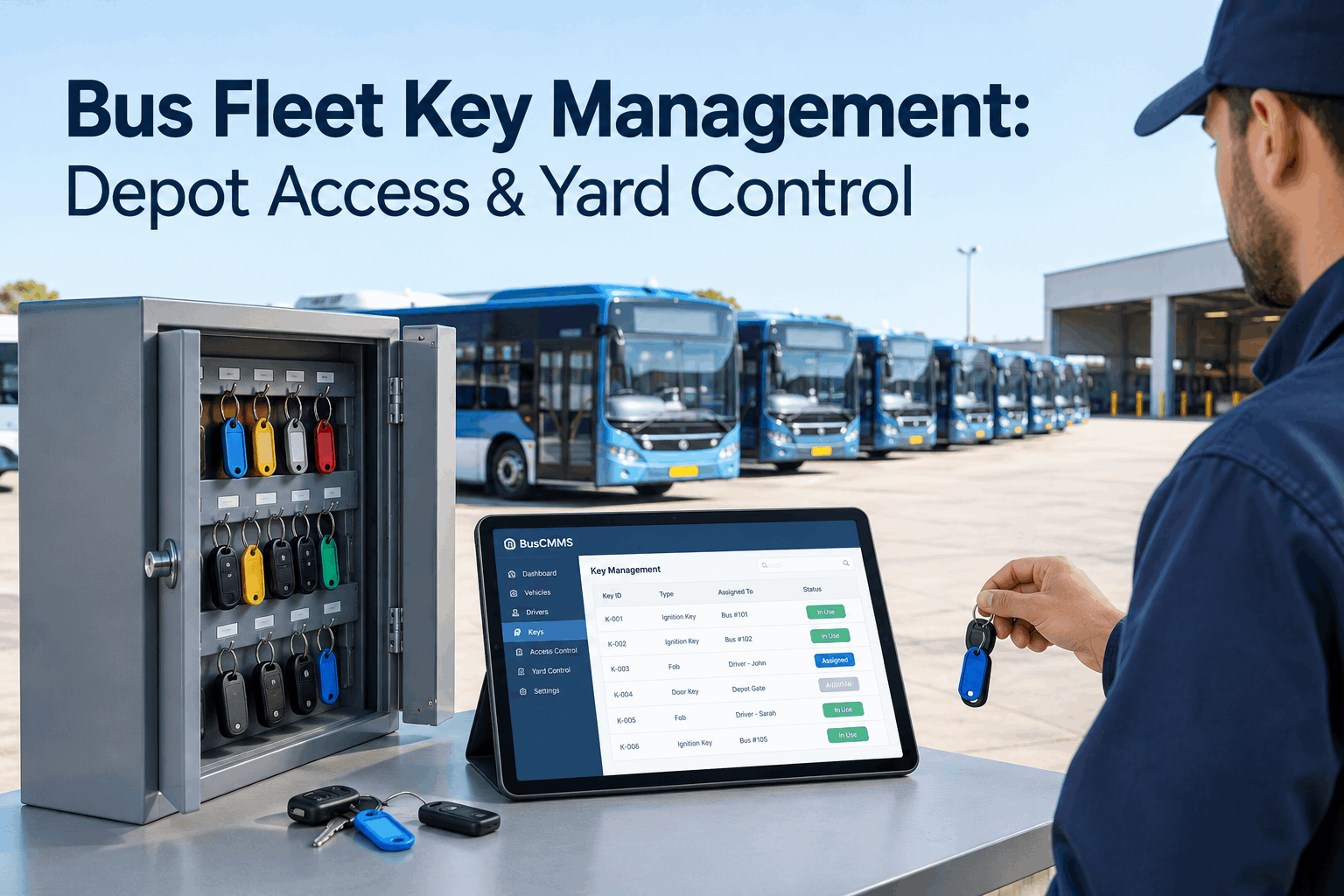
BusCMMS treats every key and fob as an asset in the same register that holds buses, tools, and parts — which means every access credential lives beside the vehicle or facility zone it opens, and every checkout event ties into the same bus and driver history the CMMS already maintains.
-
Key & Fob Asset Register
Every credential logged with type, associated bus or zone, issue date, current custodian, and status. One source of truth.
-
Role-Based Access Tiers
Tier 1-4 permissions assigned per role. Substitute drivers get time-boxed Tier 4 automatically at shift start.
-
Checkout Timestamp Log
Every checkout and return timestamped, named, and permanently searchable. Custody chain never breaks.
-
Exception Alerts
Keys still checked out past shift end, buses returned without their key logged, unauthorized zone entry — all flagged in real time.
-
Offboarding Revocation
Driver termination or reassignment triggers automatic access revocation. Fobs deactivated, key checkout privileges suspended.
-
Bus-Level Custody History
Every bus record shows every key checkout, driver, and return timestamp. If something happened to that bus, the custody chain answers "who had it."
None of it requires a dedicated electronic key cabinet on day one. Depots that add one later benefit because BusCMMS already knows the roles, tiers, and bus assignments — the cabinet becomes an input to a system that is already tracking everything, not a standalone island. Which is exactly the position an audit or an incident investigation wants you to be in.
The Practitioner View: What Digital Tracking Actually Ended
The story is quiet on purpose. There is no dramatic security breach in most depot key-management stories — just the slow leak of accountability that costs an hour a week until it costs a full-day search. Fixing it is not a big project. It is a decision to treat the key board as an operations system, not a facilities detail. Sign up free and log every key against its bus in your first week on the platform.
The Bottom Line on Bus Fleet Key Management
Bus fleet key management is a discipline that pays off quietly every day and dramatically on the days something goes wrong. The four ingredients are the same everywhere: a full inventory of keys and fobs, a tiered access hierarchy tied to role, a checkout and return workflow that names a custodian at every point in time, and a lost-key protocol that contains the incident inside 24 hours. Depots that run all four turn key management from a chronic mystery into a routine background process. Depots that skip any of the four keep running the daily hunt and paying the audit surprise. Book a walkthrough to see the full key and access register running against real bus and driver records.
What is bus fleet key management and why does it matter?
Bus fleet key management is the operational discipline of cataloging every ignition key, spare, yard gate fob, shop key, and master credential at a depot; assigning each to a role-based access tier; running a documented checkout and return workflow for every issuance; and maintaining an audit trail linking every custody event back to a named person and timestamp. It matters because every key is an access credential to a piece of equipment your organization is legally responsible for — and every fob is a physical login to a facility with student or passenger vehicles inside it. Poor key control creates audit findings, insurance exposure, and daily operational delays; strong control turns the whole thing into a background process nobody has to think about.
What are the main categories of keys and fobs at a bus depot?
Five categories cover almost everything. Bus ignition keys: one primary key or key-fob per bus in daily circulation; highest turnover credential in the yard. Spare / backup bus keys: duplicates held in reserve, most frequently "missing" category at unmanaged depots. Yard gate and perimeter fobs: electronic fobs for gate access and after-hours entry; every active fob is a live perimeter credential requiring immediate deactivation on termination. Shop, parts room, and fuel access: keys and fobs for maintenance bay, parts crib, and fuel island cabinet. Master and sub-master keys: credentials that open all vehicles or all facility zones, issued only to the transportation director and one or two named backups.
How should keys and fobs be assigned across depot roles?
A four-tier access hierarchy works cleanly for most bus depots. Tier 1 (Master Access): transportation director + 1-2 named backups; master key, all-zone fob, emergency override; never delegated. Tier 2 (Zone Access): depot manager, shop foreman, dispatch lead; all buses in their zone plus shop/parts/fuel access. Tier 3 (Vehicle-Specific): assigned drivers, assigned mechanics, and hostlers; the bus or buses they are working on today plus yard gate fob during shift hours. Tier 4 (Temporary / Substitute): substitute drivers, contract mechanics, vendors; single-bus or single-shift access, time-boxed and auto-expiring at end of shift. Tiers make issuance decisions routine and make revocation instant on offboarding.
What should happen when a bus key or fob goes missing?
A defined lost-key protocol runs three escalating tiers. First 24 hours (Trace & Contain): named last custodian contacted, pockets/truck/locker checked; bus or zone locked out from next assignment pending resolution; spare key used only under dispatcher authorization and logged separately; yard gate fob deactivated within the hour if a perimeter credential is missing. 24-72 hours (Formal Report): incident report filed with named custodian, dates, and last verified location; depot manager sign-off, copy to HR; insurance carrier notified if a facility fob or master; replacement issued with old fob revoked. Seven days and beyond (Remediate & Prevent): root-cause note added to key register; rekey if bus is regularly parked off-depot; full facility rekey if a master or sub-master is unrecovered; pattern check for repeat custodians or categories.
How does BusCMMS handle keys, fobs, and yard access?
BusCMMS treats every key and fob as an asset in the same register that holds buses, tools, and parts — so every credential lives beside the vehicle or facility zone it opens. Features include a key and fob asset register with type, associated bus or zone, issue date, and current custodian; role-based access tiers with automatic time-boxing for substitute drivers; checkout and return timestamp logging with permanent searchability; real-time exception alerts for keys still out past shift end, buses returned without their key logged, or unauthorized zone entries; automatic offboarding revocation on driver termination or reassignment; and bus-level custody history so every vehicle record shows every key checkout, driver, and return timestamp. All of it lives in the same platform as PM, DVIR, and fleet operations — no separate key-management silo.