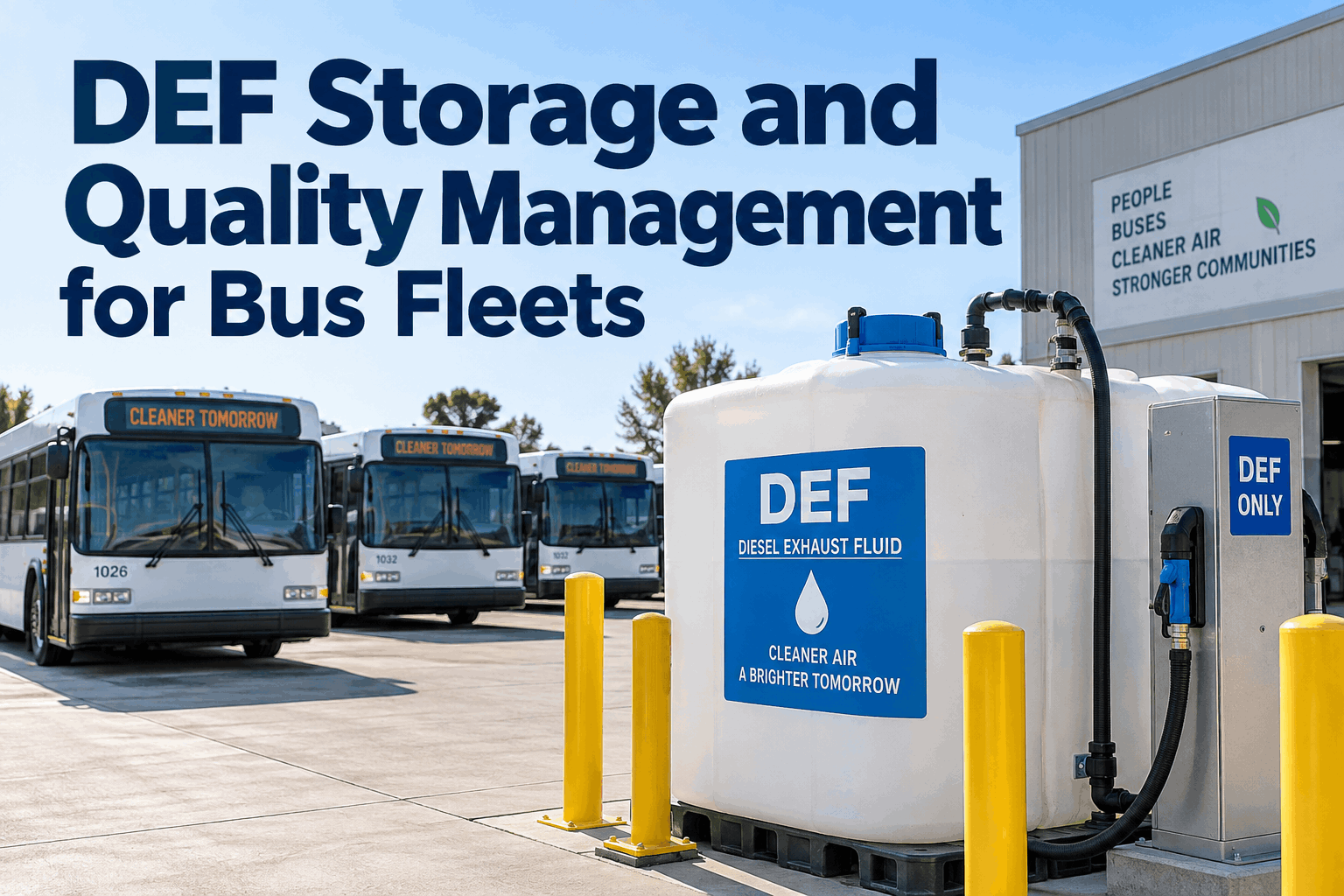
A shop foreman pulls the cap off the depot DEF tote and finds a copper fitting on the transfer pump the parts distributor swapped in last month. The DEF has been running through that fitting for six weeks. Three buses come in with SCR fault codes within the next 30 days — each catalyst replacement runs $8,000 to $15,000. That is what contaminated DEF actually costs. This guide covers DEF storage bus fleet best practices — ISO 22241 specs, tank materials that work vs materials that destroy DEF, temperature limits, shelf life, contamination prevention, and the depot inventory system that keeps bad DEF out of your buses.
DEF Storage and Quality Management for Bus Fleets
The storage specs, tank materials, temperature limits and inventory system that protect your SCR catalysts from the day a tote is delivered.
- 32.5%Urea spec
- 12-86°FStorage range
- $8-15KSCR repair
Why DEF Quality Is a Parts & Inventory Problem
Every diesel bus built after 2010 runs Selective Catalytic Reduction. That system depends on Diesel Exhaust Fluid meeting ISO 22241 — a tight specification covering urea concentration, density, alkalinity, biuret, aldehyde and trace metals. When DEF drifts off spec, the SCR catalyst does not fail in an obvious way. It slowly poisons. Fault codes appear weeks later. By the time the fleet sees the pattern, three or four buses need catalyst replacement at $8,000-$15,000 each — and the root cause is often a $40 transfer pump fitting that nobody thought to check.
The single biggest misconception in fleet DEF management, according to API's Diesel Exhaust Fluid Certification Program, is the belief that if the urea concentration is on spec, the DEF meets required quality. Concentration matters — but the ISO 22241 specification includes many other quality characteristics. Urea alone does not confirm the fluid is fit for a bus SCR system.
This puts DEF squarely on the desk of the parts manager, not just the mechanic. Where the fluid was purchased, what container it arrived in, what tank it went into, what temperature it sat at, what date the batch was manufactured, and what date each drum was opened — every one of those is an inventory event. Miss any of them and the traceability is broken. When the SCR faults appear a month later, nobody can identify which batch is the problem, so nobody can quarantine the rest of the drums. Book a demo to see how DEF batches are tracked from delivery through consumption.
What Contaminated DEF Actually Costs a Bus Fleet
Before the storage rules, the damage math. This is what a mid-size fleet is really protecting when it locks down DEF handling — not a compliance fine, an actual repair-bill avalanche that begins weeks after the contamination event.
The asymmetry is what makes DEF worth managing carefully. The fluid itself is cheap. The catalyst it protects is not. And the failure mode is delayed and cumulative — meaning by the time you know you have a problem, the problem is already fleet-wide. Proper storage discipline plus batch traceability is a small cost that avoids a very large one.
The DEF Temperature Safe Zone
DEF is a chemical solution. It has a real temperature window, and both edges cost quality. The safe zone is 12°F to 86°F. Below the low end DEF freezes — usable once thawed with no damage, but frozen totes cannot be dispensed. Above the high end, the urea starts to hydrolyze and shelf life falls off rapidly. A tote left in a Phoenix or Houston yard through August can lose most of its usable life in a single season.
The practical takeaway for depots in the South, Southwest and Mountain West is that outdoor tote storage on the yard in summer is a slow-motion contamination event. Sun-exposed totes routinely hit internal temperatures well above ambient. Move totes into a shaded, ventilated area — even a simple shade canopy over the storage bay changes the shelf-life math substantially. Sign up free and start logging tote receipt dates with the storage location on record.
Tank & Fitting Materials: What Works and What Destroys DEF
DEF is corrosive to a specific list of metals, and any of them in a storage tank, transfer line, pump body or fitting will leach into the fluid and put it off spec. The manufacturers of every SCR system on the market publish the same materials list. It gets ignored constantly — usually when a shop grabs whatever pump or fitting is on the shelf to fix a leaking dispenser on a Friday afternoon.
COMPATIBLE MATERIALS
- Stainless steel · grades 304 and 316
- HDPE polyethylene · high-density plastic (typical tote material)
- Polypropylene
- PTFE (Teflon) · seals and gaskets
- Viton fluoroelastomer · O-rings
- EPDM · hoses and gaskets
NEVER USE
- Carbon or mild steel · rusts and leaches iron into DEF
- Copper · leaches into fluid, poisons catalyst
- Brass · contains copper and zinc
- Aluminum · reacts with urea over time
- Zinc-coated or galvanized · zinc leaches
- Solder joints · typically lead or tin
The trace-metal specifications in ISO 22241 are strict for a reason. Calcium, iron, copper and zinc each carry a maximum of about 0.5 mg/kg — parts-per-million territory. A single brass fitting in the transfer line can push a batch over the limit within days. When ordering pump kits, transfer nozzles or replacement fittings, spec them explicitly as DEF-compatible. Most reputable suppliers stamp or label DEF-rated hardware. If a fitting is not labeled, treat it as not compatible until proven otherwise. Book a demo to see DEF-rated parts flagged in your inventory catalog.
Where Contamination Actually Enters a Depot
In a well-run yard where the storage temperature is right and the tank materials are correct, contamination still finds a way in. Six real entry points cover almost every case seen in the field.
-
Wrong Fittings
Brass or aluminum pump body, elbow, or nozzle installed during a shop fix. Leaches metals into the fluid over days.
-
Cross-Contamination
Funnel, jug or hose previously used for oil, coolant, wash chemical or diesel — then used for DEF. Even trace residue is off-spec.
-
Dilution
Someone tops off a bus DEF tank with tap water thinking it's harmless. Chlorine, calcium, and minerals in tap water destroy the batch.
-
Open Storage
Tote lid left off. Dust, debris, insects, rain enter. Airborne contaminants react with urea over time.
-
Expired Batch
Drum sat in the corner past its manufacture-plus-12-month window. Urea has hydrolyzed. Still looks like DEF — is not on spec.
-
Off-Brand Supply
Delivery not carrying the API Certification Mark. May be diluted, off-concentration, or made outside ISO 22241 protocols.
Every one of these is a process failure, not an equipment failure. Wrong fittings happen because the parts room does not know a fitting has to be DEF-rated. Cross-contamination happens because the funnels are not color-coded. Dilution happens because no driver has been trained on DEF-versus-water. Expired batches happen because nobody is tracking receipt dates. These are inventory and training problems, not chemistry problems.
Shelf Life: The Batch You Store Today Expires When?
DEF has a real, finite shelf life. In optimal conditions, 12 months minimum is typical — often longer. Above 86°F, that window collapses. This is where batch traceability earns its keep. The date on the drum is the manufacturing date, not the receipt date. And the shelf life clock started at manufacture, not the day the depot took delivery.
The operational rule that follows from this: first-in, first-out. Rotate the depot stock so older drums are dispensed first, and never let a drum age out of window in the corner behind the newer inventory. Every drum receipt should log the manufacture date printed on the container, the receipt date at the depot, and a computed expected-expiration based on the storage temperature. Depots that manage this well never write off DEF; depots that don't routinely dispose of hundreds of gallons per year.
The Depot Delivery Inspection: 5 Checks That Take 5 Minutes
Every DEF delivery gets inspected before it goes into inventory. Not every three months. Every time. Five checks cover the entire quality window at the receiving dock.
API Certification Mark
Look for the API-Licensed mark on every container. This is the only public confirmation the product meets ISO 22241. Missing mark = missing quality guarantee.
Manufacture Date & Batch Number
Record both on the receiving log. Manufacture date drives the shelf-life clock; batch number is what you'll trace against if SCR faults appear later.
Visual Clarity
DEF is clear as water. Any tint, cloudiness, or sediment is a reject. Draw a sample into a clear jar and look through it against a white background before accepting.
Refractometer Check
A handheld DEF refractometer confirms 32.5% urea concentration in 30 seconds. $50-$100 tool. Best diagnostic-per-dollar investment in the whole parts room.
Seal Integrity
Check that the container seal is intact and unbroken. Any evidence the container has been opened in transit is a reject — contamination or dilution can't be ruled out.
Five minutes at receiving prevents most of the field problems. The refractometer check is worth calling out separately — it is the single test that gives real-time confirmation that a delivery is on-spec for the parameter that matters most. A refractometer reading below 31.8% or above 33.2% is an immediate reject and a call back to the supplier. No calibration lab, no lab shipment, no waiting.
How BusCMMS Runs DEF as a Managed Inventory Item
DEF cannot sit as a generic parts-room SKU. It needs batch-level tracking, receipt date logging, expiration alerts, and consumption ties to specific buses so that a bad batch can be quarantined the moment SCR faults appear. Here is how a bus-specific CMMS actually runs it.
-
Batch & Lot Tracking
Every drum, tote and bulk delivery logged with API mark confirmation, batch number, manufacture date, receipt date, storage location.
-
Shelf-Life Alerts
Auto-computed expiration based on manufacture date + storage temperature zone. Alerts before expiry so old stock gets used first.
-
Receipt Inspection Log
Digital checklist for the 5-point delivery inspection. Refractometer reading, visual clarity, seal check — all recorded per delivery.
-
Consumption Per Bus
DEF issued to each bus is logged back to the source batch. Unusual consumption spikes (DEF/fuel ratio drift) flag quality problems early.
-
Batch Quarantine
If SCR faults trace back to a batch, one action quarantines all remaining stock of that batch across every depot. No hunting.
-
DEF-Rated Parts Flag
Pump kits, fittings, hoses, and totes flagged as DEF-rated in the parts catalog so a shop fix never grabs an incompatible brass elbow.
The consumption-per-bus feature is the one that catches problems earliest. Every bus has a normal DEF-to-diesel ratio — roughly 2-3% by volume depending on duty cycle. When the ratio starts to drift on multiple buses at once, and those buses all drew from the same recent batch, the diagnosis writes itself. That is the difference between quarantining a bad tote in week one and replacing three catalysts in month two.
The Practitioner View
This is why DEF is a parts & inventory problem, not a shop-floor problem. The failure vector is upstream of the mechanic — it is the container, the fitting, the storage location, the batch date. Once contaminated fluid reaches the bus, the damage is already in progress. Sign up free and start batch-level DEF tracking within a week.
The Bottom Line on DEF Storage for Bus Fleets
DEF storage bus fleet discipline is a small cost that prevents an enormous one. Four rules cover most of it: buy only API-licensed product, store between 12°F and 86°F, use only compatible tank and fitting materials, and track every drum by batch number from receipt through consumption. The fluid is cheap. The SCR catalyst it protects is not, and neither is the downtime that follows when three buses come in with fault codes in the same month. A parts-and-inventory system that treats DEF as a critical fluid — not a generic SKU — is the difference between a routine depot operation and a catalyst-replacement crisis. Book a walkthrough to see the full DEF inventory workflow on a bus fleet like yours.
What temperature range does DEF need to be stored at?
The safe storage window is 12°F to 86°F. Below 12°F the fluid freezes but is not damaged — it thaws back to usable DEF, though depot dispensing is not possible while frozen. Above 86°F, urea starts to hydrolyze into ammonia and shelf life drops sharply. At 50°F storage, DEF can hold quality for 36 months or longer; at 77°F, roughly 12 months; at sustained 95°F yard temperatures, useful life falls to weeks. Store totes and drums out of direct sunlight even inside the safe range, because container temperatures run well above ambient in the sun.
What materials can DEF storage tanks and fittings be made of?
Compatible materials are stainless steel (grades 304 and 316), HDPE polyethylene, polypropylene, PTFE, Viton fluoroelastomer, and EPDM. These are non-reactive with the urea solution. Never use carbon or mild steel (rusts and leaches iron), copper (poisons the SCR catalyst), brass (contains copper and zinc), aluminum (reacts with urea), zinc-coated or galvanized components, or joints made with lead-tin solder. A single incompatible fitting on a transfer pump or dispenser can push a batch above the ISO 22241 trace-metal limits of about 0.5 mg/kg within days. Spec every pump, hose, nozzle, and fitting explicitly as DEF-rated.
How long does DEF last in storage?
In optimal storage conditions, minimum shelf life is 12 months from the manufacture date printed on the container — often substantially longer. Cool storage extends this considerably: at 50°F, 36 months or more is realistic. Elevated storage temperatures compress it: at 86°F, roughly six months. The clock starts at manufacture, not at depot receipt, so track the manufacture date on every drum as it comes in. Depots should run first-in, first-out rotation, and every drum receipt should be logged with the manufacture date, receipt date, and expected expiration so old stock never sits behind newer inventory.
What are the most common ways DEF gets contaminated at a bus depot?
Six real-world entry points: (1) incompatible pump or transfer fittings made of brass, aluminum, or carbon steel; (2) cross-contamination from a funnel, jug, or hose previously used for oil, coolant, wash chemical, or diesel; (3) dilution when tap water is added to a bus DEF tank (chlorine and minerals destroy the batch); (4) open storage where containers are left uncapped and dust, debris, insects, or rain enter; (5) expired batches sitting past their manufacture-plus-12-month window; (6) off-brand supply without the API Certification Mark. Every one of these is a process or training problem rather than a chemistry problem — which is why inventory discipline solves most of it.
How does BusCMMS manage DEF quality for a bus fleet?
BusCMMS treats DEF as a batch-tracked critical fluid, not a generic parts SKU. Every drum, tote, and bulk delivery is logged with API Certification Mark confirmation, batch number, manufacture date, receipt date, and storage location. Shelf-life alerts compute expiration from manufacture date plus storage temperature zone. A digital receipt-inspection checklist captures the five-point delivery check including refractometer reading and seal integrity. Consumption per bus is logged back to the source batch, so unusual DEF-to-diesel ratio drift flags quality problems early. If SCR faults trace back to a batch, one action quarantines all remaining stock of that batch across every depot. DEF-rated pump kits, hoses, and fittings are flagged in the parts catalog so no shop fix ever grabs an incompatible brass elbow.