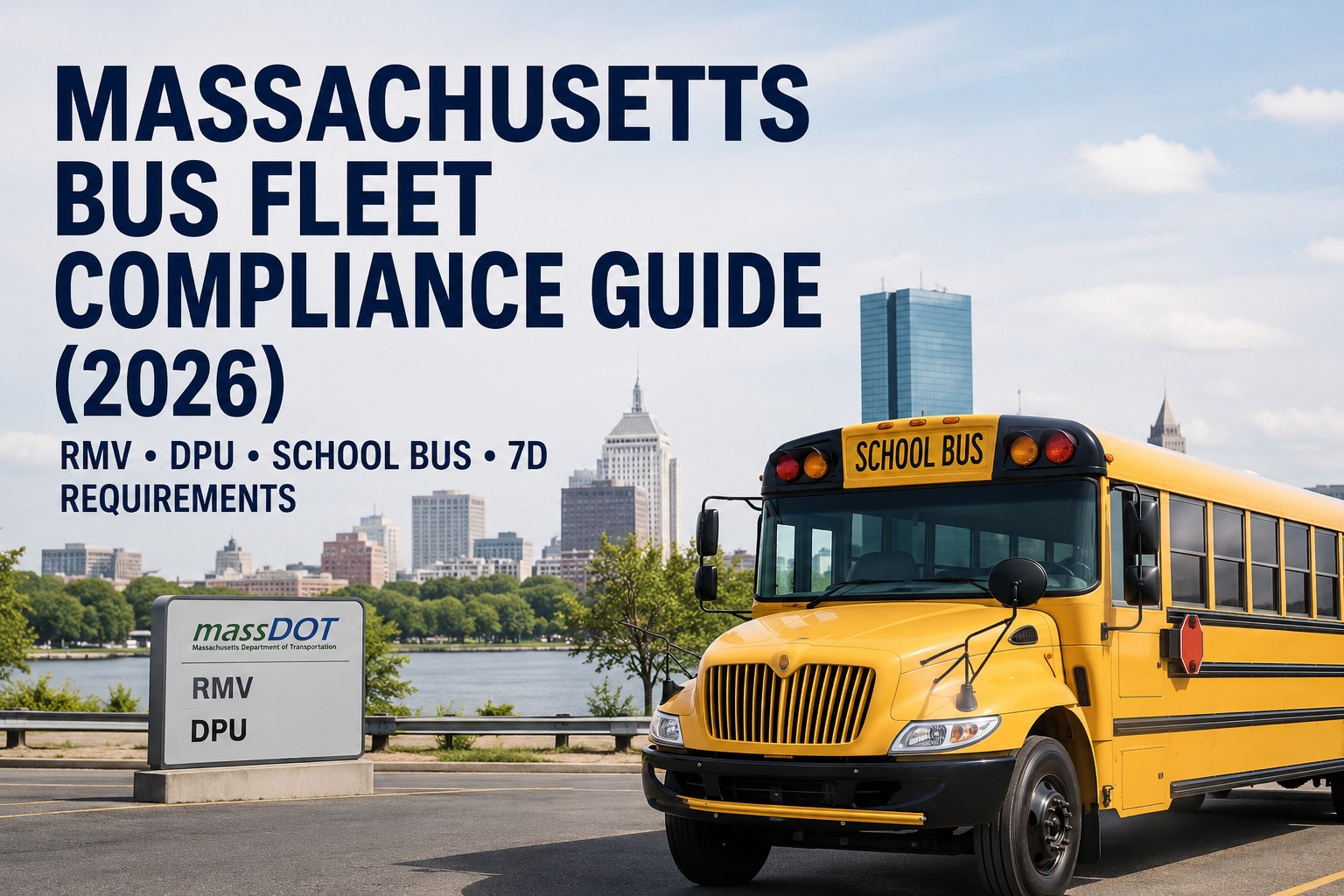
Massachusetts is the only state in the country with a "7D vehicle" -- a distinct classification for school pupil transport vans that gets inspected twice a year instead of once, under a completely different chapter of the CMR than a full school bus. It is also one of a handful of states where three separate agencies -- the RMV, the DPU, and the FMCSA -- each own a different slice of your compliance obligation, and where the DPU still requires a public hearing to grant operating authority for any for-hire bus carrying 10 or more people intrastate. This is the practical 2026 walkthrough of the four core CMR chapters that govern Massachusetts bus fleets, the 7D rules that trip up new operators, and the DPU process that catches carriers off guard. See BusCMMS pre-loaded with 540 CMR 7 checkpoints → book a 20-min demo.
Massachusetts Bus Fleet Compliance Guide
RMV, DPU, and FMCSA jurisdiction, the 7D semiannual inspection rule, and the operating-authority process every carrier needs to know.
RMV
Registry of Motor Vehicles- 540 CMR 4 · annual inspection
- 540 CMR 7 · school bus standards
- 540 CMR 21 · 7D semiannual
- 7D endorsements + stickers
DPU
Dept. of Public Utilities- Operating authority (159A)
- Intrastate passenger carriers
- Motor bus driver certificates
- Road tests + hearings
FMCSA
Federal Motor Carrier Safety- Interstate operations
- CSA / SMS scoring
- Clearinghouse queries
- DVIRs (49 CFR §396.11)
How to read this split: Every Massachusetts bus fleet answers to at least two of these agencies. School districts answer to RMV. Charter operators answer to RMV + DPU. Interstate coach operators answer to all three. The 7D fleet answers to RMV only. Know which agencies apply to your operation before the inspector arrives.
The 4 CMR Chapters That Actually Matter
Bookmark these. Every Massachusetts bus compliance question routes back to one of them.
CMR
4
Annual Safety & Emissions Inspection
All motor vehiclesGoverns the annual sticker inspection every registered vehicle needs. Sets rules for inspection stations, licensed inspectors, and equipment. New buses must be inspected within 7 days of Massachusetts registration.
CMR
7
School Bus & 7D Construction Standards
MOST-CITED CHAPTEREstablishes minimum construction, maintenance, and inspection standards for Type A, B, C, D school buses plus 7D pupil transport vehicles. Adopted under M.G.L. c. 90 §§ 7A, 7C, 31. All post-1989 school buses must comply.
CMR
21
7D Semiannual Safety Inspection
7D vehicles onlyRequires 7D pupil transport vehicles to be inspected every 6 months, not annually. Inspector must hold a 7D endorsement on their Class A/B/D/F inspector license. Old 7D sticker is removed at each inspection.
CMR
27
School Grounds Idling Regulation
Driver certification linkedUnder M.G.L. c. 90 §16B, buses cannot idle on school grounds beyond the statutory limit. School bus companies must inform every driver of the rule upon employment and annually thereafter.
These four chapters cover 95% of Massachusetts inspection findings for bus fleets. See BusCMMS pre-loaded with 540 CMR checkpoints → book a demo.
The 7D Vehicle: What Every Massachusetts Fleet Should Know
Unique to Massachusetts. Different rules. Different inspection cycle.
A "7D vehicle" -- shorthand from M.G.L. c. 90 §7D -- is a specific classification used only in Massachusetts. It refers to a passenger vehicle with a gross vehicle weight rating of 10,000 pounds or less used to transport school pupils. Think of the smaller vans that carry special-needs students or handle route consolidation for smaller districts. Since July 1, 2020, seating capacity is capped at 10 passengers plus the driver, with a rare waiver up to 11 available under 540 CMR 7.10. Every 7D vehicle carries its own compliance checklist that differs meaningfully from full-size school bus rules.
Vehicle Classification
- GVWR ≤ 10,000 lbs
- Max 10 passengers + driver
- School pupil plate under M.G.L. c. 90 §2
- Company name/city/state on both sides, 2" glossy black letters
Required Equipment
- First aid kit + body fluid clean-up kit
- Two chock blocks
- Seat belt cutter in driver compartment
- Fire extinguisher rated 2A10BC or greater
- Three reflective triangles
- Fire/evacuation blanket (wheelchair only)
Inspection Cycle
- Semiannual under 540 CMR 21
- Every 6 months, not annual
- Inspector must hold 7D endorsement
- Class A/B/D/F license required
- Old sticker removed at each inspection
The 7D semiannual cycle is the single most-missed compliance detail for new Massachusetts operators. See BusCMMS auto-schedule 7D semiannual inspections → book a demo.
The DPU Operating Authority Process
Any for-hire intrastate bus with 10+ seats needs this. Here is exactly how it works.
Under M.G.L. c. 159A, the DPU's Transportation Oversight Division regulates all intrastate motor bus carriers -- charter, sightseeing, and fixed route. If your bus operation begins and ends in Massachusetts and carries 10 or more people including the driver, you need DPU operating authority. Interstate operations are federal (FMCSA), and RTAs contracted for regional service are exempt from DPU authority except on safety matters. The DPU process is deceptively procedural: the paperwork is straightforward, but the public hearing catches many first-time applicants off guard.
- 1
Choose Carrier Type
Before applicationDetermine whether you are applying as charter, sightseeing, or fixed-route service. Each has different documentation requirements.
- 2
Submit Application + Fee
First Friday of the monthSubmit business registration documents (or DBA certificate for sole proprietors) plus application fee. Applications received by first-Friday close of business scheduled for next month's hearing.
- 3
Public Hearing
2nd Tuesday of following monthPrincipal owner of the business must attend in person. This is where most first-timers stumble -- delegates cannot substitute. Held at One South Station, 3rd floor, Boston.
- 4
60-Day Document Window
Post-hearingYou have 60 days from the hearing date to submit all supporting documents required for operating authority. Miss the window, restart the process.
- 5
Inspector Review
After document submissionA DPU Inspector contacts the applicant to schedule an in-person review of documents and physical inspection of any vehicles being registered under the authority.
- 6
Authority Issued + Driver Certificates
OngoingDPU issues operating authority. Every driver operating a regulated bus needs a separate DPU motor bus driver certificate, road test through the DPU, and a DOT physical.
The DPU authority + driver certificate expiration cycle catches operators off guard every year -- log both against the calendar. See BusCMMS track DPU expirations per driver → book a demo.
School Bus vs 7D Vehicle: Compliance Side by Side
Same passengers. Same students. Different rulebook entirely.
Full-Size School Bus
7D Pupil Transport
Type D: 33K+ lbs
Running a mixed fleet? The scheduling logic diverges by vehicle class. See BusCMMS handle mixed school bus + 7D fleets → book a demo.
The 5-Point Massachusetts Readiness Check
What separates the fleets that pass audit week from the ones that scramble.
- 1
Every VIN tagged by classification
FoundationFull-size school bus (Type A/B/C/D), 7D pupil transport van, or coach/transit. The classification decides everything downstream -- inspection interval, driver license, equipment list, applicable CMR chapter. Get this wrong and every subsequent record is wrong.
- 2
Semiannual 7D inspections scheduled by VIN
540 CMR 21 complianceEvery 7D vehicle needs an inspection every 6 months -- twice a year. Missing one is a citable finding even if the vehicle is clean. Track next-due date per VIN with a 45-day forward alert.
- 3
Driver certifications synced to correct authority
RMV + DPU + FMCSASchool bus driver S endorsement (RMV), 7D driver license (RMV), DPU motor bus driver certificate (DPU), and CDL medical certificate (FMCSA + June 2025 National Registry electronic submission). Different expiration dates. Different renewal paths.
- 4
Annual 540 CMR 27 idling training documented
School bus fleetsEvery school bus driver must be informed of the school-grounds idling rule at hire and annually thereafter under M.G.L. c. 90 §16B. Documented training with driver signature. Missing signatures = missing compliance.
- 5
Audit-ready export per fleet segment
RMV / DPU / FMCSAWhen the state or federal inspector arrives, pull the export they need -- 540 CMR 4 stickers, 540 CMR 21 7D reports, DPU driver certificates, FMCSA DVIRs -- in minutes, not days. This is what turns a stressful audit week into a routine one.
Where BusCMMS Fits Your Massachusetts Fleet
Six ways every 540 CMR chapter stops surprising you.
540 CMR Checkpoints Preloaded
Pre-trip DVIRs pre-loaded with Chapter 7 school bus items -- brakes, seat belts, emergency doors, 8-light warning system, stop arm. No custom form-building.
7D Semiannual Scheduler
Every 7D vehicle scheduled every 6 months under 540 CMR 21, not the annual default. Alert fires 45 days before next inspection due date.
Multi-Certificate Tracking
S endorsement (RMV), DPU motor bus driver certificate, CDL medical certificate, 7D driver license -- each with independent expiration + renewal alerts per driver.
Idling Training Log
Annual 540 CMR 27 idling training documented per driver with signature capture. Auto-fires on hire date + annual anniversary.
Agency-Specific Export
Pull the exact record set each agency wants -- RMV inspection stickers, DPU driver certs, FMCSA DVIRs -- in one click. Audit week ends in an afternoon.
Mixed Fleet Support
School bus + 7D + charter coach on one dashboard with correct rules applied per classification. No manual switching between spreadsheets by vehicle type.
We run 28 full-size school buses and 12 7D vans, and the biggest headache in Massachusetts is not the buses, it's remembering the 7D calendar. Twice-a-year inspections, seven inspectors with 7D endorsements to track, and every 7D van has its own equipment kit that has to stay compliant. We had a finding in our 2024 audit because two 7D vans had missed their second-half inspection by 11 days -- clean vehicles, just missed the calendar. Moved everything into BusCMMS with the 45-day forward alerts. Zero missed 7D inspections since.
7D inspection window opens in 6 months? The reminder system starts today. Sign up free and load your VIN list →
Frequently Asked Questions
What is a 7D vehicle in Massachusetts?
A 7D vehicle -- named for M.G.L. c. 90 §7D -- is a "School Pupil Transport Vehicle": a passenger vehicle with a gross vehicle weight rating of 10,000 pounds or less used to transport school pupils. Since July 1, 2020, the seating cap is 10 passengers plus the driver, with a rare waiver up to 11 available under 540 CMR 7.10. These are typically vans used for smaller routes, special-needs students, or route consolidation for smaller districts. Unlike full-size Type A/B/C/D school buses, 7D vehicles do not require 8-light warning systems, stop arms, or CDL with S endorsement, but they must display a school pupil plate under M.G.L. c. 90 §2 and the company name/city/state on both sides in 2" glossy black lettering. Massachusetts is the only state using this specific classification.
How often does a 7D vehicle need to be inspected?
Every 6 months under 540 CMR 21 -- semiannually rather than the annual cycle that applies to full-size school buses under 540 CMR 4. This is one of the most commonly missed compliance details for new Massachusetts operators. The inspection must be performed by an inspector holding a special 7D endorsement on their Class A, B, D, or F inspector license. At each inspection, the old 7D vehicle sticker is removed and a new one issued if the vehicle passes. Registration, VIN, expiration date, school pupil plate, and annual Certificate of Inspection are all verified. A missing or invalid Certificate of Inspection results in immediate rejection. Any equipment defect triggers a 7D Repair Form (EQ) that must be resolved before the vehicle returns to pupil transport service.
Do I need DPU operating authority to run a bus company in Massachusetts?
Yes, if you are operating a for-hire passenger vehicle carrying 10 or more people including the driver on intrastate routes -- meaning your service begins and ends in Massachusetts. Under M.G.L. c. 159A, the Department of Public Utilities Transportation Oversight Division issues operating authority for three types: charter, sightseeing, and fixed route. Interstate operators are regulated by FMCSA instead. Regional Transit Authorities and their contracted operators are exempt from DPU authority except on safety matters. The application process runs on a monthly cycle: applications submitted by the close of business on the first Friday of each month are scheduled for a public hearing on the second Tuesday of the following month. The principal owner of the business must attend the hearing in person -- delegates cannot substitute. After the hearing, applicants have 60 days to submit all supporting documents before a DPU Inspector conducts the physical review.
Which Massachusetts CMR chapters apply to school bus fleets?
Four chapters of 540 CMR cover 95% of Massachusetts school bus compliance. 540 CMR 4 governs the annual safety and combined safety and emissions inspection for all registered vehicles, including full-size school buses. 540 CMR 7 establishes minimum construction, equipment, maintenance, and inspection standards for Type A, B, C, D school buses plus 7D pupil transport vehicles -- this is the most-cited chapter. 540 CMR 21 mandates the semiannual safety inspection specific to 7D school pupil transport vehicles, requiring inspector 7D endorsements. 540 CMR 27 regulates motor vehicle idling on school grounds under M.G.L. c. 90 §16B, and requires school bus companies to inform every driver of the rule at hire and annually thereafter. Together these four chapters -- backed by M.G.L. c. 90 §§ 7A, 7B, 7C, 7D, 16B, and 31 -- form the Massachusetts state framework layered on top of federal FMCSA rules for interstate operations.
How does BusCMMS help Massachusetts bus fleets stay compliant?
BusCMMS ships with 540 CMR checkpoints pre-loaded on digital pre-trip DVIRs -- Chapter 7 school bus items including brakes, seat belts, emergency doors, 8-light warning systems, and stop arms -- so form-building is done on day one. 7D pupil transport vehicles are auto-scheduled on the 540 CMR 21 semiannual cycle, not the annual default, with 45-day forward alerts before each due date. Every driver certification tracks independently: RMV S endorsement, DPU motor bus driver certificate, CDL medical certificate under the June 2025 National Registry, and 7D driver license, each with separate expiration alerts. Annual 540 CMR 27 idling training auto-fires per driver on hire date plus annual anniversary with signature capture. Agency-specific export produces exactly the record set the RMV, DPU, or FMCSA inspector requests in a single click. One 40-vehicle Central Massachusetts mixed fleet reported eliminating missed 7D semiannual inspections after moving the calendar into BusCMMS -- catching what a spreadsheet routinely missed by 11 days.