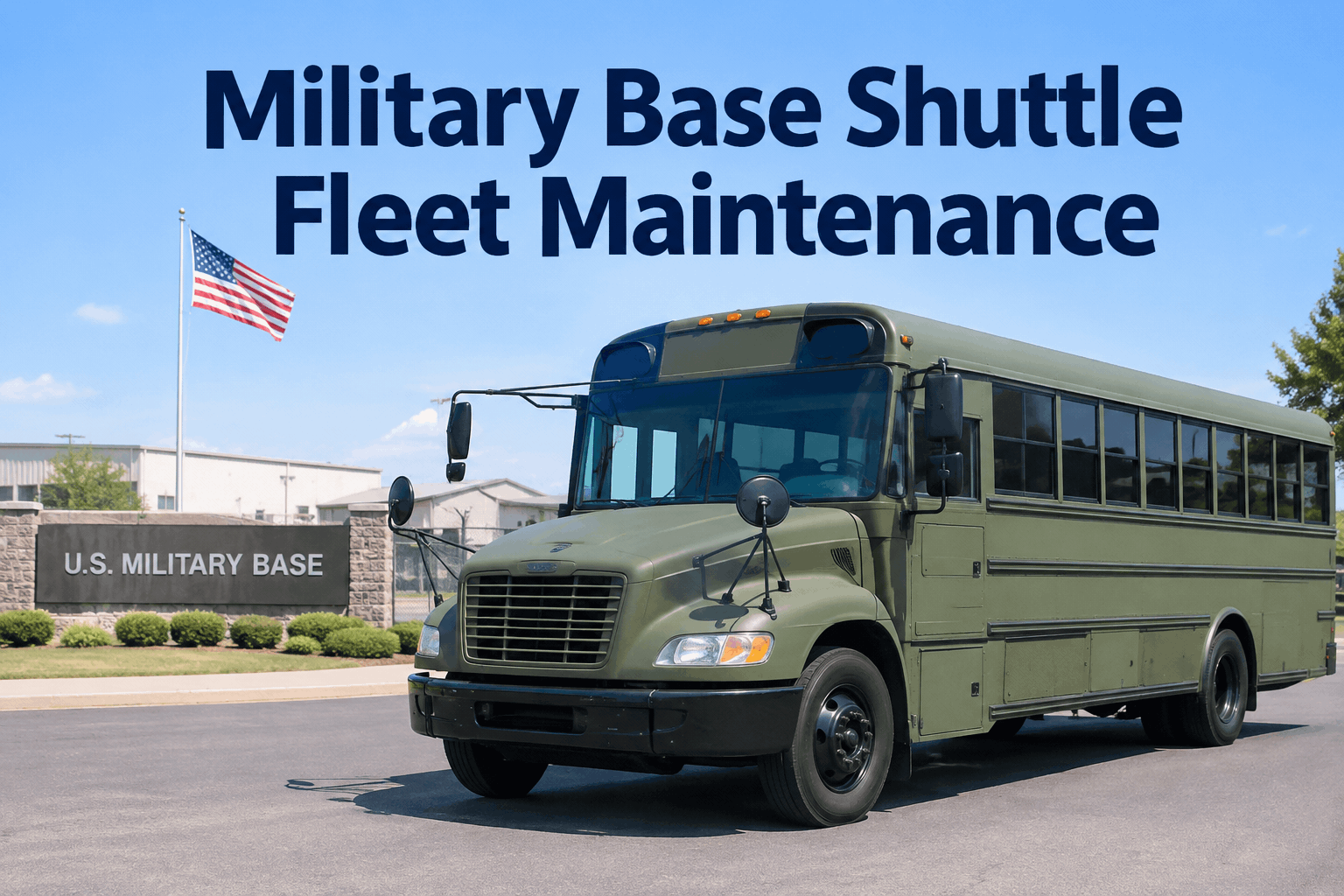
At 0600 the installation shuttle has to start moving personnel across base, and the number that matters is how many of your buses are mission-ready right now. On an aging government fleet, that number moves every day. Military base shuttle fleet maintenance software keeps it high by catching problems before a bus rolls, and you can see your readiness board in a quick demo.
Military Base Shuttle Fleet Maintenance Software
Your base shuttle runs an aging, mixed-ownership fleet that has to stay mission-ready and audit-ready at once. Military base shuttle fleet maintenance software keeps every bus serviced, every repair tracked, and your readiness rate where it needs to be.
Why a Base Shuttle Fleet Is Not a Civilian Fleet
An installation shuttle operates under constraints a commercial operator never sees. Four of them shape every maintenance decision.
Aging buses, hard use
Government shuttles often run years past their planned life. An older fleet breaks more and needs tighter, better-tracked preventive maintenance just to stay available.
Mixed ownership on one base
GSA-owned, installation-owned, and commercially leased buses sit side by side — each with different maintenance responsibility and records. One undifferentiated list is how a reporting error starts.
Mission readiness, not a route
The shuttle is how thousands of personnel move across the installation. A bus down is not a late trip — it is base mobility degraded, and someone asks why.
The annual data call is coming
Federal fleets report annually through FAST under 41 CFR 102-34. Even a GSA-leased bus still needs your own inspection and usage records — clean or scrambled, they are due.
The real target is not fewer repairs — it is a readiness rate you can hold and a record you can hand over on demand.
The Three Ownership Lanes on Your Installation
Most base shuttle fleets are a mix of three ownership types, each with its own maintenance responsibility. They have to feed one fleet view, or the records fall apart.
Confirm which model applies to each bus with your fleet management office and GSA — then let the system keep them straight. You can walk through mixed-ownership tracking in a demo.
What Military Base Shuttle Maintenance Software Tracks
These are the things that decide whether an installation shuttle fleet stays mission-ready and audit-ready. A real government fleet maintenance software keeps them in one place.
Swipe sideways to see all columns
Your Installation Shuttle Readiness Checklist
Run this against your fleet before the next duty day. The red items are what drop your readiness rate; the green items are what keep it steady.
- Live readiness rate for the whole fleetYou can see how many shuttles are mission-ready at any moment, not guess.CRITICAL
- Digital pre-trip on every shuttle, dailyDrivers catch defects before the first run, not out on a base loop.CRITICAL
- PM intervals tightened for an aging fleetOlder buses get serviced on a schedule that fits their condition, flagged early.PLAN
- Each bus tagged by ownership typeGSA, installation, and leased units kept on their own maintenance and cost lines.PLAN
- Failed items become work ordersA flagged defect routes straight to the shop — nothing lost on a paper note.PLAN
- Exportable records for the data callDated service and inspection history per bus, ready to feed FAST and agency reports.PLAN
If the two critical lines are still manual, that is where a dropped readiness rate comes from — sign up free and put every item on one board.
How BusCMMS Keeps a Base Shuttle Fleet Mission-Ready
BusCMMS is built for bus and coach fleets, so a government shuttle operation maps straight onto it. Three capabilities carry the readiness load.
A live readiness board
Real-time fleet availability and PM compliance on one dashboard, so your mission-ready rate is a number you can see and report, not estimate.
Pre-trip straight to work order
Pre-built digital DVIRs any driver can run; a failed item becomes a work order the shop sees at once, so an aging bus is caught early.
Records ready for the data call
Dated PM, inspection, and repair history per bus, tagged by ownership and exportable — so the annual report is a pull, not a scramble.
It fits the people who run base transport — your installation and government fleet, on the passenger transit fleet page. To set it up for your fleet, book a demo and bring your bus list.
What a Higher Readiness Rate Is Worth
On an installation, the readiness rate is the scoreboard. Three ways tracking maintenance in one system moves it.
Fewer surprise down days
PM caught before it slips means an aging bus goes down on your schedule, in the shop — not mid-loop with personnel aboard.
A number you can defend
When leadership asks why the rate moved, you have the work orders, parts, and dates behind it — not a guess.
A data call that is a pull
Clean, dated records per bus mean the annual report comes out of the system instead of out of three binders.
Readiness is a habit the system enforces, not a scramble you repeat every morning.
From a Base Transportation Manager
Key Takeaways on Military Base Shuttle Maintenance
Military base shuttle fleet maintenance software earns its keep at the readiness board and the data call. Four things to hold onto.
Readiness is the scoreboard
The mission-ready rate is the number leadership asks for; the system keeps it visible.
Aging fleets need tighter PM
Older buses break more; scheduled, flagged service is what keeps them available.
Keep the ownership lanes straight
GSA, installation, and leased buses each stay on their own maintenance and cost line.
Records make the data call easy
Dated, exportable history per bus turns the annual report into a pull, not a scramble.
Run a base shuttle fleet off a readiness view built for aging, mixed-ownership government buses and the morning stops being a guess — you know what is ready, what is in the shop, and that the record is already written.