Last Tuesday a mobile mechanic spent 3 hours on Bus #14 — $525 billed. Your shop manager has no idea what was actually done. No parts list. No measurement data. No before/after documentation. Just an invoice that says "brake service" and a number to pay. Multiply that by 12 outside service calls a month and your fleet is leaking $50,000–$80,000 a year into a black hole where nobody tracks what work happened, whether it was done right, or if it duplicated something your in-house tech already did last week.
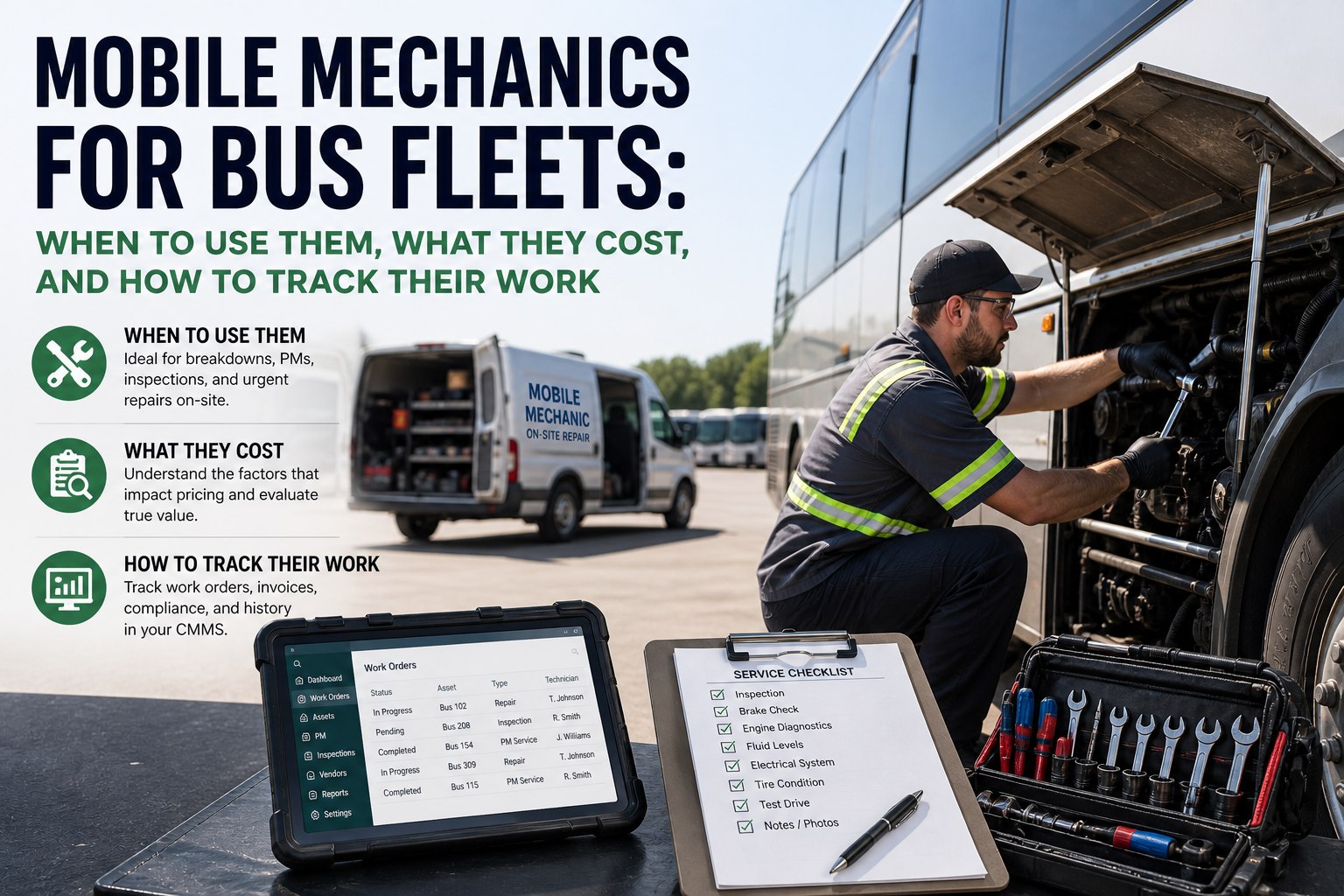
Mobile Mechanics for Bus Fleets: When to Use Them, What They Cost, and How to Track Their Work
$95– $175/hr is the rate. But the real cost is what you can't see — undocumented work, duplicated repairs, and compliance gaps. Here's how to fix that.
The Real Cost Gap
12% of the average bus fleet budget goes to outsourced repairs — $45,000/yr for a 50-bus fleet
When Mobile Mechanics Make Sense (And When They're Draining You)
Specialized work your shop can't do (DPF, transmission, AC)
Overflow during peak seasons (back-to-school, winter prep)
Emergency roadside breakdowns where towing costs more
Fleets with no in-house techs (shops with zero staff)
DOT annual inspections if your staff isn't qualified per 396.19
Routine PMs your mechanic can handle (oil, filters, brakes)
Work sent outside because parts weren't in stock
Repairs your tech could do but "didn't have time" for
Repeat work on the same bus — the mobile didn't fix it right
Any work you're not tracking in your CMMS
Here's the number that matters: fleets with 5–25 vehicles handle only 48.2% of maintenance in-house. Fleets with 1,000+ handle 62.4%. The larger fleets aren't smarter — they have better visibility into shop capacity. They know exactly which work should stay inside and which should go out. That visibility comes from tracking every work order — in-house and outsourced — in one system.
BusCMMS gives you that visibility. Every work order — whether your mechanic or a vendor completes it — is logged against the same bus, in the same timeline, with the same cost tracking. You see in-house vs. outsourced spend per bus, per month, per repair type. The patterns that tell you "we should bring brake work back in-house" become obvious in 30 days of data.
See in-house vs outsourced cost comparison in one dashboard — book a demo
What Mobile Mechanics Actually Cost (Beyond the Hourly Rate)
Standard mobile diesel mechanic rate. Varies by region, specialization, and urgency. Emergency/after-hours: add 25–50%.
Flat fee per visit regardless of repair scope. Some vendors waive if repair exceeds minimum. Always negotiate this.
Mobile mechanics mark up parts over wholesale. Your in-house shop buys at fleet pricing. Same filter: $18 in-house, $28 from vendor.
No documentation in your CMMS. No per-bus cost tracking. No compliance history. No warranty capture. This is where the real money disappears.
A brake job done in-house costs roughly $420 in labor and parts. The same job from a mobile mechanic: $680–$900. That's 60–115% more for the same repair — and that's before the hidden cost of undocumented work that doesn't show up in your per-bus maintenance history when the DOT auditor asks for records.
See real in-house vs. vendor cost per repair type — book a demo
How to Track Mobile Mechanic Work So Nothing Disappears
The problem isn't using mobile mechanics — it's using them without tracking. Here's what happens when outside work isn't in your CMMS:
GapMobile mechanic replaces brake pads on Bus #22. Not logged in your system.
ResultYour PM schedule triggers brake service on Bus #22 next week. Your mechanic does the same job again. Double cost.
GapVendor invoices arrive by email. Filed in a folder. Never linked to bus records.
ResultDOT auditor asks for complete maintenance history on Bus #22. Vendor brake work is missing. Incomplete record = violation.
GapMobile mechanic does a repair that should be warranty-covered. Nobody checks.
ResultYou pay $1,800 for a repair the manufacturer should have covered. Warranty expired 2 months later. Money gone.
BusCMMS eliminates every one of these gaps. When a mobile mechanic works on your bus, you create a work order in BusCMMS and mark it as "Vendor" with the mechanic's name. You log parts used, labor hours, invoice amount, and attach photos or the vendor invoice. That work order links to the bus — same timeline as your in-house work. PM schedules see the vendor's brake job and don't re-trigger it. DOT auditors see a complete history. Warranty tracking catches covered repairs before you pay.
1
Create vendor work order in BusCMMS — select bus, assign to vendor name
2
Log parts, labor, cost — attach vendor invoice photo or PDF
3
PM schedule auto-updates — no duplicate work orders for same service
4
Cost reports show in-house vs. vendor spend per bus, per month, per repair type
See vendor work order tracking in a live demo — book 20 minutes
You're Paying $125/Hr for Work Nobody's Tracking
BusCMMS logs vendor work orders alongside in-house repairs — same bus, same timeline, same cost tracking. You see exactly where outside money goes, what it bought, and whether it was worth it. Purpose-built for bus fleets.
"We were spending $4,200/month on a mobile mechanic and had no idea what we were getting for it. After 60 days of tracking vendor work orders in BusCMMS, we found $1,100/month in duplicated work — repairs our guy already did that the vendor redid because neither knew what the other had done. We cut outsourced spend 38% just by making both visible in one system."
Every month of untracked mobile mechanic work is a month of duplicated repairs, missing compliance records, and cost reports that undercount your real spend by 12–15%. The tracking takes 3 minutes per work order. The savings show up in 30 days.
Stop losing money to invisible vendor work — sign up free today
Mobile mechanics aren't the problem. Untracked mobile mechanics are. I've audited fleets that outsource 40% of their maintenance with excellent results — and fleets that outsource 15% and hemorrhage money. The difference is always the same: do you have visibility into what the vendor did, what it cost, and whether it duplicates work your own shop already handles?
The staffing shortage makes this more urgent, not less. The 2026 School Bus Fleet survey shows shops without in-house techs are forced to rely entirely on mobile mechanics, contracted labor, or dealership support. If that's your situation, tracking is everything. You're paying 2–3x the hourly rate — so you need to know exactly what you got for it, and you need that work to show up in your DOT compliance records. A CMMS that can't log vendor work orders alongside in-house repairs is only telling you half the story.
Mobile mechanics are a necessary part of bus fleet operations in 2026 — especially for shops without full-time techs, specialized work, and seasonal overflow. At $95–$175/hr plus trip charges and parts markup, the cost is 2–3x your in-house rate. The real question isn't whether to use them — it's whether you're tracking the work they do.
BusCMMS tracks vendor work orders alongside in-house repairs in one unified timeline per bus. PM schedules see vendor completions. Cost reports show in-house vs. outsourced spending. DOT audit records include all maintenance — not just the work your shop did. The 3-minute work order entry that captures mobile mechanic work is the highest-ROI habit your fleet manager can build.
See how vendor + in-house tracking works in one system — book a demo
In-House + Outside Work. One System. Complete Visibility.
Vendor work orders, in-house repairs, PM schedules, cost tracking, DOT compliance — all in one bus-specific CMMS. Stop losing money to invisible maintenance.