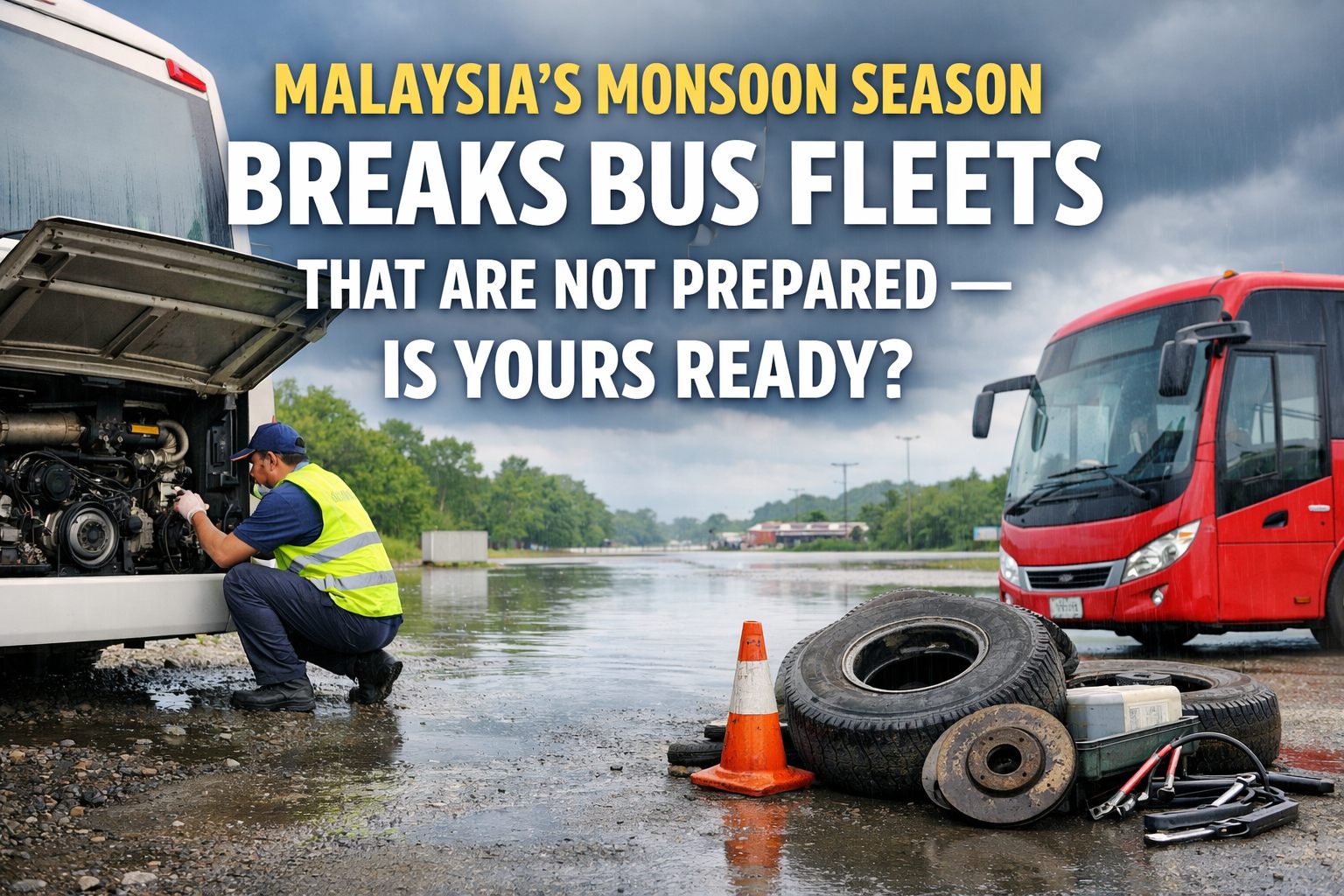
Malaysia's northeast monsoon does not arrive quietly. Between November and March, states across Kelantan, Terengganu, Pahang, Johor, Sabah, and Sarawak face five to seven distinct heavy rainfall episodes — and the 2024/2025 season was officially the worst since 2014, with 137,000 people displaced and infrastructure repair costs estimated at RM 940 million nationwide. For bus fleet operators, the monsoon is not a weather event. It is a predictable mechanical stress test that hits engines, electrical systems, brakes, and tyres simultaneously — and the fleets that fail it are the ones that treated it as a surprise. This guide gives you the exact pre-monsoon maintenance protocol, component-by-component, timed to Malaysia's rainfall calendar, so your buses are ready before the first surge hits. Start your BusCMMS account free and build your monsoon PM schedule before November.
The Four Mechanical Systems Monsoon Season Attacks on Your Bus Fleet
The monsoon does not damage buses randomly. It attacks the same four systems every year — predictably, in the same sequence. Knowing which components are under stress and why is the first step to protecting them before the rain arrives.
When a bus drives through floodwater and water enters the air intake, it reaches the combustion chamber. Water does not compress like air-fuel mix — the piston attempts to compress it, bending connecting rods and destroying the engine internally. Repair or replacement: RM 15,000–50,000 per bus. The most expensive single monsoon failure.
High humidity and water ingress through corroded grommets, worn cable sheathing, and unsealed connector blocks cause electrical shorts, dashboard failures, and ECU damage. Modern buses rely on electronics for braking (ABS), door systems, and engine management — a single moisture-induced short can strand a bus mid-route.
Water between brake pads and drums reduces friction coefficient significantly, increasing stopping distances. Contaminated brake fluid absorbs moisture over the season, lowering boiling point and causing brake fade under heavy use. Meanwhile, wet roads increase aquaplaning risk dramatically for buses with worn brake linings — a combination that ends in roadside incidents.
Tread depth below 3mm on wet Malaysian roads creates hydroplaning conditions at speeds as low as 60 km/h. A bus on the Kota Bharu–Kuala Lumpur route hitting standing water with worn tyres loses steering and braking simultaneously. Pothole damage from waterlogged roads also spikes tyre sidewall failures in the months following heavy rainfall.
The Pre-Monsoon Inspection Protocol — Component by Component
Run every bus in your fleet through this sequence during September and October. Work orders for anything flagged must be closed before November 1. BusCMMS converts this protocol into scheduled work orders per bus, tracked to completion.
What to Stock Before November — The Monsoon Parts Inventory
Emergency repairs during active monsoon weather cost 3–5x more than planned maintenance — because parts are air-freighted, technicians charge overtime, and your bus sits off-road during peak demand. Stock these items in October. See how BusCMMS tracks parts inventory levels per component and triggers reorder alerts automatically.
| Component | System | Qty per 10 buses | Why Stock It | Risk if Out-of-Stock |
|---|---|---|---|---|
| Air filters | Engine | 10 | High consumption during dust-then-rain cycles | Water ingress, engine damage |
| Air dryer desiccant cartridges | Brake | 5 | Saturated in 3–4 months of high humidity | Moisture in air brake circuit |
| Brake fluid (DOT 4) | Brake | 20 litres | Flush cycle accelerates in monsoon conditions | Brake fade on wet descents |
| Wiper blades (all sizes) | Electrical | 20 sets | Degrade rapidly in continuous monsoon use | Reduced visibility, safety risk |
| Cable ties & wiring grommets | Electrical | Bulk pack | Harness re-routing during water ingress repairs | Delay in electrical fault repair |
| Tyre repair kits + sealant | Tyre | 5 per bus | Pothole punctures spike during monsoon roads | Extended roadside downtime |
| Dielectric grease | Electrical | 10 tubes | Connector protection during high humidity | ECU and sensor faults |
| Engine oil (correct grade) | Engine | 50 litres | Contamination risk from water ingress | Engine bearing failure |
Expert Review: Why Malaysian Fleets Fail the Same Way Every Monsoon Season
The 2024/2025 monsoon was the worst since 2014. The 2021/2022 season caused RM 1 billion in vehicle losses across Malaysia. Yet the breakdown patterns are identical year after year — because the failures are systemic, not random. Here is why the same fleets get caught, and what the ones that don't get caught do differently.
Conclusion: The Monsoon Is Predictable — Your Fleet's Readiness Should Be Too
Malaysia's northeast monsoon arrives every year between November and March. METMalaysia issues forecasts. NADMA issues state-level warnings. The calendar is not the problem. The problem is that most bus fleet operators do not have a maintenance system that responds to the calendar — one that automatically schedules pre-season checks, tracks completion across every bus, and ensures parts are stocked before emergency pricing kicks in.
The difference between a fleet that operates reliably through December flooding in Kelantan and one that has three buses stranded on the Kota Bharu corridor is not mechanical luck. It is whether someone scheduled the engine air filter replacement in October, the brake fluid flush before November, and the tyre tread measurement the week before the surge. BusCMMS does all of that — automatically, for every bus in your fleet, with a completion record you can open in 30 seconds if your operations manager asks. Sign up free today and build your fleet's first monsoon-ready PM schedule before the season opens.
Frequently Asked Questions
When does Malaysia's northeast monsoon season start and which states are most affected?
Malaysia's northeast monsoon (Monsun Timur Laut) typically begins in early November and runs through March, with peak intensity from late November through January. The most consistently affected states for bus operators are Kelantan, Terengganu, Pahang, and Johor on the east coast of Peninsular Malaysia, as well as Sarawak and Sabah in East Malaysia. The 2024/2025 season began on 5 November 2024 and impacted nine states — making it the most severe season since 2014. METMalaysia typically forecasts five to seven distinct heavy rainfall episodes per season, each capable of triggering flash flooding on bus routes.
What is hydrostatic lock and why is it the most expensive monsoon engine failure for bus fleets?
Hydrostatic lock occurs when water enters the engine's air intake system — typically when a bus drives through floodwater that reaches the air filter or intake snorkel. Water enters the combustion chamber and, unlike an air-fuel mixture, cannot be compressed. When the piston attempts to complete its compression stroke, it cannot travel through the water, causing connecting rods to bend or break. This results in immediate engine seizure. Repair requires a complete engine rebuild or replacement — costing RM 15,000 to RM 50,000 per bus depending on engine size. The single most cost-effective prevention is an annual pre-monsoon air filter replacement and intake seal inspection conducted before November.
How does the monsoon affect bus brake performance on Malaysian roads?
Monsoon conditions affect brakes through three mechanisms. First, water contamination of drum brakes reduces friction coefficient, increasing stopping distances on wet roads. Second, brake fluid absorbs atmospheric moisture over time — at 3% water content, the fluid's boiling point drops to below 140°C compared to the rated 205°C, causing brake fade during extended downhill operation in wet conditions. Third, aquaplaning on waterlogged roads removes tyre contact with the road entirely, making even fully functional brakes ineffective. All three mechanisms can occur simultaneously. Pre-monsoon brake fluid flush, pad thickness measurement, and ABS sensor testing are the three most critical actions before November onset.
What parts should a Malaysian bus fleet stock before the monsoon season to avoid emergency repair costs?
The highest-priority items for pre-monsoon stockpiling are air filters (one per bus, for any mid-season emergency replacement), air dryer desiccant cartridges for air brake systems (replaced every 3–4 months in high humidity), brake fluid in the correct DOT specification, wiper blade sets for all bus types in the fleet, and tyre repair kits. Electrical components — including dielectric grease, cable ties, and grommets — should also be stocked in bulk as wiring harness repairs spike during monsoon season. The key principle is that parts ordered during an active monsoon event cost 3–5 times more due to emergency freight and higher workshop rates during peak demand periods.
How does BusCMMS help Malaysian bus fleets prepare for the monsoon season specifically?
BusCMMS supports monsoon preparation through four specific capabilities. It creates calendar-triggered PM schedules — generating pre-monsoon inspection work orders for every bus automatically when the preparation window opens in September, with configurable completion deadlines before November. It tracks inspection completion per bus and per depot in real time, so fleet managers know exactly which vehicles are ready and which have open items. It manages parts inventory with reorder thresholds, alerting operators 30 days before projected monsoon onset when critical stock is low. And it digitises driver defect reports, routing brake, electrical, and tyre-related reports directly into work orders the same day — preventing paper-based reports from sitting unfiled when the next monsoon surge arrives.