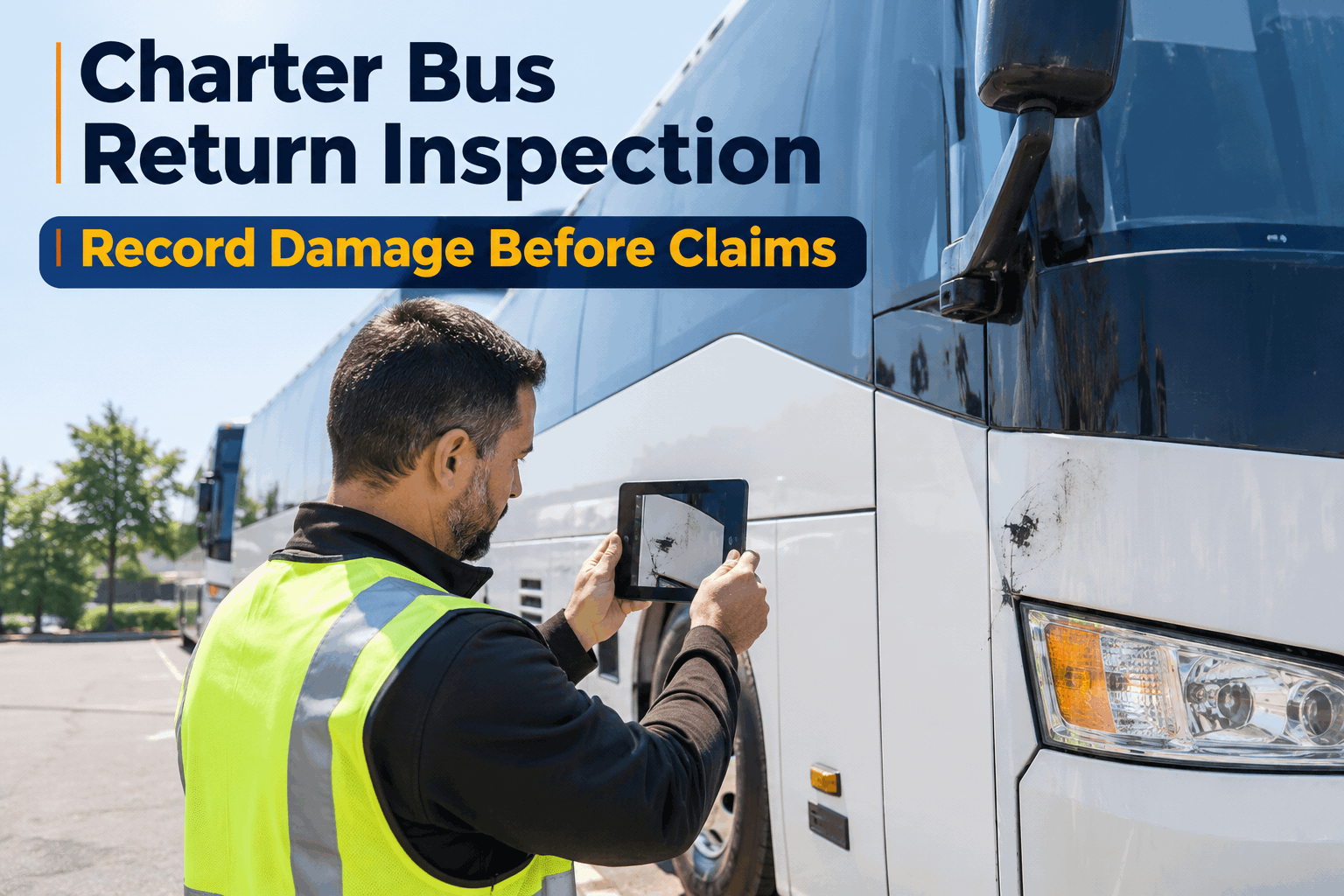
A coach comes back from a three-day away game and there is a long scrape down the right side that was not there on your lot — or was it? Without a dated record from pickup, you cannot prove it, and "I'm pretty sure that's new" is not an argument that wins a claim or a chargeback. Solid charter bus damage documentation is the difference between recovering a repair cost and quietly eating it. You can see how dated condition records and photos travel with each coach in a demo and stop arguing from memory.
Charter Bus Return Inspection: Record Damage Before Claims
Document condition at pickup, document it again at return, and the difference is your evidence. Here is how to build a damage record that actually holds up when a claim is on the line.
Baseline condition
- Dated photos, every panel
- Existing scuffs noted
- Signed-off starting point
Compared condition
- Same panels, re-shot
- New damage stands out
- Logged against the trip
Why Undocumented Damage Quietly Costs Charter Operators
Every coach picks up scuffs — a mirror clipped in a tight hotel lot, a curb strike, a scrape from a charter group loading gear. The problem is never the damage itself. It is not being able to say, with proof, when it happened and who is responsible.
You eat the repair
If you cannot prove damage arrived during a charter, you cannot bill it back. Undocumented damage defaults to your cost center — every time, across every coach.
Claims fall apart
An insurer or client disputes a claim and asks for the before-and-after. "We think it was new" does not survive that question. Dated evidence does.
Repairs slip
Damage spotted at return and not logged into a work order gets forgotten until the next trip — now it is worse, and you are explaining it to the next charter group.
The fix is not catching every scuff — it is having a dated, photographed record at pickup and return so the difference is obvious and defensible.
What Makes a Charter Damage Record Actually Hold Up
A note on a clipboard that says "scratch on side" proves nothing. A record that supports a claim has four things, every time — and missing any one of them is the gap a disputing party will drive through.
A clear photo
A close shot of the damage plus a context shot showing where on the coach it sits. One without the other leaves room for doubt.
A timestamp
When the photo was taken, tied to pickup or return. The date is what places the damage inside or outside a specific trip window.
A damage location
Which panel, which side, front or rear. A specific location makes the record match the physical coach and the repair estimate.
A condition note
A short written description — new vs pre-existing, severity, cause if known. The words that tell the story the photo cannot.
Get those four onto every finding and the record speaks for itself. You can sign up free and capture photo, time, location and note in one inspection entry instead of four scattered places.
Walk the Coach: Where Charter Damage Actually Shows Up
A consistent walk-around is what makes before-and-after comparable — shoot the same areas in the same order every pickup and return. These are the spots that take the hits on charter work.
Lower side panels & skirts
Curb strikes, loading-dock scrapes, and tight-lot clips land low on the body — the most common new-damage zone.
Mirrors & corner caps
Fixed objects in hotel and venue lots catch mirrors and front corners. Quick to miss, expensive to replace.
Baggage bays & doors
Gear loaded and unloaded by charter groups dents bay doors and scuffs edges — damage tied directly to that trip.
Interior seats & trim
Torn seat fabric, broken tray tables, stained trim — interior damage is just as billable, and just as easy to forget to shoot.
Rear cap & bumper
Backing into tight spaces catches the rear. Photograph both rear corners — damage here is often found days later.
Glass & windshield
Chips and cracks spread fast. A dated pickup shot proves a crack was small or absent before the charter.
Same route around the coach, every time — that consistency is what turns a pile of photos into a comparable before-and-after for charter, coach and shuttle fleets.
From Damage Found to Claim Resolved: The Paper Trail
Documenting damage is only half the job — the record has to carry through to a repair and a resolved claim, or it is just a photo in a folder. Here is the trail a return finding should follow.
Return inspection catches it
The coach comes back, the walk-around is done, and new damage is captured with photo, timestamp, location, and a condition note — compared against the pickup baseline.
Finding becomes a record
The damage is logged against that specific coach and trip, so it is tied to a date and a charter — not floating in someone's phone camera roll.
A work order opens
Repairable damage becomes a tracked work order so it actually gets fixed and scheduled — not forgotten until it is worse on the next trip.
The record supports the claim
When you bill a client or file with insurance, the dated before-and-after plus the repair record is the evidence package — pulled in minutes, not reconstructed from memory.
That is the whole point of documentation: not just proof the damage exists, but a line from finding to fixed. You can book a demo and see a damage finding move to a work order and a resolved record.
Your Charter Return-Inspection Checklist
Run this at every return before the coach goes back on the lot. Each item is something that, when skipped, is exactly what a disputing party uses to deny a claim — and each is something a bus-built system turns into a required, dated step.
- Photos match the pickup baselineSame panels, same angles — so new damage is obvious next to the before shots.CRITICAL
- Every finding is timestampedThe date ties each piece of damage to this trip window — the heart of any claim.CRITICAL
- Damage location is recordedPanel and side noted so the record matches the coach and the repair estimate.LOG IT
- New vs pre-existing is markedA condition note separates fresh charter damage from what was already there.LOG IT
- Repairable damage opens a work orderSo it gets fixed on schedule instead of forgotten until the next charter.LOG IT
- Records stay with the coachA continuous per-vehicle history you can pull the moment a claim or client asks.LOG IT
The two critical items — matched photos and timestamps — are what make a claim defensible, so never skip them; book a demo and we will set this return flow up around your coaches.
How BusCMMS Keeps Charter Damage Records Claim-Ready
Documenting damage is exactly the kind of inspection-and-records job a purpose-built bus CMMS is made for — capturing the finding, turning it into a repair, and keeping the trail per coach so it is there when you need it.
Photo & condition capture
Record damage with dated photos, location, and a condition note right in the inspection — the four things a claim needs, in one entry.
Damage-linked work orders
Turn a return finding into a tracked work order so repairs happen and the fix is documented alongside the damage.
Per-coach history on demand
Every inspection, defect, and repair stays with the vehicle — so the before-and-after for any claim is a quick pull, not a scramble.
One system of record for condition, damage, and repair across the fleet. To set it up around your charter operation, book a demo and bring a recent damage dispute.
A Charter Operator's Take
Key Takeaways on Charter Damage Documentation
Strong charter bus damage documentation is not about catching every scratch — it is about being able to prove when it happened. Four things to carry back to the lot.
Document both ends
Pickup baseline plus return comparison — the difference is your evidence.
Four things per finding
Photo, timestamp, location, condition note — miss one and the record weakens.
Carry it to a work order
A finding that becomes a tracked repair is the difference between proof and a lost photo.
Keep it per coach
A continuous history makes any claim a quick pull, not a reconstruction.
Photograph both ends of every charter, capture the four things on every finding, carry it through to a repair, and keep it with the coach — and the next damage dispute becomes a two-minute conversation instead of a cost you absorb. That is what documentation is for.