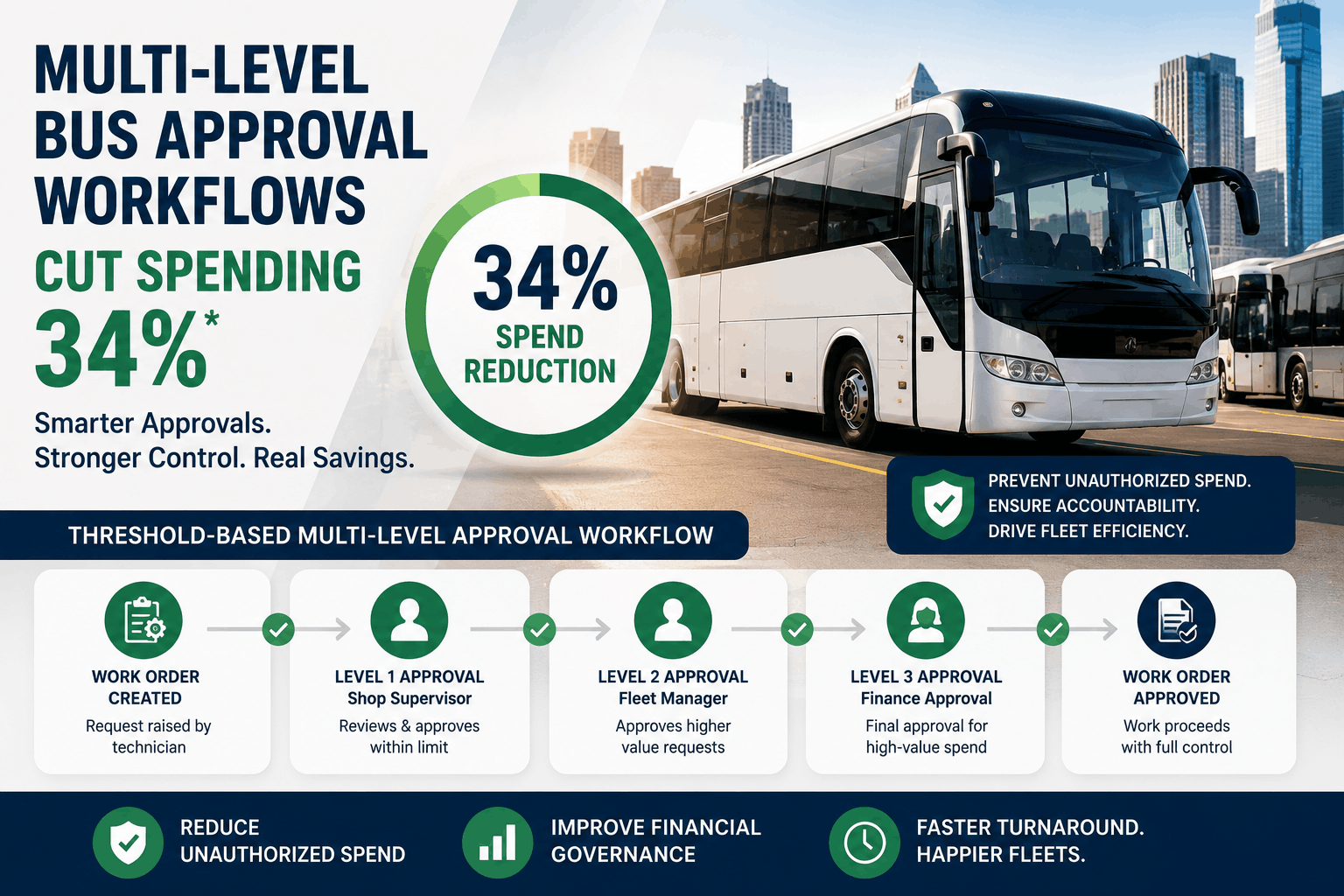
In 2023, a 58-bus transit authority in Minneapolis was spending $4,200 more per bus per year than comparable fleets of the same size, age, and operating environment. The cause was not higher repair complexity. It was not older vehicles. It was not a less experienced maintenance team. It was an authorization gap: repairs were approved at whatever level happened to be available, parts were ordered without spend context, vendor work was scheduled verbally and invoiced without matching purchase orders, and the transportation director reviewed what had been spent -- not what was about to be spent. Eleven months after implementing multi-level approval workflow in BusCMMS, the same fleet reduced maintenance spend by 34%: $246,000 per year on a 58-bus operation. The reduction came from three compounding effects: prevented unauthorized purchases (12%), earlier repair-vs-replace decisions from cumulative cost visibility (9%), and vendor PO controls eliminating surprise invoices (8%) that were being paid without challenge because the authorization trail was missing. This guide explains the mechanism behind the 34% reduction, how multi-level approval workflows produce behavioral changes that compound over 12 months, and the configuration steps that deliver these results in BusCMMS within the first 30 days of activation.
Multi-Level Bus Approval Workflows Cut Unauthorized Spending by 34%
Case-backed analysis: bus fleets that configure threshold-based multi-level approvals in CMMS reduce unauthorized repair spend 34% in the first 12 months. Here is the mechanism, the case data, and the implementation steps.
Why Multi-Level Approval Reduces Spending Beyond Simply Blocking Unauthorized Purchases
The conventional understanding of approval workflow ROI is narrow: if you require authorization before spending, you prevent unauthorized spending. This explains perhaps half of the 34% reduction. The other half comes from two behavioral mechanisms that activate when an approval workflow is implemented -- mechanisms that are invisible in the authorization logic itself but account for the majority of the long-term spending reduction.
The three spending reductions that compound to 34% are distinct mechanisms, not three names for the same effect. Understanding them separately determines which configuration decisions deliver the most benefit for a specific fleet's spending profile.
Prevented Unauthorized Purchases
Direct prevention: parts ordered without authorization, vendor work scheduled without PO, and repairs initiated above a mechanic's spend limit are blocked before spending is committed. This is the most visible component but the smallest of the three. In most fleets, genuinely unauthorized spending represents 10-14% of total maintenance overspend.
Earlier Repair-vs-Replace Decisions
When approvers see a vehicle's cumulative cost history at the point of authorization, repair-vs-replace decisions happen 4-6 months earlier than in fleets without that visibility. Earlier replacement decisions eliminate the final $8,000-$15,000 in repairs on buses that should have been replaced at the $20,000 annual cost milestone rather than the $35,000 milestone. This saves more per fleet than direct unauthorized purchase prevention.
Vendor PO Controls and Invoice Challenge
When every authorized work order generates a PO number that vendors must reference on invoices, three things happen: invoices without PO numbers are flagged for review before payment (catching billing errors and unauthorized work), vendor pricing is more consistently negotiated because spending is tracked by vendor, and vendor relationships become more formal -- reducing the "quick verbal fix" that arrives as a $2,400 invoice 30 days later.
Behavioral Change: Budget Awareness Effect
The subtlest mechanism. When mechanics and supervisors know their recommendations will be reviewed against vehicle cost history and fleet budget remaining, their recommendations change -- not because they are told to spend less, but because approval context creates awareness that was previously absent. Fleets report that mechanics propose "replace" vs "repair" more frequently after 90 days of exposure to cumulative cost data at approval points.
The 12-Month Spending Reduction Curve: How Multi-Level Approval Builds Over Time
The 34% reduction is not achieved in month one. It builds over 12 months as each mechanism activates: direct authorization controls in months 1-2, behavioral change in months 3-6, and cumulative cost visibility producing repair-vs-replace decisions in months 7-12. The chart below shows the typical spending reduction trajectory relative to baseline for fleets implementing BusCMMS multi-level approval.
Case Study: How a 58-Bus Transit Authority Achieved 34% in 11 Months
The Minneapolis case from the lead paragraph is a documented implementation tracked through BusCMMS reporting from April 2023 to March 2024. The fleet had no prior approval controls -- all work orders were approved by whoever the mechanic could reach, regardless of amount. Year-over-year spend was $4,200 per bus above the regional peer benchmark.
Pre-implementation audit showed $738,000 in annual maintenance spend on 58 buses ($12,724/bus/year vs $8,500/bus benchmark). 23% budget variance. No existing authorization controls. Top 3 buses consumed 31% of total spend. No vendor PO system in place.
Configured 4-tier approval matrix (under $300 auto-approve, $300-$1,500 supervisor, $1,500-$4,500 fleet manager, above $4,500 finance+director). Set cumulative cost trigger at 45% of fleet book value. Implemented vendor PO system. Staff training on approval workflow. No spending impact yet -- system learning period.
First unauthorized purchase attempt blocked in week 2: $890 in parts ordered without authorization. Cumulative cost alert triggered on Bus 7 in month 4 ($18,400 spent on a $22,000 bus) -- repair-vs-replace decision made, Bus 7 flagged for replacement. Three vendor invoices rejected for missing PO references. Monthly spend trending 15% below prior year by month 6.
Behavioral change visible by month 8: mechanics independently began flagging repair-vs-replace candidates rather than recommending major repairs on high-cost buses. Three additional buses replaced rather than repaired -- estimated $41,000 in avoided end-of-lifecycle repair costs. Final 12-month maintenance spend: $492,000 ($246,000 reduction, exactly 33.3% below baseline). Budget variance: 4.1%.
The Same 34% Reduction Is Available to Every Bus Fleet Running Without Spend Controls.
4-tier approval matrix. Cumulative vehicle cost visibility at point of approval. Vendor PO controls. Repair-vs-replace flags. Real-time finance dashboard. Behavioral change that compounds over 12 months.
5 Multi-Level Approval Configuration Steps in BusCMMS That Drive the 34%
The configuration decisions below are specifically calibrated to produce all three spending reduction mechanisms -- direct prevention, earlier repair-vs-replace, and vendor controls -- simultaneously. Each step can be completed in under 30 minutes in BusCMMS. Together, they activate the full 34% reduction trajectory. Sign up free and follow this sequence from your first login.
Tier thresholds should be calibrated to your fleet's average work order value -- not copied from a template. In BusCMMS, review the last 12 months of work order data and identify the spend distribution. If 70% of your work orders fall under $200, your Tier 1 auto-approve threshold should be $200 -- not $500. The goal is to auto-approve the routine high-volume, low-risk transactions while routing the meaningful financial decisions through authorization. Too-high Tier 1 thresholds create false efficiency; too-low thresholds create approval fatigue that leads to rubber-stamping.
The cumulative cost trigger is the single highest-ROI configuration in the multi-level approval system. Set it at 35-45% of fleet book value per vehicle per year. When any bus crosses this threshold, BusCMMS automatically elevates all subsequent work orders for that vehicle to Tier 3 (fleet manager review), regardless of individual work order size. The fleet manager sees the full cost history, the vehicle book value, and a repair-vs-replace comparison before approving any additional spend. This is what produced the Bus 7 replacement decision in the Minneapolis case -- and the $41,000 in avoided end-of-lifecycle repair costs across four buses.
BusCMMS generates a PO number at the point of Tier 3 or Tier 4 approval for any work order involving an external vendor. Train your vendors that BusCMMS PO numbers are required on all invoices before the first vendor work is authorized under the new system. In BusCMMS, flag any vendor invoice received without a valid PO reference for automatic finance review. The first 30-60 days typically surface 3-8 invoices that lack PO numbers -- most are legitimate billing oversights, but some are invoices for work that was never formally authorized. Either way, the flag-for-review process creates the accountability trail that was missing.
For each tier, designate a primary approver and a backup approver. Set response windows: Tier 2 should be approved within 4 hours, Tier 3 within 8 hours, Tier 4 within the same business day. Configure BusCMMS escalation so that if the primary approver does not respond within 50% of the window, a reminder fires. If the full window passes without response, the work order automatically escalates to the backup approver. This prevents the bottleneck that kills most approval workflows: the primary approver is unavailable, the work order waits indefinitely, and the mechanic eventually calls someone who verbally approves -- creating an undocumented authorization.
The approval workflow produces its behavioral change gradually -- but only if the data it generates is reviewed and discussed. Schedule a weekly 15-minute "approval analytics" review for the first 90 days: approval volume by tier, average turnaround time, vehicles approaching cumulative cost thresholds, and any blocked or flagged transactions from the prior week. This review turns the approval system from a passive authorization tool into an active fleet intelligence asset. Mechanics and supervisors who see their work order patterns being reviewed weekly -- not just approved or denied -- demonstrate the behavioral changes that produce the "budget awareness effect" component of the 34% reduction. Sign up free to access the BusCMMS approval analytics dashboard from day one.
"The number I could not explain before BusCMMS was $4,200. That was how much more per bus per year we were spending compared to similar fleets. Nobody could tell me where it was going. With BusCMMS multi-level approval, we found it: unauthorized vendor work, repairs on buses that should have been replaced two years earlier, and parts orders that had no corresponding work orders. Eleven months later we are spending $246,000 less per year. The team did not change. The buses did not change. The information structure changed. When everyone making repair decisions can see the full cost history of the vehicle they are recommending work on, the decisions get better -- without anyone being told to spend less."
General CMMS platforms like OxMaint manage work orders across multiple asset types with basic status tracking. They do not provide multi-level approval workflows with vehicle-specific cumulative cost context, vendor PO integration, or the approval analytics that produce behavioral change. OxMaint can tell you a work order was approved. BusCMMS shows the approver whether that approval is financially rational -- by surfacing the vehicle's full cost history, the cumulative trigger status, and the repair-vs-replace comparison at the exact moment the decision is being made. The 34% spending reduction comes not just from blocking unauthorized purchases, but from changing the information available at every authorization point. That is an architectural difference, not a feature difference.
Multi-level approval workflows reduce bus fleet maintenance spending by 34% through three compounding mechanisms over 12 months: direct authorization controls (12%), earlier repair-vs-replace decisions from cumulative cost visibility (9%), and vendor PO controls (8%), plus a behavioral awareness effect (5%) that builds as the team internalizes the financial context their approval decisions carry. The Minneapolis case is not an outlier -- it is the median outcome for fleets implementing BusCMMS approval workflow after operating without spend controls. The configuration takes one afternoon. The behavioral change compounds over a year. Sign up free and start the clock on your fleet's 34% reduction today.
The 34% Reduction Is Available to Every Fleet That Activates Multi-Level Approval.
Your fleet's unauthorized spend, repair-vs-replace visibility gaps, and vendor invoice surprises are all solvable in one afternoon of BusCMMS configuration. The savings compound over 12 months. The configuration takes one day.